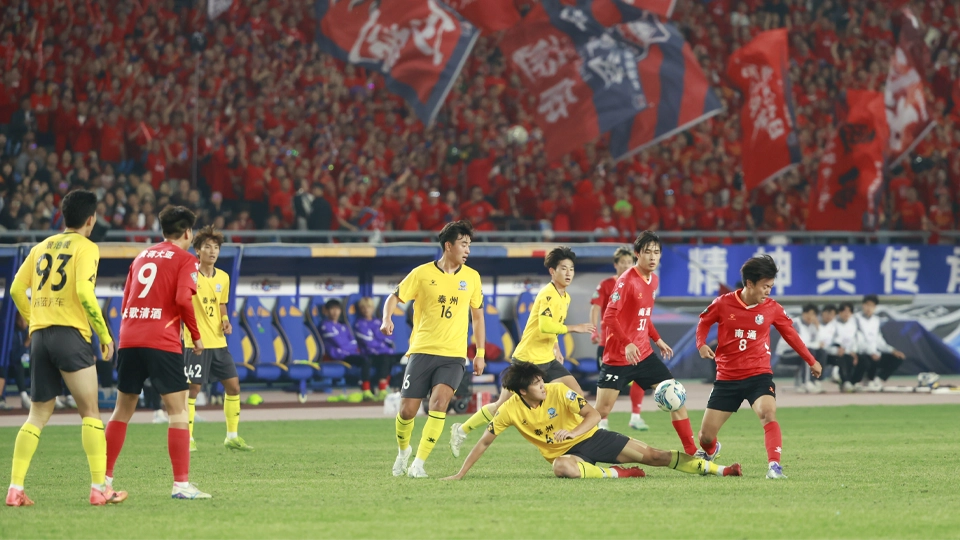
The Jiangsu Football City League (JSCL), also known as the Su Super League or “Su Chao” in Chinese, has gained astonishing popularity. What began as a modest provincial competition played by amateur players in small venues now sells out stadiums across East China.
Posts about Su Chao matches reportedly rack up millions of views on Weibo and billions on China’s major short-video platform, Douyin.
One key factor behind its popularity is broad public participation, the Vice-President of the Jiangsu Football Association, Wang Xiaowan, told Xinhua News Agency.
This participation happens both on and off the field. The grassroots soccer competition features 13 teams, each named after their respective cities in the province of Jiangsu, located in the prosperous Yangtze River Delta region and bordering Shanghai to the south.
More than 60 per cent of the league’s players are amateurs from everyday professions. Students, delivery workers and teachers take to the pitch before returning to their regular jobs for the rest of the week.
Tourism departments and creators in Jiangsu have picked up on the thrall and promote the League through short videos, animation and AI-generated content, blending dialects, food traditions and local heritage into their storytelling.
The Su Super League has adopted a relatively open approach to user-generated content (UGC) and AI-generated content (AIGC), allowing memes, remixes, commentary and locally inspired narratives created by fans to circulate widely online.
Media reports note that the League has been quick to capture public attention with UGC and humor related to the city playing a central role in its popularity.
Live interventions such as a horde of dinosaurs entertaining spectators during halftime further increase both the pull to stadiums and the viral hype.
Yet as the League's appeal spreads beyond the province, strengthening Jiangsu’s urban identity and building commercial potential, new questions arise in relation to IP.
Protecting Jiangsu Football City League through IP
What started as a regional, non-professional soccer competition is quickly accumulating brand value, commercial opportunities and cultural influence. At the same time, the Su Super League IP framework has yet to keep pace.

The surge in attention has brought a rapid influx of businesses and market actors. In light of this, in May 2025, the Jiangsu Football Association filed 20 trademark applications covering core categories such as the competition name, event identifiers and mascot. In June, it submitted a second batch of applications, extending protection beyond the competition name to include potential derivative products.
At the time of writing, according to the trademark database of the China National Intellectual Property Administration (CNIPA), key competition names such as “江苏省城市足球联赛 JIANGSU FOOTBALL CITY LEAGUE” and “JSCL” have been filed for trademark registration by the Jiangsu Football Association.
Public records indicate that the earliest application for the “JSCL” trademark was submitted in May 2025, with the applicant listed as the “Jiangsu Football Association”. Applications for other related trademarks are pending.
Su Super League merchandise
At the same time, more than 300 trademark applications related to the keyword “Su Super League” have been submitted, reflecting the ongoing abundance of trademark filing activity surrounding the League, which has encouraged many companies to develop associated merchandise and cultural products.
One example is the Purple Dream of Football, a product launched in Wuxi that combines Yixing purple clay craftsmanship with soccer imagery in the form of a purple clay trophy meant to symbolize the pursuit of dreams.
With the support of the Yixing Intellectual Property Rapid Protection Center, the design patent was granted by CNIPA in just five working days.
As China’s “capital of plush toy gifts”, Yangzhou has also demonstrated strong capabilities in monetizing IP amid the surge of the Su Super League.
Publicizing Jiangsu’s intangible cultural heritage
Some enterprises, after producing initial designs of Su Super League-themed toys, have promptly secured copyright registrations to build their own IP portfolios.
At the same time, the Yangzhou municipal government has supported this industrial upgrading through various policies. Measures introduced as early as April 2025 explicitly promote the incubation of original IP, encourage the integration of intangible cultural heritage elements into design and foster convergence with the culture and tourism sectors. This is also generating coordinated momentum across policy support, innovation and market expansion.

The IP issues surrounding the Su Super League therefore highlight both opportunities and challenges. They show how quickly sporting events can generate brand value, but also why a coherent IP strategy is necessary to turn short-term popularity into lasting assets – even for grassroots sports.
So, if the Su Super League is to evolve from a trending competition into a lasting urban sports and cultural brand, what IP pillars will it need?
Promoting Su Super League’s brand through trademarks
For any sporting event, names, logos and slogans form the core of its brand identity. In the case of the Su Super League, the league name, competition logo, team names and crests are among the most important assets to protect.
Some slogans that have spread widely during the rise in popularity, such as the playful phrase “competition first, friendship fourteenth”, have also become part of the emerging culture of the League.
If these expressions continue to gain public recognition, they may develop trademark potential and become valuable elements of the league’s brand. In the future, they could also support licensing partnerships and merchandising opportunities.
Preserving Jiangsu’s local delicacies through geographical indications
Much of the appeal of the Su Super League stems from the distinctive identities of the cities in Jiangsu. Products such as Nanjing salted duck, Yangcheng Lake hairy crab of Suzhou and Zhenjiang vinegar are not only well-known regional specialties but also symbols of local culture.
Linking these geographical indication (GI) products with the league’s promotion and merchandising could strengthen its cultural identity while creating new market opportunities for regional brands.
Safeguarding JSCL’s sports innovations through patents
As the League becomes increasingly commercialized, innovations surrounding merchandise design, smart ticketing systems, stadium management and broadcasting technologies may involve design patents or other forms of technical protection.
In an era in which digital dissemination and immersive viewing experiences are increasingly important, IP relating to technology and design is leading to another dimension of competitiveness for sporting events.
Protecting Su Super League’s creative content through copyright
The influence of the Su Super League extends beyond the matches themselves. A wide range of creative content has emerged around the tournament, including city-themed posters, promotional videos, short-form social media clips, live broadcast footage and photography.
Building Su Super League as a lasting sports brand
At the same time, local media and official accounts have amplified engagement through mascots, cartoon characters and creative videos. As the scale of content production and distribution expands, questions of copyright, licensing, content sharing and revenue allocation will become more significant.
For a city-based soccer league like Su Chao, an effective IP strategy does not rest solely in managing trademarks, copyrights and patents in isolation. Rather, it requires integrating these different forms of protection into a mutual system that allows a local sporting event to evolve from a short-lived viral phenomenon into a long-term brand.
About the author
Ying Ye holds a PhD from Durham Law School, United Kingdom. Her research interests lie in AI and IP law, as well as technology law and policy. Dr. Ye is an IP attorney in China and practices at Beijing Huicheng Law Firm (Chengdu). She is often in Nanjing, thanks to long-standing connections, and has experienced the excitement of the Su Super League first hand as a regular spectator.