The innovations honored by the 2025 Nobel Prizes in physics, chemistry and medicine can help extract water from desert air, decode immune system regulation and show the improbable workings of quantum mechanics.
The savvy inventors behind these breakthroughs have filed more than 200 applications under the Patent Cooperation Treaty (PCT), many of which were filed years before the Nobel recognition in their respective fields. Here, WIPO Magazine finds out more, using WIPO’s PATENTSCOPE database to track the applications.
Better living through chemistry
The Nobel Prize in Chemistry 2025 was awarded to Susumu Kitagawa, Richard Robson and Omar M. Yaghi for their work on molecular building blocks for metal–organic frameworks (MOFs).
According to the Royal Swedish Academy of Sciences, MOFs are “specifically attractive and very spacious studio apartments for water (and other) molecules.”
Thanks to the work of the laureates, which began decades ago, chemists worldwide have designed tens of thousands of different MOFs. Today, they help capture carbon dioxide, store toxic gases and deliver medicines, among other “chemical wonders,” according to the Nobel description.
The variety of uses is reflected in patent applications. MOFs are a technical field generating great interest in seeking patent protection with more than 14,000 related patent applications in the PATENTSCOPE database alone. The largest numbers of MOF-related patent applications appear to originate from China, the United States, the Republic of Korea, European countries, and Japan.
Kitagawa, Robson and Yaghi themselves are among the inventors actively seeking to patent their MOF-related inventions.
Finding new frameworks
Inspired by the structure of diamonds, Robson, who was born in the UK, began thinking about the concept that would form MOFs in 1974, while teaching at the University of Melbourne, Australia. However, it would take more than 10 years for him to create a crystal structure based on diamond architecture.
Robson published his findings in 1989. But it was a series of revolutionary discoveries by Kitagawa and Yaghi that provided Robson’s building method with a firm foundation. Between 1992 and 2003 they made, respectively, a series of revolutionary discoveries.
Kitagawa, a Japanese chemist who specializes in coordination chemistry, began seeking patents on his work in 1996 and has been actively using the PCT since 1997. Of Kitagawa’s more than 40 PCT filings, four PCT applications relate to his improved MOF structure.
Robson also kept working and inventing. One notable and recent patent filing involving Robson is PCT/AU2017/050727, for methods of capturing and storing anesthetics using metal–organic frameworks. Gaseous anesthetics evaporate and therefore exposes personnel. According to the patent application description, the MOF aims to make the delivery much more precise and reduce risk.
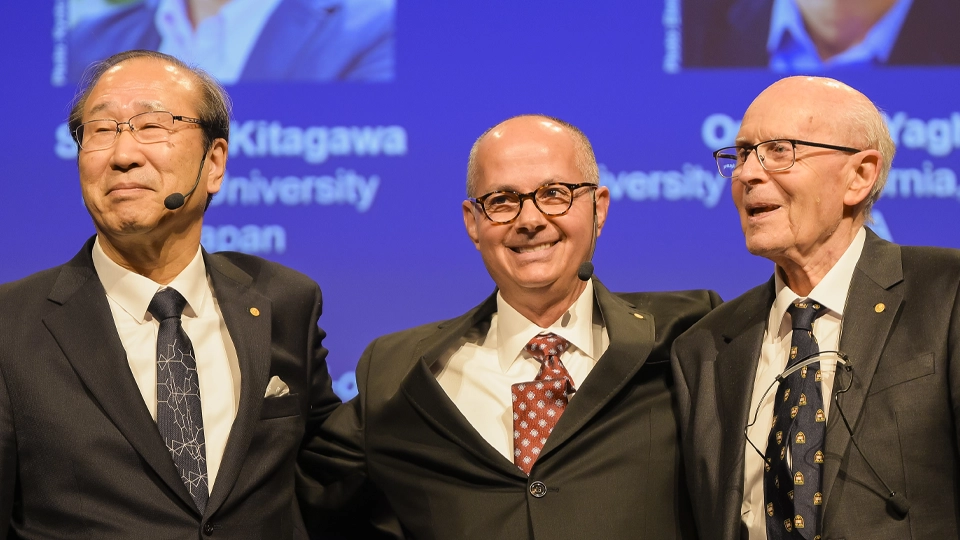
Working separately but in parallel, Yaghi may be the most prolific inventor among the laureates and is an active user of the PCT system.
Born in Jordan and studying and working in the US, Yaghi coined the term “metal–organic framework” in a 1995 Nature article after creating a very stable MOF; his were like nets held together by copper or cobalt.
Today, more than 350 patent applications list Yaghi as an inventor, with 72 patent applications filed through the PCT system. Among his earliest is an application (PCT/US2002/013763) filed in 2002 for an MOF with implications for gas storage. Yaghi has sought patent protection in Australia, Spain, Canada, Austria, Japan, the US and Germany.
One of his latest applications, filed in 2024 and published in April this year (PCT/US2024/050115), covers covalent organic frameworks for atmospheric water harvesting - the stuff that could make the desert bloom.
Quantum leaps in physics
The Nobel Prize in Physics 2025 went to John Clarke, Michel H. Devoret, and John M. Martinis, who conducted experiments in quantum physics. As the Academy notes, the laureates used experiments on a chip to “demonstrate the bizarre properties of the quantum world.” Their work is considered fundamental for developing next-generation quantum technology, including quantum cryptography, quantum computers and quantum sensors.
The scientists’ experiments date back to 1984 and 1985 at the University of California, Berkeley. They began filing patent applications related to their discoveries as soon as they started experimenting.
More recently, 20 PCT filings – mostly filed by Yale University as the applicant – list Devoret as inventor. For example, one of the notable inventions from Devoret, PCT/US2019/012441 , for hardware-efficient fault-tolerant operations with superconducting circuits, ultimately sought patents in Canada, Singapore, the US, China, Japan, the European Patent Office, and the Republic of Korea. There are 16 PCT filings with Martinis listed as inventor, primarily with Google as the applicant, from 2017 to 2023. For example, PCT/US2016/032917 for fidelity estimation for quantum computing systems, was filed by Google and lists Martinis as the primary inventor. This application has entered key markets for patent protection, including Australia, Canada, the US, the European Patent Office, Japan, Singapore, and China.
Medical breakthroughs and patent protection
Medicine is a field with high patent activity. The 2025 Nobel Prize winners in Physiology or Medicine, Mary E. Brunkow, Frederick J. Ramsdell and Shimon Sakaguchi, have been awarded for their work on “peripheral immune tolerance”, which prevents the immune system from harming the body.
According to the Academy, “their work has laid the foundation for a new research field and spurred development of treatments for cancer and autoimmune diseases.” Unsurprisingly, it has seen busy patenting activity.
The 2025 Physiology or Medicine laureates actively use the PCT system. Brunkow has filed seven PCT applications since 1999, seeking wide protection across Asia, Europe and North America. Among these are two PCT applications co-filed by Brunkow and Ramsdell. Ramsdell holds another seven PCT filings, while Sakaguchi is named in 25 PCT applications and has continuously used the PCT system since 1997 to seek patent protection in multiple countries.
Notable applications include PCT/US2002/015897, for a method for regulating immune function in primates using the foxp3 protein; PCT/US1999/018407, for identification of the gene that causes the mouse scurfy phenotype and its human ortholog; and PCT/US2006/018540, for methods of using phhla2 to co-stimulate T-cells. All are directly related to the scientists’ Nobel discoveries.
The Nobel laureates’ journeys this year show how frameworks for collaboration and protection accelerate the path from discovery to real-world impact. The PCT system has enabled the 2025 laureates to seek protection for their inventions across borders while ensuring that the knowledge they have generated is shared with the Nobel laureates of tomorrow.
All patent data was sourced through the WIPO PATENTSCOPE database using inventor-name and chemical-compound searches, as of November 2025. More information on the laureates and their work is from the press and advanced information provided by the Nobel Foundation webpages .