India’s rich cultural traditions have given rise to many forms of music and musical instruments. Traditionally carved from a single piece of jackwood, the Bobbili veena is a large string instrument first crafted in the 17th century in the town of Bobbili, southern India.
In 2012, the Government of India issued a geographical indication certificate for the Bobbili veena. Such certificates are used on goods, including agricultural and other products, that have a specific geographical origin and possess qualities, a reputation or other characteristics connected to the place in which they are made. Consider Italian Grana Padano cheese, Mexican Tequila and Darjeeling tea.
Objects that are handmade using natural resources and embedded in the traditions of local communities can also obtain geographical indications.
In the case of the Bobbili veena, the geographical indication safeguards the culture of the local artisans who craft it, thereby increasing its market value. That, in turn, boosts the regional economy.
The art of the Bobbili veena
In India, music is about more than entertainment. It is about attaining spirituality. The sounds that emanate from the country’s traditional instruments make that possible.

There are many types of veena, a generic term that refers to the many stringed instruments of the Indian subcontinent. The Bobbili veena is rooted in the royal patronage of Bobbili, in the modern state of Andhra Pradesh. The Bobbili kingdom was founded by King Pedarayudu in the 17th century. He adored music and ordered veenas to be produced and played at his court. The ancestors of today’s artisans migrated from Vizianagaram and settled in Bobbili. Their skills have been passed down through successive generations living in the nearby village of Gollapalli.
How the veena is made
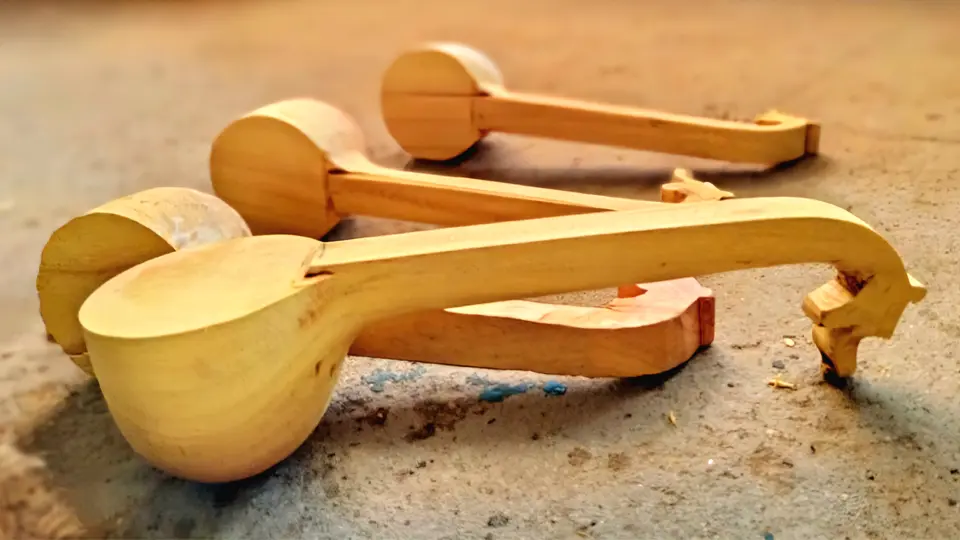
The essential raw material used in crafting the Bobbili veena is wood from the jackfruit tree, which is native to India. The instrument is carved from a single piece of jackwood. First comes the kunda, or bowl, which is hollowed out and later covered with a wooden plate. Then comes the dandi, or neck, which is typically 51 inches long and carved from the same log. Seven strings are attached before the decorative inlay is applied. The process requires skill and patience; it takes up to 25 days to make a Bobbili veena.

Gollapalli is a small village with minimal facilities, low literacy levels and few economic opportunities. The Bobbili veena is an integral part of Carnatic music, a form of Indian classical music associated with South India. However, with the rise of contemporary music, demand for traditional musical instruments, including the Bobbili veena, has fallen. The drop in demand for the magnificent instrument caused many artisans to give up the craft in pursuit of other work. Many even migrated from the area.
To revive the craft, senior artisans are building awareness of the importance of continuing family traditions to preserve cultural heritage and promote economic wellbeing. After forming the Sarada Veena Workers Cottage Industrial Cooperative Society in the 1950ies, the artisans began crafting miniature veenas as souvenirs. Also made of jackwood, these miniatures generated demand of their own.
Issuing a geographical indication certificate in India
As it battled in the 1990s to protect such products as Basmati rice internationally, India passed the Geographical Indications of Goods (Registration & Protection) Act in 1999. The Act complies with the World Trade Organization (WTO) Agreement on Trade-Related Aspects of Intellectual Property Rights (TRIPS), which contains a section on geographical indications.
In India, the Controller General of Patents, Designs and Trade Marks oversees the Geographical Indication Registry. The registration process is rigorous and requires, for example, that the origin of the proposed good be proven and supported by historical evidence and local unity and coordination.
Handicraft societies and government authorities often help local communities to register geographical indications. For the Bobbili veena, the initial application was made through the Andhra Pradesh Handicrafts Development Corporation (APHDC), which identified the instrument as a product of the state potentially deserving of a geographical indication. Later, the APHDC and the Andhra Pradesh Technology Development & Promotion Centre established a crafts development center in the village and helped the artisans to market their products. In 2012, a geographical indication was granted for the Bobbili veena under the musical instruments class and for miniature veenas under the handicrafts class.
The geographical indication tag has revived the instrument’s reputation, especially among the younger generations. India has also launched initiatives to better harness it: artisans have been honored with awards for their skills; jackfruit trees have been planted to improve the supply of quality wood; and the Bobbili veena was added to the One Village One Product (OVOP) initiative list.
Yet, success depends not only on artisans and policies – the public also has a part to play, by being aware of and creating demand for sustainably handcrafted instruments.
About the author
Neelima Bogadhi holds a PhD from Andhra University, India, for her thesis on Indian law and geographical indications. She is assistant editor of the Journal of the Academy of Juridical Studies and of the Bonafide Voices online magazine, and a faculty member at the Damodaram Sanjivayya National Law University in Andhra Pradesh. Neelima came second in the 2023 WIPO Youth Video Competition.
This article first appeared in WIPO Magazine's Music Special . The full magazine is available for free download as a PDF.