Protecting your Inventions Abroad: Frequently Asked Questions About the Patent Cooperation Treaty (PCT)
Also available in [PDF]
Introduction
These frequently asked questions about the Patent Cooperation Treaty (PCT) outline the PCT procedure from an applicant's perspective. For specific questions, further information and contact points, consult Question 29.
Overview of the PCT System
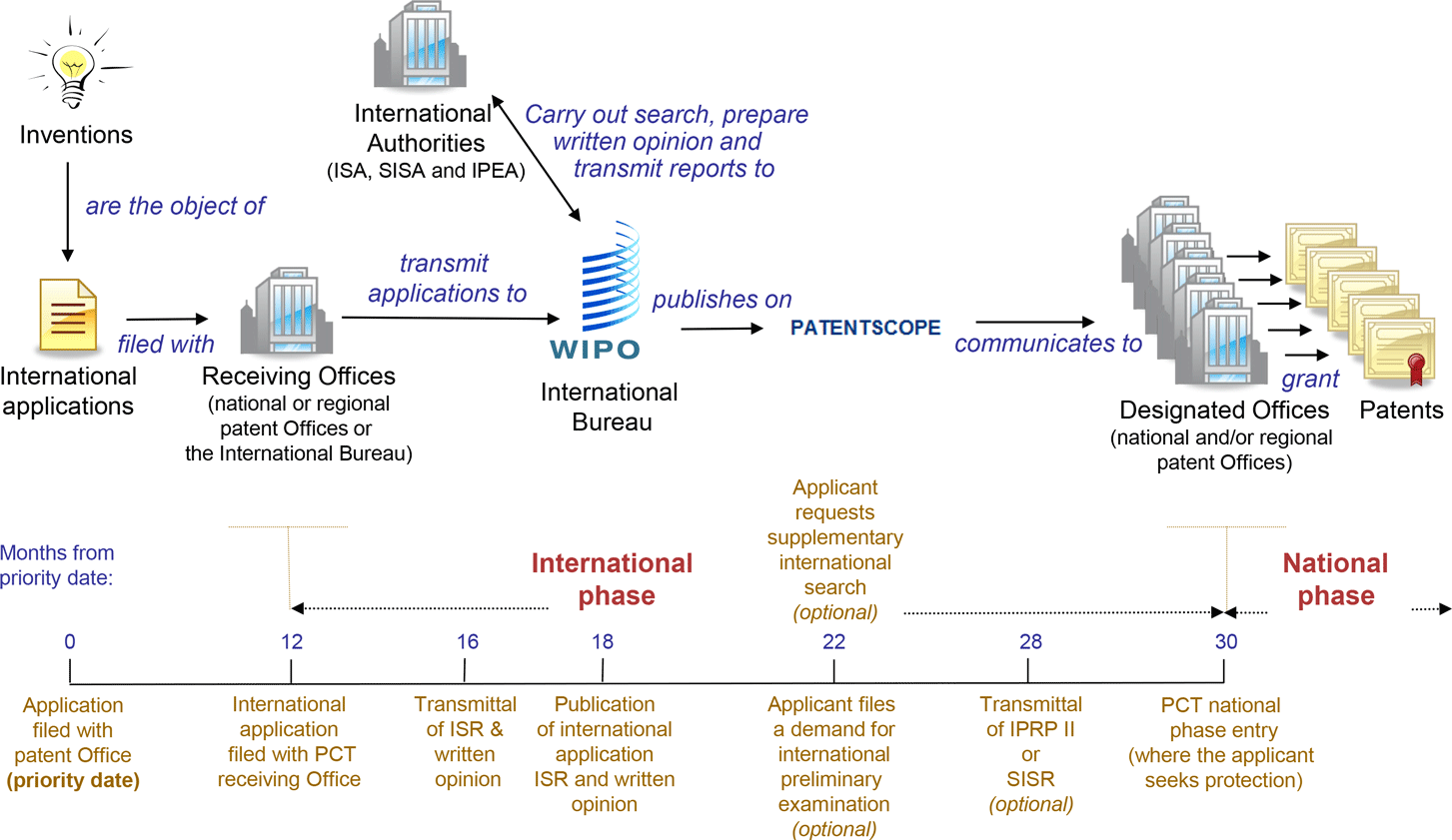
The PCT is an international treaty currently comprising 159 Contracting States.[1] The PCT makes it possible to seek patent protection for an invention simultaneously in a large number of countries by filing a single "international" patent application instead of filing several separate national or regional patent applications. The granting of patents remains under the control of the national or regional patent Offices in what is called the "national phase".
(a) Direct or Paris route: you can directly file separate patent applications at the same time in all of the countries in which you would like to protect your invention (for some countries, regional patents may be available) or, having filed in a Paris Convention country (one of the Member States of the Paris Convention for the Protection of Industrial Property), then file separate patent applications in other Paris Convention countries within 12 months from the filing date of that first patent application, giving you the benefit in all those countries of claiming the filing date of the first application (consult Question 11);
Comparison of Paris and PCT Route

The PCT is used by the world's major corporations, research institutions, and universities when they seek international patent protection. It is also used by small and medium sized enterprises (SMEs) and individual inventors. The PCT Yearly Review contains a yearly list of the largest PCT filers.
Filing
In general terms, your international patent application, provided that it complies with the minimum requirements for obtaining an international filing date, has the effect of a national patent application (and certain regional patent applications) in or for all PCT Contracting States. Moreover, if you comply with certain formal requirements set out in the Treaty and Regulations, which are binding on all of the PCT Contracting States, subsequent adaptation to varying national (or regional) formal requirements (and the cost associated therewith) will not be necessary.
You are entitled to file an international patent application if you are a national or resident of a PCT Contracting State. If there are several applicants named in the international application, only one of them needs to comply with this requirement.
You can file an international patent application, in most cases, with your national patent Office, or directly with WIPO if permitted by your State's national security provisions. Both of those Offices act as PCT "receiving Offices". If you are a national or resident of a country which is party to the ARIPO Harare Protocol, the OAPI Bangui Agreement, the Eurasian Patent Convention or the European Patent Convention, you may alternatively file your international patent application with the regional patent Office concerned, if permitted by the applicable national law.
In the vast majority of cases, applicants file PCT applications electronically. You can file PCT applications electronically with any competent receiving Offices that accept such filings. The specific electronic filing method that you can use to file your international applications electronically is determined by the receiving Office. Many receiving Offices accept WIPO web service (ePCT) which helps you to prepare your applications by automatically validating the entered data and drawing your attention to incorrectly or inconsistently completed parts. Moreover, it helps you to manage your applications, for example, by monitoring time limits for relevant actions. You are also entitled to certain PCT fee reductions when filing electronically. More details about PCT electronic filing .
Because an international patent application is effective in all PCT Contracting States , you do not incur, at this stage in the procedure, the costs that would arise if you prepared and filed separate applications at national and regional Offices. Further information about PCT fees can be obtained from the receiving Offices, the dedicated PCT Fee webpage , the PCT Applicant's Guide or the PCT Newsletter (consult Question 29).
PCT fee reductions are available to all applicants who file electronically, based on the type of filing and the format of the application submitted (consult Question 7).
In addition, to encourage the use of the PCT System by applicants from developing countries, 90% reductions of certain fees, including the international filing fee, are available to natural persons, filing in their own right.[3] This same 90% reduction applies to any person, whether a natural person or not, who is a national of and resides in a State that is classed as a least developed country by the United Nations. If there are several applicants, each must satisfy those criteria.
Some ISAs also provide for a reduction of the international search fee if the applicant or applicants are nationals or residents from certain countries (consult Annex D of the PCT Applicant's Guide).
Some national or regional Offices provide for fee reductions for natural persons, universities, not-for-profit research institutes and small and medium-sized enterprises (SMEs) for the fees you will need to pay as you enter the national phase (consult respective National Chapters of the PCT Applicant's Guide).
You have, in most cases, up to an additional 18 months from the time you file your international patent application (or usually 30 months from the filing date of the initial patent application of which you claim priority - consult Question 11) before you have to begin the national phase procedures with individual patent Offices and to fulfill the national requirements (consult Question 26).
Since, in the national phase, each patent Office is responsible for examining your application in accordance with national or regional patent laws, regulations and practices, the time required for the examination and grant of a patent varies across patent Offices
Generally, patent applicants who wish to protect their invention in more than one country usually first file a national or regional patent application with their national or regional patent Office, and within 12 months from the filing date of that first application (a time limit set in the Paris Convention, consult Question 2), they file their international application under the PCT.
You can file an international patent application in any language which the receiving Office accepts. If you file your application in a language which is not accepted by the ISA that is to carry out the international search, you will be required to furnish a translation of the application for the purposes of international search. Receiving Offices are, however, obliged to accept filings in at least one language which is both a language accepted by the competent ISA that is to carry out the international search (consult Question 13) and a "publication language", that is, one of the languages in which international patent applications are published (Arabic, Chinese, English, French, German, Japanese, Korean, Portuguese, Russian and Spanish). You therefore always have the option of filing your international patent application in at least one language from which no translation is required for either PCT international search or publication purposes.
International Search
The following have been appointed by the PCT Contracting States as International Searching Authorities (ISAs): the national Offices of Australia, Austria, Brazil, Canada, China, Chile, Egypt, Finland, India, Israel, Japan, Mexico[4], the Philippines, the Republic of Korea, the Russian Federation, Saudi Arabia, Singapore, Spain, Sweden, Türkiye, Ukraine and the United States of America, and the following regional Offices, the Eurasian Patent Office, the European Patent Office, the Nordic Patent Institute and the Visegrad Patent Institute. The availability of a particular ISA to the nationals or residents of a country is determined by the receiving Office where the international application was filed. Some receiving Offices provide a choice of more than one competent ISA. If your receiving Office is one of those, you can choose any one of them, taking into account differing requirements relating to language, fees, etc.
A PCT international search is a high-quality search of the relevant patent documents and other technical literature in those languages in which most patent applications are filed (including Chinese, English, Korean and Japanese, and in certain cases, German, French, Russian and Spanish). The quality of the search is assured by the standards prescribed in the PCT for the documentation to be consulted, and by the qualified staff and uniform search methods of the ISAs, which are all experienced patent Offices. The results are published in an international search report and a written opinion of the ISA on the potential patentability of your invention (consult Questions 15 and 18).
The international search report consists mainly of a listing of references to relevant prior art, including published patent documents and technical journal articles which might affect the patentability of the invention disclosed in the international application. The report contains indications for each of the documents listed as to their possible relevance to the critical patentability questions of novelty and inventive step (non-obviousness). Together with the search report, the ISA prepares a written opinion on patentability, which will give you a detailed analysis of the potential patentability of your invention (consult Question 18). The international search report and the written opinion are sent to you by the ISA.
If you do not request international preliminary examination (consult Question 23), the written opinion will form the basis of the international preliminary report on patentability (IPRP Chapter I) which will be provided, together with its English translation at the end of the international phase to the national (or regional) patent Offices; the decision on the granting of a patent remains the responsibility of each of the national or regional Offices in which you enter the national phase; the IPRP (Chapter I) should be considered by the Offices but is not binding on them.
Supplementary Internation Search
International Publication
International Preliminary Examination
International preliminary examination is a second evaluation of the potential patentability of the invention, using the same standards on which the written opinion of the ISA was based (consult Question 18). If you wish to make amendments to your international application in order to overcome documents identified in the international search report and conclusions made in the written opinion of the ISA, international preliminary examination provides the only possibility to actively participate in the examination process and potentially influence the findings of the examiner before entering the national phase - you can submit amendments and arguments and are entitled to an interview with the examiner. At the end of the procedure, an international preliminary report on patentability (IPRP Chapter II) will be issued.
The International Preliminary Examining Authorities (IPEAs) which carry out the international preliminary examination are the ISAs mentioned above (consult Question 13). For a given PCT application, there may be one or more competent IPEAs; your receiving Office can supply details or you may consult the PCT Applicant's Guide and the PCT Newsletter .
National Phase
It is only after you have decided whether, and in respect of which States, you wish to proceed further with your international application that you must fulfill the requirements for entry into the national phase. These requirements include paying national fees and, in some cases, filing translations of the application. These steps must be taken, in relation to the majority of PCT Contracting States' patent Offices, before the end of the 30th month from the priority date. There may also be other requirements in connection with the entry into the national phase - for example, the appointment of local agents. More general information on national phase entry can be found in the PCT Applicant's Guide, National Phase, and specific information concerning fees and national requirements can be found in the national chapters for each PCT Contracting State in the same Guide.
Further Information
WIPO administers the PCT. It also serves as Secretariat to member States bodies such as the PCT Assembly , the PCT Working Group and the Meeting of International Authorities. Further, for each PCT application filed, WIPO is responsible for:
- receiving and storing all application documents;
- performing a formality examination;
- publishing the international application on WIPO's online database PATENTSCOPE;
- publishing data about the PCT application as prescribed in the Treaty and Regulations;
- translating various portions of the PCT application and certain associated documents into English and/or French, where necessary;
- communicating documents to Offices and third parties; and
- providing legal advice on requests to Offices and users.
- provides acoordination of the PCT System;
- provides assistance to existing, new and potential Contracting States and their Offices;
- provides advice on implementing the PCT in national legislation and on setting up internal procedures in the Contracting States' patent Offices;
- publishes the PCT Applicant's Guide and the PCT Newsletter;
- creates and disseminates PCT information via the PCT website, webinars, and through telephone and e-mail assistance; and
- organizes and gives PCT seminars and training courses.
(a) you have up to 18 months more than if you had not used the PCT to reflect on the desirability of seeking protection in foreign countries, to appoint local patent agents in each foreign country, to prepare the necessary translations and to pay the national fees;
(b) if your international application is in the form prescribed by the PCT, it cannot be rejected on formal grounds by any PCT Contracting State patent Office during the national phase of the processing of the application;
(c) the international search report and written opinion contain important information about the potential patentability of your invention, providing a strong basis for you to make business decisions about how to proceed;
(d) you have the possibility during the optional international preliminary examination to amend the international application, enter into dialogue with the examiner to fully argue your case and put the application in order before processing by the various national patent Offices;
(e) the search and examination work of patent Offices in the national phase can be considerably reduced thanks to the international search report, the written opinion and, where applicable, the international preliminary report on patentability that accompany the international application;
(f) you may be able to fast-track examination procedures in the national phase in Contracting States that have PCT-Patent Prosecution Highway (PCT-PPH) agreements or similar arrangements;
(g) since each international application is published together with an international search report, third parties are in a better position to evaluate the potential patentability of the claimed invention;
(h) for you as an applicant, international publication online puts the world on notice of your invention. You may also highlight your interest in concluding licensing agreements on PATENTSCOPE, which can be an effective means of advertising and looking for potential licensees;
(i) you also achieve other savings in document preparation, communication and translations because the work done during the international processing is generally not repeated before each Office (for example, you submit only one copy of the priority document instead of having to submit several copies); and
(j) if your invention appears to be not patentable at the end of the international phase, you may abandon the PCT application and you will have saved the costs you would otherwise have incurred by directly seeking protection in foreign countries, appointing local patent agents in each foreign country, preparing the necessary translations and paying the national fees.
- brings the world within reach;
- streamlines the process of fulfilling diverse formality requirements;
- postpones the major costs associated with seeking multinational patent protection;
- provides a strong basis for patenting decisions; and
- is used by the world's major corporations, research institutions and universities when they seek multinational patent protection.[5]
- PCT Applicant's Guide;
- PCT Newsletter (monthly);
- PCT Highlights;
- Learn the PCT Video Series;
- PCT Distance Learning Course;
- PCT Trainings
PCT Information Service (for general questions about the PCT):
Telephone: (41 22) 338 83 38
E-mail: pct.infoline@wipo.int
For filing international applications directly with WIPO, please contact:
World Intellectual Property Organization
PCT Receiving and Processing Section
34, chemin des Colombettes
CH-1211 Geneva 20, Switzerland
Telephone: (41 22) 338 92 22
E-mail: ro.ib@wipo.int
Website address: www.wipo.int/en/web/pct-system/filing/filing
ePCT
WIPO IP Portal
[1] The list of those States can be found on the WIPO website.
[2] Amount applicable on 1 July 2026.
[3] Consult full list of States and 2017 Assembly Understanding.
[4] The Mexican Institute of Industrial Property (IMPI) has been appointed as an ISA/IPEA but has not yet started operations.
[5] Such as: Huawei Technologies, Samsung Electronics, Qualcomm, LG Electronics, Contemporary Amperex Technology, Panasonic, LG Energy, Boe Technology Group, Beijing Xiaomi Mobile Software, Mitsubishi Electric; University of California, Tsinghua University, Board Of Regents Of The University Of Texas System, Leland Stanford Junior University, MIT, Seoul National University, Johns Hopkins University, Zhejiang University, University of Michigan, Tohoku University.