The Philippines is home to over two million rice farmers, most of whom are low-income smallholders providing the country with its main staple food. Labor time, the cost of seedling transplanting, a lack of manpower, and worsening climate disturbances add to farmers’ hardships. A Filipino engineer developed a rice seeder that can bring them relief and higher yields.

Engr. Delfin Cuevas, an electrical engineer, is the founder of Farmwell Agricultural Machinery Manufacturing and the inventor of the Palatak Palay Seeder. After a 33-year career in Canada, where he developed technical skills and was exposed to various technologies, he returned to his hometown with the hope of helping rice farmers.
“My greatest inspiration was my mother, Aling Tinang, who lived to be a hundred,” he said. “Growing up with her, I witnessed the real challenges and physical hardship of rice planting.”
Upon his return to the Philippines, Delfin sought to develop locally made agricultural machinery that would be affordable, durable, easy to use, and suited to actual field conditions in the Philippines.
According to Delfin, the cost of manual transplanting can reach PHP 10,000 (US$163) to PHP 12,000 (US$196), as labor becomes more expensive. There is also a shortage of farm workers, disrupting planting schedules and threatening entire cropping seasons.
Palatak Palay Seeder
The seeder that Delfin developed has a stainless-steel frame and is equipped with six lightweight 3D-printed parts made of Polyethylene terephthalate glycol (PETG), a thermoplastic polyester, that can be easily replaced.
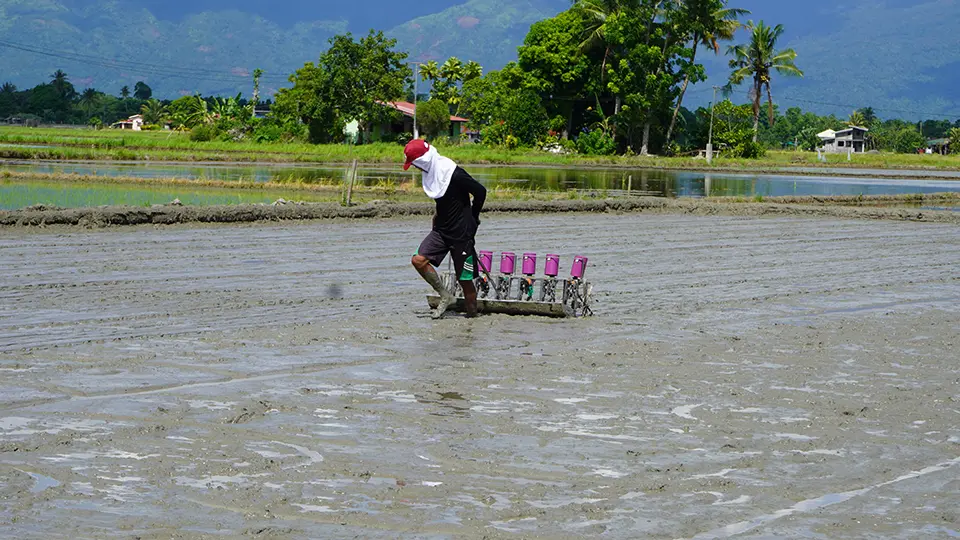
The Palatak Palay Seeder is operated manually and does not require fuel. It opens the soil, drops the right amount of seeds, and covers them up with soil. That system protects the seeds against strong winds, birds, rodents, and heavy rainfall. The seeder plants the seeds in straight rows, with uniform spacing. It features a wind deflector, allowing farmers to continue seeding even during windy conditions, Delfin explained, adding that the seeder is “suitable for everyday realities of Filipino rice farmers.”
Efficient Direct Seeding of Rice
Traditionally, farmers grow rice seedlings and then manually transplant them one by one into the field. This method is time-consuming and costly. It can also stress the seedlings as they need to be uprooted and replanted, Delfin explained.
With the Palatak Palay Seeder, farmers can pre-germinate seeds and plant them directly into the prepared fields.
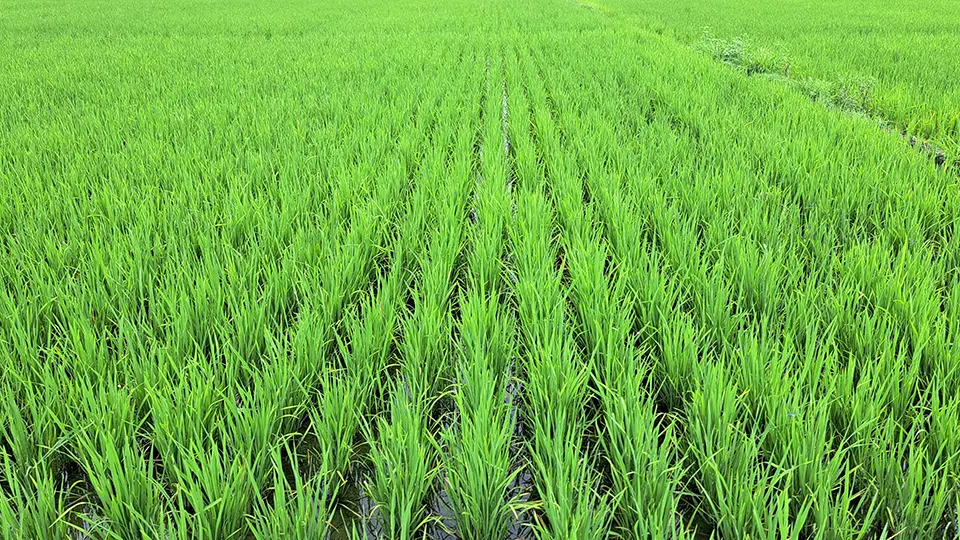
A more recent method is direct seeding, scattering seeds randomly by hand or mechanically. Delfin’s seeder, placing the seeds in a straight, evenly spaced row, helps with weeding, reduces seed waste, and supports better crop growth, he said.
The 17-kilo Palatak Palay Seeder can be pulled across the fields by either a man or a woman. The device, Delfin remarked, “allows small and medium farmers to experience the benefits of mechanization without investing in expensive machinery.”
The seeder works on six rows and can cover up to 2 hectares per day with three people, depending on field conditions, land preparation, and the operators’ efficiency, he said. Most small and medium farmers are established on 2- to 10-hectare fields.
Developing Palatak Palay Seeder
The seeder was officially commercialized in October 2024 and was developed with support from the Philippines Department of Science and Technology (DOST) of the Mimaropa region. Since the creation of Farmwell Agricultural Machinery Manufacturing in 2022, DOST assistance has enabled the social enterprise to acquire the necessary production equipment, allowing it to mass-produce and organize field demonstrations.
During one of those demonstrations, a heavy rain downpour started right after the seeding. Farmers were naturally expecting the seeds to be dispersed, but to their surprise, they remained in place, Delfin recalled. “This moment helped us build trust in the technology, and more farmers became interested.” Social media platforms also played an important role in promoting the seeder.
Underlining the affordability of his seeder, Delfin said its cost could be recouped in a cropping season.
Expanding Production and Reach of paddy seeder machine
Delfin started with a modest 70-square-meter backyard production area. “It was a small setup, but I had a big dream to make a Filipino-made technology that could help our farmers.”
“Through hard work, government’s support and growing demand, this small operation expanded into a 500-square-meter operation,” Delfin said, adding that the company recently acquired a 1,200-square-meter property.
“The Palatak Palay Seeder is not only a machine but also a livelihood opportunity for farmers, young people, and rural communities.” According to Delfin, the company has now reached 72 provinces in just 17 months.
If the current customers are individual farmers, the company is starting to serve local government units that want to provide the seeder to their farming communities. Some farmers have also bought several units to rent to neighboring farmers, generating extra income.
From its humble beginning with 2 workers, Farmwell Agricultural Machinery Manufacturing now employs 17 full-time floor workers, 3 administrative staff, and 5 part-time students, which, Delfin said, is “giving young people a chance to learn skills in agricultural machinery manufacturing.”
IP Protection Key for Filipino-Made Direct Seeding Technology
With the help of DOST, the company registered two utility models and three industrial designs and trademarked its logo. A trademark registration is ongoing to protect the name Palatak.
Delfin said he values IP protection because it strengthens the technology's identity and helps build trust in the market. “It is not about the ownership but is part of preparing the business for growth,” he said. “It is important for us that our Filipino-made technology can expand properly while protecting the originality and value of our innovation.”
As a participant in WIPO’s IP Management Clinic supporting SMEs in the area of Agriculture 4.0 in ASEAN, Delfin said even if the clinic was challenging for him because his knowledge of IP was very limited, it helped him understand that IP is not only about protecting the Palatak Palay Seeder, but also everything connected to our business.”
Larger Rice Seeder for Larger Areas
Farmwell Agricultural Machinery Manufacturing also recently added a new version of the Palatak Palay seeder, the Palatak 2+. With its 12-row sowing capability, it serves different types of farmers, farmers’ associations, and farmers’ communities. It covers a larger area and is faster than the first model, reaching 7 hectares per day, and can be pulled by a water buffalo or a small hand tractor.

At 64, Delfin experiences “a strong sense of urgency.” In the next five years, he wants to fast-track the distribution of seeders so that more farmers can benefit from them by strengthening partnerships with government agencies, cooperatives, farmer associations, and private organizations.
He also wished he could be reunited with his wife, who is still living in Canada, after he feels he has built the “legacy that helps transform the Philippines agriculture, supports farmers, and proves that Filipino-made innovation can create impact here and abroad.” “Transforming the Philippines agriculture one seed at a time.”