Fluorosis: A Condition Still Prevalent in the 21st Century
Presented by the Spanish Patent and Trademark Office
In Ethiopia, millions of people are exposed to fluorosis, a bone disease caused by the excessive consumption of fluoride, a groundwater pollutant that can be found in drinking water.

Some studies suggest that more than 14 million Ethiopians run the risk of suffering from either dental or skeletal fluorosis. The disease notably affects children since their permanent teeth are still forming.
Detecting the cause and finding the solution through science and research
On determining the cause, the aim was to reduce high levels of fluoride present in the water to 1.5 milligrams per liter (mg/L), as established by the World Health Organization.

In the Great Rift Valley of Ethiopia, 41% of drinking water sources contain a concentration of fluoride exceeding that level. This means that ingredients for food and the food prepared with locally sourced water may also be a significant source of fluoride consumption.
A team from the Spanish National Research Council (CSIC) and the Addis Ababa University of Ethiopia developed technology that removes fluoride from water in an inexpensive and sustainable manner.
“A dream come true with the help of zeolite technology”
This new technology is rooted in the use of zeolite, abundant minerals commonly found in the Great Rift Valley that help filter out fluoride. Natural zeolites are of volcanic origin and possess a unique microporous structure that can trap a wide variety of elements, such as sodium, potassium and magnesium. The CSIC research team was able to modify zeolites so that, in this case, they could trap fluoride.
This technique has therefore proven to be far more efficient that other known solutions for fluoride extraction. It is also cheaper and does not produce pollutant waste.
Implementation: a dream come true
Patent ES2500042A1 protects the technology owned by the Canarian company, Tagua SL, which launched commercial production of the zeolite-based filter under the name HINDROP. It has earned, among other recognitions, the distinctive stamp of Innovative SME from the Spanish government. The new filter technology does not require trained personnel or complex infrastructure for installation. It can also be adapted for both domestic and communal use.
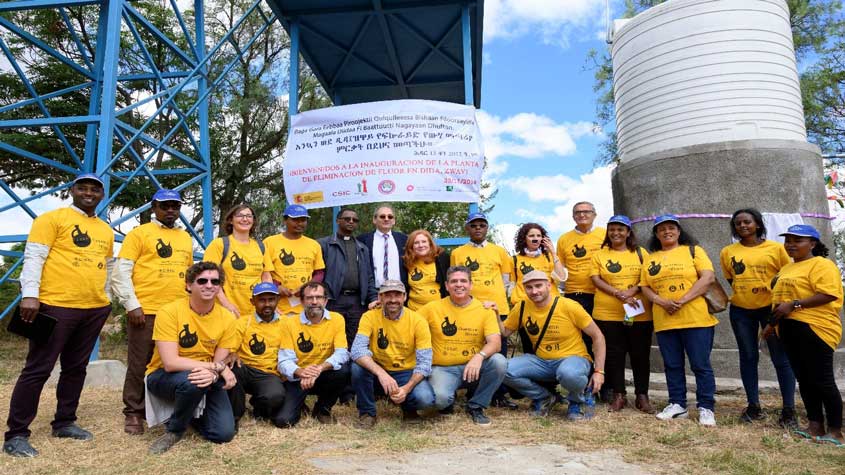
The collaboration between CSIC and the NGO Amigos de Silva, together with the Juan Entrecanales de Azcárate Foundation (Spain) and the Stiftung Freie Gemeinschaftsbank (Switzerland) has enabled the development of two zeolite-based water treatment plants that were inaugurated on November 23, 2019. They are situated in the villages of Dida and Obe, some 25 kilometers from Ziway in the Great Rift Valley, 160 kilometers south of the capital Addis Ababa, where fluorosis remains highly prevalent.
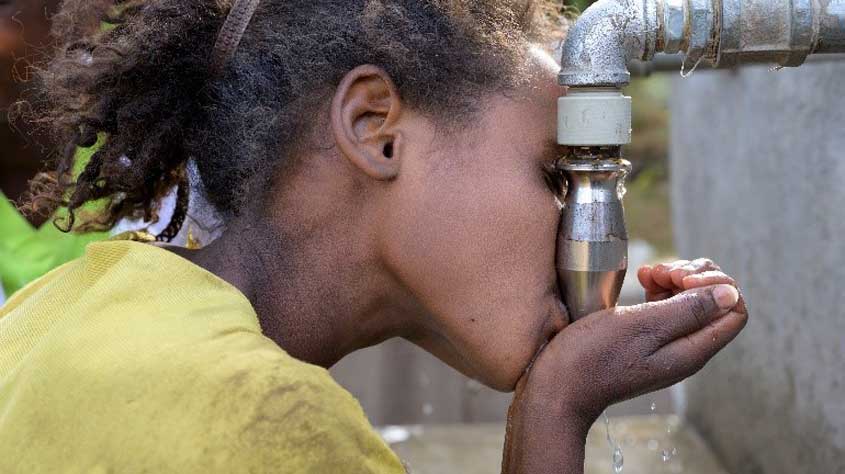
Two filters were developed, manufactured and placed in two contaminated wells that supply water to the local community, which has a primary school with 400 pupils, a recreation center and a mother-and-child health center with the assistance of nurses. The water from the wells had a fluoride concentration of 2-3 mg/L, which is now filtered out thanks to this new zeolite-based technology, and the community is now supplied with good drinking water.
Sustainable Development Goals: more relevant than ever
The development of this technology demonstrates the firm alignment of research conducted by CSIC with the 17 Sustainable Development Goals (SDGs) of the United Nations Development Programme (UNDP), specifically with Goal 6, which is intended to achieve clean water and sanitation.
Details of the patent holder
The Spanish National Research Council (CSIC) is the State Agency for scientific research and technological development in Spain. Its aim to promote, coordinate, develop and disseminate multidisciplinary scientific and technological research in order to contribute to the advancement of knowledge and economic, social and cultural development.
The CSIC has 120 centers across the country where it performs research in all scientific and technological areas. The CSIC was the first patent applicant in Spain, the first Spanish applicant for European patents and for patents under the Patent Cooperation Treaty (PCT) and ranks third among European public bodies in terms of European patents.
Over the last five years, CSIC has applied for 437 technologies to be protected on the market, of which 216 have been patent-protected.
Details of the licensed company
- SME name: Tagua SL
- Sector: Environmental (Integral water cycle management (CNAE 3600) water collection, purification and distribution)
- Address: Calle José Manuel Guimerá, 3 - 4º, Edificio Urbis, 38003 Santa Cruz de Tenerife, Spain
- Contact person: Luis González Sosa
- Telephone: +34 922 28 16 39
- Website: www.tagua.es
Tagua SL is a company that is firmly committed to innovation. It was founded in 1987 and its main purpose was to capture and sell groundwater from wells and underground tunnels. Later in 2001, it expanded its activities to civil engineering, where it performed a wide variety of works related to hydraulic infrastructure in integral water cycles. The company has expanded its activities over the years and is now a recognized expert in the integral water cycle at all stages: collection, treatment, desalination, distribution, sanitation, purification and reuse.