them to third parties to produce merchandize, including apparel, accessories, footwear and more. For example, Manchester United has a 10-year agreement (it runs through July 2025) with sportswear giant, Adidas, with respect to global technical sponsorship and dual-branded licensing rights. According to the Club, it plans to expand its portfolio of product licensees and to enhance the range of products available to its fans. The strategic marketing alliances that now exist between sports organizations and major apparel companies like Adidas, Nike, Puma, Under Armour, etc., mean that sports clubs and leagues are now fast becoming global lifestyle brands as consumers buy in to the powerful image and values that sports encompass.
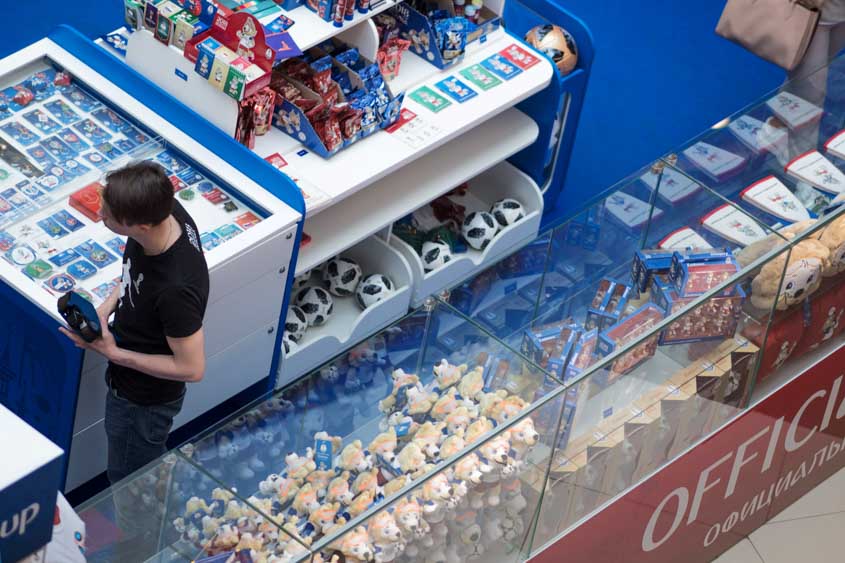
A wide range of official products or merchandize carrying the emblem of a sports event, such as stickers, mugs, keyrings, sports apparel, balls, etc., are produced under license by official licensees of an event. These products help build excitement around a major sports events and allow fans to connect with it. Here a fan shop with official products in St Petersburg, Russia, during the 2018 FIFA World Cup. (Photo: Yulia Koltyrina / Alamy Stock Photo)
Top athletes are also getting in on the game. Many are leveraging their personal brands
(built around their sporting success) to generate significant revenue through endorsement contracts with major sportswear and other companies. Recognizing the significant marketing potential of these superstars, companies often pay millions of dollars for sports (and other) high-profile personalities to endorse their products. Some even develop product ranges bearing the athlete’s name. That’s what Nike did when it developed its products ranges for basketball superstars Michael Jordan and Lebron James. Countless athletes in many other sports, for example, Lewis Hamilton (Formula One), David Beckham (soccer), Rory McIlroy (golf), Lindsey Vonn (downhill skiing), Maria Sharapova (tennis) and more have benefited from such endorsement deals.
Copyright and broadcasting
Administrative Instructions under the Patent Cooperation TreatySports organizations depend on broadcasters to transmit coverage of their events and engage fans worldwide, and indeed, to attract sponsors. Copyright and related rights
(a) Where a national Office intends to proceed under Rule 19.4(b) having regard to Rule 19.4(a)(i), (ii) or (ii-bis), it shall, if it requires payment of the fee referred to in Rule 19.4(b) and that fee has not already been paid, promptly invite the applicant to pay that fee within a time limit of 15 days from the date of the invitation.
(b) Where a national Office intends to proceed under Rule 19.4(b) having regard to Rule 19.4(a)(iii), it shall promptly request the International Bureau as receiving Office to agree to the transmittal of the international application. The International Bureau as receiving Office shall promptly respond to that request. If the International Bureau as receiving Office agrees to the transmittal, the national Office shall promptly invite the applicant:
(i) if the transmittal has not already been authorized by the applicant, to submit to that Office, within a time limit of 15 days from the date of the invitation, an authorization of the transmittal, and,
(ii) if the Office requires payment of the fee referred to in Rule 19.4(b) and that fee has not already been paid, to pay that fee within the time limit referred to in item (i).
(c) The national Office:
(i) need not proceed under Rule 19.4(b) having regard to Rule 19.4(a)(i) to (iii) if the Office requires payment of the fee referred to in Rule 19.4(b) and the applicant does not pay that fee;
(ii) shall not proceed under Rule 19.4(b) having regard to Rule 19.4(a)(iii) if the International Bureau as receiving Office does not agree to, or if the applicant does not authorize, the transmittal of the international application under Rule 19.4(a)(iii).