“Patents Provide the Foundation for Concept-driven Architecture”
For Mitsuru Senda, design has no limits. The architect founded the Environment Design Institute in 1968 to promote innovate design at all scales, from individual pieces of furniture to entire cityscapes. Uniting this ambitious mission is a focus on the “living environment” created by design.
This philosophy considers buildings and shared spaces as more than bricks and mortar to explore the experiences they might evoke and communities they can nurture. For Mitsuru Senda, environment design is about looking out for future generations. “I want to design the environment that creates the future,” he explains. “It must be beautiful, safe, comfortable, and increase environmental value.”
Environmental Design inspired by Circular Playgrounds
Making play work

on the design of children’s play environments.
(Image: Environment Design Institute)
Mr. Senda’s belief in the importance of environment design has a surprising inspiration: children’s playgrounds. A leading researcher on the design of playgrounds and playground equipment, he literally wrote the book on the design of children’s play environments. His research led him to develop his concept of “circular play systems,” which argues that designs must incorporate – and encourage – movement to create a successful play environment. The importance of using architecture and design to promote activity and creativity in childhood remains at the heart of the Environment Design Institute, which has built a wide range of innovative playgrounds, schools and other child-friendly spaces.
Conceptual Design Architecture
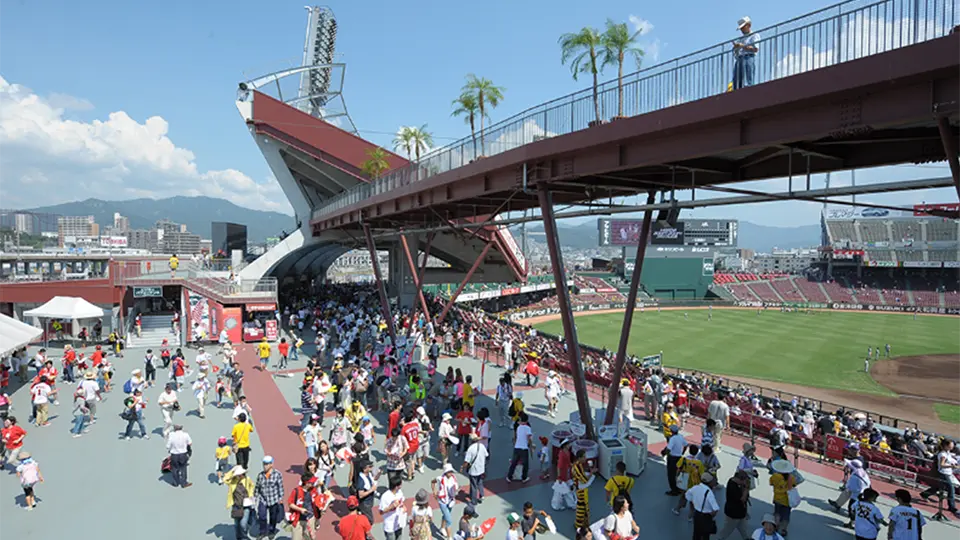
However, the Institute has also applied the concept of circular play systems beyond the playground. The same principles that underpin engaging play environments can also be used to create spaces that evoke feelings of togetherness while allowing users – young and old – to enjoy a variety of experiences. The concept was used, for example, in the design of the award-winning Mazda Zoom-Zoom Stadium in Hiroshima, completed in 2009.
Ishikawa Prefectural Library – A Social Architecture Masterpiece
Another example of this environmental design philosophy in action is the Ishikawa Prefectural Library, completed in 2022. Whereas the angular exterior is inspired by turning the pages of the book, the interior uses an oval, “amphitheater” design that encourages discussion and movement; a social architecture masterpiece! And, in true Senda fashion, the library includes large and bespoke pieces of furniture for children to use, helping to promote the idea of reading as a fun and engaging childhood activity.

Protecting intellectual property in architecture

improves the strength of roof-bearing structures.
(Image: Japanese Platform for Patent Information)
No matter how bold an idea or ambitious a design, Mitsuru Senda is clear that architectural innovation must be protected as intellectual property (IP). Likening the design industry to the world of scientific research, Mr. Senda notes that an open culture and intellectual competition is key to its continued development.
Architectural innovations and other design elements of an environment can be protected in various ways, including industrial designs and patents. One of Mr. Senda’s patents is for an architectural design that improves the strength of structures with the use of multiple intersecting columns fixed to various parts of a roof (patent application no 2000-254900). The challenge of creating load-bearing structures is as old as architecture itself, but this patent shows that there is still room for creativity and new approaches in this utilitarian task.

in this patent application a dual purpose.
(Image: Japanese Platform for Patent Information)
Another of Mr. Senda’s patent applications for column design (patent application no 2000-229312) also shows how creativity can come from necessity. This patent includes seating fixed to the columns, and the staggered positioning of columns provides a sense of openness without obstructing the view of those sitting on the attached stools.
The award-winning architectural designs of Mitsuru Senda and the Environment Design Institute show that IP protection is just as important for concept-driven architectural designs as it is for “nuts and bolts” inventing. Indeed, as Mr. Senda’s embrace of IP protection shows, patents can help protect bold new designs and promote an industry-wide culture of innovation. It is an approach that combines the pragmatic and the imaginative – much like one of Mitsuru Senda’s designs.