On December 11th, 2025, the World Health Organization (WHO), the World Intellectual Property Organization (WIPO) and the World Trade Organization (WTO) held the 12th Trilateral Cooperation Technical Symposium titled “Antimicrobial Resistance: Addressing the Innovation Gap, Access Inequities, and Supply Challenges.” This timely symposium underscored the urgency of advancing practical solutions that help preserve antimicrobial effectiveness for future generations.
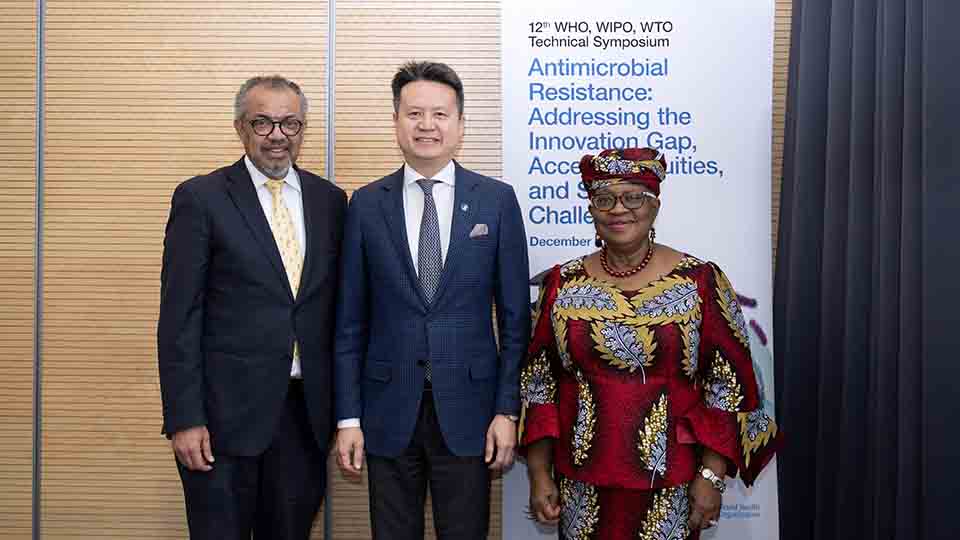
The event featured opening remarks by Mr. Daren Tang, WIPO’s Director General, Dr. Ngozi Okonjo-Iweala, WTO’s Director General, and Dr. Tedros Adhanom Ghebreyesus, WHO’s Director-General. Read their full statements. They were followed by remarks from Dr. Ayoade Alakija, Nigeria’s Global Ministerial Envoy for Antimicrobial Resistance (AMR) and Board Chair of FIND, Ms. Gabriella Balasa of the WHO Task Force of AMR Survivors, and, as the keynote speaker, Professor Ramanan Laxminarayan, University of Washington and One Health Trust.
The opening session set the stage for subsequent discussions connecting public health, IP and trade aspects. Dr. Alakija announced that Nigeria will host the 5th Global High-Level Ministerial Meeting on AMR (June 28 to 30, 2026). In her AMR survivor testimony, Ms. Balasa recounted her near-fatal infection in 2019, urging swift, coordinated action, warning that “we are running out of time.” Prof. Laxminarayan during the keynote lecture stressed the need for diagnostics, affordable drugs and R&D tailored to low- and middle-income countries (LMICs), as well as stronger health systems to ensure timely, appropriate treatment. He called on WHO, WIPO, and WTO to reduce trade barriers and support innovation that aligns with the needs of patients worldwide.
The symposium featured three moderated panels, bringing together diverse perspectives from governments, industry, academia, inter-governmental organizations, and civil society, including the University of KwaZulu-Natal; the Quadripartite Joint Secretariat on AMR; the University of Bern; the Ministry of Public Health of Thailand; the Norwegian Institute of Public Health (NIPH) and ReAct; the Global Antibiotic Research & Development Partnership (GARDP); the Kenya Medical Research Institute (KEMRI); the Swiss Federal Institute of Intellectual Property (IPI); the Innovation+Design Enabling Access (IDEA) Initiative; the European & Developing Countries Clinical Trials Partnership (EDCTP); Roche Pharmaceutical Research and Early Development (pRED); Ministry of Health & Population for International Relations of Egypt; Africa Centres for Disease Control and Prevention (Africa CDC); the Pan American Health Organization (PAHO); the International Generic and Biosimilar Medicines Association (IGBA); and the International Federation of Pharmaceutical Manufacturers and Associations (IFPMA). Read more.
In her closing remarks, Ms. Amy Dietterich, Director of WIPO’s Global Challenges Division, emphasized that AMR is a complex, cross-cutting challenge that spans science, public health, trade, IP, innovation, manufacturing, supply chains, and financing. She added that the Trilateral Cooperation among WHO, WIPO and WTO will continue to support Members and stakeholders through policy dialogue and technical assistance, helping to foster more impactful responses to AMR at national, regional and global levels.