What are frontier technologies?
Frontier technologies are transforming the global economy, with advances in digital technologies, biotechnology, human augmentation, quantum computing and clean energy expected to create trillions of dollars in value.
To ensure these benefits are widely shared, the intellectual property (IP) system must continue to encourage innovation and creativity, and adapt to the speed and complexity of emerging technologies. Both policy discussions and the development of tools for modern, efficient IP administration are essential to supporting innovators and creators and driving inclusive economic growth. One of the most talked about frontier technologies is artificial intelligence.
The last two decades have seen an explosion of technologies that are transforming how we work and live in an increasingly interconnected digital world. The emergence and merging of frontier technologies is at the heart of what is sometimes termed the Fourth Industrial Revolution or Industry 4.0. Frontier technologies are changing how we do business, how we innovate and how we create, and the rate of change is increasing exponentially.
The field of frontier technologies is rapidly evolving and although there is no agreed definition for this concept, frontier technologies share some common features. They operate at the intersection of radical scientific developments and real-world implementation. Furthermore, they are changing the way we communicate, solve problems, provide goods and services, create and do business. Frontier technologies could be described as advanced technology that can address global issues.
Examples of fontier technologies
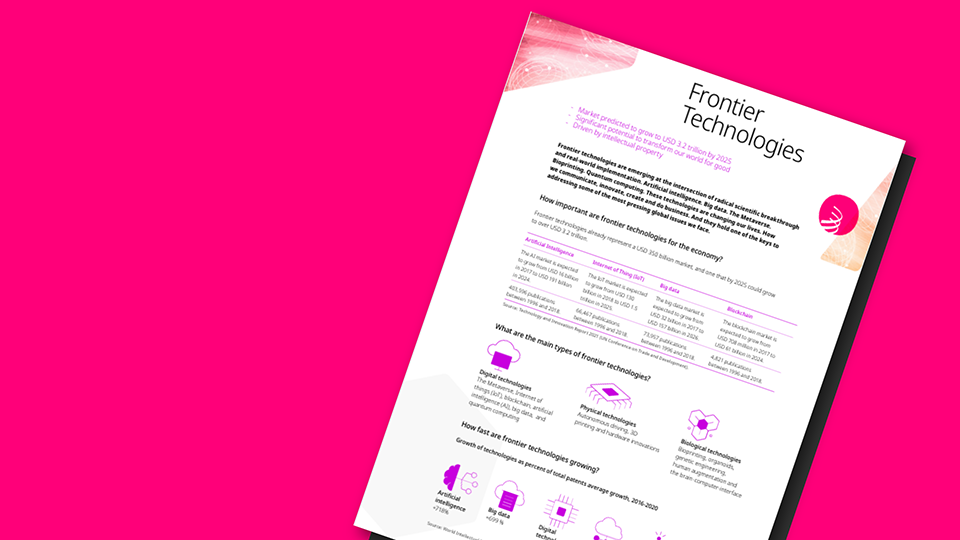
Frontier technologies include:
- digital technologies, such as the Internet of things (loT), blockchain, the metaverse, artificial intelligence (Al), including GenAI, big data and cloud computing
- physical technologies, such as autonomous driving, 3D printing and hardware innovations and
- biological technologies such as genetic engineering, human augmentation and the brain-computer-interface.
Data and intangible assets are the bedrock of our new, digitalized world. IP is rapidly gaining increasing importance over physical assets.
The IP system that we have today was developed with a focus on human creation and innovation and to encourage the development of technologies that enabled production process and trade of physical products. The IP system was also designed when the speed of innovation and creation was much slower than it is today.
One of the important tasks that we face today is to ensure that the current IP system continues to promote human-centered innovation and creativity in the age of frontier technologies.
At WIPO, the IP and Frontier Technologies Division, in close collaboration with the IP Futures and Knowledge Management Section, facilitates discussion and knowledge building among Member States and stakeholders on how frontier technologies interact with IP, supporting well‑informed policy choices. WIPO organizes an annual event to deep dive into one particular frontier technology and its IP touch points and implications.

IP and Quantum Computing
October 15, 2026 (virtual)
To receive regular updates about our events and projects, subscribe to our newsletter.
Explore more about IP and specific frontier technologies

IP and artificial intelligence
The growth of AI across a range of technical fields raises a number of policy questions with respect to IP. These questions implicate issues ranging from patent eligibility, to ownership of AI-assisted creative output and innovations, to the scope of copyright exceptions and limitations in the context of AI training data. Discover WIPO’s work on IP and AI.

IMAGE: evgeniyShkolenko / iSTock / Getty Images
IP and quantum computing
Quantum computing presents a major opportunity to drive innovation and economic growth. As the technology advances, IP will play a key role in fostering innovation, protecting breakthroughs, enabling the commercialization of quantum technologies across industries, and facilitating access to this ground-breaking technology.

IMAGE: Gremlin /E+ / GeTTY Images
IP and the metaverse

IP and blockchain

IMAGE: Jacob Wackerhausen / iStock / Getty IMages
IP and data
All frontier technologies are fueled by accelerating digitalization, rely on data and often generate data. Find out why this intangible asset increasingly matters and is changing how we do business, innovate and create.

IMAGE: Pixels Effect / E+ / Getty Images
IP administration with frontier technologies
Frontier technologies such as AI, big data analytics, and the blockchain may be useful to address the growing challenges facing IP offices in order to make the IP system efficient and accessible for everyone, everywhere. Discover the AI-powered services and tools by WIPO.
News

WIPO Conversation on IP and Frontier Technologies
Going forward, IP and AI discussions will move to WIPO’s Global Forum on IP and AI, launching in November 2026.
Frontier technologies beyond AI will remain a key focus area for WIPO, as they continue to reshape innovation, creativity, and economic activity while raising evolving questions for the IP system. As many of these technologies are developing over a longer-term horizon, the IP and Frontier Technologies Division, in collaboration with WIPO’s IP Futures and Knowledge Management Section, will organize an annual public event to examine their longer-term implications for the IP system.