Gender Equality: Japan's Effort to Leave No One Behind
January 12, 2023
January 12, 2023 ・ 5 minutes reading time

In her presentation at WIPO’s Online Seminar Series on the IP Gender Gap in the Asia-Pacific Region, Dr. Miyoko Watanabe, Standing Trustee at Nihon University and Chair of Committee on gender-based innovation in the Science Council of Japan, described the importance of women’s participation for intellectual property.
Why should we promote gender equality and womens’ participation in innovation and science and technology?
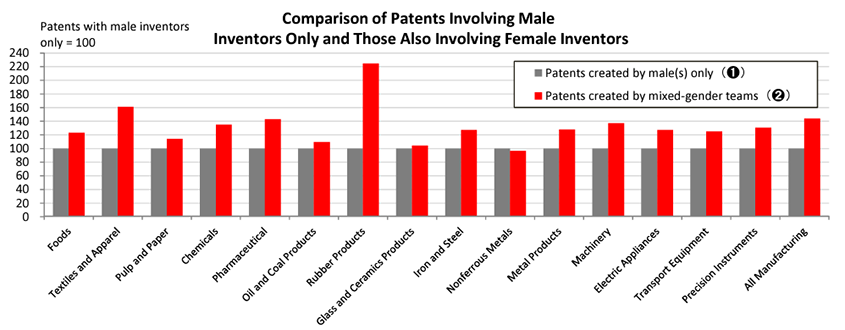
Most patents across the fifteen technological fields are overwhelmingly generated by male-only gendered teams. Even in the fields where the share of women scientists are almost on par with men, the male-only teams still generate more than a third of the inventions.
Why should we promote women participation?
Beyond the natural fairness argument according to which women deserve to participate as much as men, and the loss of potential by not exploiting the full inventive workforce capacity, Ms. Miyoko reports that adding women inventors can increase the economic value of inventions. Indeed, the Development Bank of Japan conducted studies showing that in engineering the economic value of inventions stemming from Japanese mixed-gender teams is 50% higher than male only teams.
What is Asia’s current situation?
The Asian region overall performance on gender equality tracked by the Sustainable Development Goals index shows that gender equality is one of the region’s greatest weaknesses. Japan, in particular, is one of the only three OECD countries that still faces major challenges on this topic.
Moreover, there are biases that affect Asian women globally that impact their participation in innovative activities, such as:
- Selection biases by venture capital decision makers, who are more likely to select white male entrepreneurs than women entrepreneurs and/or entrepreneurs from other racial groups.
- Machine learning biases in translation and facial recognition, which make identifying Asian women more difficult.
The trend of women's participation in science
The ratio of Japanese female researchers has been increasing regularly over the last 20 years. However, the pace of this increase is too slow. It would take more than 35 additional years to reach a rate of 30 percent of women among researchers in Japan.
In addition, when analyzing the same ratio for different fields, the results show that female participation in engineering and natural sciences is dramatically lower than nursing and home economics.
What is Japan doing to address this trend?
Japan Science and Technology Agency has established organizations to award prizes to female researchers to promote them. These prizes are:
- the Jun Ashida Awards directed towards researchers under 40 years old in any scientific field, and
- the Marie Curie Awards for early-career researchers in science and technology.
In 2022, the University of Tokyo implemented a plan for gender equality, with a 5-year target, in which:
- the participation of female professors and associate professors rises from 16% to 25%, and
- the ratio of female students grows from the current 20% to 30% in 2027.
Related resources
Guidelines for producing gender analysis from innovation and IP data