Can clean technologies spread fast enough to fight climate change?
7 septembre 2026
7 septembre 2026 ・ minutes reading time
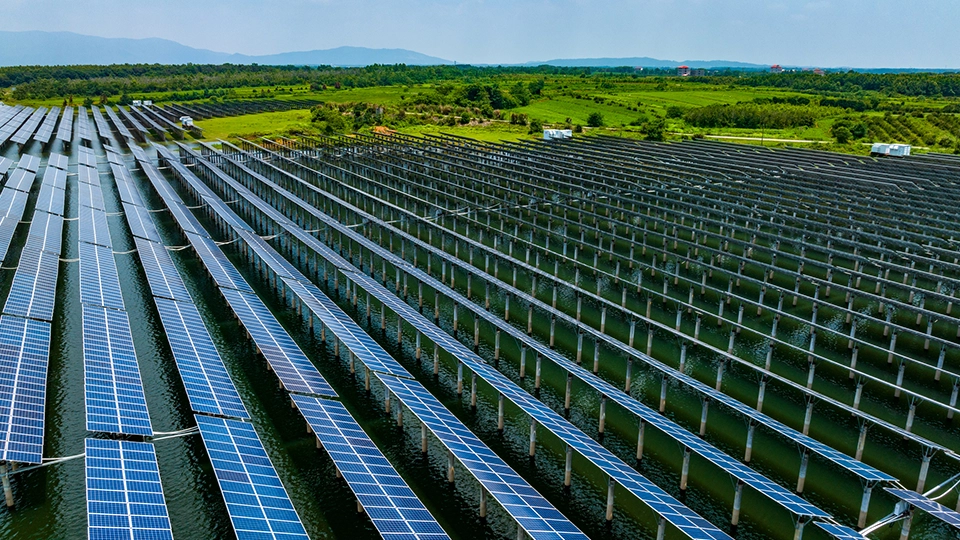
The world is running out of time to cut greenhouse gas emissions. The good news is that several clean technologies, such as solar photovoltaics, electric vehicles, and wind turbines, have scaled from negligible levels in the early 2000s to hundreds of gigawatts of capacity and millions of annual sales today. The bad news is that deployment has been rapid in power generation and light transport but remains limited in hard-to-abate sectors like steel, cement, and long-distance shipping. And adoption outside high-income economies has begun only recently.
As Chapter 4 of the World Intellectual Property Report 2026 points out, clean technologies don't diffuse on their own. They need the right mix of affordability, infrastructure, skills, and policy — and each technology faces a distinct combination of enablers and barriers.
The price of progress: solar PV's cost journey
Perhaps no story better illustrates what's possible than solar photovoltaics (PVs). It took more than half a century for solar PV to reach a significant market share after the prototype stage. Yet once costs began falling driven by R&D, learning-by-doing and economies of scale, especially through the rapid expansion of manufacturing in China.
Between 1975 and 2024, solar panel prices have fallen by more than 99 percent. Every time cumulative installed capacity doubled, costs dropped further. This self-reinforcing cycle, known as a learning curve, is one of the most powerful forces in clean technology diffusion.
Over time, solar PV prices have declined significantly as cumulative capacity has increased
Solar PV panel prices vs. cumulative capacity, 1975–2024 (plotted on a logarithm axis)

A key reason solar scaled so quickly was its modular design: a single solar panel can generate useful electricity at just 100 watts, making it affordable even at small scale — unlike coal or nuclear plants that require hundreds of millions of watts to be economical. This modularity also enabled manufacturing standardization, rapid iteration, and deployment across a vast range of contexts, from rooftops in Germany to off-grid villages in sub-Saharan Africa.
But being affordable alone is not enough. Even where solar panels are cheap, their spread can be blocked by grid infrastructure that can't absorb fluctuating supply, by a shortage of qualified installers, or by trade tariffs that raise import prices. When the United States imposed tariffs on Chinese solar imports in 2014, domestic solar prices rose by roughly 10 percent, slowing adoption in one of the world's largest markets.
Three technologies, three stories
Solar PV, electric vehicles (EVs), and hydrogen are the three case studies that clearly illuminate how clean technologies succeed — or struggle — to scale. Each has reached a different stage in its diffusion journey, and each faces a distinct set of enablers and barriers.
Explore the enablers and barriers shaping the diffusion of clean technologies
Overview of enablers and barriers in the diffusion of solar photovoltaic, electric vehicles, and hydrogen technologies

No single barrier explains slow diffusion — and no single policy can fix it. The challenge is systemic.
Three key takeaways
Solar PV shows what works. A combination of R&D, industrial policy, and modular design created a virtuous cycle of cost reduction and adoption that is now reaching even low-income countries. Surplus Chinese manufacturing has lowered global prices, making solar more accessible than ever before. But grid infrastructure must keep pace — especially in the developing world, where growing electricity demand and limited grid investment create a critical bottleneck.
EVs demonstrate the power and limits of policy coordination. Affordability remains one of the most persistent barriers to broad-based EV adoption. Norway achieved the world's highest EV market share through a stable, long-running package of fiscal incentives. China transformed its EV sector through coordinated industrial policy, driving battery costs down by over 90 percent in a decade. Furthermore, EVs require a dense network of charging infrastructure before mass adoption becomes viable, yet charging providers hesitate to invest before there is sufficient EV uptake. Charging infrastructure is a critical bottleneck for EV diffusion.
Hydrogen faces the hardest road. Cost is the primary constraint on clean hydrogen diffusion. Unlike solar panels or EV batteries, hydrogen cannot be easily modularized — it requires pipelines, storage facilities, and port infrastructure that don't yet exist at scale. Of the 56 countries with a hydrogen strategy, 43 identify infrastructure as their most critical barrier. "Hydrogen hubs” which co-locate production, infrastructure, and industrial demand — are the leading policy idea, but most remain at the announcement stage. The evidence base for their effectiveness is still thin.
Patents: a double-edged sword for clean technology
Intellectual property sits at the heart of a difficult trade-off in clean technology diffusion. Patents incentivize costly R&D by offering temporary monopoly protection, but they also restrict access by design. In the climate context, this tension is especially acute: every year of delayed diffusion translates directly into higher cumulative greenhouse gas emissions. The real gap lies less in the urgency of climate action, which is high across countries, than in the geography of ownership: most clean-technology patents are held by entities in high-income countries and China, while lower- and middle-income countries face the greatest need for access to these technologies and for financial support.
Alternative approaches, such as patent pledges, have attracted attention but delivered mixed results. Tesla's 2014 pledge not to sue good-faith users of its EV patents was hailed as a bold move to accelerate diffusion — yet the company continued to guard its most valuable process innovations, including advanced battery manufacturing, through trade secrets. Meanwhile, clean innovation itself remains unevenly distributed across sectors: patenting has concentrated heavily on electricity generation, storage, and smart grids, while hard-to-abate sectors lag far behind.
Looking ahead
The case studies of solar PV, EVs, and hydrogen reveal common patterns as well as specificities in how clean technologies successfully navigate infrastructure barriers, incumbent resistance, and coordination challenges.
Future diffusion will hinge not only on technological progress, but also on managing systemic risks. Mineral scarcity, AI expansion and political headwinds could raise costs and fragment markets, but innovation, diversification and credible policy can offset them. The balance is uncertain: in some contexts, these pressures may slow adoption, in others, they may catalyze new investment and coordination. Whether clean technologies keep scaling at the speed required will depend on how effectively institutions provide stability, openness and resilience.