
Introduction
Climate change is imposing economic damage through extreme heat, shifting rainfall, rising seas, and disruption to ecosystems and societies.
Clean technologies have not diffused uniformly, nor have they spread at the same speed across different contexts. Figure 4.1 shows the time required for energy technologies to move from prototype to market introduction and early adoption, defined here as reaching 1 percent market share. For instance, nuclear power scaled from prototype to early adoption within 20 years of its invention in France, while direct reduced iron took six decades. Even recent success stories illustrate slow progress: solar photovoltaic (PV) needed more than half a century to reach material market share.

Recent experience highlights several broad trends in clean technology diffusion. Rapid cost declines have been achieved through early research and development (R&D), subsidies, feed-in tariffs, and large-scale manufacturing, driving steep learning curves. Production and adoption have shifted toward Asia, with China’s industrial strategy reshaping supply chains, lowering prices and enabling uptake across middle-income economies. Yet diffusion has stalled at the margins: low-income countries and hard-to-abate sectors remain far behind. The policy challenge is now twofold – mobilizing capital, infrastructure and skills, so cost declines reach the poorest adopters, and driving industrial technologies down their cost curves through targeted R&D, demonstration and early-market creation.
This chapter examines how clean technologies have spread, why adoption is uneven, and what this implies for the next phase of diffusion. It focuses on mitigation technologies, with an emphasis on deployment over the last two decades rather than early scientific discovery.
First, it identifies key mitigation technologies and assesses their maturity across sectors and regions, with special attention paid to China's influential position in the global landscape. Next, it presents three instructive case studies: solar (PV), electric vehicles (EVs), and hydrogen.
Solar PV illustrates a complete diffusion journey from early R&D to worldwide deployment; EVs demonstrate how technological competition can be resolved through policy support and industry coordination; and hydrogen highlights strategies for overcoming complex market formation challenges requiring simultaneous infrastructure and demand development. These carefully selected cases reveal common patterns as well as specificities in how clean technologies successfully navigate infrastructure barriers, incumbent resistance, and coordination challenges. The analysis identifies critical success factors, potential policy interventions, and strategic approaches to overcome adoption barriers. Finally, the chapter examines emerging risks and opportunities, including geopolitical tensions, supply chain vulnerabilities, and the financing challenges that will define the next phase of global clean technology diffusion.
Mitigating climate change requires targeted innovation in technologies that reduces the environmental impact of economic activity. Clean technologies, also known as low-carbon technologies, serve multiple critical functions: reducing greenhouse gas emissions, enhancing energy efficiency, optimizing resource utilization, minimizing waste generation, and promoting reuse and recycling. These technologies generate significantly lower CO2 emissions compared to conventional fossil fuel alternatives.
Understanding which clean technologies are most needed requires examining where global greenhouse gas emissions originate, how they are distributed across economic sectors, and which technologies can effectively reduce them.
Table 4.1 provides a comprehensive overview of these mitigation options. It links each sector's emission share to available and emerging technological solutions, revealing that the global clean technology transition has progressed unevenly over the past two decades. The table includes technology readiness levels (TRLs) to indicate each solution's market maturity.
Innovation rarely proceeds linearly through these different TRL stages: feedback loops, reversals and redesigns are common. Still, the TRL scale is valuable because it highlights the types of barriers that typically arise at different points. At low TRLs, technical and financing risks dominate; at intermediate levels, demonstration and early adoption hinge on supply chains, certification and early demand; and at prominent levels, the main challenges concern integration into energy systems, infrastructure and markets.

Technology maturity varies widely across sectors
First, mature technologies already address a significant share of emissions, particularly in power generation and buildings, where solutions have achieved broad market deployment. Power generation has led this transition, beginning with wind power in the mid-2000s, supported by pioneering policy frameworks like Denmark’s feed-in tariffs and industrial support measures. Solar PV followed later, achieving exponential growth after the late 2000s as module costs fell dramatically and policy support mechanisms expanded globally. Together, wind and solar dominated renewable capacity additions throughout the 2010s, driven by learning effects and increasingly competitive auctions.
Second, hard-to-abate sectors, like heavy industry and long-distance transport, remain critically dependent on technologies still at the prototype, demonstration, or early adoption stages, presenting both urgent innovation needs and substantial investment risks. Industry accounts for about one-third of global CO2 emissions and is among the hardest sectors to decarbonize. Some progress can be made through efficiency improvements and electrification of low- to medium-temperature heat, which is already commercially available. But most high-temperature processes, such as those in steel, cement and chemicals, depend on technologies that are still at pilot or demonstration stage. Options include hydrogen-based steelmaking, alternative cement binders, and electrified processes in chemicals and aluminum. Carbon capture and storage can also play a role, though it remains costly and infrastructure intensive. Overall, deep cuts in industrial emissions hinge on advancing and scaling technologies that are not yet fully commercial.
Third, cross-cutting enablers such as grid infrastructure, energy storage, hydrogen, and carbon management systems play essential roles across multiple sectors, yet span a wide range of technological maturities, creating complex interdependencies in the transition pathway. For example, the transportation sector transition lagged significantly behind, with EVs remaining marginal until the late 2010s. The subsequent rapid growth in EVs was primarily driven by policy mandates in key markets – particularly China, Europe and the United States. By the early 2020s, EVs had achieved double-digit market shares in major markets, as automakers committed to large-scale battery platforms.
This framing makes clear that deep decarbonization requires both the rapid diffusion of mature options and a sustained effort to pull lower-TRL technologies through to market. However, the specific challenges vary significantly by sector. In some sectors, the main challenge is not the cost of the technology itself, but systems integration, which spans TRLs from early adoption to widespread deployment. Deep cuts in industrial emissions depend on advancing and scaling technologies that are not yet fully commercial.
The cross-cutting enablers present a particular complexity: their diversity of maturity levels highlights the critical importance of developing enabling infrastructure – grids, CO₂ pipelines, storage basins, and hydrogen networks – without which specific technologies cannot scale effectively. Meanwhile, in buildings, the main barriers are not technical feasibility, but diffusion challenges including upfront costs, building codes and retrofit logistics. In agriculture, while a broad technical toolkit is available, adoption relies heavily on policy support, consumer behavior and institutional capacity rather than technological development.
Clean tech in the past 20 years: where and how much?
Having mapped the landscape of available mitigation technologies and their maturity levels, the question is how far these options have diffused. Over the past two decades, clean technology has moved from the margins to the center of the global energy system (see Figures 4.2 and 4.3). Solar PV, wind turbines and EVs have scaled from negligible levels in the early 2000s to hundreds of gigawatts of installed capacity and millions of annual sales today (see Chapter 1).


These parallel patterns of deployment and innovation frame this subsection.
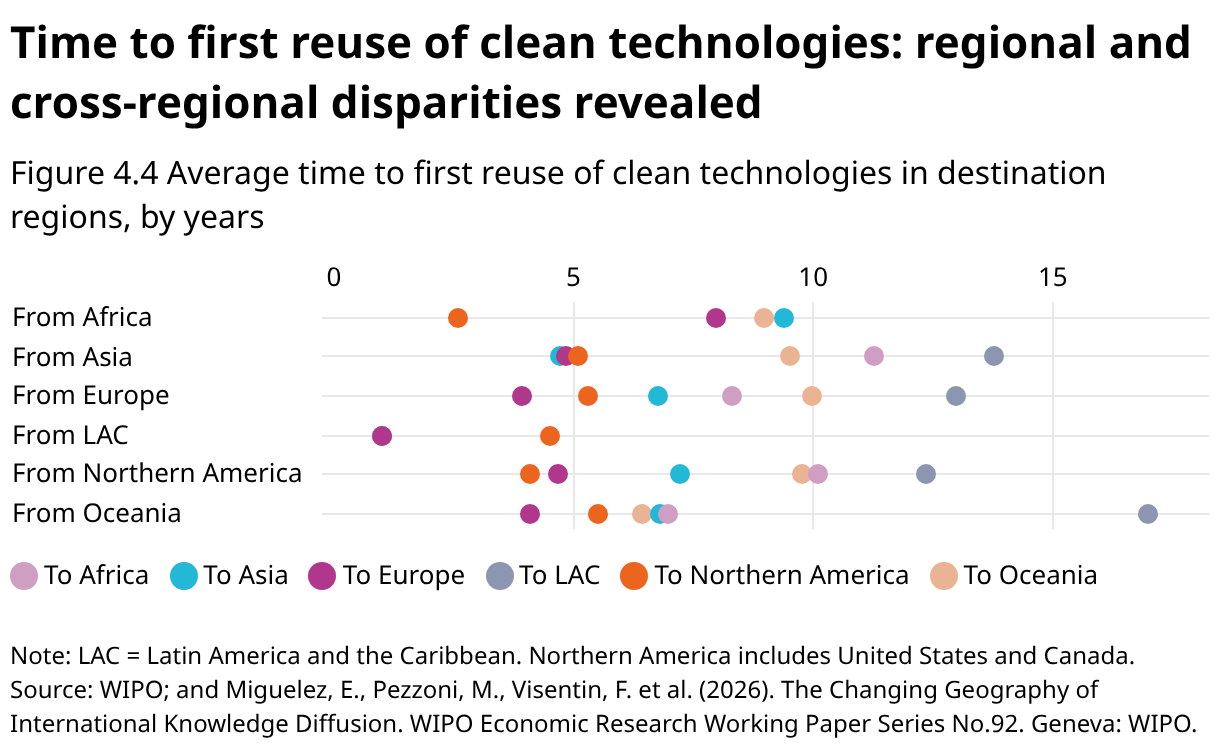
Figure 4.4 reveals significant disparities in how quickly green technology trajectories reach destination territories, with flows ranging from 1 to 17 years. Latin American clean technology trajectories diffuse to Asia and Europe within one year, yet the region experiences protracted delays of 12–17 years when receiving technologies from most other territories, with the Oceania-to-Latin America pathway exhibiting the maximum temporal barrier of 17 years. In contrast, Northern America demonstrates consistently efficient absorptive capacity, integrating incoming trajectories within 2.6–5.5 years of irrespective origin. This might reflect the presence of robust institutional frameworks and well-established collaborative networks.
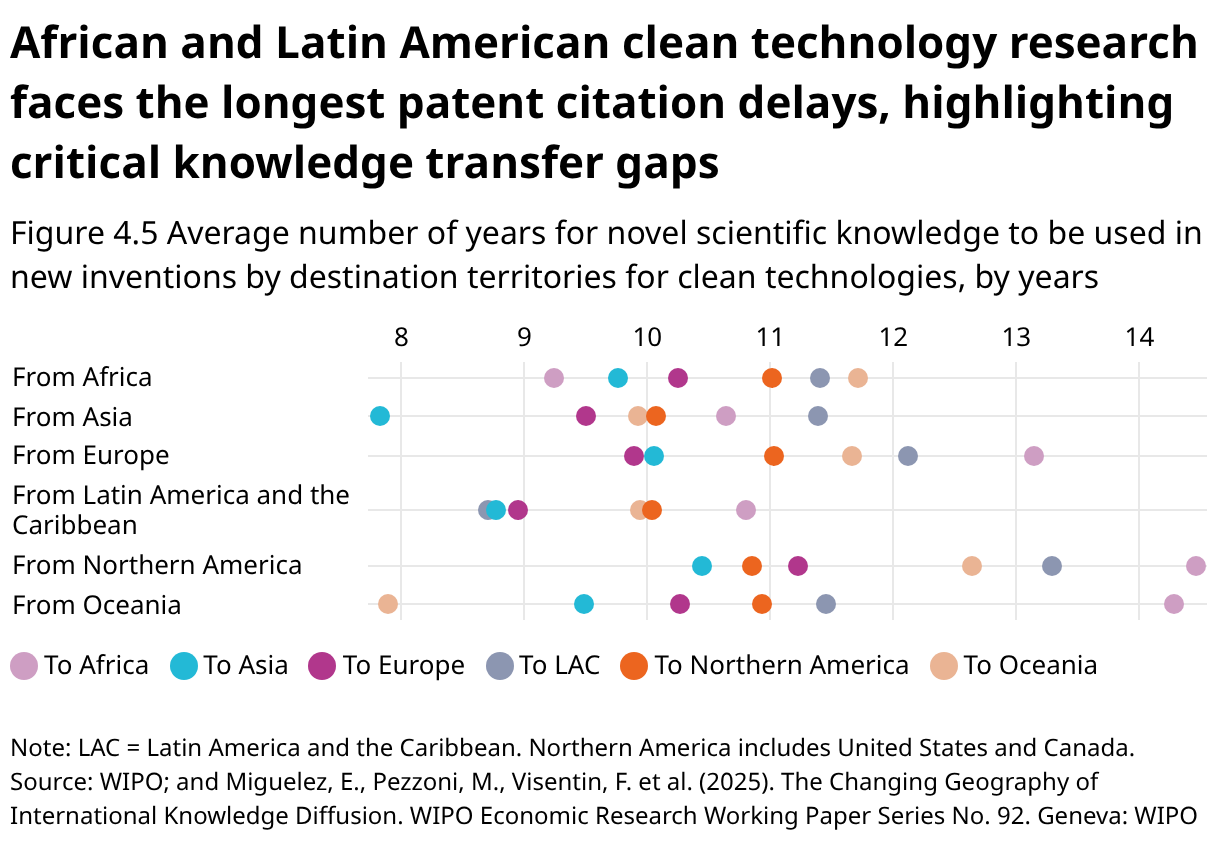
Clean technology diffusion from scientific publications to patents takes between 8 and 14 years, with clear regional patterns (see Figure 4.5). The fastest conversions occur within regions: Asian science reaches Asian patents in 7.82 years, while Latin American and Oceanian science converts to domestic patents in approximately from 8 to 9 years. This is confirmation that co-location matters.
Cross-regional knowledge flows are consistently slower, typically requiring between 10 and 13 years. Africa faces the most significant delays, with scientific papers taking between 13 and 14 years to be cited by African patents regardless of origin, suggesting weak links between research and innovation infrastructure rather than poor science quality. In fact, African and Latin American research is cited relatively quickly by patents in other regions (9–11 years), indicating that these regions produce valuable knowledge, but lack the institutional capacity to rapidly convert external science into local innovation. Northern American science takes longest to reach developing region patents (13–14 years), possibly reflecting relevance gaps or access barriers.
Several factors underpin this rise, notably the structural shifts across the three development phases of China's solar PV strategy.
Second, adoption outside of high-income countries remained limited until the early 2020s, though recent trends suggest this may be starting to change. Innovation trends mirror this transformation. Clean technology adoption has been concentrated in high-income economies and China, with middle- and low-income countries playing a much smaller role. This imbalance is beginning to shift as middle-income markets expand deployment through auctions, concessional finance and grid investments, and as some low-income countries see early projects. Surplus manufacturing capacity in China has further lowered global solar prices, making solar panels more accessible in regions such as Africa.
Drivers and barriers of clean tech diffusion: the case of solar photovoltaics, electric vehicles, and hydrogen
Multiple interconnected factors drive clean technology diffusion: inner technological characteristics, affordability and cost trajectories; supporting infrastructure networks; technical standardization; workforce capabilities; organizational absorptive capacity; and institutional and regulatory frameworks. These factors both create virtuous cycles that accelerate adoption as well as erect barriers that impede market penetration. This section examines how these factors specifically influence solar PV, EVs, and green hydrogen, illustrating distinct diffusion pathways and revealing transferable insights for accelerating the clean energy transition across diverse technological and market contexts.
Affordability
The deployment of wind, solar and EVs has been inseparable from the massive cost declines these technologies have experienced. Cost declines in clean technologies emerge from several reinforcing mechanisms: R&D delivers fundamental improvements; learning-by-doing reduces costs as firms gain production experience and economies of scale lower unit costs as output expands. These processes, often amplified by knowledge spillovers and growing markets, underpin the steep learning curve observed across many clean technologies. Nonetheless, a caveat of very rapid learning effects, as the ones observed in renewable energy, is that users may prefer to adopt a "wait-and-see" behavior, delaying diffusion if they anticipate cheaper and more efficient products will be soon available on the market.
For any technology to diffuse, it must meet the cost and quality requirements of specific users and applications, and compete effectively with incumbent alternatives. In the context of clean technologies, what matters for diffusion is whether clean technologies are able to compete on an equal basis with dirty (fossil-based) technologies. In practice, however, due to unpriced environmental externalities and established market dominance, fossil-based incumbents benefit from a competitive advantage. The absence of carbon pricing means that the social costs of pollution are not reflected in market prices, distorting investment decisions.
Solar PV
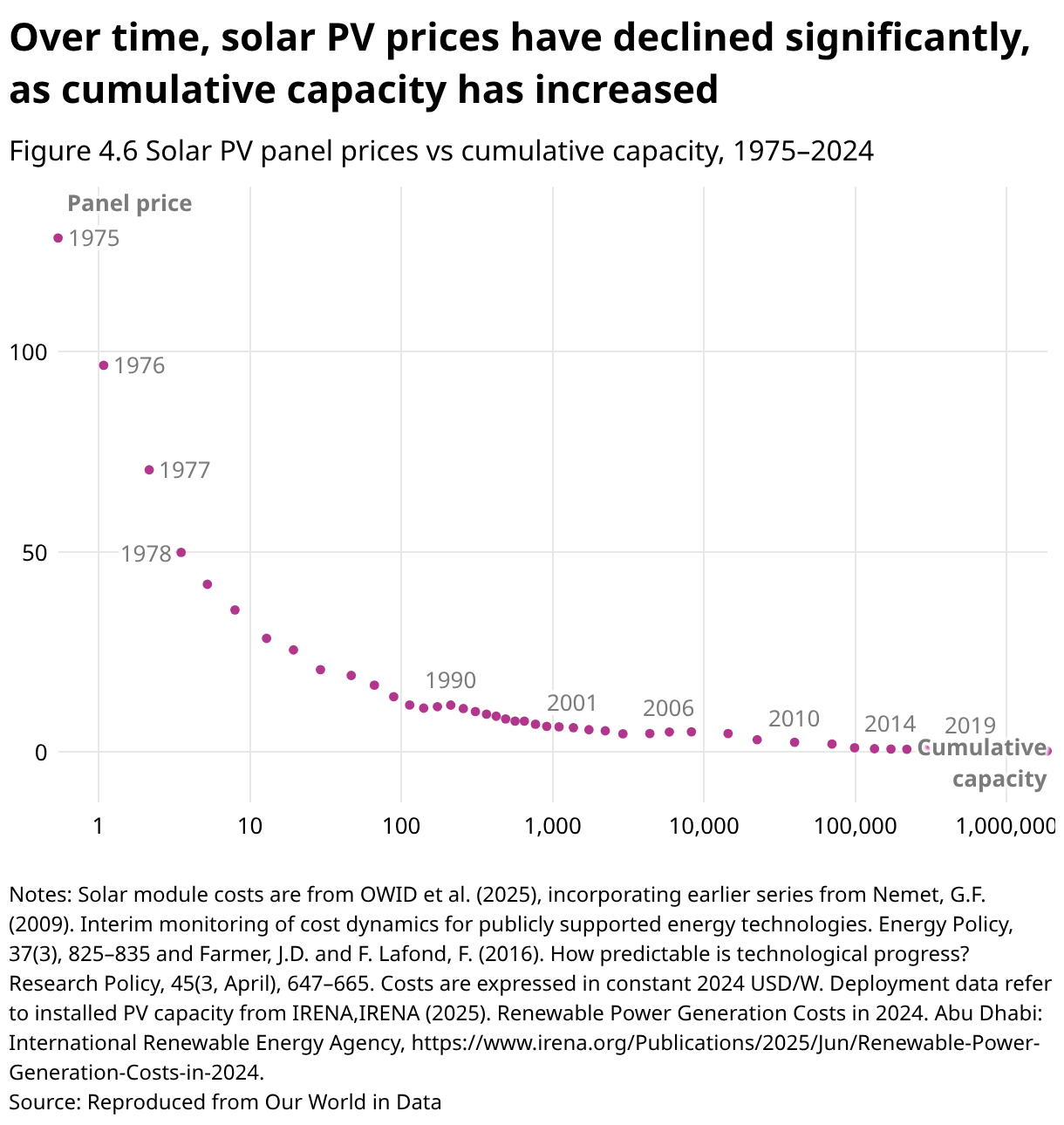
For instance, for solar PV, mass production for the Chinese market contributed to accelerating learning-by-doing and economies of scale, leading to a significant cost decline in solar PV prices as cumulative capacity increased, as depicted. The speed and extent of scale economies were greatly facilitated by the modular design
Regarding solar PV, trade restrictions imposed by the United States since 2014 and Europe over the 2013–2018 period have increased the cost of importing solar PV, leading to reduced solar adoption. There is evidence that following the 2014 US tariffs, prices for solar PV in the United States increased by about 10 percent relative to other markets, and by 20 percent following the 2018 tariffs, leading to reduced adoption of solar panels in that country.
EV
Affordability remains one of the most persistent barriers to broad-based EV adoption. While lifetime costs are often favorable, the purchase price of battery-electric cars in Europe and the United States remains between 10 and 50 percent higher than for comparable internal-combustion models, dampening uptake outside high-income households.
Hydrogen
By contrast, integral, site-specific systems in heavy industry – such as steel, cement or large reactors – face higher capital costs, longer project cycles, and fewer opportunities for iteration, which may help explain their slower and more uneven spread.
Cost is the primary constraint on clean hydrogen diffusion. Renewable and other low-carbon hydrogen remain several times more expensive than hydrogen produced from unabated fossil fuels (“grey” hydrogen), creating a persistent “green premium” (the higher production cost of low-carbon hydrogen relative to grey hydrogen). The gap is driven by three main factors: (i) electricity prices and electrolyzer utilization, (ii) capital intensity and stack durability, and (iii) midstream costs for compression, storage and transport. Electricity is the dominant cost component, but recent evidence also points to higher-than-expected electrolyzer costs. While falling renewable power costs improve the long-term outlook, the post-2022 decline in natural gas prices has reduced grey and blue hydrogen costs, widening the cost gap in the near term. Overcoming this premium will require more than subsidies alone; it calls for sustained R&D to improve efficiency, durability and catalyst design; demonstration programs to bring emerging pathways such as methane pyrolysis and nuclear electrolysis to market; and a scale-up of manufacturing and system integration to capture learning effects and economies of scale. In the case of green hydrogen, currently more than 99 percent of global hydrogen is produced from grey hydrogen, while low-carbon “blue" and renewable “green” pathways are still at the demonstration stage or at the early commercialization scale.
Infrastructure
In the diffusion of clean technologies, “systemic failures”
Indeed, the availability of complementary technologies and infrastructure is a constraint to solar diffusion ensuring the reliability of the electricity grid. Many complementary investments in high-voltage transmission lines, transmission networks (i.e., improving interconnections with other regions), grid stability equipment (i.e., voltage control equipment, advanced inverters), net metering systems (e.g., when prosumer policies allow consumers to inject the surplus of energy into that network), and improved distribution network (e.g., smart grids, sensors) are required to manage fluctuating supply and demand locally. Failure to invest fast enough in grid infrastructure impedes the efficient integration of solar PV systems.
In developing countries, a lack of complementary infrastructure to accommodate renewables into the electricity grid is particularly challenging. With a growing population gaining access to energy-using goods, demand for electricity across the developing world is projected to rise sharply in the coming decades, and choices of energy infrastructures in developing countries today will have significant implications both for economic development and global climate change.
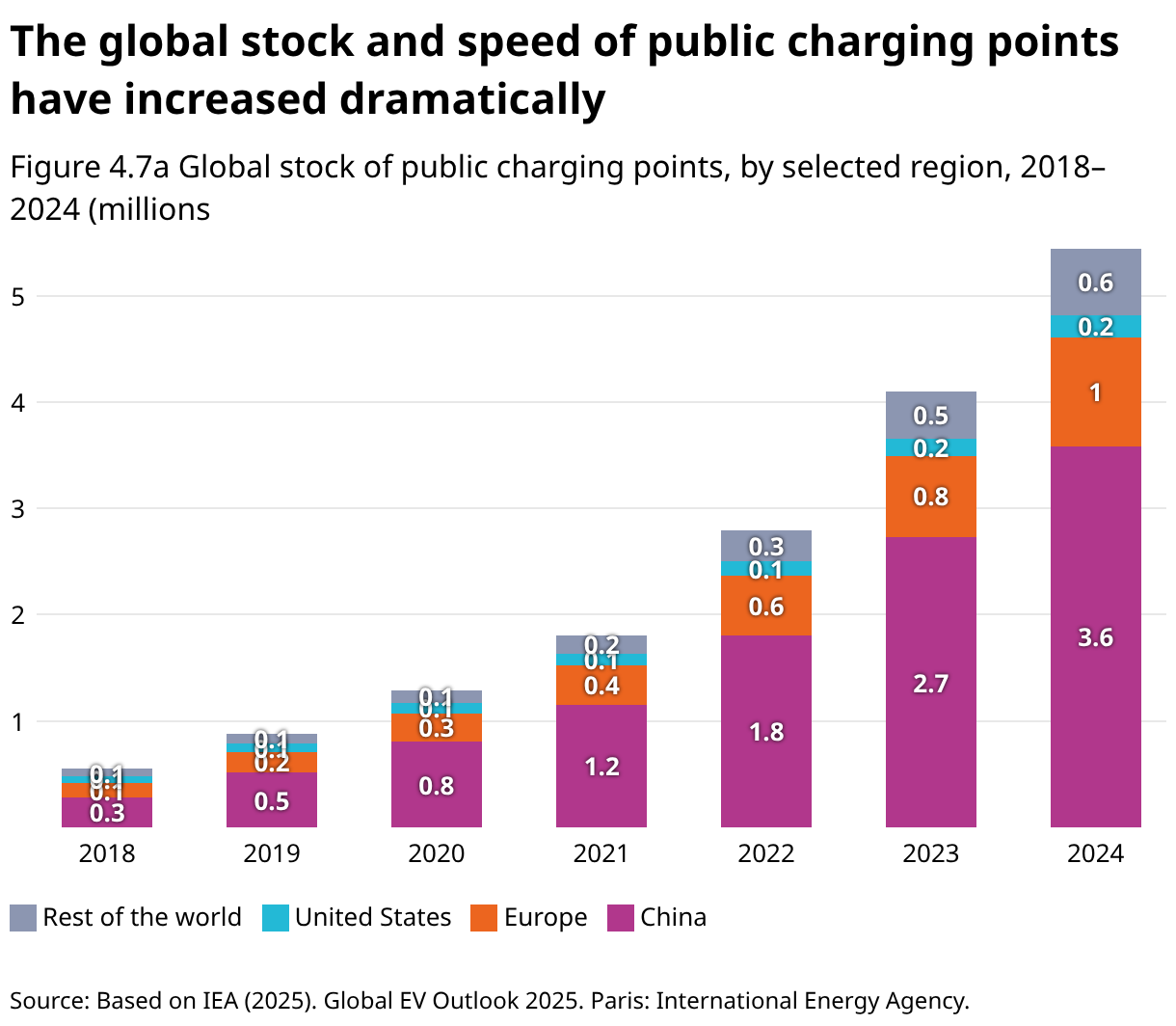
EVs require a dense network of charging infrastructure before mass adoption becomes viable, yet charging providers hesitate to invest before there is sufficient EV uptake. Charging infrastructure is a critical bottleneck for EV diffusion. As shown in Figure 4.7, the global stock of public charging points expanded from under 1 million in 2018 to more than 5 million by 2024. Most of the growth has been in slow chargers, though fast and ultra-fast options are increasing rapidly. Ultra-fast chargers (>USD 150~kW) are becoming more common, having grown by about 50 percent in 2024, but they still account for only around 10 percent of public fast-chargers worldwide. Cross-country comparison shows that those markets with a denser charging network achieve higher EV shares, highlighting the central role of infrastructure in enabling adoption. As shown, Norway’s success reflects generous incentives and sustained investment in public charging.

Hydrogen requires the building of new pipelines, and solar and wind energy can only scale if accompanied by investments in grid flexibility, storage and transmission. Dedicated pipelines, storage facilities and port infrastructure are scarce. Of the 56 countries with a hydrogen strategy, 43 consider infrastructure to be the most critical barrier.
Human capital and skills
Technology adoption depends on the availability of the skilled workers, engineers, and technicians who enable firms to absorb the tacit knowledge embedded in new innovations. Evidence shows that the mobility of scientists facilitates technology diffusion.
Beyond scientists and engineers, clean technology deployment requires a skilled workforce for installation, maintenance and repair. The spread of solar PV in the United States accelerated only after qualified installers became available.
Training programs, vocational education, reskilling, and workforce transition policies greatly contribute to expanding the pool of workers in clean technology sectors. In the context of developing countries, the key challenge is to build a base of skills that would allow these countries to leapfrog directly to clean technology adoption. Yet attracting workers in green jobs will depend crucially on job quality (i.e., level of informality, pollution exposure and wages) and may require complementary institutional changes to labor regulations, as well as the building up of specific education and training institutions.
Adopter behavior plays a critical role in clean technology diffusion.
Empirical evidence reveals substantial differences in the socio-demographic profiles of solar PV and EV adopter groups, which in turn shape distinct regional diffusion patterns. Spatial mismatches have significant implications for smart energy system integration. Scenarios examining regional EV–solar PV integration show that vehicle-to-grid (V2G) systems may not be viable in every region, as the geographical distribution of EV adoption does not necessarily align with areas of high solar PV deployment. This underscores the need for place-based approaches that account for local adopter characteristics, infrastructure constraints, and energy system configuration when designing policies to support clean technology diffusion.
Intellectual property
Intellectual property (IP) is a double-edged sword in the diffusion of clean technologies. Patents and related rights create incentives for firms to undertake costly R&D by offering temporary monopoly protection, but they also restrict access by design. In the climate context, this trade-off is especially acute: each year of delay in diffusion translates into higher cumulative greenhouse gas (GHG) emissions. The asymmetry lies less in the urgency of climate action – which is high everywhere – than in the geography of ownership and resources. Most clean-technology patents are held by entities in high-income countries, while lower- and middle-income countries face the great need for financial support and technology assistance to implement mitigation and adaptation at scale. This imbalance has made IP a recurrent point of contention in international climate negotiations.
Yet exclusivity also creates barriers. Licensing negotiations are costly, access is restricted, and adoption can be delayed. For developing countries, these challenges are compounded by limited financial resources and absorptive capacity. The solar sector illustrates the implications: namely, that as markets have matured and competition has intensified, disputes over incremental but valuable innovations have proliferated. First Solar’s recent lawsuits against rivals for alleged infringement of the “TOPCon cell” patents are emblematic of a broader rise in litigation;
Patent pledges have also attracted attention as an alternative to traditional exclusionary practices, but their practical impact on diffusion remains uncertain. Tesla’s 2014 announcement that it would not initiate lawsuits against good-faith users of its EV patents is the most prominent example. While hailed as a bold move to accelerate market growth, scholars debate whether such pledges represent genuine commitments, strategic branding or attempts to position one’s own technology as the dominant standard.
Most clean innovation over the past two decades has concentrated on electricity generation, storage and grids, with especially strong growth in the batteries and smart-grid technologies that underpin both power and transport. In contrast, innovation for hard-to-abate sectors remains small: CCS patenting, although growing, remains at roughly 100 patent families per year, and hydrogen activity was relatively strong in the early 2000s, but declined once lithium-ion batteries became dominant in transport.
Institutions, regulations and competition
The diffusion of clean technologies does not occur within a political vacuum. Because they displace entrenched industries, clean technologies generate both winners and losers, shaping the incentives of powerful actors to either support or resist change. Fossil fuel incumbents have strong incentives to defend existing revenue streams and protect sunk capital. Utilities, coal producers, and oil and gas majors have historically lobbied against carbon pricing, emissions standards and subsidy removal.
Environmental and land-use impacts of large solar farms further complicate deployment, especially in densely populated regions where local opposition is expressed through “Not In My Backyard” movements.
Political economy and trade
Political and industrial factors also shape how widely EVs are adopted. In the United States, EV adoption is highly polarized – meaning it is concentrated in certain political areas. About half of all new EVs registered between 2012 and 2023 were bought in just the 10 percent most Democrat-leaning counties. One-third were in the top 5 percent of the most Democratic-leaning counties.
Global EV overcapacity is beginning to distort markets. Aggressive expansion within China has pushed production beyond domestic demand, triggering intense price competition. In early 2024, average EV transaction prices fell by about 10 percent, as Tesla and BYD cut prices to protect market share. While this benefits consumers in the short run, prolonged price wars could erode profitability and discourage investment in further innovation.
Emerging policy tools: hubs and equity
Because technologies like rooftop solar and EVs are typically purchased by higher-income households, early subsidy programs disproportionately benefited the well-off. Policy design must therefore anticipate distributional consequences. The Inflation Reduction Act in the United States addressed this by linking EV tax credits to income and vehicle price thresholds, while electricity tariff reform or renewable support schemes in developing countries also need to balance equity and political feasibility.
Hydrogen hubs have emerged as a prominent policy idea, though more in theory than in practice. The concept is that co-locating production facilities, midstream infrastructure, and end-users within a single region could accelerate deployment. By synchronizing investment timelines and sharing assets, hubs are expected to help projects move from pilots to commercial scale. In this framing, the hub serves as a coordination device – reducing first-mover risk and providing a setting for technological learning.
The central question is whether hubs will prove effective in addressing the barriers outlined above. In principle, they are designed to reduce production costs through shared infrastructure, create credible demand signals via anchor off-takers, accelerate the build-out of pipelines and storage, and provide greater regulatory clarity through demonstration and certification. Yet at this stage the evidence base is thin. Most hubs are still at the announcement or early implementation stage, and it is too soon to know whether these mechanisms will work in either practice or at scale.
These uncertainties highlight the need for systematic evaluation as hubs move from concept to operation. Careful design will be essential: engaging communities, ensuring transparent emissions accounting, and aligning projects with long-term decarbonization goals. Comparative evidence across regions will be particularly valuable for assessing whether hubs deliver on their promise or simply repackage existing barriers in a new form.
The case studies of solar PV, EVs, and hydrogen illustrate the common mechanisms, as well as specificities, in the diffusion of these technologies . Early R&D and targeted demand–pull policies in lead markets initiated diffusion. China’s industrial strategy then scaled production, delivering steep cost reductions. Complementary inputs – grids, charging infrastructure, finance, and skills – were critical to sustaining adoption. Political economy headwinds slowed, but did not prevent progress where credible policy frameworks were in place.

Looking ahead: challenges and risks for the next phase of diffusion
This chapter reviewed how clean technologies have spread, why adoption has been uneven, and what this implies for the next phase of diffusion. Four stylized facts stand out.
Deployment has been rapid in power and light transport, but remains limited in hard-to-abate sectors.
China has become the central actor in both innovation and deployment.
Modularity has been decisive in driving cost declines and scaling.
Adoption outside high-income economies has begun only recently, though the potential is large.
The case studies of solar PV, EVs, and hydrogen reveal common patterns as well as specificities in how clean technologies successfully navigate infrastructure barriers, incumbent resistance, and coordination challenges.
There are pressing challenges that will shape the next phase of clean technology diffusion. Beyond the urgent task of accelerating adoption across developing countries, several risks are emerging. Heightened vulnerabilities in the supply of critical minerals raise new concerns about costs and affordability, while uncertainty around the transformative – and potentially disruptive – impacts of artificial intelligence (AI) introduce both opportunities and risks for clean innovation and deployment. At the same time, geopolitical tensions are redefining the global landscape and could redirect the trajectory of clean technology diffusion in unforeseen ways.
Future diffusion will hinge less on breakthroughs than on managing systemic risks. Mineral scarcity, AI expansion and political headwinds could raise costs and fragment markets, but innovation, diversification and credible policy can offset them. The balance is uncertain: in some contexts, these pressures may slow adoption, in others, they may catalyze new investment and coordination. Whether clean technologies keep scaling at the speed required will depend on how effectively institutions provide stability, openness and resilience.