
Introduction
The World Intellectual Property Report 2026: Technology on the Move reveals striking patterns in how technologies spread globally, with profound implications for economic development.
Since the Industrial Revolution, humanity has experienced unprecedented growth: global per capita income has increased more than tenfold and life expectancy has nearly doubled in developed nations. This reflects the power of creative destruction – successive waves of innovation replacing older technologies, enabling economies to produce vastly more with the same resources.
Creating innovative solutions does not automatically translate into economic growth or societal benefits. For new technologies to fulfill their potential, they must be adopted and effectively used by firms and households. This process, called technology diffusion, represents a crucial bridge between invention and impactful innovation, yet it is neither automatic nor guaranteed.
The World Intellectual Property Report 2026 aims to provide policymakers, business leaders, and researchers with a comprehensive understanding of technology diffusion. This knowledge can inform decisions about innovation policy, IP systems, and strategies for harnessing technological progress to improve economic outcomes and address global challenges.
Do new technologies diffuse faster?
The report draws on historical data spanning 250 years and cutting-edge analysis of recent digital innovations. It uncovers several transformative trends reshaping our understanding of technology diffusion. The report also provides a deep dive on how technologies diffuse within specific contexts by looking into three case studies: agricultural technologies, clean technologies, and digital technologies.
There is a striking acceleration of global technology adoption
Using a historical technology database, the report reveals an unprecedented acceleration in how quickly new technologies reach global markets. There has been a remarkable compression in the time between the invention of new technologies and their first use worldwide.
Historical technologies took decades to adopt, while new digital technologies are adopted within days
The telegraph and the automobile, invented in the 19th century, took around four decades to reach countries around the world. By contrast, generative AI – exemplified by ChatGPT's release in November 2022 – had users in virtually every country within days of becoming available online (see Figure 1). This unprecedented speed of diffusion reflects a ready-made global digital infrastructure enabling immediate worldwide access.

Developing economies show encouraging signs of convergence in their speed of adoption
Advanced economies consistently emerge as early adopters. Historically, these economies embraced new technologies 20–80 years in advance of the global average. However, this historical advantage has diminished over time. Virtually all newer technologies demonstrate converging adoption lags between advanced and developing economies.
The gap in intensity of use was first widening, now it is narrowing
Beyond adoption time lag, the report examines how intensively technologies spread within countries after initial introduction. Studying the intensity of technology use across countries reveals a fascinating historical reversal: from the 19th through much of the 20th century, the gap in the intensity of use between advanced and developing economies generally widened, with newer technologies showing larger differences in how intensively they were used, as illustrated in Figure 2.

The dramatic reversal relates to recent digital technologies revolution
Digital innovations like 3G and 4G show a converging usage intensity across countries, suggesting that today’s digital technologies offer greater opportunities for developing economies to narrow historical gaps. Regional analysis reveals that while Africa exhibits the widest technology gaps, followed by Latin America and then Asia, all three regions show such gaps narrowing for recent technologies. Figure 3 shows how Asia stands out not only in having narrowed technology gaps substantially, but in some cases even exceeding advanced economy usage levels.

The case study on digital technologies shows that Africa managed to surf this digital wave to catalyze unique local innovations, even overcoming economic and infrastructure constraints. African innovations like mobile money services (e.g., M-Pesa in Kenya) and off-grid energy solutions have benefited global markets. The adoption of digital technologies can also improve the local socioeconomic conditions. In rural Africa, mobile connectivity has reduced gender wage gaps, narrowing when in closer proximity to 2G+ networks.
While the aggregate picture tells a positive story, especially about newer digital technologies, there are still many challenges in making technology diffusion work in developing economies. Digital inequality in developing economies operates across many dimensions: infrastructure gaps, technology quality differences, usage gaps arising from limited digital literacy, and affordability barriers. These divides create a dual digital landscape where advanced economies leverage high-value innovation while others depend on simpler solutions.
Infrastructure vulnerability and limited access to the best mobile network technology constrain Africa. High-capacity submarine cables carry over 99 percent of international data traffic connecting countries worldwide, where cable damage represents a top common cause of internet shutdowns with substantial economic losses. Africa, especially Sub-Saharan Africa, faces an infrastructure vulnerability that disproportionally disrupts the continent’s connectivity (see Figure 4). Moreover, Africa still has limited access to the atest generation mobile networks, with only 12 percent of Africans having 5G access in 2023 against 74 percent of Europeans.

Beyond the digital revolution: technology characteristics still shape adoption timelines. Different technologies display distinct adoption patterns. Even nowadays, genetically modified crops require long development periods and must be adapted to local soil, climate and pests. On average, it takes about 16.5 years from discovery to regulatory approval. Similarly, historical evidence shows clean energy technologies typically require decades before reaching just one percent of market share. Figure 5 shows how nuclear power achieved this within 20 years in France, while direct reduced iron took a full six decades. Even solar photovoltaic (PV) needed more than half a century to reach a material market share. These differences reflect variations in modularity, capital intensity, infrastructure requirements, and regulatory frameworks, and provide caution against one-size-fits all policy approaches.
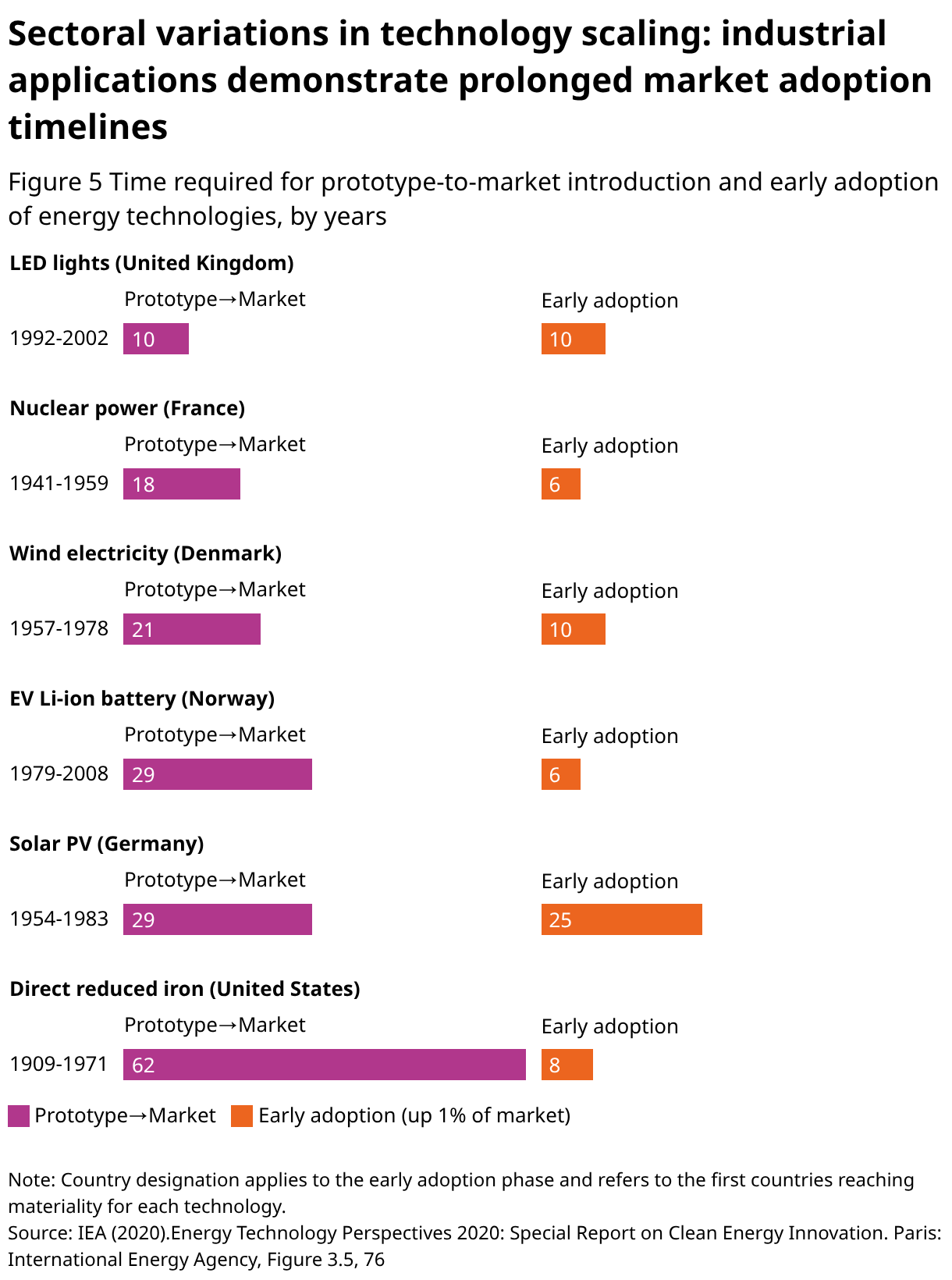
Regulatory frameworks are a crucial factor in the speed of technological adoption. Regulatory frameworks play a decisive role in genetically modified crop adoption. For example, genetically modified cotton reached 80 percent cropland coverage in the United States in roughly 10 years, while South Africa achieved this milestone in five years partly due to streamlined approval processes (see Figure 6).

Is the technological knowledge behind new inventions spreading more internationally?
Technological knowledge is the set of problem-solving principles, techniques, and capabilities that enable the creation, improvement, and application of products, processes, or services. Innovation ecosystems with more diverse technological knowledge can produce more advanced and breakthrough inventions.
Technological knowledge flows have economic impact. Evidence shows a clear link between international knowledge spillovers – measured through indicators like patent-to-patent citations – and improvements in worker productivity, industry performance, and national income. Developing economies particularly benefit by adopting and adapting knowledge from more advanced countries, which helps narrow productivity gaps and accelerate economic development.
The report uses comprehensive analysis of patent citations, scientific references, and reuse of breakthrough inventions – novel combinations of existing technical knowledge. The report’s analysis spans five decades and reveals a fundamental transformation in the diffusion of technological knowledge within the global innovation landscape.
International flows of technological knowledge have doubled in speed. The time needed for technological knowledge to spread internationally has reduced dramatically, according to every measure. Over the past 50 years, the time needed to observe the first international patent citation has halved. This systematic acceleration has occurred across all technological fields (see Figure 7).

Are geographical barriers to knowledge flows at an end?
The gap between the speed of knowledge flows within countries and across countries has all but vanished. In 1988, international patent citations took on average 12 percent longer than domestic citations. By 2020, the difference between the two had essentially disappeared, suggesting that geography is no longer a meaningful barrier to knowledge flows speed.
There is a persistent dominance of innovation leaders
Despite faster global diffusion of technological knowledge, analysis reveals a striking concentration in a handful of economies. Primarily, the United States, Western Europe and Japan dominate both as contributors to and beneficiaries of international flows of technological knowledge.
Deep tech revolution takes time
There are fascinating patterns in how scientific knowledge is sourced for deep tech innovations, such as biotechnology, artificial intelligence (AI), quantum computing, and advanced materials inventions that are built upon advanced basic science. Yet, scientific articles take an average of 10 years to receive a first patent citation – much longer than patent-to-patent citations. This extended timeline reflects the complex process of transforming fundamental scientific discoveries into industrially viable deep tech applications.
Deep tech champions source globally
Scientific knowledge sourcing is even more concentrated than general patent citations, in just a handful of economies. The United States, Western Europe and Japan absorb scientific knowledge from virtually every global source available. Technologies with higher scientific content travel longer distances and are more likely to generate new inventor clusters worldwide.

China joins the exclusive group of deep tech leaders
China emerges as the most dynamic player in this space, dramatically increasing its openness to international science. Chinese citations of US scientific papers have grown from just 2.5 percent of papers published between 1985 and 1995 to 8.8 percent for papers published between 2016 and 2022 – making China more open to international science than Japan across all source regions (see Figure 8).
Only a handful of leading economies can reuse the knowledge behind breakthrough inventions
New analysis of how novel combinations of existing technical knowledge spread globally shows that most countries build primarily on domestic breakthrough inventions, but only innovation leaders demonstrate the exceptional ability to rapidly adopt and build upon foreign inventions.
Leading innovation ecosystems reuse knowledge from foreign breakthrough inventions faster
The United States is three times faster at replicating a breakthrough invention originating from India than India itself. For example, India takes on average 11 years to re-invent based on an Indian-originated invention, while it takes the United States only three years (see Figure 9).
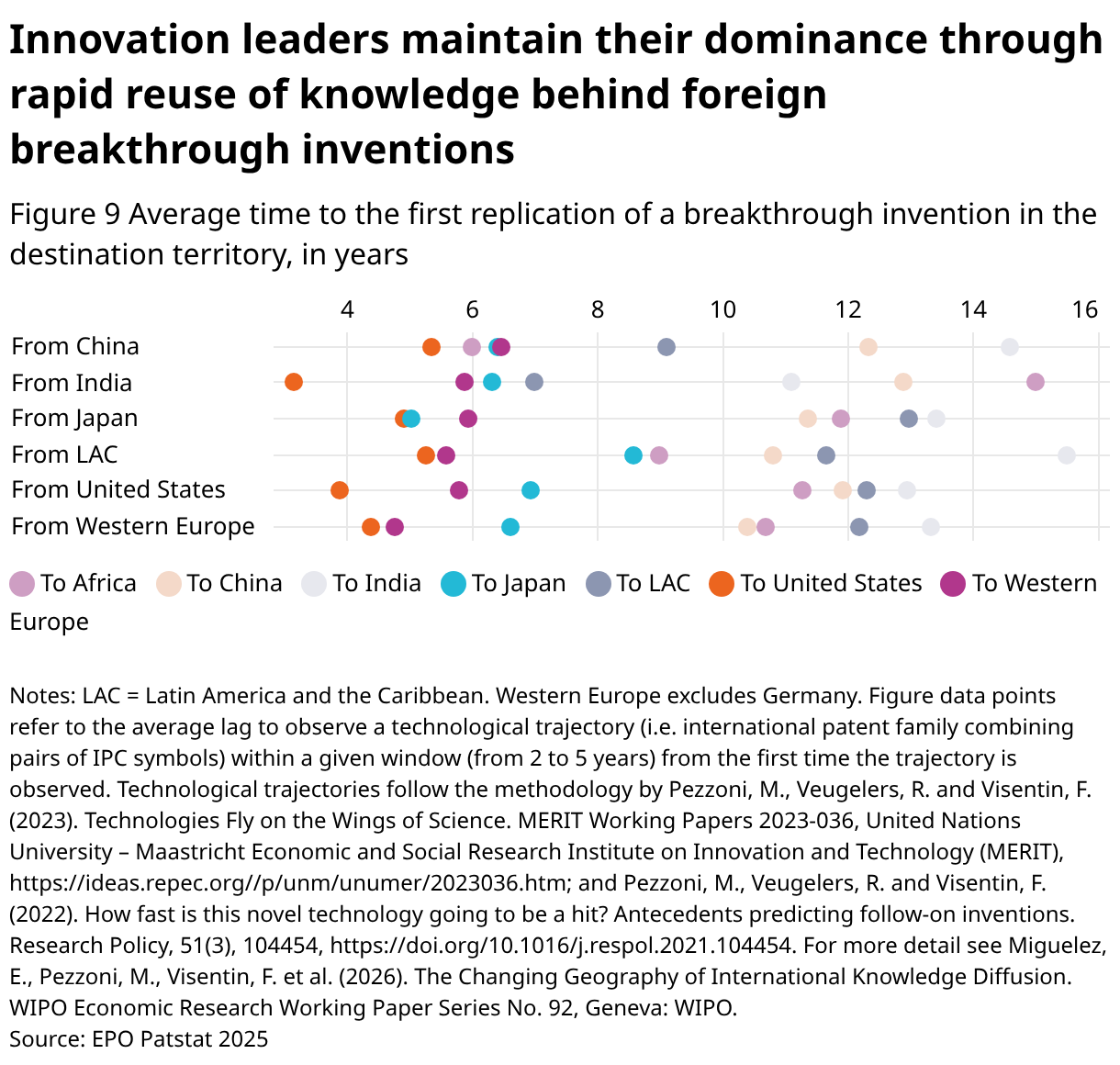
Leading innovation ecosystems reuse knowledge from foreign breakthrough inventions more intensively
Even more dramatically, the United States reuses 70 percent of Chinese-originated novel technologies within five years of invention, whereas China reuses less than 5 percent of US technologies within the same timeframe (see Figure 9).

Developing economies struggle to benefit from global knowledge flows
While developing economies may generate innovative technologies, they show marginal participation in international technological knowledge flows. For instance, Africa has a limited ability to reuse foreign technological knowledge, whereas the technical knowledge behind African breakthrough inventions is re-used extensively in developed economies: 100 percent is reused in Western Europe, 96 percent in the United States, 92 percent in Japan, and 81 percent in Germany (see Figure 10).
Implications for global development and policy
These findings carry profound implications for global development strategies. The acceleration in diffusion speeds and convergence in usage intensity for recent technologies suggest unprecedented opportunities for developing economies to catch up or even leapfrog traditional development stages.
There are four critical factors affecting technology diffusion:
Technology characteristics matter fundamentally. Technologies with immediate benefits spread faster than complex, costly ones requiring complementary investments. Infrastructure requirements prove particularly crucial – technologies leveraging existing infrastructure (like large language model (LLMs) using the internet) diffuse rapidly, whereas those requiring new networks (like electric vehicles needing charging stations) face significant delays.
Information speed has changed knowledge diffusion dramatically. While 19th-century knowledge traveled only as fast as it could be transmitted by traditional mail and newspapers, today’s digital platforms enable near-instant access to technical information globally.
Technology diffuses faster where it can be absorbed easily. The absorptive capacity – the ability to understand, adapt and apply new knowledge – varies dramatically across users and contexts. Complex technologies requiring local adaptation demand substantial technical know-how, built through education, training, research institutions, and global knowledge networks.
Public policy and institutions can shape diffusion. Regulatory and institutional frameworks provide complementary infrastructure investment, standardization and interoperability frameworks, safety regulations and IP systems that balance innovation incentives with technology access.
However, realizing this potential requires addressing persistent capability gaps. Countries showing above-predicted GenAI usage demonstrate that appropriate policies and investments enable the rapid adoption of frontier technologies. Success depends on building absorptive capacity and innovation capabilities through education and skills development, investing in complementary infrastructure, and creating institutional frameworks that support technology adaptation and innovation.
For policymakers, analysis serves to emphasize that encouraging invention alone is insufficient. Equal attention must be focused on creating conditions that enable rapid, broad technology diffusion through infrastructure investment, human capital development, access to financing, appropriate regulatory frameworks, and IP systems balancing innovation incentives with technology access.
This report ultimately demonstrates that while technology diffusion has accelerated dramatically and shows encouraging convergence trends, realizing the full potential of new technologies for global development requires deliberate, coordinated policy action addressing the multiple factors that determine diffusion outcomes.