
Introduction
This chapter explores the patterns and trends of international technological knowledge diffusion over time.
Innovation drives technological progress. New knowledge helps companies produce goods more efficiently and create better, more varied products. This process fuels economic growth and helps countries to develop. Economic evidence shows that differences in productivity growth explain most of the income gaps between countries during the 20th century.
Why do these productivity differences persist? As discussed in Chapter 1, innovation is not equally distributed across countries or regions. However, technology spreads more easily over long distances when it is built into goods and equipment ready for use. The spread of major technologies was crucial for the Industrial Revolutionʼs diffusion across countries and shaped the distribution of income per capita over the past two centuries.
Yet, technological knowledge is not always built into physical products. Much of it remains tacit – existing as unwritten expertise rather than codified information. This makes technological knowledge harder to spread over long distances unless the people who hold this knowledge move or the knowledge gets written down and shared with others. Tacit knowledge spreads mainly through face-to-face interactions and specialized professional networks that tend to be geographically concentrated.
Can new communication technologies change how quickly technological knowledge spreads? Despite advances in remote collaboration tools and long-distance communication, geographical distance still affects the diffusion of ideas, knowledge and technological change.
Technological knowledge flows have economic impact. Despite barriers to cross-border movement, international knowledge diffusion plays a crucial role in shaping global economic patterns.
Understanding international technological knowledge diffusion is essential for policymakers who want to promote innovation-driven growth, reduce global inequality and boost productivity. As the world evolves, the pace and direction of knowledge flows will remain central to discussions about economic development and global competitiveness.
The measurement of knowledge diffusion remains a challenge for innovation scholars.In his 1991 book Geography and Trade, Paul Krugman noted that knowledge spillovers “leave no paper trail by which they can be measured and tracked.” This observation challenged innovation economists to find ways to measure these invisible knowledge flows, spurring decades of research to develop empirical methods for tracking knowledge spillovers.
Using intellectual property data as a lens, this chapter maps international technological knowledge diffusion and examines how patterns have changed over time. Patent documents make technological knowledge diffusion observable by recording inventions and categorizing them by technology areas through systems like the International Patent Classification (IPC).
The chapter has two main objectives: first, to map international technological knowledge diffusion and track changes over time using intellectual property (IP) data; second, to examine these findings from the viewpoint of economic literature on the main channels for international technological knowledge diffusion.
The analysis takes a global perspective and uses multiple approaches to track technological knowledge diffusion documented in patent and related data. Box 2.1 discusses methods for measuring international technological knowledge diffusion.
In his 1991 book Geography and Trade, Paul Krugman asserted that knowledge spillovers are an agglomeration force that leave “no paper trail by which they can be measured and tracked.” This statement challenged economists directly, spurring a decades-long quest to find empirical proxies for this invisible phenomenon.
Innovation economists have since developed several metrics, mostly based on patent data, to capture technological knowledge diffusion. These are the main approaches:
Patent locations show where new technological knowledge appears over time by tracking the geographical origins of applicants or inventors in patent filings.
Patent citations represent the most common approach for tracing technological diffusion. When a new patent cites an earlier one, this represents a potential knowledge flow from the older invention to the newer one. Patent citations dominate strategies for making invisible knowledge flows visible, despite ongoing debates about strategic considerations and institutional constraints in patent systems.
(7)Thompson and Fox-Kean (2005) revealed that the technological classes used in Jaffe et al (1993)'s matching procedure were too coarse, potentially conflating technological proximity with geographic proximity and invalidating their findings of localization. Thompson (2006) argued that citations added by applicants (including inventors and attorneys) are more likely to represent genuine knowledge flows than those added by patent examiners. This initiated a literature focused on disentangling citation origins. However, this applicant/examiner distinction is itself problematic: applicants often act strategically, sometimes withholding citations, while examiners outside the United States operate under different rules (Lampe, 2012). See, Jaffe, Adam B., Trajtenberg, M. and Henderson, R. “Geographic localization of knowledge spillovers as evidenced by patent citations.” The Quarterly Journal of Economics 108, no. 3 (1993): 577–98. https://doi.org/10.2307/2118401; Lampe, R. (2012). Strategic citation. The Review of Economics and Statistics, 94(1), 320–33, https://doi.org/10.1162/REST_a_00159; Thompson, P. (2006). Patent citations and the geography of knowledge spillovers: Evidence from inventor- and examiner-added citations. Review of Economics and Statistics, 88(2), 383–88, https://doi.org/10.1162/rest.88.2.383; and Thompson, P. and Fox-Kean, M. (2005). Patent citations and the geography of knowledge spillovers: A reassessment. The American Economic Review, 95(1), 450–60. The diffusion trajectories of breakthrough inventions assume that novel breakthrough technologies emerge when existing components are combined for the first time in a new patent. Researchers map the knowledge diffusion trajectories using initial combinations of patent classification codes (e.g., IPC) and tracking their subsequent re-appearance over time and geography.
(8)Following the assumption that breakthrough technologies emerge when pre-existing components combine for the first time (Arthur, 2009; Fleming, 2001; Verhoeven et al., 2016), Pezzoni et al. (2022, 2023) use patent classification codes (e.g. IPC or CPC codes) in patent data to build proxies for the pre-existing components at the base of a technology. See Arthur, W.B. (2009). The Nature of Technology: What It Is and How It Evolves. Simon and Schuster; Fleming, L. (2001). Recombinant uncertainty in technological search. Management Science, 47(1), 117–32, https://doi.org/10.1287/mnsc.47.1.117.10671; Verhoeven, D., Bakker, J. and Veugelers, R. (2016). Measuring technological novelty with patent-based indicators. Research Policy, 45(3): 707–23; Pezzoni, M., Veugelers, R. and Visentin, F. (2023). Technologies Fly on the Wings of Science. MERIT Working Papers 2023-036, United Nations University – Maastricht Economic and Social Research Institute on Innovation and Technology (MERIT), https://ideas.repec.org//p/unm/unumer/2023036.html; and Pezzoni, M., Veugelers, R. and Visentin, F. (2022). How fast is this novel technology going to be a hit? Antecedents predicting follow-on inventions. Research Policy, 51(3), 104454, https://doi.org/10.1016/j.respol.2021.104454 Patent citations to scientific articles track the science-to-technology pipeline that creates “deep tech” innovations.
(9)See Ahmadpoor, M. and Jones, B.F. (2017). The dual frontier: Patented inventions and prior scientific advance. Science, 357, 583–87; Arora, A., Belenzon, S. and Suh, J. (2021). Science and the Market for Technology, NBER Working Paper Series No. 28534, Cambridge, MA: National Bureau of Economic Research, https://doi.org/10.3386/w28534; Marx, M. and Fuegi, A. (2020). Reliance on science: Worldwide front-page patent citations to scientific articles. Strategic Management Journal, 41, 1572–94. https://doi.org/10.1002/smj.3145; and Marx, M. and Fuegi, A. (2022). Reliance on science by inventors: Hybrid extraction of in-text patent-to-article citations. Journal of Economics & Management Strategy, 31(2), 369–92. https://doi.org/10.1111/jems.12455. These citations reveal how fundamental scientific discoveries translate into breakthrough technologies in highly science-based fields like biotechnology, artificial intelligence, quantum computing and advanced materials.Patent families trace knowledge diffusion by connecting where inventors first file patents and their subsequent international extensions.
(10)See Martínez, C. (2011). Patent families: When do different definitions really matter? Scientometrics, 86, 39–63, https://doi.org/10.1007/s11192-010-0251-3; and Martinez, C. (2010). Insight into Different Types of Patent Families. OECD Science, Technology and Industry Working Papers No. 2010/02. Paris: OECD Publishing,https://doi.org/10.1787/5kml97dr6ptl-en These extensions reflect territories where applicants intend to enforce patent protection.Specialization patterns in trade, science and patents show that countries consistently diversify into products, technologies and scientific fields related to their existing expertise, suggesting knowledge diffusion between technologically neighboring regions.
(11)See, Hidalgo, C.A., Klinger, B., Barabási, A.-L. et al. (2007). The product space conditions the development of nations. Science, 317, 482–87; Bahar, D., Hausmann, R. and Hidalgo, C.A. (2014). Neighbors and the evolution of the comparative advantage of nations: Evidence of international knowledge diffusion? Journal of International Economics, 92(1), 111–23, https://doi.org/10.1016/j.jinteco.2013.11.001; Balland, P.-A., Boschma, R., Crespo, J. et al. (2018). Smart specialization policy in the European Union: Relatedness, knowledge complexity and regional diversification. Regional Studies, 1–17 ; and Petralia, S., Balland, P.-A. and Morrison, A. (2017). Climbing the ladder of technological development. Research Policy, 46, 956–69, https://doi.org/10.1016/j.respol.2017.03.012. Other IP data include recent experiments with trademark data and other IP indicators to map innovation geography and knowledge diffusion.
(12)See Castaldi, C. (2020). All the great things you can do with trademark data: Taking stock and looking ahead. Strategic Organization, 18(3), 472–84, https://journals.sagepub.com/doi/full/10.1177/1476127019847835; Castaldi, C. and Drivas, K. (2023). Relatedness, cross-relatedness and regional innovation specializations: An analysis of technology, design, and market activities in Europe and the US. Economic Geography, 99, 253–84; and Castaldi, C., Abbasiharofteh, M. and Petralia, S. (2019). From Patents to Trademarks: Towards a Concordance Map. EPO-ARP Programme Report.
Advantages of patent data: Patent data offer rich, quantifiable and publicly available records of inventive output. Patents are classified by technology, include detailed geographical information and span long time periods, allowing researchers to track innovationʼs geography, timing and nature globally.
Limitations of patent data: Not all innovations get patented; patenting propensity varies across industries and countries, and patent quality differs significantly. Patent citations can partially address these issues but introduce other complications, such as questions about who inserts citations in the patent documents.
Despite being imperfect measures of knowledge spillovers, patents and their citations data provide useful quantifiable benchmarks that can be easily measured and analyzed. They remain the primary tool in empirical literature on knowledge diffusion, both within and across countries.
When knowledge diffusion leaves a trail in patent citations
Innovation economists often analyze how technological knowledge spreads by examining the geographic location of patents and their citations.
Patent data offer unique research advantages. Patent data provide a rich, quantifiable and publicly available record of inventive activity. Patents that cite other patents are carefully classified by technology and include detailed information on inventors and applicants. Patents are filed over long time periods, allowing researchers to track the geography, timing and nature of innovation worldwide.
Interpreting patent citations requires caution. Patent citation data have notable limitations that require careful interpretation.
Patent-to-patent citations can reveal knowledge flows. Patent-to-patent citations represent the main empirical approach for observing the “paper trail” of international technological knowledge diffusion.
Technological knowledge is diffusing faster
Analysis of international patent citation flows clearly shows that technological knowledge spreads faster today than in the past. All patent citation measures indicate that technologies are accelerating their diffusion paths.
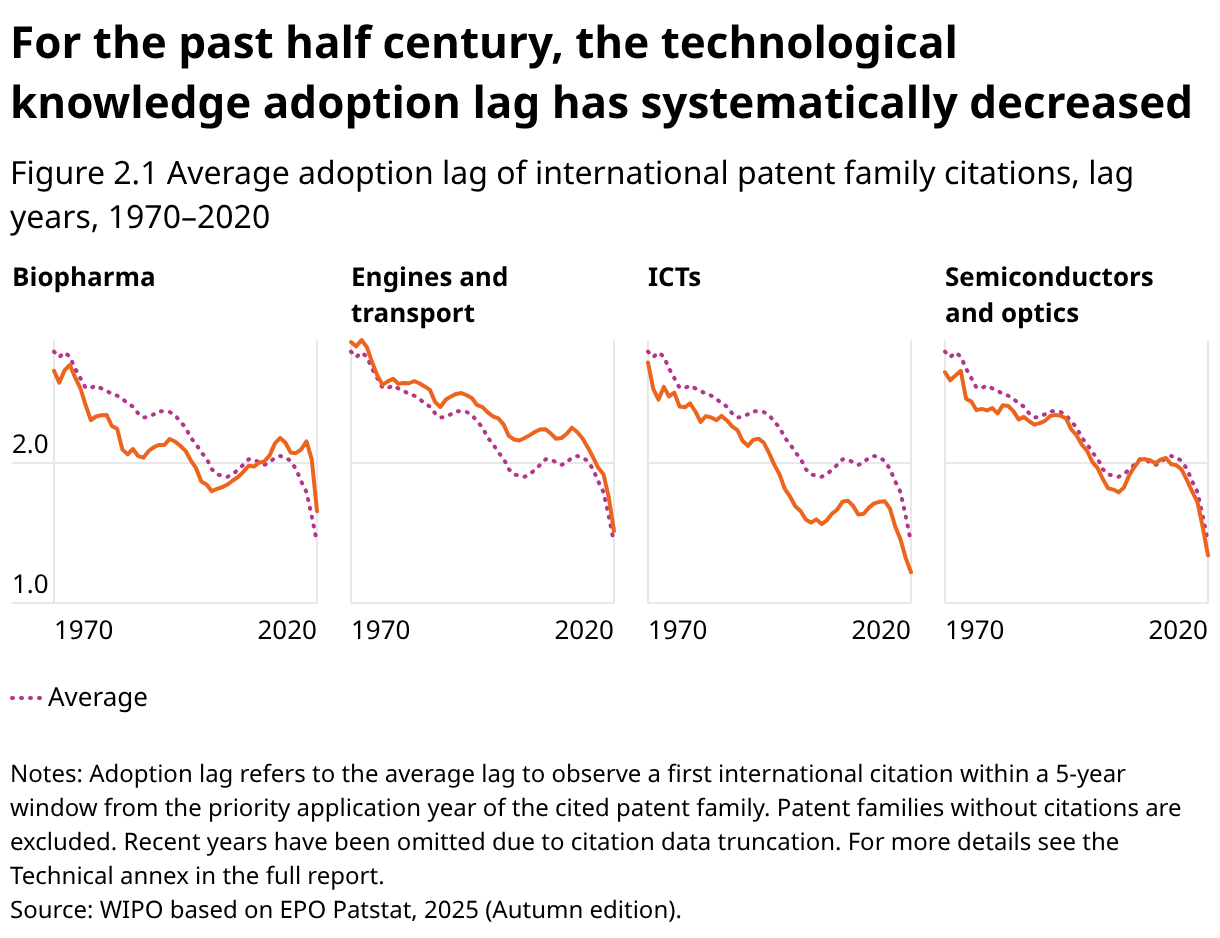
International adoption times have halved. Figure 2.1 shows that the international adoption lag – measured by the first international citation to an existing patent family – now takes half the time it took 50 years ago. In the early 1970s, the average patent family received its first international citation around 2.8 years after filing. By 2020, this international adoption lag had fallen to less than 2 years. The decline has been continuous, with one notable exception: from the mid-2000s to mid-2010s, the adoption lag stabilized at around 2 years. This period coincides with rapid increases in patenting by China and other emerging players, which significantly increased the number of patent documents not immediately available in English.
All technology fields show faster diffusion. The international adoption lag reduction occurs across all technological fields, although average lag times differ. Figure 2.1 breaks down adoption lags for four selected technology areas: biopharma; engines and transport; information and communication technologies (ICTs); and semiconductors and optics. All four follow the general trend toward faster adoption.
ICTs consistently show shorter adoption lags than average, with this advantage growing over time. The gap started at just 5 percent in 1970 and reached 15 percent by 2020. Engines and transport show the opposite pattern, with adoption lags only 2 percent slower than average in 1970 but 6 percent slower by 2020.
Biopharma technologies follow a distinctive path. They started with adoption lags 5 percent faster than average, improving steadily until the early 2000s, when they peaked at 10 percent faster. However, this trend reversed in the early 2010s, reaching a peak of 25 percent slower than average.
Advances in digital technologies can explain the faster diffusion. This long-term trend can largely be attributed to remarkable advances in communications and information technologies during the same period. Patent documents shifted from paper-only publication to primarily digital formats. Researchers and inventors gained increasing access to patent information through online databases that offered automatic translation into multiple languages. Communication methods evolved from time-consuming traditional mail and expensive phone calls to virtually free, instant video calls, messaging and file sharing on portable devices.
The gap between national and international knowledge flows is narrowing
The trends toward shorter adoption lags reflect what scholars call the beginning of a knowledge economy.
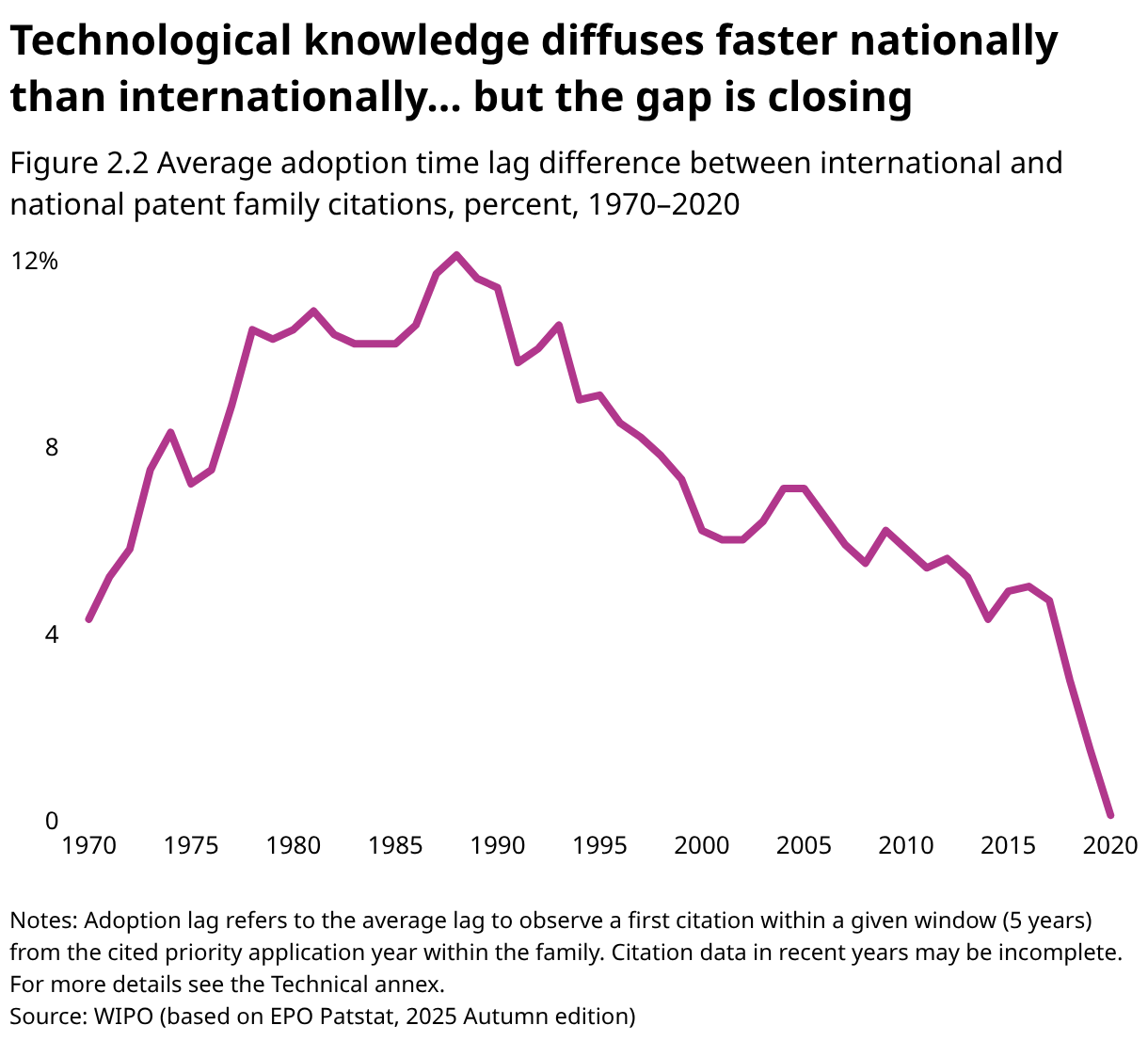
Distance still matters, but less than before. Both research theory and evidence confirm that distance affects knowledge diffusion. Knowledge spillovers occur more easily when the distance between origin and destination is shorter. Figure 2.2 illustrates this by showing the difference in adoption lags between national and international patent citations. As expected, patent citations happen faster within national boundaries than across them.
However, the international gap is disappearing. Since the late 1980s, this gap has been closing steadily. The difference peaked in 1988, when the average international adoption lag was 12 percent slower than the average national adoption lag. Since then, the gap has reduced significantly. By the early 2010s, the difference was only around 5 percent and by 2020 it appears to have virtually disappeared.
This convergence suggests that geographical barriers to knowledge diffusion are weakening over time. The same technological advances that have shortened overall adoption times have also made international knowledge sharing nearly as fast as domestic knowledge sharing.
Advanced economies absorb foreign knowledge faster
Knowledge diffusion varies significantly across countries. The speed of technological knowledge diffusion is not evenly distributed globally. While international diffusion has accelerated overall, clear differences remain in how quickly knowledge moves between different countries and regions.
Domestic knowledge always travels fastest. Figure 2.3 shows the average time between a patentʼs filing date and its first citation elsewhere. Geography clearly matters. In every case, inventors cite technologies from their own country faster than foreign inventors cite the same technologies. This pattern holds even among advanced innovation economies. For example, US applicants cite their own technologies twice as fast as German or Chinese applicants cite US patent families, and three times faster than applicants in Japan or the Republic of Korea. The reverse pattern also applies. Applicants from Germany, the Republic of Korea, Japan and China cite their own technologies 2.5, 4, 5 and 6 times faster than US applicants cite technologies from these countries, respectively.
Advanced economies absorb foreign knowledge faster. Substantial differences exist in diffusion speeds along different international knowledge corridors. High-performing innovation economies – including the United States, East Asian countries and Western European nations – benefit from faster inward flows of foreign technological knowledge from almost every other region compared to how quickly the rest of the world absorbs their knowledge. In contrast, Africa, Latin American and Caribbean countries and Eastern Europe typically experience slower inward knowledge diffusion.
Knowledge flows favor leading innovation ecosystems. US applicants systematically take less time to cite technologies from other countries than those countries take to cite US technologies. This pattern suggests that leading innovation economies have developed stronger capabilities to identify, absorb and build upon foreign technological advances.

A few leading countries both contribute and absorb most global knowledge
Speed does not tell the whole story about knowledge volumes. The previous analysis shows how quickly economies become aware of technologies created elsewhere, indicating their innovation development and how actively they are sourcing for specific technologies. However, it reveals little about the actual volume of knowledge that economies contribute to and receive from the global pool of technological knowledge.
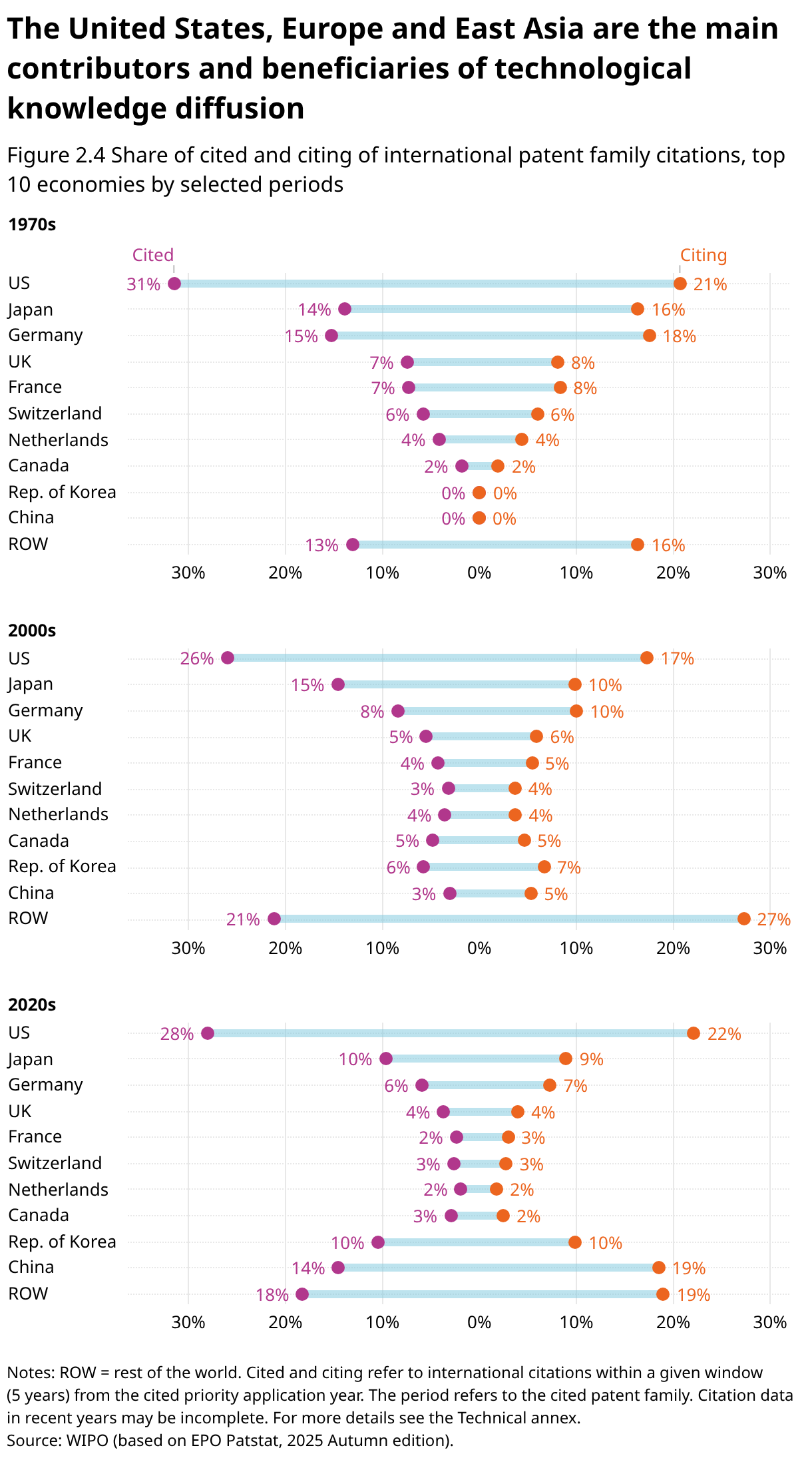
A few economies dominate global knowledge flows. Only a handful of economies account for the majority of patent citations that flow internationally – both as sources and as destinations of knowledge. Figure 2.4 shows the top 10 contributors and beneficiaries during the period 1970–2020. The United States leads as the main sender of technological knowledge abroad throughout the past five decades. It also ranks as the most important receiver of knowledge during the same period.
East Asian economies have joined the leaders. Historically, the United States was followed by Japan, Germany, the United Kingdom, France, Switzerland, the Kingdom of the Netherlands and Canada. In the 2000s, the Republic of Korea and China began gaining ground. By 2020, these two East Asian economies showed the largest increases of the analyzed period and joined the United States in the top three.
Contributors and beneficiaries are largely the same. All top economies show relatively similar patterns in terms of their shares as both cited and citing countries, and this balance remains consistent across time periods. The same pattern applies to the rest of the world as a whole.
Active contributors are also active absorbers. This balance indicates that economies contributing technologies that attract international attention are the same economies that find foreign technologies most interesting. Countries that generate globally relevant innovations also actively seek out and build upon innovations from elsewhere. This suggests that successful innovation systems both create and consume knowledge at high volumes.
Technological knowledge diffusion is intensifying
Not only has technological knowledge accelerated over recent decades, but also its diffusion intensity. Figure 2.5 reveals the share of bilateral knowledge flow patterns across the main economies and regions of the world. The general trend is of widespread increase in citation intensity.
Countries primarily build on their own knowledge. The largest citation shares appear along the main diagonal, indicating that all regions rely heavily on their own technological knowledge. This pattern is particularly strong for large, technologically established countries such as the United States, Japan, Germany, and other Western European economies.
The United States and Western Europe absorb knowledge on a global scale. The high citation shares for the United States and, to a lesser extent, Western Europe as destinations show that these regions cite knowledge produced from virtually all territories. The United States and Western European economies benefit extensively from technological knowledge created worldwide.
Asian economies use foreign knowledge extensively, but they are also becoming more self-reliant. Several territories have become heavier users of their own knowledge, as shown by increasing values along the main diagonal over the decades. This trend is most notable for China and the Republic of Korea and, to a lesser extent, India. These countries are building more extensively on their own technological foundations rather than relying primarily on foreign knowledge.


Deep tech sourcing: when technologies leverage scientific knowledge
There is an increasing interest in “deep tech” innovations. Scholars and policymakers recognize that basic science drives technological innovation and economic growth.
Science creates valuable knowledge repositories. Countries and regions serve as repositories of scientific research. Investments in science and education enhance territoriesʼ ability to develop novel technologies and breakthrough innovations.
New data reveal science–technology connections. Uncovering links between science and technology has attracted research attention for years. Policymakers increasingly seek evidence from the academic community to design and evaluate their policies.
Scientific knowledge travels further than technical knowledge. How does science affect international technological knowledge diffusion? Economic research shows that technologies with higher scientific content travel longer distances and are more likely to generate new inventor clusters, especially during their growth and maturity phases.
Measurement limitations remain. Patent citations to scientific papers have limitations. This approach underestimates scienceʼs impact by capturing only the research done openly, while omitting private channels like academic consulting or public–private partnerships.
Scientific knowledge takes time to become deep tech applications
Science-to-technology transformation requires patience. Analysis of global patent citations to scientific articles reveals that patents take much longer to cite scientific articles than to cite other patents. On average, scientific articles receive their first patent citation about 10 years after publication. This pattern aligns with economic studies showing that transforming scientific knowledge into industrial applications requires significant effort.
Geography affects scientific knowledge sourcing. Like patent citations, geography matters when sourcing scientific knowledge. Figure 2.6 shows how long scientific knowledge from one region takes to “diffuse” into technologies elsewhere. Patent applicants worldwide source more recent scientific knowledge nationally than from other countries or regions. This pattern exists even among advanced innovation economies like the United States, Germany and Japan, although less dramatically than for patent citations. For example, US science gets cited by US applicants only 3 and 11 percent faster than by German and Chinese applicants, respectively, and 9 percent slower than by Japanese applicants. Conversely, when citing German science, applicants from the United States, China and Japan are 22, 20 and 7 percent slower than German applicants, respectively.
Chinese scientific knowledge diffuses relatively quickly. Chinese papers get cited relatively quickly by foreign patents – within a maximum of 8 years from publication. Conversely, US papers take longer to diffuse to patents, with a minimum average time of 9 years and 4 months for Japanese patents and a maximum of more than 13 years for African patents.
These comparisons need careful interpretation. First, document volumes are not comparable since the United States produces far more cited scientific articles. Second, emerging scientific players – notably China, plus Southeast Asian, Latin American and African countries – have significantly increased their scientific publication rates recently. This means that older scientific references are more likely to originate from the United States and Europe. Finally, these adoption lags do not reveal the intensity or type of scientific knowledge being diffused.

A few innovation leaders dominate global science sourcing for deep tech
Scientific knowledge sourcing is highly concentrated. More than is the case for patent-to-patent citations, reliance on scientific knowledge is heavily concentrated in a handful of regions. From virtually all global sources, the bulk of cited scientific papers flow to the United States, Western European economies and Japan.
Leading economies absorb science on a global scale. Figure 2.7 shows that among all foreign scientific papers published between 1985 and 1995 with at least one patent citation, US patents cite at least 39 percent of them. Japan, Germany and other Western European countries show similar patterns. These high-performing innovation ecosystems consistently cite scientific articles from other regions more than those regions cite their own articles. These leading economies also interact intensively with each other – about one-third of US scientific papers get cited by Western European patents, while about half of Western European scientific articles get cited by US patents.
These sourcing patterns have shown remarkable stability over the past decades. Comparing the 2016–2022 period (Figure 2.8) with earlier decades reveals only minor variations. The United States, Japan and Western Europe have continued to demonstrate openness to international science since the earliest measured years.
China has emerged as a major science consumer. The most notable change over the past three decades is Chinaʼs increased openness to international science. Only 2.5 percent of the oldest US papers published during the 1985–1995 period were cited by Chinese patents, but this percentage increased significantly to 8.8 percent for US papers published between 2016 and 2022. This growth has made China more open to international science than Japan across all source regions.
Local science still matters everywhere. Despite the dominance of a few high-performing innovation ecosystems in international scientific sourcing, geography still matters. Even for less scientifically advanced regions, the largest share of scientific sourcing remains domestic. This suggests that while deep tech innovations increasingly draw on global scientific knowledge, local research capabilities remain important for all regions.


Technological knowledge trajectories: when breakthrough inventions spread globally
Patent citations miss part of the innovation story. Previous analyses rely on patent citations, which often do not represent the complete trajectory of technological knowledge diffusion behind the cited patents or scientific articles. Scholars have found that many patent citations do not even belong to the same technological class.
Alternatively, scholars have tracked the international diffusion of technological knowledge by identifying the first appearance of a breakthrough invention and its international reuse. Recent studies examine the first and subsequent appearances of specific technologies to understand their diffusion over time and space. These studies map technological knowledge diffusion using the concept of “reuse”, which is tracked across regions and years.
How can breakthrough technologies be mapped? Breakthrough technologies emerge through the novel recombination of existing technical knowledge. Following the idea that innovation stems from recombining existing knowledge components, scholars have mapped the diffusion trajectories of technologies using novel combinations of international patent classification (IPC) codes.
The transgenic mouse breakthrough provides an interesting example of this process. Consider transgenic mammal technology – the foundation for genetically modified laboratory mice used to develop treatments for cancer and Alzheimerʼs disease. This novel technological trajectory originated in 1985 when Harvard patented the “onco-mouse,” listing for the first time the patent codes for “gene isolation” and “injection of material into animals.” Subsequently, multiple patents reused this same combination. For instance, Seoul National University patented the “diabetic mouse” in 1996. All inventions classified under the same combination can be assumed to belong to the same technological trajectory.
Innovation leaders rapidly adopt foreign breakthrough technologies
The usual suspects dominate both creation and adoption. As with patent citations, the United States leads as the top origin of breakthrough inventions generating new technological trajectories, followed by Western Europe and Japan. These same regions also rank as the top three adopters reusing these foreign breakthrough inventions. Developed countries are the most active reusers of breakthrough technologies originated elsewhere. Given the increased patenting activity over recent decades, both new technology combinations and their reuse are growing in volume.
Advanced economies excel at rapid adoption of the knowledge behind these breakthrough inventions. Geographical patterns become even more pronounced when examining the time required for technological knowledge reuse. Countries and regions like the United States, Japan, Germany and other Western European economies prove to be much faster at reusing breakthrough technologies that originated elsewhere (see Figure 2.9). For example, the diffusion trajectories of the breakthrough technological knowledge originating in India take, on average, one-third of the time to be reused in the United States compared to reuse within India itself. The United States particularly excels at rapidly adopting the knowledge behind the breakthrough inventions from abroad.
Speed differences reveal the innovation capabilities of the resuing economy. This pattern suggests that leading innovation economies have developed superior technological capabilities not just for creating new technologies, but also for quickly identifying, understanding and building upon breakthrough innovations from other regions. This rapid adoption advantage may help to explain why innovation leaders maintain their competitive positions over time.

Developing economies struggle to reuse breakthrough technologies intensively
Domestic reuse dominates globally. Figure 2.10 shows overall technological knowledge flows across countries. Most breakthrough inventions get heavily reused in their country of origin, as shown by high values along the matrix’s diagonal. For example, 99 percent of breakthrough inventions originating in the United States get reused within that country. Similarly, Germany reuses 94 percent of its homegrown breakthrough inventions, while Japan reuses 92 percent of its own breakthrough inventions.
Innovation leaders also absorb foreign breakthrough inventions actively. Despite high domestic reuse rates, leading innovation economies remain open to reuse foreign breakthrough inventions. Japan serves as a destination for about 84 percent of breakthrough inventions originating in the United States, meaning that most US breakthrough inventions eventually reach Japan. Germany demonstrates similar openness, actively reusing breakthrough inventions from abroad while maintaining high domestic reuse rates.
Regional partnerships emerge around shared technology interests. Bilateral exchanges exist between countries like China and the Republic of Korea, reflecting both geographical proximity and technological affinity. These reuse flows are concentrated in nanotechnologies and electric data processing – core activities for companies like Samsung, LG and Huawei. Geographic and technological similarities create natural partnership corridors for breakthrough invention reuse.
Developing economies face challenges in reusing breakthrough inventions. Most developing economies show marginal participation in international knowledge flows based on the reuse of breakthrough technologies. Africa demonstrates limited capability to reuse foreign knowledge behind breakthrough inventions, as indicated by low reuse rates across all origins. However, African breakthrough inventions flow extensively to developed economies – all of the African breakthrough inventions are reused in Western Europe, while large shares are reused in the United States (96 percent), Japan (92 percent) and Germany (81 percent).
These patterns suggest that successful breakthrough invention reuse requires sophisticated innovation capabilities. Leading economies excel at both creating breakthrough technologies and rapidly identifying, adapting and building upon innovations from elsewhere. Developing regions may generate innovative technologies but lack the institutional infrastructure and technical capabilities necessary to maximize reuse of foreign breakthroughs.

Innovation leaders excel at rapid and intensive adoption of foreign breakthroughs
The United States and Western Europe dominate early adoption of breakthrough inventions. Figure 2.11 reveals that the United States and Western Europe excel as early and intensive reusers of foreign breakthrough inventions. These regions successfully reuse high shares of foreign technological knowledge already from their initial stages of technology development.
Geographic proximity influences adoption patterns. In early stages, Japan intensively reuses breakthrough inventions from other Asian countries but reuses less intensively from distant regions than the United States and Western European countries. This suggests that geographic and cultural proximity can facilitate faster technology diffusion, especially for nascent innovations.
Even strong patent producers struggle with early breakthrough inventions reuse. Despite their strong performance in patent citations, China and the Republic of Korea struggle to reuse breakthrough inventions intensively during early stages. For instance, China reuses less than 5 percent of US-originated breakthrough inventions within 5 years of invention. It takes 20 years for China to reach 28 percent reuse of US-originated breakthrough inventions. In contrast, the United States reuses 70 percent of Chinese-originated breakthrough inventions within the first 5 years of invention.
Developing regions face persistent reuse gaps. Regardless of the stage, India, Southeast Asian, Latin American and African countries lag significantly behind. These regions can reuse only small fractions of foreign-originated breakthrough inventions, indicating substantial capability gaps in identifying, understanding and implementing breakthrough technological knoweldge from abroad.
Speed and intensity of reuse reveal competitive advantages. The ability to quickly adopt and build upon foreign breakthroughs represents a crucial competitive advantage. Early adopters can enhance these technologies, create derivative innovations and establish market positions before slower adopters catch up. This pattern helps to explain why innovation leaders maintain their advantage over time – they excel not only at creating breakthrough technologies but also at rapidly incorporating innovations from elsewhere.

Understanding the channels behind international knowledge diffusion
Multiple channels drive technological knowledge across borders. The patterns observed in previous sections reflect well-established channels through which technological knowledge spreads internationally. Economic research identifies several key pathways: international trade in goods, foreign direct investment, skilled migration, licensing agreements and global value chains.
Absorption requires capabilities, not just exposure. Simply being exposed to foreign knowledge doesnʼt guarantee adoption. Successful absorption depends on domestic factors like human capital, institutional quality, research capacity and what economists call “absorptive capacity” – a countryʼs ability to recognize, understand and use external knowledge. This explains why innovation leaders like the United States and Western Europe excel at rapidly adopting foreign breakthroughs or sourcing deep scientific knowledge while other regions struggle.
Knowledge travels in traded goods
Trade remains the primary diffusion channel. The most common way technological knowledge spreads is through goods that embody new technologies. Consumers access embedded innovations through their purchases while companies use imported machinery, components and materials as inputs for their own production. These flows create learning opportunities as firms reverse-engineer foreign technologies.
Imports can boost domestic innovation. Recent studies show strong positive relationships between imports and patents.
Skilled people bridge knowledge gaps
Inventors and scientists drive knowledge flows. Skilled migration – particularly of inventors and scientists – plays a crucial role in global knowledge diffusion. Historically, major technological shifts have coincided with cross-border mobility of highly skilled individuals.
Migrants connect otherwise isolated communities. Skilled migrants act as knowledge brokers by building ties in host countries while maintaining connections to their origins.
Brain circulation can benefit all parties. Rather than creating “brain drain,” skilled migration often generates “brain circulation.” Even emigrants who do not return facilitate co-patenting, co-publications and technology transfer through their networks. Return migration further reinforces these processes, contributing to new technological specializations in origin countries.
International business creates knowledge highways
Multinational companies transfer knowledge systematically. Foreign direct investment and multinational enterprises represent major conduits for international knowledge diffusion. These companies bring advanced production techniques, organizational practices and technological capabilities to host countries, creating potential spillovers for local firms through competition, labor mobility and supplier relationships.
Local capabilities determine success. However, these spillovers are not automatic. They depend on domestic absorptive capacity – determined by R&D intensity, human capital and institutional quality. This explains why the same foreign investment can generate varying outcomes in different countries. Successful knowledge transfer requires co-evolution between global and local actors through reciprocal learning.
Global value chains expand knowledge networks. Modern production networks embed firms within international innovation systems. Foreign investment supports “knowledge upgrading” by connecting domestic companies to global production and innovation networks, although outcomes depend on complementary institutions, such as education systems, R&D incentives and intellectual property protection.
Patent protection enables technology markets
International patent systems facilitate knowledge flows. Since the 1883 Paris Convention established priority rights across patent offices, international patent protection has become crucial for reaching foreign markets with new technologies.
Modern treaties have expanded access. International patent protection has expanded significantly since the 1970s through treaties such as WIPO’s Patent Cooperation Treaty and regional agreements establishing the European Patent Office, African Regional Intellectual Property Organization and other regional systems. These developments have made it easier for inventors to protect innovations across multiple jurisdictions.
Patents enable technology trade. Patent protection in foreign markets facilitates international technology licensing and transfer agreements. These “markets for technology” improve overall welfare and innovation by enhancing innovation activity, knowledge diffusion and the emergence of specialized inventors. Patent trade stimulates the geographical spread of technology by enabling inventors to monetize their innovations globally.
Distance still creates barriers. Despite these mechanisms, uncertainty remains higher for international technology trade than for domestic transactions. Three types of uncertainty limit technology trade’s geographical reach: uncertainty about property rights, about technology value and about trading processes.
Implications for the observed patterns
Multiple reinforcing channels favor innovation leaders. The patterns observed in patent citations, scientific sourcing and the reuse of breakthrough inventions reflect these multiple reinforcing diffusion channels. Innovation leaders like the United States, Western Europe and Japan benefit from advantages across all channels – they attract skilled migrants, engage in extensive international trade, host multinational companies and maintain effective patent protection systems.
Absorptive capacity explains persistent gaps. Developing economies’ limited participation in rapid and intensive technology adoption reflects constraints across these channels. Lower absorptive capacity, weaker institutions, smaller trade volumes and limited skilled migration create cumulative disadvantages that persist over time.
Policy can strengthen diffusion channels. Understanding these mechanisms suggests that countries can enhance their participation in global knowledge flows by strengthening education systems, improving institutions, expanding trade integration, attracting skilled talent and developing effective intellectual property frameworks and institutions. The economies which have been most successful at catching up have typically improved across multiple channels simultaneously.
Key insights on global knowledge diffusion patterns
This chapter has examined how technological knowledge diffuses internationally by analyzing global patterns across multiple dimensions of innovation flows. Using patent citations, scientific references and the reuse of breakthrough inventions, the analysis has mapped where knowledge originates, how it spreads and which countries benefit most from international technological knowledge transfer.
Key findings reveal persistent but evolving patterns. Patent citation analysis shows that technological knowledge spreads faster today than 50 years ago, with international adoption times dropping by half since the 1970s. The gap between national and international knowledge flows has nearly disappeared, suggesting that geographical barriers are weakening. However, advanced economies like the United States, Western Europe and Japan dominate both as contributors and as beneficiaries of global knowledge flows, while most developing regions participate only marginally.
Scientific knowledge follows different diffusion patterns. Deep tech technologies based on scientific breakthroughs take much longer to develop – about 10 years from publication to first patent citation – but create more globally relevant technologies. Most science-to-technology flows are concentrated in a handful of leading economies, with the United States, Western Europe and Japan absorbing scientific knowledge from virtually all global sources. China has emerged as increasingly open to international science, showing the fastest growth in transnational scientific citations.
The trajectories of breakthrough inventions reuse reveal adoption capabilities. Analysis of breakthrough inventions reuse demonstrates that most countries primarily build on their own technological knowledge. However, innovation leaders excel at rapidly and intensively adopting foreign breakthroughs – the United States reuses 70 percent of Chinese-originated breakthrough inventions within five years, while China reuses less than 5 percent of US breakthrough inventions in the same timeframe. This asymmetry highlights critical differences in absorptive capacity.
Three main conclusions emerge from this chapter’s wide-ranging analysis:
First, global innovation remains highly concentrated. Advanced economies still dominate knowledge flows, although emerging economies, particularly China, are playing an increasingly important roles. This concentration reflects advantages across multiple diffusion channels rather than single factors.
Second, science is reshaping innovation geography. Scientific knowledge increasingly underpins breakthrough technologies, particularly in fast-moving fields. Countries that effectively combine global scientific inputs with local capabilities can gain competitive advantages in deep tech innovation.
Third, diffusion benefits remain unequally distributed. Large parts of the developing world remain excluded from rapid technology adoption, despite producing knowledge that flows to advanced economies. Geographical proximity and technological affinity influence adoption patterns, but absorptive capacity ultimately determines successful knowledge integration.
Implications for policy and future research
For policymakers, these findings emphasize that accessing global knowledge flows requires more than openness – it demands sustained investments in education, research capabilities and institutional quality. Countries seeking to participate more actively in global innovation networks must strengthen their absorptive capacity across multiple dimensions simultaneously.
For researchers, the results highlight the value of analyzing multiple diffusion indicators together. Each measure – citations, scientific references, breakthrough inventions reuse – captures different aspects of how knowledge spreads internationally. Future work should explore the causal relationships between these different diffusion mechanisms and their combined effects on economic development and global competitiveness.