
Introduction
Digital technologies (DTs) have reshaped the global economy and the way societies innovate. Over the past three decades, they have changed how people communicate, access information and carry out daily transactions.
While much of today’s digital technology development is concentrated in the United States of America and China, its benefits extend far beyond national borders.
While many digital technologies matter, this chapter focuses on those that make internet connectivity possible at both national and international levels. These include submarine cables (SMCs) as well as mobile and fixed broadband. Such backbone technologies act as gatekeepers and enablers, providing the foundation for the wider spread of digital innovation. Without them no other DTs have a high chance of widespread diffusion.
Despite the significant potential of digital technologies to drive economic growth and social development, substantial barriers continue to impede their adoption and diffusion, especially in developing economies. This case study examines the primary obstacles to DT diffusion, such as infrastructure constraints, human capital challenges, affordability, regulatory impediments and market structure issues. These barriers vary widely across regions and demographic groups, creating persistent digital divides that threaten to exacerbate existing socioeconomic inequalities.
The chapter also examines how intellectual property shapes diffusion in the digital era. Global technology standards, such as 4G, 5G, and Wi-Fi, play a central role in digital transformation. The patents protecting inventions essential to these standards, known as standard essential patents (SEPs), are central to digital transformation.
By exploring these dynamics, the analysis seeks to inform policies that foster the effective spread of digital technologies while addressing the risks and inequalities that may emerge. The findings aim to serve a broad set of stakeholders, from technology developers and investors to policymakers and development agencies, who are working to harness digital innovation for inclusive and sustainable growth.
Relevance to innovation economics and global development
To begin, we define digital technologies as those innovations that allow information to flow and communication to take place. They include devices such as mobile phones, computers and radios, along with the services and functions that run through them, such as messaging, online transactions and data processing. They also cover the systems that support these functions, from basic text protocols to complex digital platforms. Over the years, successive generations of digital technologies have emerged. They range from intangible tools, such as cloud computing and artificial intelligence (AI) to those with physical manifestations, such as robots and drones.
DT diffusion refers to the way these technologies spread across people, firms and institutions.
Digital technologies reduce many costs. They make it cheaper to search for, copy and transport information. They lower the cost of storing and processing data. They also cut the cost of targeting and tracking, which makes communication and service delivery more efficient. Quantitative evidence shows that digital technologies, compared to traditional technologies such as steam engines, have spread much faster while their usage intensity gap globally has become wider.
For global development, DT diffusion has emerged as both a powerful enabler and a source of new disparities.
On a positive note, while developing countries’ constraints often hinder the diffusion of technologies, they can also serve as catalysts for innovation that benefit both developed and developing economies. For instance, Africa’s limited grid access has driven the development of off-grid energy solutions, generating technological knowledge that both developed and developing economies can adapt. Empirical evidence supports this dynamic: technological trajectories originating in Africa that have reached the United States and Japan are linked to battery technologies and fuel cells,
Digital technology diffusion follows distinct patterns that differentiate it from the spread of other innovations and has implications for both developed and developing economies. The following section examines the core features that characterize how digital technologies propagate through economies and societies, focusing on network dynamics, infrastructure requirements, local absorptive capacity,
Bandwidth boom: a key feature of digital technology spread
General purpose technology and network effects
From an innovation economics perspective, the spread of digital technologies offers a clear example of how general purpose technologies (GPTs) move through economies.
Evidence from literature shows that digital GPTs are growing faster than the average patent filings across all technologies.
Network effects stand as another defining characteristic of internet and general DT diffusion, fundamentally altering traditional technology adoption patterns.
Two distinct types of network effects drive DT diffusion. Direct network effects occur when a technology’s value grows directly with its user base, exemplified by social media platforms, which become more valuable to users as their social contacts join the network.
These network dynamics create distinct adoption patterns, characterized by initial slow uptake followed by rapid acceleration and eventual saturation. The diffusion of smartphones across income groups demonstrates this pattern vividly.
Firewall ahead: barriers to digital adoption and diffusion
While internet use reached 74 percent of the world's population in 2025, this figure masks significant regional disparities, with the African population at only 36 percent connectivity compared to 92 percent in Europe.
Infrastructure constraints and capital requirements
The most fundamental divide is infrastructure and basic connectivity access. This gap stems from physical limitations, such as uneven deployment of broadband networks, energy infrastructure, insufficient carrying or data center capacity, or limited access to appropriate end-user devices. These infrastructures are organized around three interdependent layers that mirror the structure of the internet value chain: network infrastructure, data centers and end-user devices.
International infrastructure gap
Backbone connectivity infrastructure, particularly submarine cable deployment and international bandwidth capacity, are critical in facilitating cross-border data flows and ultimately the diffusion of digital technologies.
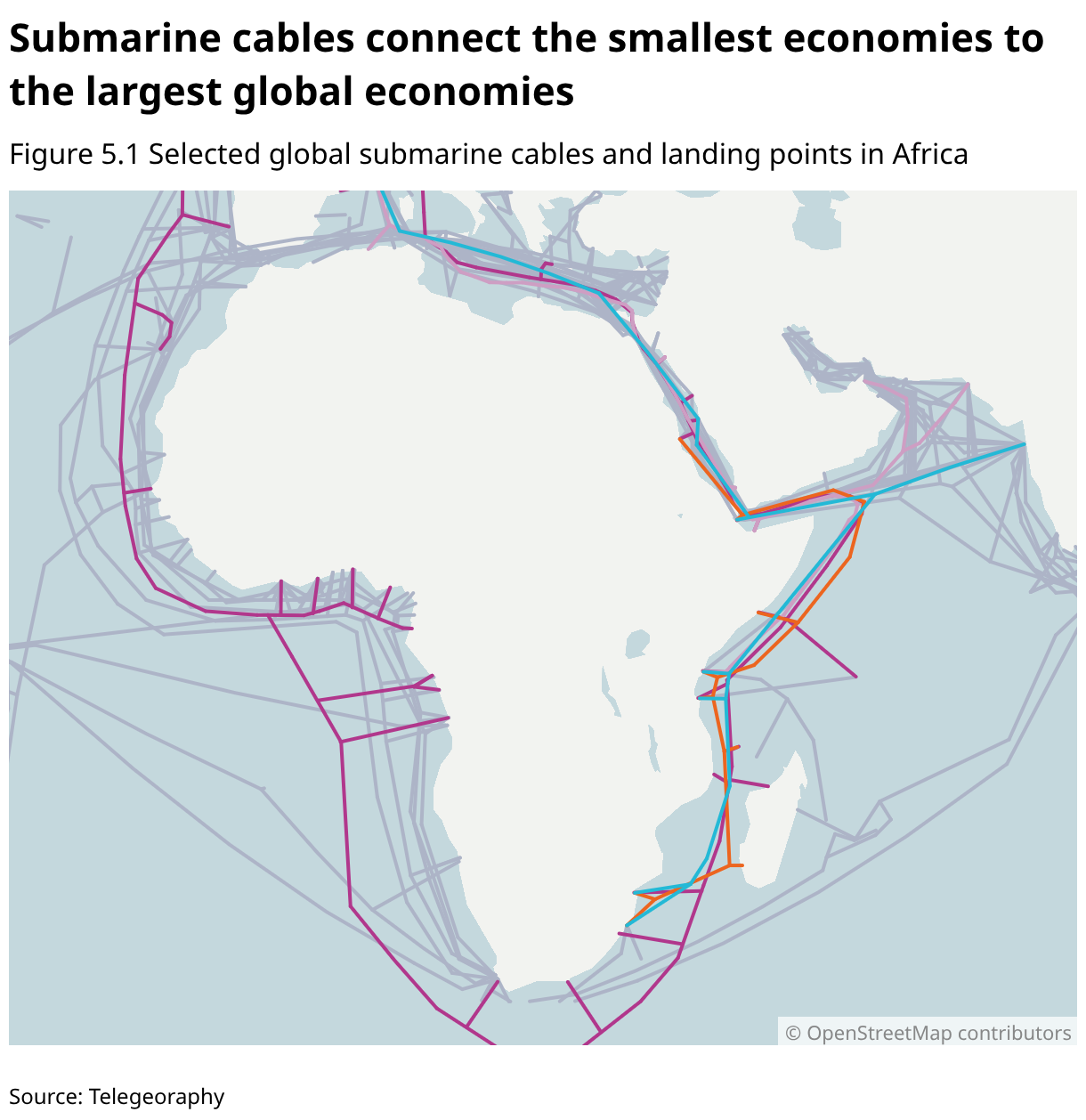
Access to global bandwidth capacity remains uneven across regions, as illustrated by Figure 5.2. Over the past decade it has expanded significantly in Europe, Asia-Pacific and the Americas, while Africa, the Arab States and Commonwealth of Independent States (CIS) countries continue to lag, despite recent catch-up. These infrastructures are also subject to vulnerability. An SMC cut or fault is probably the most harmful digital hazard. SMC damage is mainly caused by maritime activities, particularly anchoring and fishing nets, and, to a lesser extent, by sabotage or natural hazards, such as earthquakes or typhoons.
Figure 5.3 illustrates the extent to which regions with a limited number of SMCs, such as Sub-Saharan Africa, are subject to disproportionate level of disruptions in connectivity in cases of SMC damage. In March 2024, for example, 10 African countries, primarily in West and Southern Africa, experienced major internet outages due to failures in four undersea cables.


National infrastructure gap
Once SMCs are laid, access to telecommunications and the internet primarily relies on the terrestrial network at the national level. In African countries, this network is mainly the mobile infrastructure network, with cell towers the principal “last-mile” infrastructure (Figure 5.4a). In contrast, European countries extensively rely on fixed broadband networks, including when reaching the last mile, often relegating mobile infrastructure to a supplementary role (Figure 5.4b). This dual deployment pattern profoundly influences internet access devices and the types of digital services accessible to users.


Technology gap
An often overlooked dimension of digital inequality is the technology gap, which is the difference in the quality and capability of the digital tools available to users. Together with the infrastructure and usage gaps, it shapes how effectively individuals, firms and public institutions can apply digital technologies in daily life and economic activities. Ultimately, these gaps determine the kinds of innovations that emerge, who benefits from digital transformation and to what extent.


In many low-income countries, particularly in Africa, the spread of advanced internet-based technologies remains constrained by low internet penetration and scarce fixed broadband coverage. As a result, much innovation has taken root on mobile platforms. Africa mobile money (MoMo) services, such as Kenya’s M-Pesa, show how digital solutions can scale inclusively when they work through basic mobile phones and unstructured supplementary service data (USSD) systems, without needing smartphones or internet access.
Despite such success stories, the adoption of advanced digital technologies, such as AI, cloud computing, big data analytics and the Internet of Things, remains heavily concentrated in high-income and emerging regions, including Northern America, Western Europe and parts of Asia. These regions benefit from the combined expansion of fixed and mobile broadband networks that support data-intensive applications. Advanced technologies require stable, high-capacity connections, large-scale servers and platforms capable of managing vast data flows – conditions that are still rare in most developing economies.
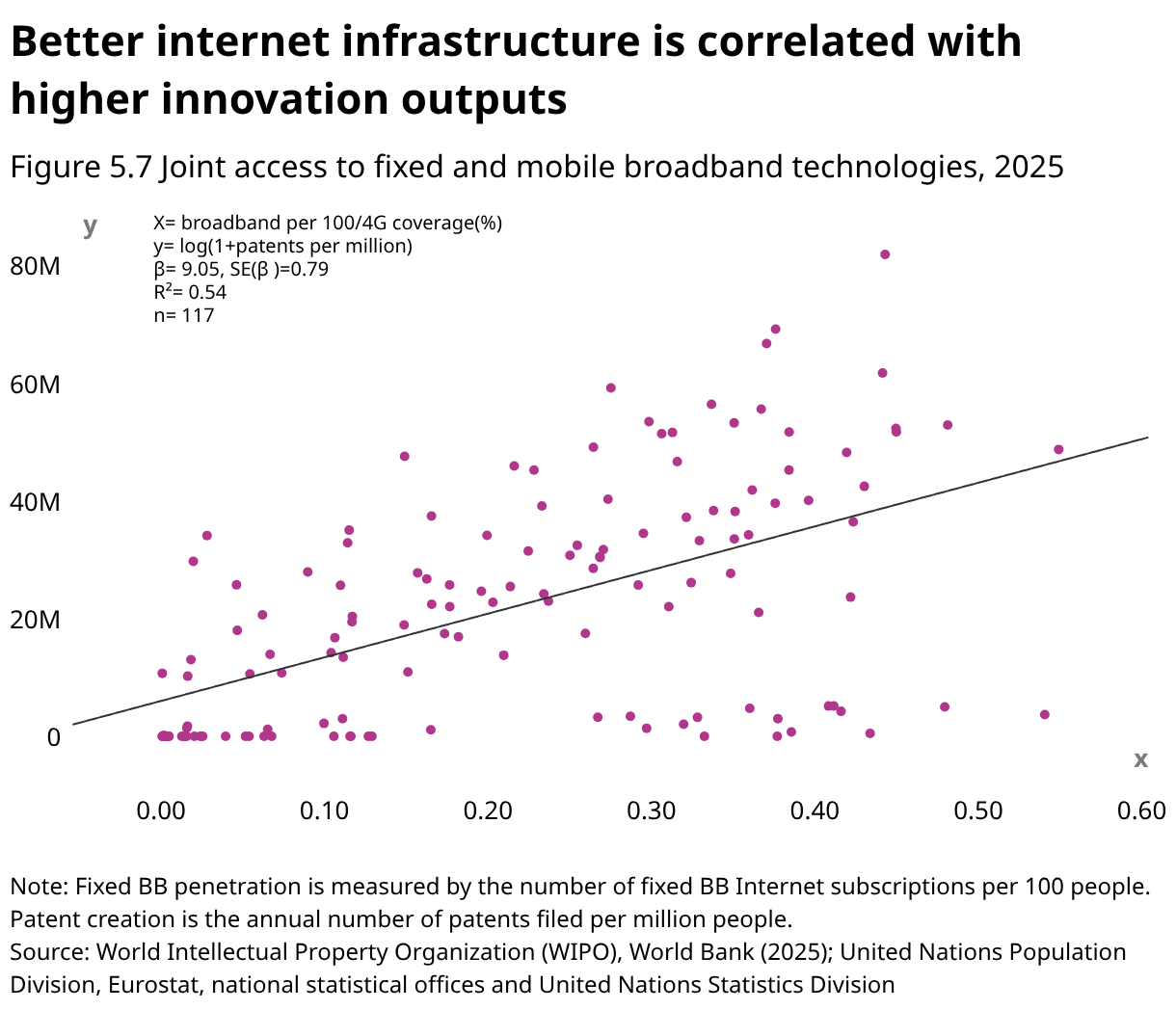
The result is a dual digital landscape: some countries fully leverage high-value, data-driven innovation, while others depend mainly on simpler, mobile-based solutions. Figure 5.7 illustrates this divide. Countries with both fixed and mobile broadband access show higher innovation outputs, such as patent activity, compared to those with limited infrastructure.
In developing economies, affordability remains the main barrier to accessing high-speed internet, owning smartphones or using mobile internet, underscoring how economic and technological divides continue to reinforce each other.
Usage gap: digital literacy and human capital challenges
The usage gap is shaped by limited digital literacy, skills and the ability to engage in basic and advanced digital activities. At a basic level, digital literacy is often linked to broader affordability issues, as well as language barriers and restrictive social norms, particularly those that disadvantage women and marginalized communities in rural areas. Without these foundational capabilities, potential users cannot effectively utilize available digital technologies.
The gap in intermediate and advanced digital skills has strong ties with education and skilled labor deficits, which combine to shape the absorptive capacity of the population. Many educational systems struggle to cultivate the competencies needed for productive DT adoption, limiting the economic returns from DT investments and hindering the localization and development of contextually relevant digital applications. These challenges are not confined to developing economies. In both developed and developing countries, albeit to varying degrees, disparities persist between urban and rural areas, and between educational and training opportunities available to workers in large firms versus those in small and medium-sized enterprises.
The digital skills gap extends to businesses and governments, hindering organizational adoption of DTs. Similarly, limited technical capabilities within public institutions impede e-government initiatives and digital public services that could otherwise accelerate broader DT diffusion.
Affordability gap: submarine cable deployment and the cost of internet access
As mentioned earlier, the affordability gap continues to present a substantial barrier to DT adoption in low- and middle-income countries. The cost of basic connectivity – “first-mile” access – depends in large part on SMC systems. SMCs require investments of several hundred million dollars and are often financed by consortia of telecom operators. In recent years, large technology companies such as Google, Meta and Microsoft have become leading investors. By 2023, such firms accounted for nearly three-quarters of global bandwidth use.
These international bandwidths lower costs directly by cutting wholesale costs and indirectly by stimulating competition. The size of these effects depends on the structure of domestic markets and the strength of regulation. Empirical evidence from large samples of low-, middle- and high-income countries confirms that the relationship between SMC deployment and broadband prices is not straightforward.
Moreover, doubling SMC capacity can cut mobile broadband prices by up to half and fixed broadband prices by about a third, with similar effects across regions.
Market concentration also matters. In competitive markets, capacity expansions lead to sustained price reductions. Where markets are more concentrated, the impact of new cables is weaker, especially for fixed broadband. As a result, high costs can keep internet access out of reach in many developing economies, holding back the spread of advanced digital tools and reinforcing global divides. These results are important as they can be factored into policies to alleviate the barriers that disproportionately affect women, rural populations and marginalized communities and reinforce existing patterns of disadvantage.
Institutions, regulations and competition
Regulatory frameworks play a decisive role in determining how quickly and widely digital technologies spread. They shape market entry, competition and innovation, yet restrictive or outdated rules continue to slow DT adoption in many countries.
A country’s approach to digital regulation can profoundly affect how technologies take root across its economy. Evidence shows that, in the case of the internet, countries that require internet service providers (ISPs) to obtain formal approval before launching operations tend to have fewer users and hosts. Likewise, government regulation of ISP prices often results in higher end-user costs.
Data governance frameworks have become another key determinant of diffusion. Clear data protection rules build trust and safeguard privacy, but overly restrictive or ambiguous regulations can deter innovation and raise compliance costs, especially for smaller firms that lack the capacity to navigate complex rules.
Policy predictability is equally critical for investment. Uncertainty or frequent regulatory changes increase risk for telecommunication providers, particularly given the long-term capital commitments required for broadband infrastructure. Stable and transparent regulatory environments are therefore essential to encourage sustained investment, fair competition and the continued spread of digital technologies.
Market structure also shapes DT diffusion by influencing prices, service quality and incentives for innovation. Research consistently shows that competition in telecommunications drives lower prices and better services.
Recent findings demonstrate that international bandwidth, delivered through SMCs, can reduce broadband costs through two main channels.
The strength of these effects depends on domestic market structure and regulatory oversight. Strong, independent regulators are therefore vital to ensure that infrastructure investments translate into affordable, high-quality connectivity and support broader digital inclusion.
Economic and social impact
The dual nature of digital diffusion and trade
Digital technology diffusion has a dual nature. It acts as a catalyst for export growth and productivity, yet it can also deepen global trade disparities. On the positive side, digital tools improve efficiency, reduce transaction costs and enable innovation. Firms benefit from better inventory management, customer engagement and data-driven decision-making. High-speed connectivity infrastructure has particularly strong effects. The arrival of the SEACOM and EASSy submarine cables in Eastern and Southern Africa, for example, led to higher exports in logistics-intensive sectors, such as minerals and vegetables.
Yet the benefits of connectivity are uneven. Studies show that, while new SMC links encourage export participation among firms in advanced economies, they can lead to exit among exporters in developing economies with limited capacity to absorb digital technologies.
Recent work highlights the importance of digital connectedness.
A study conducted on 60 developing countries, including 23 from Sub-Saharan Africa, shows a positive and significant effect of digital connectedness on export complexity, with especially strong impacts in SSA.
Human capital also shapes outcomes. Broader primary education coverage strengthens the gains from connectivity, while limited internet penetration continues to hold back progress in many African economies.
Overall, the evidence shows that digital connectivity is multidimensional. It links directly to the four divides discussed earlier: the infrastructure gap, which reflects whether bandwidth connects to key global and local nodes; the technology gap, which captures the quality of digital technologies available to users; the usage gap, how effectively firms and individuals engage in basic and advanced digital activities; and the affordability gap, which concerns the cost of connectivity. Addressing all four is essential for digital diffusion to drive inclusive global growth.
Social inclusion and equity considerations
Beyond economic impacts, digital technology diffusion profoundly shapes social inclusion. Digital technologies can either reduce or deepen existing inequalities. This dual potential underscores the importance of inclusive approaches to digital development.
In rural areas, low population density, limited purchasing power and weaker digital skills often slow adoption, even where coverage exists. Yet, once adopted, the effects can be transformative. Mobile telecommunications can reduce isolation, and digital financial services can expand access to payments, credit and savings. The spread of mobile coverage and mobile phones has had a particularly strong impact on agricultural markets, lowering price dispersion and improving producers’ access to market information.
By reducing the cost of obtaining and transmitting information, mobile phones can allow farmers and traders to monitor prices across distant markets more frequently and at lower cost. This helps them to identify better trading opportunities and avoid less favorable markets. Studies on India’s fisheries
Evidence from the eight West African Economic and Monetary Union (WAEMU) countries shows that mobile connectivity has the strongest equalizing effect in agricultural tasks where labor markets are segmented by gender, helping to reduce wage disparities within these segments.
For women, these benefits can be particularly significant. Mobile technologies can help them monetize previously unpaid tasks and negotiate higher wages.
Employment and labor market transformations
The diffusion of digital technologies is reshaping labor markets around the world, transforming the demand for skills, the structure of employment and the geography of work.
However, these gains are unevenly distributed.
These contrasting dynamics illustrate the dual nature of digital diffusion in the labor market. On the one hand, digital technologies can foster inclusive growth, stimulate innovation and create new pathways for youth and women’s participation. On the other, they risk reinforcing structural inequalities if benefits are concentrated among highly skilled, well-connected workers in urban areas.
Intellectual property role in diffusion of digital technologies
Intellectual property (IP) systems play a central role in shaping how digital technologies spread. Patent protection, licensing models and trademark regimes all influence who innovates, who gains access and how fast technologies move across markets.
The patent landscape for digital technologies is highly concentrated. Most DT patent applications come from five major jurisdictions; namely, China, the United States, Japan, the Republic of Korea and the European Patent Office (see Figure 5.8). Together, they account for most global filings. This concentration creates uneven diffusion patterns, as technology often follows the investment and licensing channels controlled by leading patent holders.
Digital technologies typically integrate multiple layers of innovation, many of which rely on technology standards. Technology standards are developed and established in standardization organizations (SOs), also referred to as standards development organizations (SDOs) or standard-setting organizations (SSOs). SOs bring together a range of stakeholders, including industry representatives, researchers, and policymakers, to collaborate in identifying the most effective technical solutions for a given standard. When participants in SOs contribute protected technical solutions to a standard, they commit to licensing their relevant patents to implementers in accordance with the SO’s intellectual property rights (IPR) policy. These IPR policies vary, but they generally seek to strike a balance between the interests of SEP owners in recouping research and development investments, on the one hand, and implementers’ access to standardized technologies, on the other. For example, the 3rd Generation Partnership Project (3GPP) brings together, so-called Organizational Partners, seven regional and national SDOs.
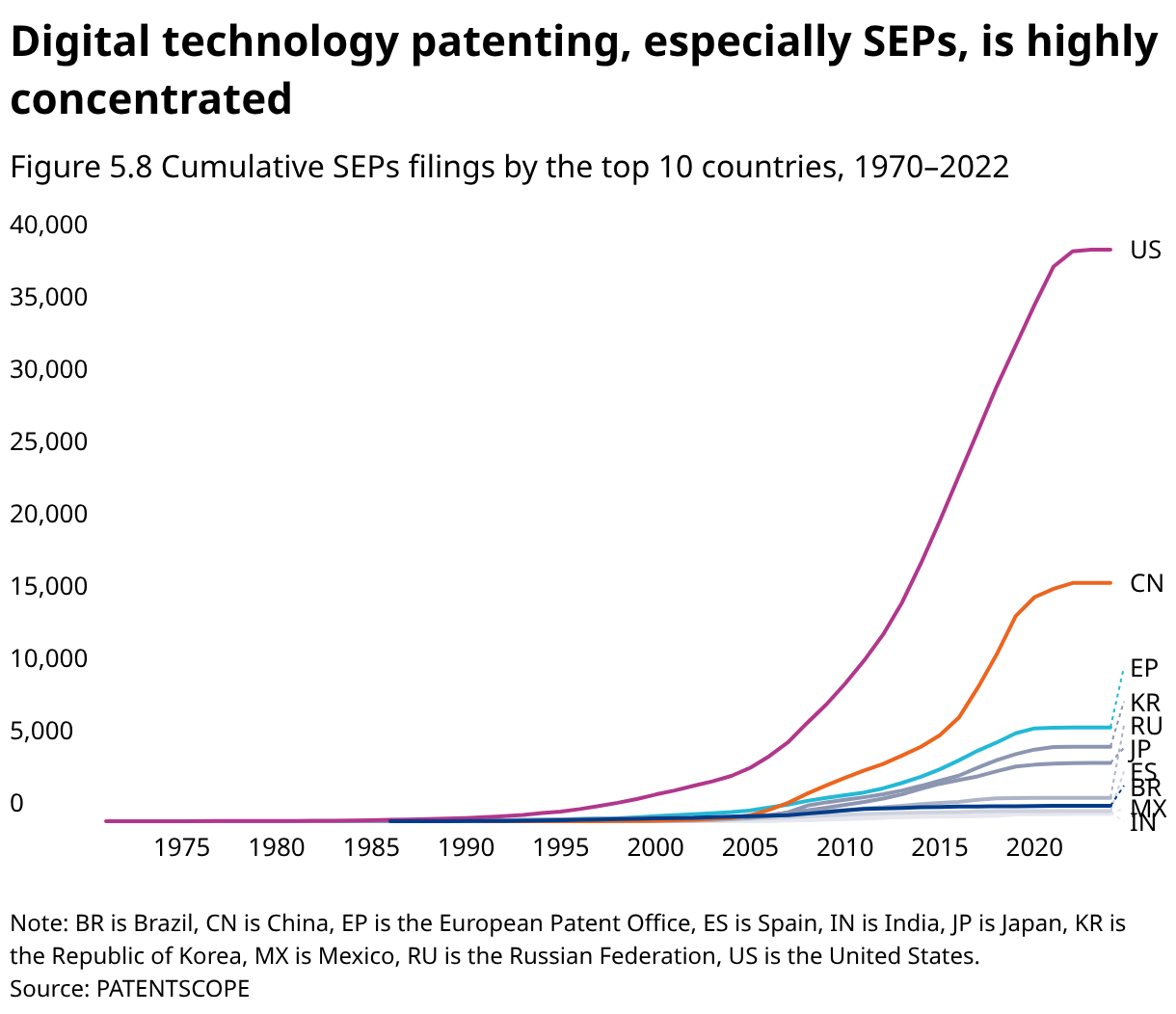
The economic importance of SEPs has grown in recent decades.
Beyond patents, other forms of IP strongly affect digital diffusion. Evidence shows that firms with greater DT capital tend to file new trademarks more frequently and retire existing ones more rapidly, resulting in shorter trademark life cycles. This reflects the faster pace of innovation and product turnover in digital industries, where business value is often realized through greater product variety, as captured by the number of trademarks held.
At the same time, the growing market concentration of major digital platforms raises new policy challenges. A small number of global technology firms increasingly control key digital infrastructures, data resources and IP portfolios, shaping the direction and speed of diffusion. Ensuring dynamic competition therefore requires regulatory frameworks that prevent excessive market dominance, encourage interoperability and promote open innovation. Balancing the legitimate protection of IP rights with measures that safeguard competition and facilitate entry for smaller and local innovators remains a central policy priority for inclusive digital transformation.
Conclusions and policy implications
Several key findings emerge from this analysis of global digital technology diffusion patterns. First, while digital technologies have spread more rapidly than earlier waves of innovation, the depth and quality of adoption differ widely both across and within countries. The classic S-shaped adoption curve remains a useful model, yet its steepness and timing depend heavily on enabling conditions, particularly infrastructure availability, local absorptive capacity, affordability and institutional and regulatory support.
Second, key features of digital technologies, such as their nature as GPTs, and the presence of strong network effects and their adherence to Moore’s Law, make their diffusion fundamentally different from that of other types of technology.
Third, DTs tend to amplify existing strengths and weaknesses rather than generate development automatically. Barriers to diffusion often interact, creating overlapping constraints that single-issue or siloed policy approaches struggle to overcome. Evidence shows that comprehensive digital economy strategies, which integrate infrastructure, skills and regulatory measures, achieve greater and more sustainable impact than fragmented initiatives.
Fourth, the dual nature of digital diffusion in trade and productivity further highlights the importance of complementary policies. While digital connectivity can boost exports, innovation and diversification, gains often accrue disproportionately to large firms and advanced economies. Evidence from Africa shows that investments in submarine cables, mobile infrastructure and digital connectedness yield the strongest benefits when supported by human capital development, digital skills training and inclusive policies that enable smaller firms and marginalized groups to participate in global markets.
Fifth, regulatory and market conditions are central to digital technology diffusion. Outdated rules, weak competition and policy uncertainty raise costs, deter investment and limit inclusion. Transparent, stable regulation and strong competition oversight are essential to ensure that infrastructure investments translate into affordable, high-quality and inclusive digital connectivity.
Sixth, IP systems are pivotal in determining how digital technologies diffuse across economies. While IP protection supports innovation and interoperability through the participation of innovative companies in technology standardization, supra-FRAND licensing rates, complex licensing negotiations, and fragmented data governance can slow diffusion, especially in developing economies. Knowledge sharing, education and balanced IP governance are critical for inclusive digital transformation.
In sum, accelerating and broadening the diffusion of digital technologies requires a holistic policy approach. Expanding infrastructure must go hand in hand with strengthening competition, reforming regulatory frameworks, investing in human capital and promoting equitable IP governance. These combined actions will help to ensure that digital transformation becomes a driver of inclusive and sustainable growth, enabling all economies, and all people, to participate fully in the opportunities of the digital age.