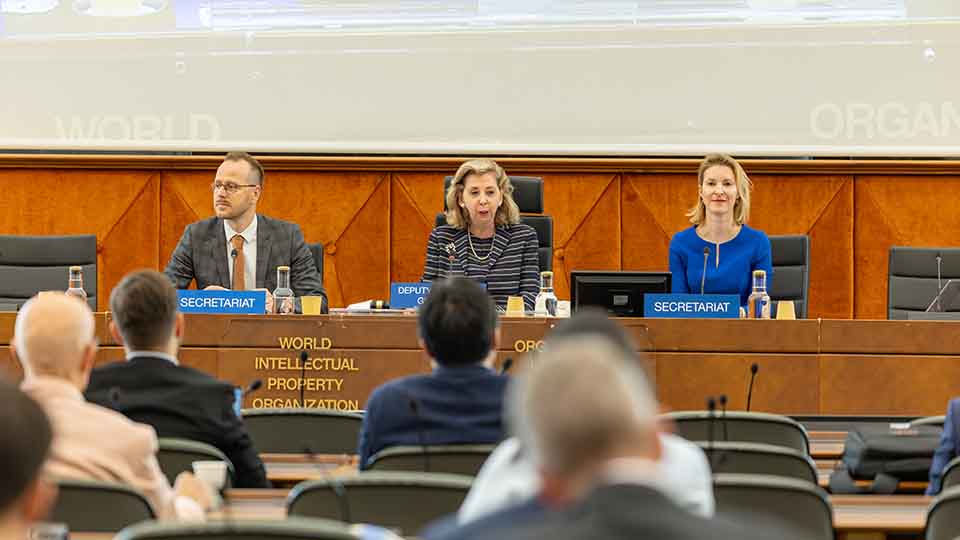
WIPO brought together judges, industry representatives, policymakers and patent experts on October 12 and 13, 2026, for its Seminar on Standard Essential Patents (SEPs) and Dispute Resolution. Held in Geneva and online, the two-day event examined licensing challenges, judicial approaches and ways to resolve disputes across borders.
Balancing innovation and technology adoption
Under the theme “Faster, Higher, Stronger - Together?”, the seminar drew on the Olympic motto to emphasize the importance of cooperation in the SEP ecosystem.
A recurring theme throughout the event was the need to balance protecting and rewarding innovation while enabling the widespread adoption of new technologies.
Addressing the gathering of experts and attendees, WIPO Deputy Director General Laura Peter underscored the importance of a system that rewards innovators while allowing businesses to implement technologies and bring products to market.
“The prospect that an invention can be protected and generate a return on investment is an important part of the bargain that supports technological progress”, she said. “At the same time, standards achieve their full economic and societal value when the technologies they incorporate can be implemented successfully and reach markets around the world.”
Peter also stressed the role of effective dispute resolution in maintaining this balance when licensing negotiations break down.
Listening to the SEP community
Alongside dispute resolution, the seminar examined how WIPO can support the SEP community through its tools and services.
On Day 1, participants heard updates on initiatives under WIPO's Strategy on Standard Essential Patents 2024–2026, including SEP information in PATENTSCOPE, the WIPO Lex SEP Case Law Collection and WIPO's report on fair, reasonable and non-discriminatory (FRAND) licensing valuation methods.
These presentations set the stage for four in-person workshops where participants were invited to share their experiences, identify gaps and suggest areas for further support. Discussions focused on data and transparency, access to legal information, FRAND licensing and future priorities.
As András Jókúti, Director of WIPO's Patent and Technology Law Division, explained in his opening remarks:
“The main purpose of the afternoon is not for WIPO to speak. It is for WIPO to listen.”
The workshops highlighted WIPO’s role in bringing stakeholders together for dialogue. Participants also recognized the untapped potential for greater use of alternative dispute resolution (ADR) solutions, particularly where adapting existing services to better meet the needs of parties involved in FRAND disputes and the need for improving education on SEP licensing, especially for new entrants to markets that rely on standardized technologies.
Exploring approaches to SEP disputes
While the program’s first day focused on identifying practical needs and challenges, the second turned to how SEP disputes are addressed in practice, both in courts and through alternative mechanisms.
Judges from ten courts around the world were represented in the discussions: Brazil, China, Germany, India, Japan, Morocco, the Republic of Korea, the United Kingdom, the United States and the Unified Patent Court.
The discussions examined judicial approaches to SEP disputes involving technologies and patents across multiple jurisdictions. The judges on the panel illustrated the differences and commonalities among courts worldwide in dealing with SEP litigation, and agreed on the importance of judicial dialogue.
Industry representatives then offered their perspectives on litigation strategies across jurisdictions. Speakers included Stephen Akerley of InterDigital, Ray Bennett of Lenovo, Robert Earle of Ericsson and Jon Chow of The Walt Disney Company. This session was complemented by a fireside reflection with Sanat Bathla of Fairphone and Andrei Iancu of Sullivan & Cromwell. The afternoon started with Prof. Daniel Gervais’s analysis of SEP-related international disputes at the World Trade Organization.
The role of alternative dispute resolution (ADR) was another highlight of the panel discussions. Representatives from Xiaomi and Nokia joined Judge Naoyuki Iwai of Japan and Heike Wollgast of WIPO's Arbitration and Mediation Center to explore how mediation, arbitration and other mechanisms, including court-facilitated mediation, can help resolve FRAND disputes. They also examined factors that influence parties' choice of dispute settlement mechanisms.
The focus then returned to the courts. The day concluded with a discussion featuring judges from China, Germany, the United Kingdom and the United States on the different approaches to FRAND rate determination. The panel examined the path leading to a FRAND rate, the role of judges in that process, and the methods they consider useful in arriving at a conclusion.
Together, the discussions reflected a central challenge in SEP dispute resolution: technology standards and licensing arrangements span borders, while litigation takes place before courts operating within different national and regional legal systems.
“We do not necessarily need every legal system to reach the same answer,” Peter noted in her remarks. She emphasized the value of dialogue across jurisdictions to better understand where judicial approaches converge and where they differ.
Looking ahead
Such exchanges are central to WIPO's broader approach to SEPs. Guided by the principles of neutrality, complementarity and voluntary participation, WIPO supports stakeholders through access to information, dialogue and neutral dispute resolution services.
By providing a forum for stakeholders to share their experiences and perspectives, WIPO aims to build a better understanding of the challenges facing the SEP community and where it can make the greatest contribution.
The insights gathered help guide WIPO's future work towards an SEP ecosystem where innovation is rewarded, technologies can be implemented and disputes can be resolved effectively.
More information
- WIPO's work on Standard Essential Patents
- WIPO ADR for SEP/FRAND Disputes
- Seminar program
- Speaker profiles