Helping farmers treat crops in Malaysia using AI and satellite imagery for precision agriculture
Rice paddies are vulnerable to a variety of pests and diseases, lowering yields, increasing farmers’ costs, and damaging health and ecosystems through the systematic use of pesticides. In Malaysia, a social enterprise is using AI-powered satellite monitoring to detect a range of diseases and pests before they gain speed and spread.

Amir Kusyairie Bin Arif graduated with a diploma in agriculture technology and a bachelor’s degree in law. He is ProLadang’s COO and was always passionate about social work. He used to volunteer regularly, particularly for a homeless program. Founding a business, he said, “is not just about getting the money, but having a justification in giving to others.”
ProLadang was founded in 2023 by Amir and three co-founders: Luqman Hakim M. Sabri (CEO), Tan Gim Thee (CFO), and Putri Humairah Binti Monashofian Putra (Head Of Research). Coming from different backgrounds, they aimed for the same goal: having a social impact. They focused first on paddy farmers, an already vulnerable population further affected by climate change.
They chose their names after the Malay word “Ladang,” which means “field.”
Eye in the Sky for Spot Spraying
The company uses third-party satellites, the EOSDA Sentinel 1 and 2. The data harvested by the satellites feeds into ProLadang’s AI model, Agriassist, which the company built, combining the CEO’s knowledge of satellite imagery and Amir’s expertise in agriculture. Agriassist can detect a specific pattern associated with a particular disease or pest well before it spreads.

It will then connect to the farmer’s phone via WhatsApp, sending an alert about an attack on their plot. A push of a button on the phone will start a GPS localization of the exact field or area under attack, and should be checked. The farmer can then decide to spray the field.
After the treatment, ProLadang can provide updated data to see the results.
Light Reflection Tell-Tale in Plant Disease Detection
After two years of research and development, the company can now effectively detect 10 specific pests and diseases in paddy fields. Examples include the leaf-rolling caterpillar, the brown plant hopper, bacterial leaf blight, and mice.
Based on plants’ property to reflect light, Agriassist analyzes threats through light reflection, Amir explained. The satellite can detect reflected light from paddy fields. Once attacked by a specific pest or disease, a plant will reflect a certain type of infrared light. For example, he developed further, if a plant is vigorously attacked by a brown plant hopper, the plant will give a very red/orangey light instead of green. If the plant is healing from that attack, the color will turn yellowish-green. The satellite captures light differentiation and converts it into an index for our AI system.

Each disease or pest will give the plant a different index. He cited the Normalized Difference Red Edge index (NDRE), a method for measuring chlorophyll and nitrogen levels in plants. The NDRE’s range is from 0 to 1, 0 being the worst mark. The system also monitors the Modified Soil Adjusted Vegetation Index (MSAVI), which measures crop growth and ranges from 0 to 5, with 5 being the optimal value.
The satellite can transmit data every day if the weather permits. According to Amir, the uniqueness of ProLadang is based on the AI developed by the company. “It is the first in the world to be able to detect specific pests and diseases,” he said. For the moment, the company can detect 10 threats.
AgriAssist’s Integration with Agriculture Sprayer Drone
To use Agriassist, farmers just need internet access and smartphones.
Beyond Agriassist, the company also favored WhatsApp over a sophisticated, high-tech application. “Most of Southeast Asia is using WhatsApp, and most of the farmers in the region do not have enough memory in their phones to install large apps.” “The interface is easy to understand and use, and from the application, farmers can connect to an automated spraying drone that will spray a specific pesticide in a specific plot,” he added.
ProLadang does not own the drones used for field operations. “We collaborate with local drone service providers across Malaysia and integrate their drone data with our AgriAssist platform to support crop monitoring and analysis.”
Reducing the Use of Pesticides with Precision Spraying
ProLadang serves both conventional and organic rice farmers. In conventional farming, farmers usually blanket-spray their paddies once a disease or pest is detected, Amir said. However, using Agriassist allows for zooming on a specific plot and reduces the amount of pesticide needed and used. According to Amir, the use of the system reduces chemical use by 15-50%.

“When fewer pesticides or fertilizers are used, less carbon dioxide and methane are released,” he explained, adding that such a reduction also alleviates the impact of chemicals on animals, particularly aquatic fauna, and reduces algae bloom, which endangers water resources.
Reducing chemicals also aligns with ProLadang's overall social impact goal, helping reduce Malay farmers’ exposure.
Affordable Precision Agriculture Technology for Cereal Cultivation
In Malaysia, according to Amir, most paddy farmers are managed by corporations or cooperatives, such as the Muda Agricultural Development Authority. They usually pay for the Agriassist system. It is a win-win situation, as farmers will save on costs and both farmers and corporations or cooperatives will get higher yields.
At the moment, the company operates in three Malaysian states: Selangor, Kedah, and Pahang, and serves 180 farmers.
After rice, which was their primary target, ProLadang considers extending their expertise to other cultures, such as maize and barley, that have “almost the same anatomy as rice, so it is easy for us to transfer our technology to those plants.”
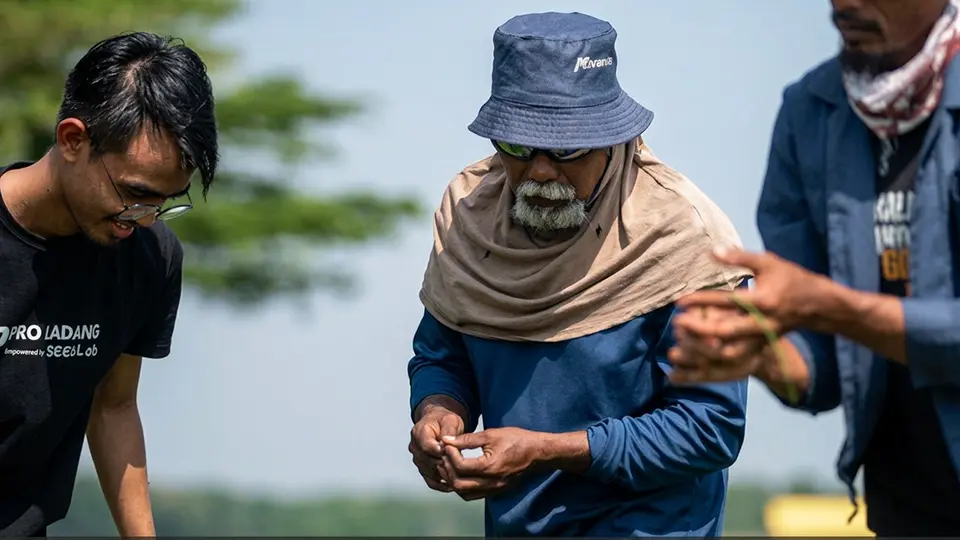
The company's small team of six also wants to expand in Southeast Asia. They have a partner in Thailand and are considering going to Indonesia. “In the next five years, we want to expand to East Asia, such as Japan and China, and then go to India.”
ProLadang participated in WIPO’s IP Management Clinic supporting SMEs in the area of Agriculture 4.0 in ASEAN. “WIPO gave us useful information about patent writing that we could take to our lawyer.” “We also learned that IP could become an essential asset in the future, and we could take this information to our finance department,” Amir said.
The company is working on a patent for its algorithm and plan to apply for a trademark.