The International Patent System in 2008
PCT Yearly Review: Developments and Performance
[ PDF Version ]
- PREFACE
- 1. HIGHLIGHTS
- 2. FILINGS OF PCT APPLICATIONS
- 3. ANALYSIS OF PCT APPLICANTS
- 3.1 Top 15 Countries of Origin
- 3.2 Indicators of Internationalization
- 3.3 PCT and Developing Countries
- 3.4 Top 20 PCT Applicants
- 3.5 Foreign Inventors named in PCT International Applications
- 3.6 Publications by Field of Technology
- 3.7 PCT National Phase Entries by Country of Origin and Designated/Elected Office
- 4. ANALYSIS OF PCT APPLICATIONS
- 5. PERFORMANCE OF THE INTERNATIONAL PATENT SYSTEM
- 6. ELECTRONIC ENVIRONMENT AND THE PCT
- 7. DISSEMINATION OF PCT AND PATENT INFORMATION
- 8. DEVELOPMENTS RELATED TO THE PCT LEGAL FRAMEWORK
- 9. STATISTICAL TABLE
- 10. GLOSSARY
- 11. PCT CONTRACTING STATES
- 12. MORE RESOURCES ON THE INTERNET
PREFACE
About the Patent Cooperation Treaty
The Patent Cooperation Treaty (PCT), which entered into force in 1978, offers inventors and industry an advantageous route for obtaining patent protection internationally. By filing one "international" patent application under the PCT, protection of an invention can be sought simultaneously in each of a large number of countries. Both applicants and patent Offices of the 139 PCT Member States benefit from the uniform formality requirements, the international search and preliminary examination reports and from the centralized international publication. The national patent granting procedure that follows, and the related expenses, are postponed, in the majority of cases, by up to 18 months from the priority date (or even longer in the case of some Offices) as compared with the traditional patent system. At the end of this period, the applicant should have received important value-added information concerning the likelihood of obtaining patent protection..
The graph below shows an overview of the main processing stages of patent applications within the international phase of the PCT system and their related timelines.
Overview of the PCT System

- An applicant using the PCT system must file a PCT international application at a receiving Office and choose an International Searching Authority that will provide him with a report and a written opinion on the patentability of his invention. The International Bureau of the World Intellectual Property Organization (WIPO) then publishes the application and communicates all necessary documents to patent Offices party to the PCT system. The applicant can choose to file a demand for a second evaluation of the patentability of his invention with an International Preliminary Examining Authority. The applicant has, in general, 30 months from the priority date to enter the PCT national phase in countries or regions in which he seeks protection.
PCT filing
A patent applicant who wishes to protect his invention in more than one country using the PCT system should file an international application under the PCT with a competent receiving Office. Generally, applicants first file a patent application with their patent Office and, within 12 months from the priority date, file their international application under the PCT.
International Bureau
The receiving Office transmits a copy of the PCT international application to the International Bureau (IB) of WIPO. The IB is responsible for:
- receiving and storing all application documents;
- performing a second formalities examination;
- publishing the application and related documents on PATENTSCOPE® search service;
- translating the title and abstract of the PCT international application and certain associated documents into English and/or French, where necessary;
- communicating documents to Offices and third parties;
- providing legal advice on request to users; and
- providing PCT-related assistance to PCT member States.
The applicant is required to pay an international filing fee of 1,330 Swiss Francs (CHF) and where the PCT international application contains more than 30 pages, an additional fee per sheet of CHF 15 (a fixed rate applies in some cases). Up to CHF 300 in fee reductions are available to applicants who file electronically. A 90% reduction in the international filing fee (including the fee per sheet over 30) and the handling fee (see "International Preliminary Examination" below), as well as an exemption from the transmittal fee payable to the International Bureau as the receiving Office, is also available to certain applicants (see section 8.1.1).
International Search
The PCT international search is carried out by a patent Office appointed to act as an International Searching Authority (ISA), within the PCT minimum documentation prescribed in the Treaty. The International Search Report (ISR) contains a list of documents with indications of relevance to the patentability, namely novelty and inventive step (non-obviousness). In addition, the ISA establishes a written opinion which contains a detailed analysis of the patentability of the invention.
The ISR and the written opinion are communicated by the ISA to the applicant normally by the fourth or fifth month after the PCT international application has been filed. Applicants are required to pay a search fee which varies from approximately CHF 328 to 2,7261 according to the ISA chosen.
International Preliminary Examination
The international preliminary examination is an optional procedure where a second evaluation of the patentability of the invention can be sought from the International Preliminary Authority (IPEA).
The preliminary examination fees vary from approximately CHF 231 to 2,526 depending on the IPEA (and the ISA) chosen. A handling fee of CHF 200 also applies.
PCT National Phase
An applicant who has decided to proceed further with his PCT international application must, before the end of the 30th month from the priority date (or even longer in the case of some Offices), fulfill the requirements for entry into the PCT national phase at the patent Offices of or acting on behalf of States in which he seeks protection. The national or regional patent Offices concerned then begin the granting procedure under the national laws. In addition to paying the official fees, the applicant usually needs to appoint local agents and have the application translated.
By using the PCT system, in addition to important value-added information concerning the likelihood of obtaining patent protection, a PCT applicant saves time and delays costs, i.e. the work performed during the international processing is generally not repeated at each Office and legal and translation costs are postponed.
Statistical Sources
The statistics in this annual review are based on two sources of data. For the international phase of the PCT System, data originate from the WIPO statistical database. Estimates have been made due to the fact that WIPO continues to receive PCT international applications filed in 2008 after the publication of this review.
For the national phase of the PCT System, statistics are based on data supplied to WIPO by national and regional patent Offices, received at WIPO often 6 months or more after the end of the year concerned, meaning that the latest available year to date is 2007. In some cases, PCT national phase entry data provided by the PATENTSCOPE® search service have been used. Data may be missing for some Offices or incomplete for some countries of origin. No estimates are made in this publication for the data concerning national phase.
The figures shown in this review are thus subject to change.2
Readers are welcome to use the information provided in this review, but are requested to cite WIPO as the source. Tables and graphs can be downloaded in image format at https://www.wipo.int/ipstats/en/statistics/pct/.
1 Highlights
In 2008, the international patent system saw several notable developments.
- Increase in the number of PCT Filings - The number of PCT international applications filings grew by 2.3% in 2008, to 163,600 applications. While the growth rate is modest, as compared to an average 9.3% growth rate in the previous three years, the total number of PCT international applications filed in 2008 represents the highest number of applications received under the PCT in a single year. The largest number of PCT international applications filed originated from applicants of the United States of America (53,521 applications).
- Some Countries show Robust Growth Rates - Applicants from the Republic of Korea (+12.0%), China (+11.9%) and Sweden (+12.5%) showed robust growth rates in their filing of PCT international applications in 2008.
- Changes in Top Applicants List - For the first time, a Chinese company topped the list of PCT applicants in 2008. Huawei Technologies Co. Ltd, a major international telecommunications company based in Shenzhen, had 1,737 PCT international applications published in 2008. Panasonic Corporation (Japan) was the second largest user of the PCT in 2008 with 1,729 international applications, followed by Koninklijke Philips Electronics N.V. (Netherlands, 1,551 PCT publications), Toyota Jidosha Kabushiki Kaisha (Japan, 1,364 PCT publications) and Robert Bosch GMBH (Germany, 1,273 PCT publications).
- Fields of Technology - The largest proportion of PCT applications published in 2008 related to medical technology (12.0%), computer technology (8.5%) and pharmaceuticals (7.9%) sectors. The fastest growing technology areas are information technology methods for management (+22.7%) and micro-structures and nanotechnology (+20.7%) although the actual number of applications for this technology remains relatively low.
- Enhancements of the PATENTSCOPE® Search Service - Several enhancements have been made to the PATENTSCOPE® Search Service, such as a complete interface in Spanish, full-text search for Japanese data and additional PCT national phase data.
- Additional PCT Statistics - In addition to further downloadable statistical tables on the PCT, two new quarterly reports are published online since the beginning of 2008. These reports provide indications and analysis on the trends and performance of the PCT system.
- Fee Reductions - As of July 2008, the PCT international fee has been reduced by 5%. In order to encourage use of the PCT in developing countries, the international filing fee is now reduced by 90% for individual applicants (not companies) from an approved list of developing countries and by 90% for all applicants from least developed countries.
2 FILINGS OF PCT APPLICATIONS
2.1 PCT International Application Filing Trends
The graph below shows the number of PCT international applications filed since their inception in 1978.
PCT International Application Filing Trends

- In 2008 163,6003 PCT international applications were filed.
- Since 1978, the number of PCT international applications filed is 1,649,698.
The graph below shows the annual growth rate of PCT international applications filed since 1980.
PCT International Application Annual Growth Rates

- In 2008 the growth rate over the previous year's level was 2.3%.
2.2 PCT National Phase Entry Trends
The graph below shows the number of PCT national phase entries (including regional phase entries) since 1995. PCT national phase statistics illustrate the number of PCT international applications where applicants actually seek protection for their inventions in countries other than their country of residence. A PCT international application will often result in multiple national phase entries.
PCT National Phase Entry Trends
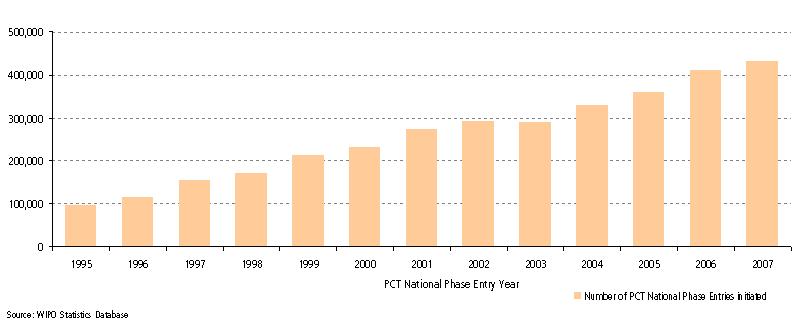
- In 2007, about 430,000 PCT national phase entries were initiated worldwide by applicants, following the PCT international phase.
The graph below shows the annual growth rate of PCT national phase entries since 1996.
PCT National Phase Entries Annual Growth Rates
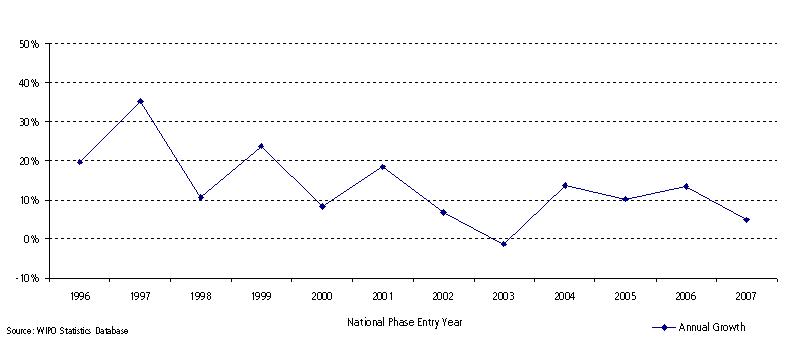
- In 2007, the number of PCT national phase entries increased by 5.1% over 2006.
3 ANALYSIS OF PCT APPLICANTS
3.1 Top 15 Countries of Origin
The table below shows the top 15 countries where applicants filed most PCT international applications in 2008. A statistical table containing all countries is available in the annex. The country of origin is taken to be the country of residence of the first-named applicant in the PCT international application.

- China, Sweden, Canada and Finland gained one place over the previous year.
- The most significant increase in the number of filings originated from Sweden (+12.5%), the Republic of Korea (+12%) and China (+11.9%).
- In 2008, 80.3% of PCT international applications filed originated from the top 8 countries of origin.
- Together, the European Patent Convention Member States account for 55.879 PCT international applications, which is an increase of 3.7% over 2007.
3.2 Indicators of Internationalization
The table below shows, for the Top 50 countries of origin according to their number of PCT international applications (IAs) filed in 20084, the conversion rate of domestic (resident) filings into PCT international application filings and of PCT international application filings5 into PCT national phase entries (NPEs) before designated/elected Offices. It also shows the share of PCT national phase entries for each origin among the total number of foreign (non-resident) filings and among the total number of PCT national phase entries initiated worldwide.

- As an example for understanding the table above, applicants from the United States of America file, on average, 0.23 PCT international applications per resident patent application filing and initiate 2.50 PCT national phase entries per PCT international application filing. Their proportion of PCT national phase entries among their total number of non-resident filings is 72.22%. Among all PCT national phase entries initiated worldwide, 30.44% originated from applicants from the United States of America.
- The share of PCT national phase entries among the total number of non-resident filings is very high for applicants from the United States of America (72.22%), States member of the European Patent Convention, Australia (67.63%), New Zealand (67.47%), Saudi Arabia (60.92%) and Brazil (60.43%). This share is relatively low for applicants from the Republic of Korea (19.82%), Canada (35.60%), Japan (37.31%) and China (41.16%).
- The conversion rate of resident filings to PCT international applications is very high for applicants from certain States member of the European Patent Convention (see footnote 5), Israel (1.61), Australia (1.37) and Singapore (1.25) and relatively low for applicants from the Russian Federation (0.02), China (0.04), the Republic of Korea (0.06) and Japan (0.09).
3.3 PCT and Developing Countries
The table below shows, among developing countries, the top 20 where applicants filed most PCT international applications in 2008.
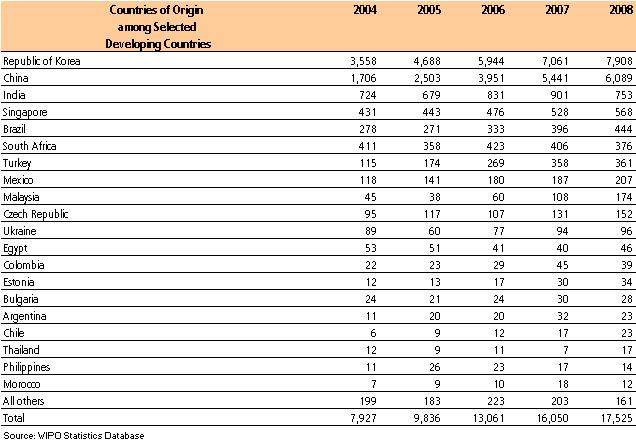
- As reflected in the statistical table in the annex, the number of PCT international applications filed by applicants from developing countries and least developed countries is low compared to the number of PCT national phase entries at their patent Offices.
3.4 Top 20 PCT Applicants
The table below shows the top 20 PCT applicants based on the number of PCT international applications published in 2008.