WIPO China: Shenzhen–Hong Kong–Guangzhou Tops the Innovation Clusters
According to the Global Innovation Index 2026 published by the World Intellectual Property Organization (WIPO), Shenzhen–Hong Kong–Guangzhou ranks first among the world’s top 100 innovation clusters. Over the past five years, on a fractional-count basis, the cluster accounted for 120,095 international patent applications filed under the Patent Cooperation Treaty (PCT) and 215,866 scientific articles, and recorded 7,328 venture capital deals.
The data show that the cluster’s PCT applications are concentrated in information and communication technology (ICT). Patents come mainly from companies and scientific articles mainly from universities, and about three-quarters of the cluster’s articles involve organizations outside the cluster.
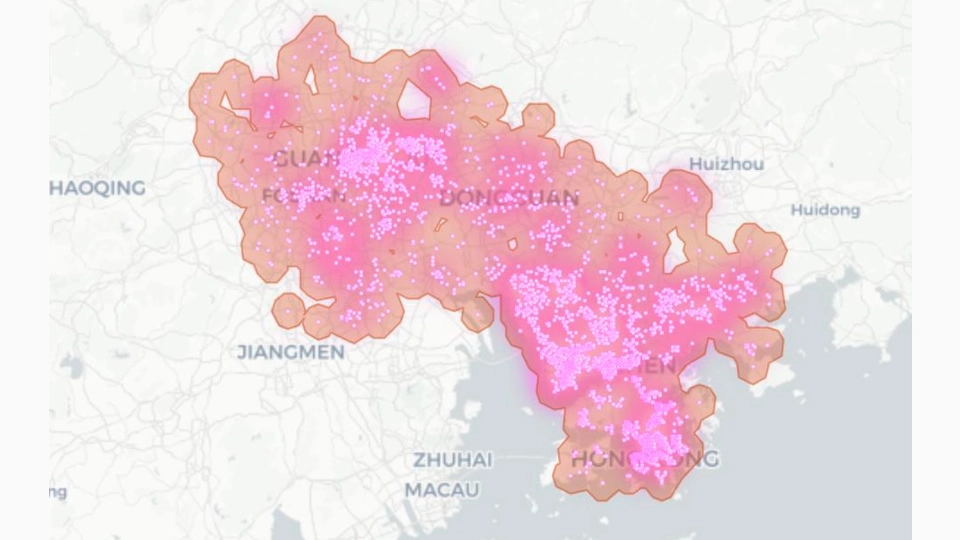
1. Ranking and scale
Shenzhen–Hong Kong–Guangzhou is a “multi-cluster” covering the Pearl River Delta region centred on Shenzhen, Hong Kong and Guangzhou, with an estimated population of about 53.16 million (53,163,094). In the 2026 ranking of the world’s top 100 innovation clusters, it ranks first on the strength of its combined performance across three indicators: PCT applications, scientific publications and venture capital deals.
| 指标(五年合计)/ Indicator (five-year total) | 唯一计数 / Unique count | 分数计数 / Fractional count | 每百万人口 / Per 1 million inhabitants |
|---|---|---|---|
| PCT 国际专利申请(件)/ PCT applications | 122,752 | 120,095 | 2,259 |
| 科学出版物(篇)/ Scientific publications | 396,967 | 215,866 | 4,060 |
| 风险投资交易(笔)/ Venture capital deals | 7,328 | — | 138 |
Unique counts include every patent or article involving a local inventor or author. Fractional counts apportion each patent or article according to the share of local contributors, which avoids double-counting across clusters. Unless otherwise stated, figures in this article are fractional counts.
2. An industry-driven patent landscape
The cluster’s patenting is highly concentrated in ICT. Digital communication accounts for 27% of PCT applications and computer technology for 17%, together more than 40%. Audio-visual technology and electrical machinery, apparatus and energy account for 7% each, telecommunications for 6%, and measurement and medical technology for 3% each.
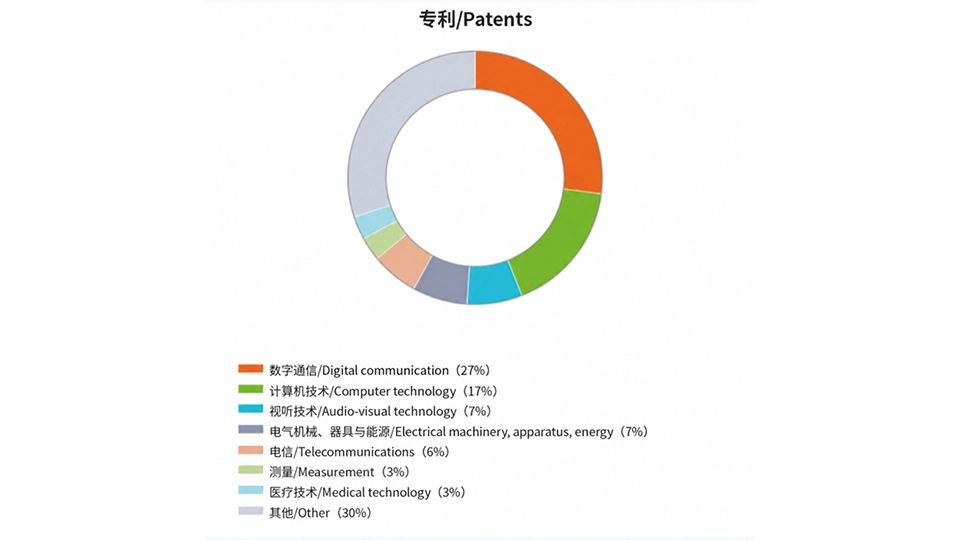
By applicant, top PCT applicants play a particularly prominent role. Huawei ranks first with 31,544 applications, or 26% of the cluster’s PCT applications. ZTE (7,745) and OPPO (7,568) rank second and third with 6% each. Together the three account for close to 40%, and all are companies in communications and smart devices.
| 排名 / Rank | PCT 申请人 / PCT applicant | 申请量(件)/ Applications | 占比 / Share |
|---|---|---|---|
| 1 | 华为 / Huawei | 31,544 | 26% |
| 2 | 中兴通讯 / ZTE | 7,745 | 6% |
| 3 | OPPO | 7,568 | 6% |
3. A university-based research foundation
Compared with PCT applications, the cluster’s scientific output is more evenly distributed across fields. Engineering (17%), chemistry (16%) and technology (14%) are the top three; physics and mathematics account for 9%, and biochemistry and biotechnology, earth sciences and clinical medicine for 8% each.
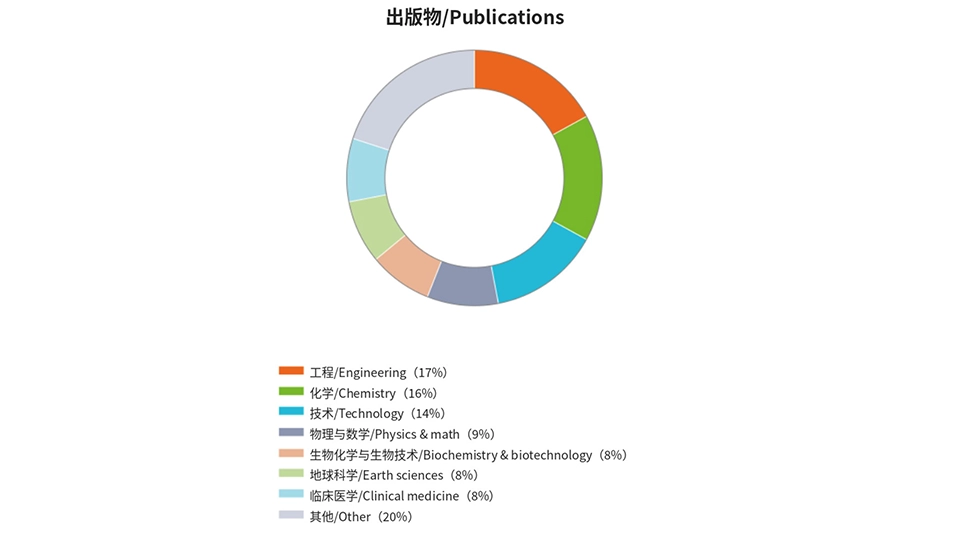
Universities are the main producers of scientific articles. Sun Yat-sen University ranks first with 18,150 articles (14%), followed by South China University of Technology (13,508, 10%) and Shenzhen University (7,707, 6%).
| 排名 / Rank | 发文机构 / Publishing organization | 论文数(篇)/ Articles | 占比 / Share |
|---|---|---|---|
| 1 | 中山大学 / Sun Yat-sen University | 18,150 | 14% |
| 2 | 华南理工大学 / South China University of Technology | 13,508 | 10% |
| 3 | 深圳大学 / Shenzhen University | 7,707 | 6% |
The top three PCT applicants are all companies, and the top three publishing organizations are all universities.
4. Two patterns of collaboration
In external collaboration, PCT applications and scientific articles follow markedly different patterns.
Patenting is largely local. Over the five years, 95,053 of the cluster’s PCT applications had multiple inventors, and 5,034 of these involved inventors outside the cluster, about 4% of all applications. The main collaborating locations are Shanghai–Suzhou, Beijing and Singapore.
Research, by contrast, is deeply embedded in external networks. Of 394,279 multi-author articles, 293,345 were produced with organizations outside the cluster, about 74% of all articles. The main collaborating locations are Beijing, Shanghai–Suzhou and Wuhan.
Taken together, about 96% of the cluster’s PCT applications involve no inventors from outside the cluster, while about 74% of its scientific articles involve outside organizations. The top three collaborating locations for articles are all other innovation clusters within China, while those for patents include Singapore.
5. Size and intensity
By total output, Shenzhen–Hong Kong–Guangzhou ranks first in the world; by innovation intensity, meaning innovation output relative to population, it ranks 44th.
Per million inhabitants, the cluster records 2,259 PCT applications, 4,060 scientific articles and 138 venture capital deals. Its population of about 53.16 million is an important basis for its lead in total output, and also means there is room to raise output per capita.
WIPO publishes rankings by both size and intensity to show cluster performance from different angles: the former reflects the absolute volume of innovation activity, the latter its density.
6. Reflecting this year’s theme: Powering entrepreneurs at the frontier of science
The theme of the Global Innovation Index 2026 is “Powering entrepreneurs at the frontier of science.” The data for Shenzhen–Hong Kong–Guangzhou offer a useful case for examining this theme.
Over the five years, the cluster recorded 7,328 venture capital deals, or 138 per million inhabitants. Venture capital links university research with corporate technology development and is an important bridge from research to market.
Here, universities produce a large volume of openly collaborative research, companies continue to build globally oriented patent portfolios, and venture capital provides resources for new firms to grow. The concentration of all three within the same geographic area makes innovation possible.
9 de noviembre de 2026