
While traditional valuation methods, such as cost, market and income approaches, have their merits, they can offer limited assessment of the potential and uncertainty associated with early-stage technologies. In addition, they overlook the strategic flexibility and timing considerations crucial in technology transfer decisions. Contrastingly, the real options method offers a forward-looking framework that incorporates the dynamic nature of IP assets and the strategic choices they present.
Real options valuation recognizes that IP assets, similar to financial options, possess the potential to generate value beyond their immediate applications. It embraces the notion that opportunities embedded within IP assets can evolve, adapt and unlock significant value over time. By integrating the concept of options into the valuation process, you can gain a more comprehensive understanding of the intrinsic value and risk associated with IP assets.
Within the realm of real options valuation, two popular approaches have emerged: the Black-Scholes model and the binomial option pricing model (BOPM). These approaches provide quantitative and visual frameworks, respectively, to assess the value of real options embedded within IP assets.
In this section, we introduce the Black-Scholes model, and the decision tree analysis of the BOPM, highlighting their strengths and applications within the real options framework. By understanding and employing these real options methods, you can embrace the uncertainty and flexibility inherent in early-stage IP assets, unlock hidden value within IP portfolios, and optimize your efforts to commercialize your technology.
The Black-Scholes model
The Black-Scholes model is a mathematical framework used for option pricing. It was originally developed by economists Fischer Black and Myron Scholes in 1973 (Black and Scholes, 1973). Over time, the Black-Scholes model has been adapted and extended for use in valuing real options, including for IP.
In the context of IP valuation, the Black-Scholes model has been extended to incorporate real options as the flexibility of, or opportunities associated with, an investment or business decision. Real options valuation recognizes that the value of an IP asset goes beyond its immediate cash flows and includes the potential for future strategic, operational or financial benefits.
The Black-Scholes model considers the characteristics of the IP asset, such as its expected cash flows, volatility, time to expiration and risk-free interest rate, to estimate its value. This allows for a quantitative assessment of the flexibility and potential upside of an IP asset, which can inform investment decisions, licensing negotiations or portfolio management.
It is important to note that while the Black-Scholes model provides a useful framework, it hinges on many assumptions and is subject to limitations. This raises the question of applicability in IP valuation, given that explicit or implicit assumptions are made about probability distributions of outcomes, volatility, the absence of transaction costs and credit risk. Real-world applications of the model therefore require careful consideration of these factors, and adjustments to account for specific circumstances and market conditions.
The binomial option pricing model
The BOPM is a versatile approach within the real options methodology and is well-suited for assessing the value of early-stage IP. It was developed as an extension of an earlier model by Cox, Ross and Rubinstein (Cox et al.,1979). The BOPM provides a structured approach to assess the value of options.
Benefits and features of the binomial option pricing model
Early-stage IP valuation can be inherently uncertain, with strategic decisions evolving over time. The BOPM’s adaptability with regard to distinct strategic choices, and its capability to handle uncertainty, make it particularly relevant. Imagine it as a versatile tree, branching into various potential futures, where each branch represents a different path that could be taken as your IP changes value over time.
To harness the power of the BOPM, you will need to consider several critical factors:
Current value of the IP asset (Vt) – as the estimated present value of your IP, this is your starting point. You can determine it through methods like the market approach (comparing it to similar IP assets in the market) or the income approach (based on projected cash flows). It sets the foundation for your valuation.
Price at which the IP can be bought or sold – this refers to the cost or investment required for a specific action related to the IP. For example, if you are pondering IP licensing, this could be the licensing fee or terms. If you are considering further IP development, it might encompass development costs. The specific price varies depending on the strategic decision you are evaluating.
Risk-free interest rate (r) – this reflects the opportunity cost of investing in the IP instead of a risk-free asset. You can use interest rates on government bonds or other low-risk securities as a proxy.
Time remaining until the option expires – this parameter indicates the expected duration until the technology becomes obsolete or loses its competitive advantage, or a significant event such as patent expiration occurs. Measure this parameter in years, aligned with the validity of the strategic option tied to the IP.
The asset’s price volatility (σ) – estimating volatility, especially for early-stage IP, can be challenging. You may rely on historical data or market expectations as sources for this estimate.
In Figure 2, we visualize a horizontal recombinant binomial tree, illustrating the stages of IP development and providing associated formulas for IP value calculation at each node.
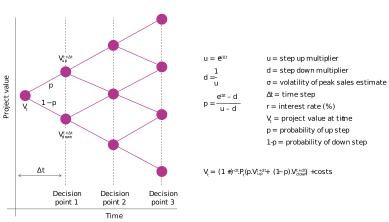
The binomial tree shows our start point on the left-hand side, with branches extending towards the right. In this layout, the decision points are shown as vertical dashed lines. These intersect with nodes that indicate where potential future values of the IP asset can be determined, and where probabilities, expected values and option values can be calculated.
The key concept is that, as you move from left to right across the tree, you are progressing through time, considering the various stages or decision points, and evaluating the IP’s potential value at each of these points. The final calculation at each leftmost node represents your estimate of the IP’s value given particular strategic options.
Using the binomial option pricing model
When using the BOPM, you can take the following steps.
Step 1: Set up the binomial tree – first imagine the initial node at the top of the tree (left-hand side) as representing the current value of your IP asset (Vt). This is the starting point. From this node, two branches emerge: one moving upwards (indicating a potential increase in IP value) and the other moving downwards (indicating a potential decrease in IP value).
Step 2: Estimate future values – consider each node as you move down the tree. These nodes correspond to decision points or stages in the development or commercialization of your IP. At these nodes, you can estimate the potential future value of your IP asset.
Step 3: Calculate probabilities – at each node, you can calculate the probabilities of the IP asset either going up (by, for example, achieving milestones, demonstrating the prototype’s functionality) or going down (by, for example, facing setbacks, failing regulatory approval). These probabilities are essential for assessing the likelihood of different outcomes.
Step 4: Calculate the expected value – moving further down the tree, you can calculate the expected value at each node. The expected value is like a weighted average of the values at the next node. This average considers both the upward and downward branches, weighted by their respective probabilities. It helps you gauge the potential value of the IP at that point in the future.
Step 5: Calculate the option value – simultaneously, you can determine the option value at each node. The option value is calculated by comparing the expected value with the price at which the IP asset can be bought or sold. This reflects the intrinsic value of the strategic option associated with the IP at that stage.
Step 6: Calculate the present value – repeat these calculations for each node, moving from the final nodes (furthest down the tree) back to the initial node (the top of the tree). As you progress upwards, you can continuously compute expected values and option values, incorporating probabilities and future IP values along the way.
The BOPM is a valuable framework for valuing options linked to IP assets, especially in their nascent stages. It empowers you to evaluate early-stage IP and make informed decisions about investment and licensing strategies.
Given the inherent uncertainty in early-stage IP valuation, engaging experts in IP valuation and financial modeling using the BOPM is critical. In particular, sensitivity analyses are essential for assessing how changes in parameter values impact your valuation results. In addition, collaborating with industry experts and conducting market research can provide valuable inputs, enhancing the robustness of your valuation.
Advantages
The method recognizes the value of adaptability and strategic decision-making linked with early-stage IP. It empowers technology transfer managers to evaluate various options, like licensing, commercialization or further development, while considering uncertainties and evolving market conditions.
Unlike traditional valuation methods, the method considers not just the intrinsic value of an IP, but also the additional value derived from its adaptability and future potential. This holistic perspective provides a more comprehensive understanding of an early-stage IP asset’s potential value.
Technology transfer managers benefit from valuable insights that assist in making informed choices about IP commercialization, investment and licensing strategies. The method quantifies the value of different options, helps assess risk-return trade-offs, and supports efficient resource allocation.
The method acknowledges that the value of IP assets evolves over time, and accounts for potential future developments. This creates a realistic and dynamic framework for valuation, which is particularly valuable in the context of early-stage IP.
Disadvantages
The method may require advanced financial modeling skills and computational resources. It can therefore pose challenges for technology transfer managers without a background in finance or accounting.
The accuracy of results hinges on the precision of input variables such as cash flow projections, volatility or dispersion estimates, and interest rates. Estimating these variables for early-stage IP can be uncertain and subjective, potentially leading to inaccuracies.
Early-stage IP often lacks historical data and market comparables, which can pose challenges in estimating variables and making reliable projections.
The method relies on making significant assumptions and judgments about the probabilities of different scenarios. This introduces subjectivity and bias into the valuation process. Technology transfer managers must carefully consider these assumptions and ensure they align with the specific characteristics of the IP being valued.
Considerations when using the real options method
When using the real options method, you should also consider the following:
Seeking expertise – by collaborating with professionals experienced in IP valuation, financial modeling and real options analysis. Their expertise can help you navigate the complexities of the real options method effectively.
Conducting sensitivity analysis – to assess how changes in key assumptions and variables affect valuation results. This can help you understand the robustness of the valuation and identify critical factors influencing the outcome.
Combining approaches – because, while the real options method offers valuable insights, it is best used alongside other valuation methods like income, cost and market approaches. Combining multiple perspectives like this enhances the reliability and credibility of the valuation.
Carrying out continuous monitoring – recognizing that early-stage IP valuation is a dynamic process. It is important to regularly reassess and update the valuation as new information becomes available, market conditions evolve, and the IP asset progresses through different stages of development.
Consider benefits and limitations – While it offers a forward-looking approach to IP valuation, it may require advanced financial modeling skills and computational resources. Be prepared to address these challenges.
Seek expertise and collaboration – Collaborate with professionals experienced in IP valuation, financial modelling, and real options analysis. Their expertise can help navigate the complexities of the real options method effectively and enhance the robustness of your valuation.
Conduct sensitivity analysis – To assess how changes in key assumptions and variables affect valuation results. This can help you understand the robustness of the valuation and identify critical factors influencing the outcome.
Combine approaches for comprehensive valuation – Consider combining the real options method with other valuation methods, such as income, cost, and market approaches. Combining multiple perspectives enhances the reliability and credibility of the valuation.