
The cost method estimates the value of a new IP technology by quantifying all relevant costs incurred in its development. The basis for cost-based valuation falls under three categories:
Creation costs – the cost to produce or create the IP.
Replacement costs – the cost to acquire comparable IP with similar utility.
Reproduction costs – the cost to develop a new IP with the same features, functionality and attributes as the IP under evaluation
Regardless of the category, costs typically include:
R&D costs – for sourcing raw materials, consumables, and prototyping.
Costs of IP protection – for engaging patent agents, filing patent applications and paying maintenance fees.
Labor costs – salaries of the R&D team (pro rata) and any outsourced skills needed for the project.
Site costs – for equipment, laboratory space and direct overheads.
Taxes – if applicable.
The cost method is often the first approach used by companies and universities when attempting to value their technologies. It is easy and efficient because the costs are typically well known. However, there is often a large discrepancy between the cost of developing a technology (to the creator/seller), and the perceived value of that technology (to a seeker/buyer). Consequently, the value of an IP to a buyer, compared to sunk costs of the developer, may be:
Lower – if, for example, the buyer has a limited capacity to meet market demand due to the resources available to them (e.g., a pre-investment startup).
Higher – if, for example, the buyer’s own pipeline product has failed regulatory approval, and the IP for sale contains the features necessary to address these regulatory conditions. Acquisition of this IP may buoy confidence in the buyer’s stock.
Ultimately, understanding the value of the technology to the prospective buyer can drastically shift the price point.
Advantages
All data required to calculate costs incurred should be readily available since research projects must be costed in advance and monitored during execution.
When focused on historical events, the valuation does not require forecasting, projections or other information on future markets.
Disadvantages
The valuation does not consider the future economic value of, or benefit from, an IP. The value of the IP will vary depending on:
The cost in time and capital, to develop the IP from the laboratory scale to a market-ready product.
The application area or end-use market in which it will be deployed.
Capabilities of the user (e.g., licensee) in marketing, reach, access to distribution channels, brand value, etc.
The costs incurred by an inventor in developing an IP are likely to be different from those incurred by the target buyer or licensee, in terms of access to skilled personnel, capital and equipment.
During license negotiations, some licensees may object to a valuation using the cost method; for example, in the case of a university, where the research funding was likely a grant and therefore “free,” costing the university nothing. However, this argument is invalid since funders will expect an equitable return on their investment, often in non-monetary terms. In addition, the cost of creation does not consider the value of the time invested.
When is the cost method most useful?
Despite the disadvantages outlined in the box showing "Advantages and disadvantages of the cost method", the cost method may be useful in the following scenarios:
Valuation of an extremely early-stage technology, potentially in a nascent market sector, where no reasonable market forecasts can be projected and where no comparable transactions have occurred. In this scenario, it is challenging to use either the income or market approaches to valuation.
When multiple collaborators are unable to decide how the economic or other returns arising from a collaboration should be shared. The amount that each party has invested in the collaboration, including in-kind contributions (access to equipment, expertise, know-how, etc.) identified through the cost method can be employed to guide any division of benefits, to define a minimum return of investment the IP owner may expect from a deal.
Litigation, where estimation of damages includes the costs of development.
Recovery of discretionary investments made by academic institutions.
Valuation of internally developed software or databases.
When estimations made using other valuation methods can be complemented by an additional data point.
When no other approach can be applied, such as when the asset has no physical form (e.g., software) and the value may be derived mostly from its function or utility to the user, buyer or licensee.
(1)IVS 105: Valuation Approaches and Methods, in IVSC, 2022 .
Calculating the reproduction cost
According to International Valuation Standard (IVS) 105, the reproduction cost method is only appropriate when “(a) the cost of a modern equivalent asset is greater than the cost of recreating a replica of the subject asset, or (b) the utility offered by the subject asset could only be provided by a replica rather than a modern equivalent”.
Calculating the reproduction cost should be a straightforward exercise. The value should reflect all costs associated with the development of an IP to its current state. In doing this calculation, it may be helpful to utilize the structure and approach taken by research-intensive universities in costing research projects. Universities tend to use a full economic costing
Full economic costing focuses on three types of cost:
Directly incurred costs – which are directly linked to the project, including consumables or staff hired directly for the purpose of the project.
Directly allocated costs – which occur regardless of whether or not the research project is conducted. These may include the cost of staff employed full-time by the university, who work on the project in addition to their other duties. It also includes estate costs such as the use of space and equipment.
Indirect costs– which are not project specific, and are often termed central or distributed services. These include human resources, information technology and finance functions.
Using the cost method
When using the cost method, you should carry out the following steps:
Step 1: Calculate directly incurred staff costs – for research and support staff such as technicians, who will work on a specific research project on a full- or part-time basis.
Step 2: Calculate directly incurred non-staff costs – which occur as a result of the project being carried out, and cover travel and subsistence, reagents and other consumables, equipment purchases and data storage costs.
Step 3: Calculate directly incurred research facility costs – for using university research facilities for the purpose of the project. Most universities have precalculated facility use rates, which can be accessed through a university’s research services.
Step 4: Calculate directly allocated staff costs – for the time spent by staff members (often a principal investigator) who are working on a grant funded project, but are not funded by the grant itself.
Step 5: Calculate directly allocated estate rates – usually precalculated by a university’s research services.
Step 6: Calculate indirect costs – also precalculated by a university’s research services team.
Step 7: Calculate IP filing and maintenance – both background IP maintenance and arising IP filing need to be included in the calculations.
It is important to note when costs were incurred, so as to appropriately account for inflation or deflation. All data needed to calculate the value of IP using the cost method should be available and considered sufficient for estimating the reproduction cost. However, the valuer may wish or need to make further amendments. For example, if the IP in question is the result of multiple projects, or developed by a consortium of collaborators, the associated costs arising from these entities and projects need to be considered to accurately estimate the true cost of the IP.
A venture philanthropy deal was struck between the Cystic Fibrosis Foundation Therapeutics (CFFT) and CombinatoRx, a Cambridge-based company with a proprietary screening technology for identifying synergistic combinations of approved drugs to treat new diseases. CFFT agreed to pay CombinatoRx USD 13.8 million in research expenses and fund up to 75 percent of clinical development expenses through Phase 2a, on the first potential product candidate.
If the milestone was successfully reached, CFFT would make a payment to cover the remaining 25 percent of costs. CombinatoRx paid 100 percent of the costs from Phase 2b to NDA approval but received milestone payments for success.
On successful commercialization, CombinatoRx would make royalty payments to CFFT that were capped at two times CFFT’s payments to CombinatoRx. CFFT would therefore double its money.
Source: Stevens, 2016
As demonstrated in case study 1, developers of IP can successfully use a cost method to provide a valuation and create successful deals. However, as the cost method does not consider either the future potential value of the IP to potential licensees, or represent the cost to a licensee of developing the IP, it can lead to inefficient negotiations, as demonstrated below.
Negotiation challenges in cost-based valuation
A cost-based valuation is divorced from the future value of a technology which could have repercussions on negotiations between an IP developer and licensees.
Consider the situation illustrated in Figure 1. The licensor has invested USD 50,000 to develop a technology and decides that a fair return on their investment is 100 percent, which translates into a further USD 50,000 margin. They therefore offer the technology for license for USD 100,000.
Licensee A needs to use the technology and starts negotiating for rights to it. They base their negotiating position on their ability to, as an alternative solution to IP acquisition, engineer a new technology around the licensor’s IP. They estimate that the re-engineering will take a year to complete, at a cost of USD 20,000. In addition, they would need to license a third-party IP at a further cost of USD 20,000 (replacement cost USD 40,000). The year’s delay to market entry is estimated to cost a further USD 20,000 (the opportunity cost). Using the cost method only, their valuation of the technology is therefore USD 60,000, so they decide to walk away from the negotiation.
Licensee B also needs to use the technology, but their estimate of the costs to engineer round the licensor’s IP themselves are quite different. They estimate that the re-engineering will take two years and cost USD 40,000, that they would need to license a third-party IP at a cost of a further USD 40,000 (replacement cost USD 80,000) and that the development and adaptation for market readiness will cost a further USD 40,000. Their valuation of the technology is therefore USD 120,000. Since the asking price is only USD 100,000, they rapidly agree to the terms, with the licensor unknowingly leaving USD 20,000 on the table.
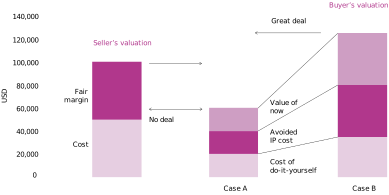
In this example, the seller did not calculate two particularly key pieces of information for either licensee A or B. These were:
The cost or benefit to the licensee of having the IP – to be explored further in our analysis of the income approach.
The replacement cost – an alternative open to a potential licensee, who has the option of either licensing the IP from the IP owner, or independently recreating new technology with analogous, or better, functionality. As shown in the above hypothetical case study, the replacement cost will be different for different licensees.
The example described here is an example of how subjective the valuation process can be. As a result of this subjectivity, the valuation of the seller’s IP was dramatically different for the two licensing companies.
IP owners often do not have the data or resources to calculate the cost or benefit to a potential licensee for a particular IP. However, there are scenarios in which a potential licensee may be willing to pay a premium. For example:
When recent changes to legislation require a company to quickly find a solution in order to be compliant with regulations.
When a company has been fined due to failing to comply with existing regulations, and therefore needs a solution to avoid further financial and reputational damage.
When a company needs to respond to the entry of a new and disruptive competitor into market.
Considerations when using the cost method
When negotiating IP valuation, you may need to consider the following questions:
Have costs significantly changed (increased or decreased) since the beginning of the research that led to creation of the IP, due to regulatory or technological changes? If so, this may be reflected in a potential licensee’s estimations of replacement costs.
Are there alternatives in the market that a potential licensee has access to? Do they have a readymade or backup alternative solution?
How likely is it for a potential licensee to design around, and replace, a particular IP? Does the IP owner have specialist technical knowledge, data or background IP that is difficult for another organization to design around their IP?
Gather comprehensive cost data – Ensure that you have access to comprehensive data on all relevant costs incurred in the development of the IP. This includes not only direct costs such as R&D expenses and IP protection costs but also indirect costs such as labor costs and site costs.
Consider all cost categories – Take into account creation costs, replacement costs, and reproduction costs. Each category provides valuable insights into the value of the IP and can help ensure a more accurate valuation.
Be mindful of potential discrepancies – Recognize that there may be discrepancies between the cost of developing the IP and its perceived value to potential buyers or licensees. Consider factors such as market demand, regulatory conditions, and the buyer's own product pipeline when assessing the IP's value.
Use the cost approach judiciously – While the cost approach can provide a useful starting point for valuation, it should be complemented by other methods, especially when negotiating with potential buyers or licensees.
Be transparent in negotiations – During negotiations, be transparent about the basis for your valuation using the cost approach. Clearly communicate the rationale behind the valuation and be open to discussing alternative perspectives or valuation methods.