
The market approach, also known as the comparables approach, compares precedent transactions of technologies similar to the one under consideration for sale or licensing.
Advantages
Valuation is based on actual deals struck for analogous IP and therefore informed by market demand and tolerance.
Arguably, there is a lower degree of reliance on uncertain financial projections into the future.
Disadvantages
The approach does not make a direct estimate of the future economic value or benefit which might be derived from the IP by a particular licensee. This suggests that a well-established buyer with a strong brand and capabilities may attribute a higher value to the technology than has been determined using the comparable valuation method. The converse is also possible.
IP by definition is unique, and it is difficult to find sufficiently similar comparables.
Sourcing data on previously concluded deals (those that are not subject to litigation in particular) can be expensive.
Data will reflect the perceived market value for an IP, for the buyer involved in the deal at a particular point in time, suggesting that:
The value of a specific IP will vary from one acquirer to another depending on their circumstances.
Interest and trends within sectors fluctuate leading to bubbles, peaks and valleys, which may distort the true value of the IP.
Using the market approach
When using the market approach, you may find it useful to take the following steps.
Step 1: Analyze and characterize the IP being valued – so as to identify the most relevant comparable deals to inform the valuation. This activity is similar to that undertaken when conducting a qualitative evaluation of the IP (see “Valuing intellectual property for technology transfer”). Key factors to evaluate include:
Type of IP
Technical sector
Features and functionality
Maturity
Age – useful lifetime remaining
IP status and strength
Regulatory process
Step 2: Review the common financial terms of a license deal or IP assignment – once you have established a fundamental understanding of the IP under scrutiny. These terms may cover the following:
Upfront payments
Ongoing pre-commercial payments
Reimbursement of patent cost
Milestone payments
Minimum annual royalties
Research support
Sharing of sublicense income
Manufacturing
Sharing of earned royalties or profit from sales
Step 3: Create a comparison matrix – as a useful tool for visualizing the similarities and differences between commercialization transactions. An example of a comparison matrix is discussed in case study 2, and shown in Table 3. When a matrix is populated with all pertinent data, you can compare transactions and estimate the “market value” of the IP.
Step 4: Search for a set of the most relevant transactions – which may be sourced from:
Internal/free sources of information, including:
Previous deals completed by a research institution. Deals conducted by an IP owner for comparable IP (in terms of functionality, features and benefits) in the past, for example, are likely to be highly useful sources of data. You can obtain further detail and nuance from speaking directly with colleagues who conducted the transactions.
Professional networks. Contacts from TTOs, academic research departments, industry, and professional service firms such as patent attorneys may provide relevant transactional data from their own records or experiences. To reduce the possibility of conflicts of interest, and confidentiality or legal breaches, contacts can be encouraged to share anonymized or aggregated information.
Commercial subscription services. Several searchable databases collate IP licensing and assignment deals for several sectors. These deals include those conducted between companies, and between companies and universities, in several jurisdictions. Providers of these services collect information from various sources including:
Their own network of technology transfer and innovation professionals.
Company filings to regulators, such as the United States Securities and Exchange Commission.
Patent databases that also collate company financial information, such as market capitalization, annual reports and others.
Court cases where the outcome of litigation (typically, IP infringement) is published.
Company or institution press releases.
Technology transfer associations. These are organizations created to support member institutions in their IP management and technology transfer efforts. Most members are research-intensive universities and public sector research institutions, and companies. Two of the largest and most established associations that collect data from their members on licensing activities and deal terms are:
The Association of University Technology Managers, which aggregates on its platform anonymized and searchable data, available for members free of charge or at a reduced price, and charged at market rate for non-members.
The Licensing Executives Society International, which publishes annual royalty rates and deal terms surveys as reference guides for those valuing IP or seeking to determine defensible terms for a deal they are negotiating.
Step 5: Populate your comparison matrix with the relevant data – once you have identified several comparable deals using the sources described above.
Step 6: Determine a defensible value for the IP under scrutiny – using this relevant data. It may be necessary to carry out additional research, such as analyzing patent claims, or reviewing the range and nature of IP in each transaction, to ensure that transactions collated in the matrix remain relevant.
Considerations when using the market approach
Even when you are able to find transactional terms for similar IP, it is inevitable that there will still be gaps in the data that require some extrapolation. To this end, you should consider the following factors:
Quality of IP relative to comparables – if the IP being valued is found to be superior in performance and ease of adoption compared to other IP, these advantages should be leveraged in negotiations, to secure more favorable financial terms.
Maturity – a later-stage, more developed technology that has successfully passed regulatory hurdles indicates that the buyer may not have to invest heavily to translate the IP into a market-ready product. For some sectors such as biotechnology and medical technology, gaining regulatory approval indicates a significant reduction of risk, and therefore cost, suggesting that the IP under negotiation is promising and of high value. These advantages should be leveraged in negotiations.
Exclusivity – an exclusive license is an agreement between the IP owner and the licensee in which no other party other than the named licensee can exploit the IP rights. Typically, exclusive licenses command a price premium, since they exclude other potential licensees and buyers.
Fields of use and geographical reach – in both cases, the broader the field and reach, the higher the fee that may be negotiated.
Timing of a deal – interest in particular technological fields and sectors can change from year to year, affecting the perceived value of IP, and the price that buyers are prepared to pay. Looking at data set trends, in reports published by the Licensing Executives Society International for example, can be a good way to understand market demand and identify fluctuations in the valuation of IP (see LESI, 2022).
Remaining useful lifetime of an IP – this is the time remaining until the IP rights associated with comparable transactions expire, and directly relates to an IP’s maturity. For example, a patent with 10 years left before expiration is typically more valuable than a patent with only one year to go. It is important to note that IP expiration does not uniformly result in a decline in value. Factors such as the reputation of the marketing company, proprietary trade secrets and access to rare raw materials can continue to uphold an IP’s value even after it has formally expired, making each valuation unique.
Some of these considerations are illustrated in case study 2.
A market approach using a comparison matrix was used to determine reasonable financial terms for the licensing of an early-stage battery technology (IP-1), and incorporated the following steps.
Step 1: Gathering comparable transaction data – using a combination of data sources, including internal deals previously carried out by the TTO, and several analogous deals collated in subscription databases. This enabled the TTO to identify several relevant transactions which could be compared against IP-1.
Step 2: Creating a comparison matrix of collected data (see Table 1) – for a systematic evaluation of key transaction details.
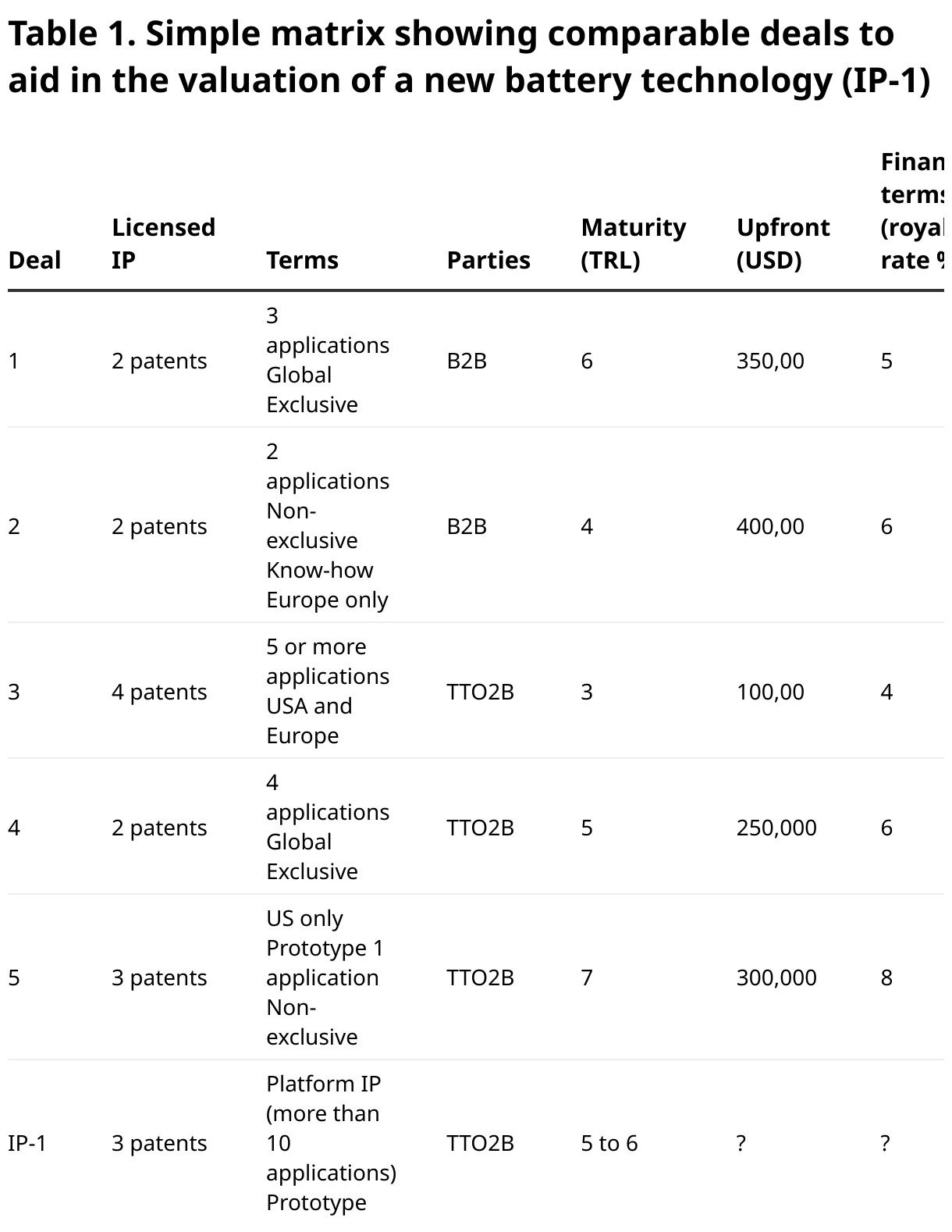
Step 3: Analyzing comparable deals – upon analyzing the comparable deals within the matrix, several key insights emerged:
Maturity comparison. Deals 2 and 3 were identified as involving IP assets at an earlier stage of development compared to the deal for IP-1, suggesting that the IP-1 TTO might be able to negotiate more favorable terms. On the other hand, deals 1 and 5 were similar in maturity to IP-1.
Business to business (B2B) advantage. Transactions involving B2B deals appeared to offer more lucrative terms for the IP owner, indicating either better negotiation acumen or a deeper understanding of market opportunities and licensee capabilities.
Role of exclusivity. It was unclear as to whether exclusivity significantly influenced deal size.
Technology development costs. Unfortunately, the available data did not provide insights into technology development costs, making it challenging to understand the licensee's financial burden.
Clustering of deal values. This was observed to some degree for IP assets with similar maturity levels.
Step 4: Determining reasonable financial terms for IP-1 – using comparable deals in the matrix. This incorporated the following:
To reconcile contrasting observations on maturity, a maturity-adjusted approach was adopted.
As B2B deals offered more lucrative terms, the dynamics of the market for IP-1 and the capabilities of potential licensees were considered.
As deals 1 and 5 closely matched the maturity level of IP-1, the financial terms of these deals were used as a benchmark for IP-1, providing guidance on a substantial upfront fee during negotiations.
While the data suggested overall trends, factors like exclusivity and technology development costs were recognized as variable, and were therefore addressed on a case-by-case basis, considering the unique interests of potential licensees and the markets in which they operated.
Based on the analysis of the comparison matrix and considering the insights gained, the financial terms determined as reasonable for negotiating the license of IP-1 were: an upfront fee of USD 250,000–350,000; milestone fees of USD 100,000–150,000; and a royalty rate of 5–8 percent.
Step 5: Addressing other factors – such as the field of application, the geographic markets in which the IP assets are protected, and whether these align with the markets where IP-1 is intended to be utilized or sold, and the license duration – all of which needed to be addressed on a case-by-case basis. These considerations depended on the specific interests of the potential licensee, their business objectives, and the markets in which they were operating.
This valuation approach is favored by those who seek a valuation approach validated by the market. Under this framework, an IP asset is worth what someone else is willing to pay for it (or for something similar).
The utility of the market method relies on the capacity of the valuer to collect data on several relevant analogous transactions. The more relevant data points you have, the better your valuation estimation will be.
The range of “market values” that emerges from using this method allows for some flexibility during negotiations, buoyed by the fact that the information shared can be verified by the buyer/licensee.
To identify relevant deals, it is important to grow your network to include professionals at the coalface of technology transfer deals, including TTOs, investors, industry professionals and associations.