
Since 2016, the Global Innovation Index (GII) has sought to identify innovation clusters using a bottom-up approach. This approach disregards administrative or political borders and instead pinpoints those geographical areas where there is a high density of inventors and scientific authors. The resulting clusters often encompass several municipal districts, sub-federal states and sometimes two or more countries.
In this 2025 edition of the GII, three innovation metrics are employed in identifying WIPO’s top 100 global innovation clusters:
location of inventors listed in published patent applications;
location of authors listed on published scientific articles;
and – new to this edition, location of firms in receipt of venture capital (VC) investment.
For patents, this method relies on published applications under WIPO’s Patent Cooperation Treaty (PCT). PCT patents offer a useful basis for analyzing patents globally. The PCT system applies a single set of procedural rules and collects information based on uniform filing standards. This reduces any potential bias that might arise from using data collected from multiple national sources. The patents selected were published over the most recent five-year period available – between 2020 and 2024 – to minimize any volatility that might occur between years.
As a second step, scientific publications from the Web of Science’s Science Citation Index Expanded (SCIE) were incorporated. The SCIE provides detailed coverage of the world’s most impactful academic journals. Science and technology fields were the focus of the analysis, while articles from the fields of social sciences and humanities were disregarded. In addition, scientific publications are limited solely to articles of original research. This excludes other published items, such as meeting abstracts, conference summaries or paper briefs. As with PCT filings, the most recent five-year period for which data are available was also used for the SCIE – that is, publication years 2019 to 2023.
To further enrich the understanding of innovation activity at the cluster level, this edition introduces VC deal count data. By integrating information on startups, unicorns or other commercial ventures in receipt of VC funding, and counting the number of VC deals by location, we have this year been able to expand our lens to include entrepreneurial and early-stage innovation activity. This allows the cluster ranking to reflect not only scientific and inventive outputs, but also innovation finance and startup outcomes.
For VC data, we utilized PitchBook’s Data Venture Capital Database
The WIPO PCT patent data set consists of approximately 1.3 million patent applications published between 2020 and 2024, containing 4.2 million inventor addresses. For the SCIE, the data set comprises 8.2 million articles published between 2019 and 2023, containing 28.5 million listed author addresses. For PitchBook VC Capital Database the data set consists of 66,755 locations between 2019 and 2023, containing 236,046 deals. The geocoding process for the addresses used in this report is as follows. PCT inventor addresses were geocoded using the Environmental Systems Research Institute (ESRI) ArcGIS World Geocoder service. In cases where the ESRI results were ambiguous or insufficiently accurate, the city name was extracted from the address string and matched against entries in the GeoNames Gazetteer database – a global dataset of approximately 48,000 geocoded cities. If the extracted city did not match any record in GeoNames, we then attempted to geocode the city name directly using the World Geocoder service.
This same city-matching approach was applied to SCIE author addresses and VC deal locations. In both datasets, the addresses were already provided in a pre-parsed format, which significantly improved our ability to match them using the GeoNames database. For SCIE and VC city names that could not be matched using GeoNames, we again attempted to geocode the city name using ESRI’s World Geocoder.
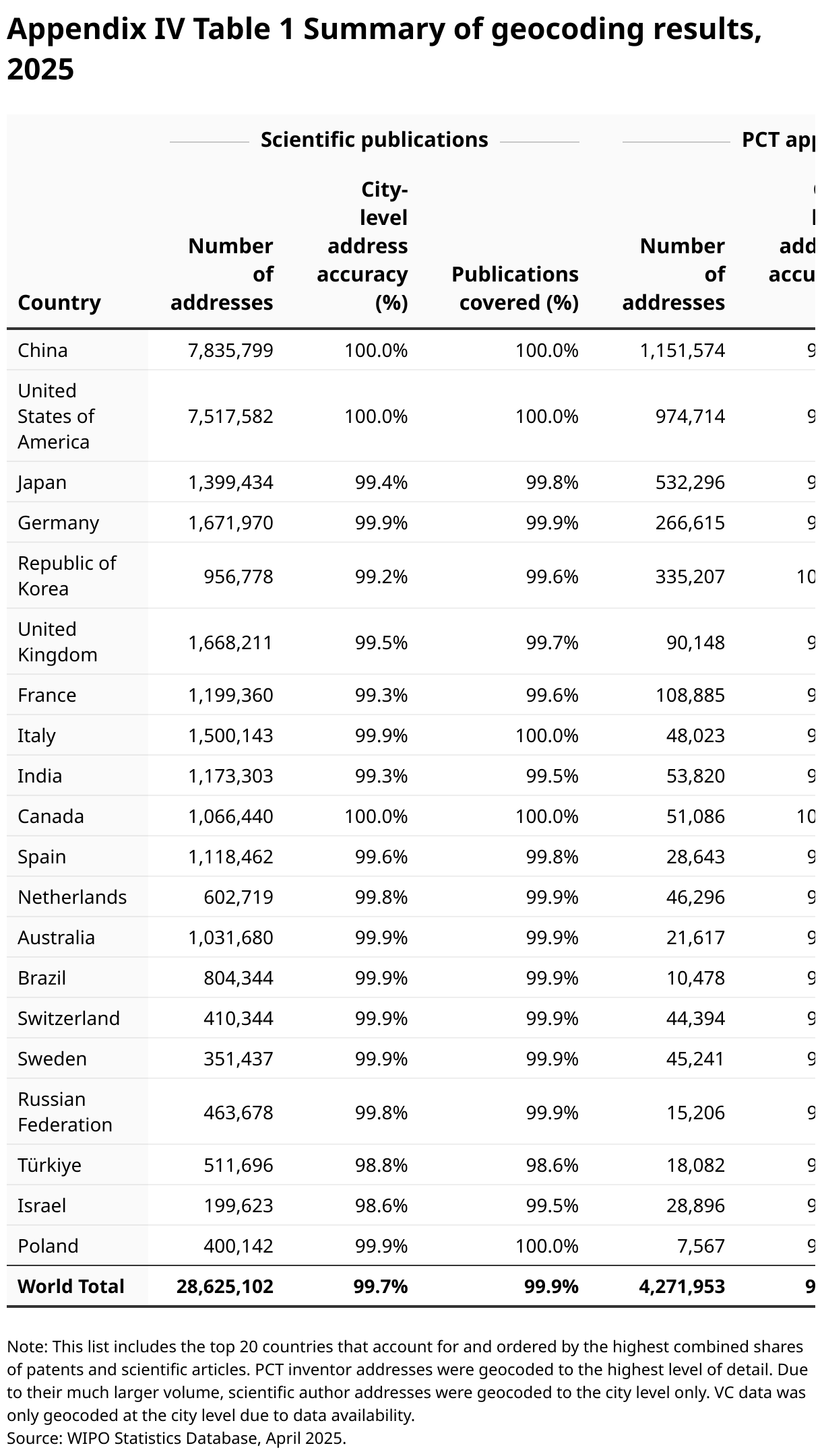
Overall, 98.4% of inventor addresses were geocoded at either the city level or a more accurate level, whereas 99.7% of scientific author addresses were geocoded at the city level. For VC data, 97.1% of VC deals were geocoded at the city level or better. Appendix IV - Table 1 summarizes the geocoding results for the top 20 countries, which together account for the majority of inventor, scientific author and VC deal addresses. As this table shows, the coverage of geocoded PCT inventor addresses across all 20 countries is above 99 percent. Similarly, coverage of scientific author addresses and VC deal addresses was also high, above 99%.
Addresses were clustered by applying the density-based spatial clustering of applications with noise (DBSCAN) algorithm. This algorithm requires predefined radius and density parameters. As in previous years, a radius of 15 km and a density of 4,500 listed inventors/authors was applied. Equal weight was given to inventors and authors by expressing data points as a share of total inventor and author addresses, respectively. Given that the number of scientific articles far exceeds the number of patents, cluster identification based on the raw data points would have resulted in clusters shaped predominantly by the scientific author landscape.
The locations of VC deal counts were excluded from the initial cluster formation process because of their relatively high geographical isolation, that is to say, the greater average distances between data points, compared to PCT inventors and scientific article authors. Including the VC data during clustering risked introducing noise and distorting the resultant clusters. To address this, we instead assigned VC data to clusters post hoc by overlaying the finalized cluster boundaries onto the VC firm locations and allocating each VC deal to the cluster into which it geographically falls.
This clustering step resulted in an initial list of 246 clusters. After review, neighboring clusters were merged if the edge of one cluster was within 3–5 km of another and where the co-author/co-inventor relationships were higher than for any other relationship with any other cluster or non-cluster points. A total of 18 clusters met these criteria, with mergers reducing the overall number of clusters identified to 237.
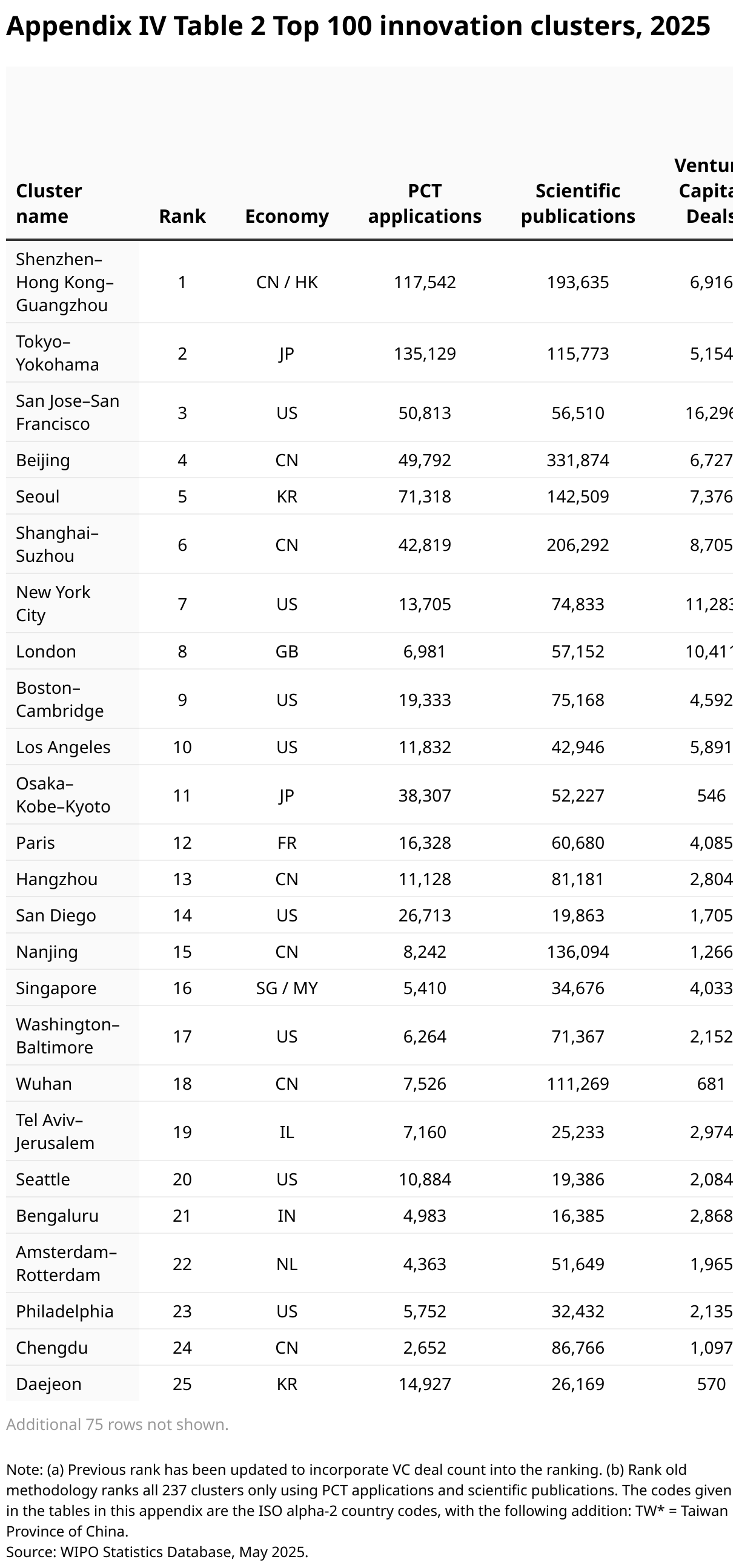
The remaining 237 clusters were then ranked by first counting the number of patents, scientific articles and VC deals within a given cluster. The numbers were calculated using fractional counting, and then global shares were derived for each innovation metric. These global shares were then aggregated, using equal weights, within each cluster and then used for the overall ranking (Appendix IV - Table 2).
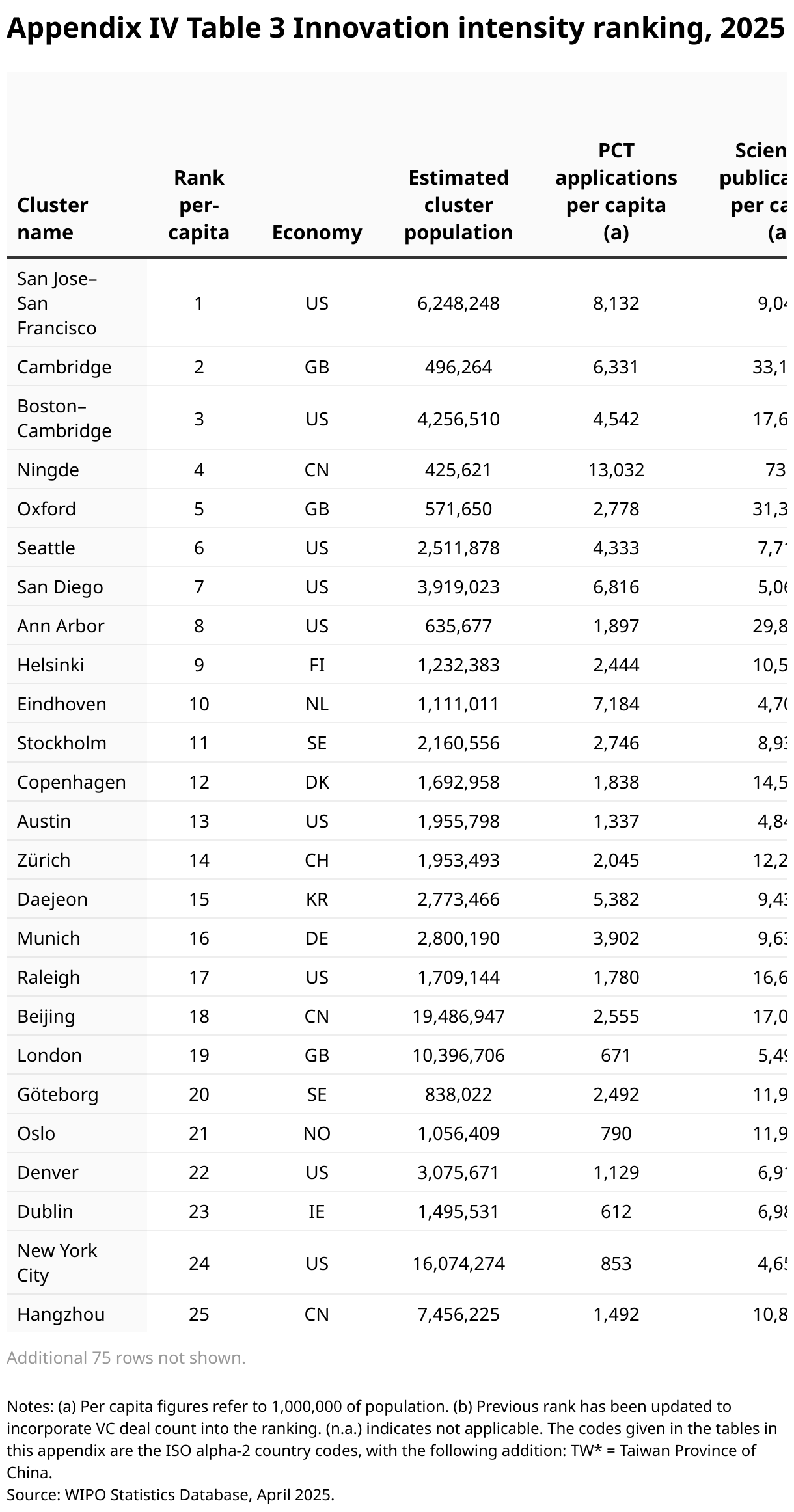
To produce an intensity ranking, the European Commission’s Global Human Settlement Layer (GHSL) population distribution data were matched geographically to the top 100 clusters identified in the overall ranking (Appendix IV - Table 3). Just as with inventor/author geocoded locations, these population data allowed us to define the total population of a cluster using a bottom-up approach. We chose to define a cluster’s area as being the space within 0.05 degrees of each inventor/author location. Overlaying the resultant cluster polygons on top of the population data and aggregating all points which lay within each polygon gave a total population estimate for each cluster. The clusters were then ranked by dividing the total innovation share by population.
To ensure consistency following the inclusion of VC data in this year’s cluster rankings, we retroactively applied the same methodological change to last year’s rankings. Specifically, VC deal counts from 2018 to 2022 were geographically assigned to the cluster boundaries used in the previous edition of the GII, and the rankings recalculated accordingly. These updated rankings form the basis for the “Rank Change” indicators presented in the main section. For reference, Appendix IV - Table 2 provides the top 100 cluster rankings calculated using the previous methodology (i.e., excluding VC data), allowing users to compare how individual clusters would have ranked using only PCT patents and scientific articles as input variables.
References
Bergquist, K. and C. Fink (2020). The top 100 science and technology clusters. In Dutta, S., B. Lanvin and S. Wunsch-Vincent (eds), The Global Innovation Index 2020: Who Will Finance Innovation? Ithaca, NY, Fontainebleau and Geneva: Cornell University, INSEAD and World Intellectual Property Organization. Available at: www.wipo.int/edocs/pubdocs/en/wipo_pub_gii_2020.pdf.
PitchBook (2024). Global VC Ecosystem Rankings: An update on our location-based VC Ecosystem Rankings. September 23, 2024. Available at: https://pitchbook.com/news/reports/q3-2024-pitchbook-analyst-note-global-vc-ecosystem-rankings.
Schiavina, M., S. Freire, A. Carioli and K. MacManus (2023). GHS-POP R2023A – GHS population grid multitemporal (1975–2030). Brussels: European Commission, Joint Research Centre (JRC). Available at: http://data.europa.eu/89h/2ff68a52-5b5b-4a22-8f40-c41da8332cfe.