Introducing the WIPO Patent Momentum Indicator (PMI)
7 يوليو 2025

The WIPO Patent Momentum Indicator (PMI) is a data-driven metric that captures the pace and intensity of innovation in global patenting, helping identify fast-evolving technologies across industries. Developed to highlight technology areas of interest by analyzing both the volume and growth rate of patenting activities, PMI offers insights into the momentum of patenting activity, making it a valuable metric for stakeholders interested in tracking technological advancements.
PMI calculation
The calculation of PMI consists of three key steps: measuring patent activity level, assessing patent activity dynamics, and computing the total patent momentum score1.
1. Patent activity level
- Compute the average annual number of published patent families for each technology field over a defined time period (e.g., the past five years).
- Normalize these values using a Z-score to standardize the data and allow for meaningful comparisons.
2. Patent activity dynamics
- Determine the compound annual growth rate (CAGR) of published patent families for each technology field over the same period.
- Normalize the growth rates using a Z-score to ensure comparability across different technology areas.
3. Total patent momentum score
- Combine the normalized scores from patent activity level and patent activity dynamics to derive the patent momentum score.
- The resulting PMI highlights technology fields with the highest levels of innovation activity and growth potential.
Why is PMI important?
The Patent Momentum Indicator (PMI) can be used to identify and assess the level and pace of technological innovation across different fields. It provides a dynamic perspective on patenting activity, helping stakeholders make informed decisions:
- Tracking emerging innovations: PMI tracks emerging innovations in fast-growing technology areas, providing early signals of advancements. By combining activity levels and growth trends, it offers a more comprehensive measure of innovation momentum than traditional patent indicators.
- Enhanced decision-making: Businesses, policymakers, and investors can use PMI insights to allocate resources effectively and support high-momentum technologies.
- Complementing other metrics: PMI works alongside other innovation indices to provide a well-rounded view of technological evolution and industry shifts.
Implementing PMI in the WIPO Technology Trends Report 2025
In the WIPO Technology Trends Report on the Future of Transportation, the Patent Momentum Indicator (PMI) was applied to assess patent activity across 16 transport modality-technology trend groupings. This analysis revealed that the highest patent momentum was seen in Sustainable Propulsion and Automation and Circularity in Land transport, as well as Communication and Security technologies in both Land and Space transport.
This application of PMI underscores its utility in identifying technology areas with significant innovation impact, guiding stakeholders in strategic decision-making and investment.
Methodology walkthrough
Example 1: Calculating PMI for Occupational Health and Safety technologies
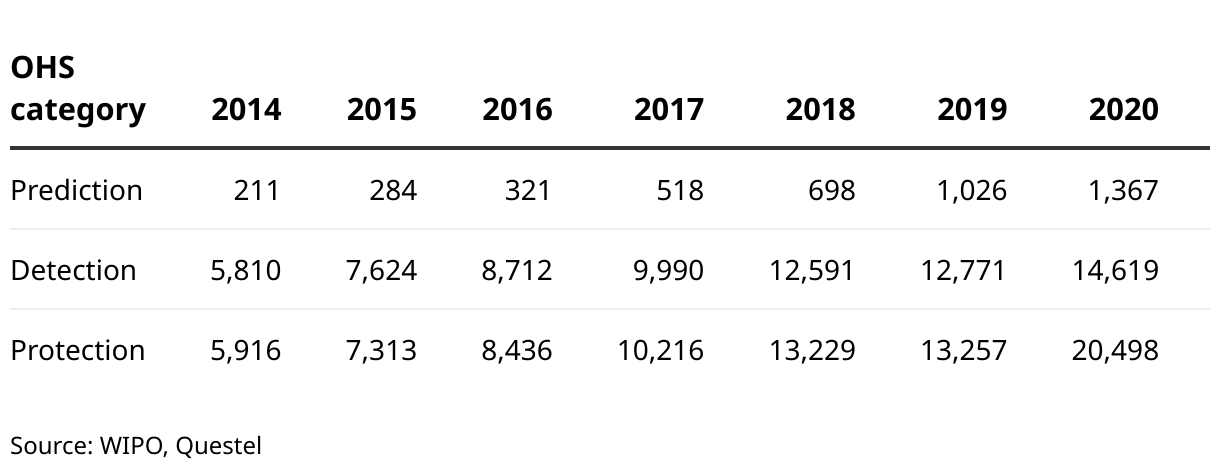
This case study demonstrates the application of the PMI methodology to three technology categories in the WIPO Patent Landscape Report on Occupational Health and Safety – Prediction, Detection, and Protection – using patent data from 2014 to 2023.
i. Data overview
The dataset consists of the annual number of patent families for each OHS category over a 10-year period (2014–2023):
ii. Calculation steps
- Average annual patent activity
- Compute the mean patent families for each OHS category over the time period.
- Compound Annual Growth Rate (CAGR)
- Measure the annualized growth rate from 2014 to 2023.
- Z-score normalization
For each metric:where mi is the raw metric (average or CAGR), and μm, σm are its cross-group mean and standard deviation.
- Total PMI score
- Sum up normalized scores of activity and growth
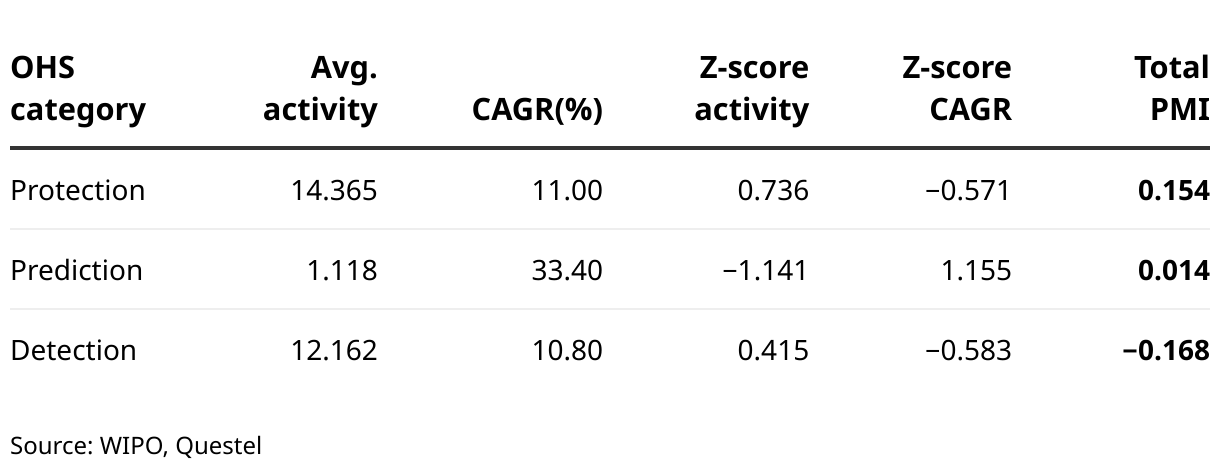
- Results
iii. Interpretation
-
The OHS Protection category exhibits the highest momentum (+0.154) due to its large volume of patent activity, despite moderate growth.
- The OHS Prediction category shows rapid growth but lower absolute patent activity, resulting in a neutral PMI (+0.014).
- The OHS Detection category has solid patent activity but modest growth, yielding a slightly negative PMI (–0.168).
Example 2: A deep dive on PMI for OHS Prediction technology areas
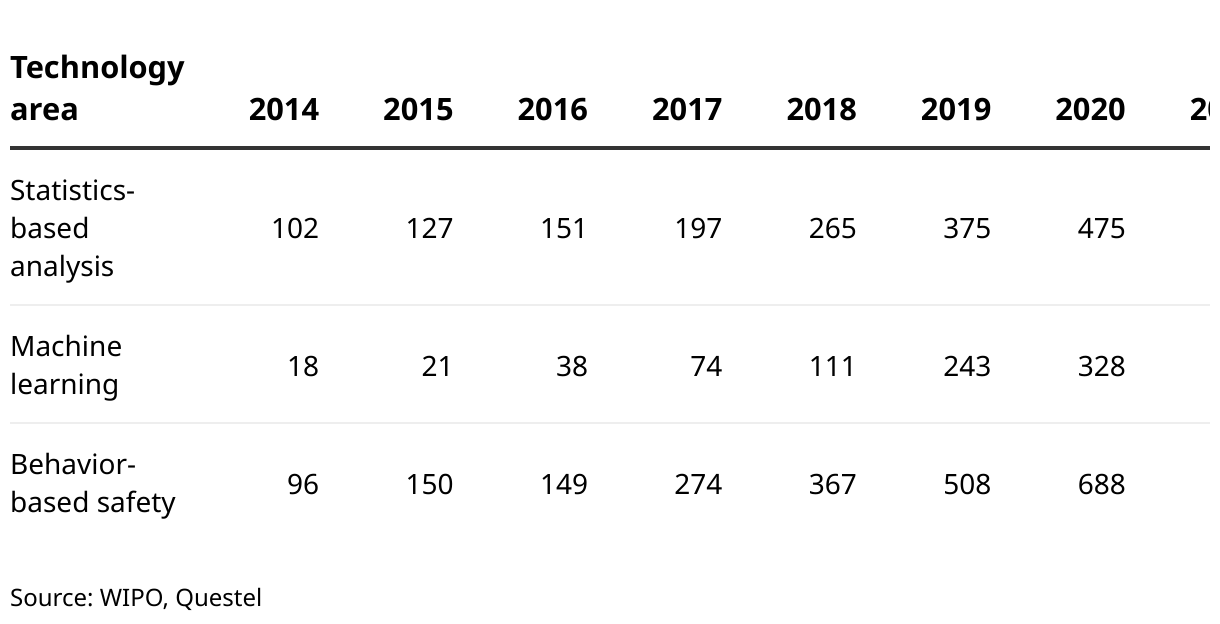
This section applies the PMI methodology to the three technology areas within the OHS Prediction category (Statistics-based analysis, Machine learning, and Behavior-based safety) using their annual patent-family counts from 2014 to 2023.
i. Data overview
ii. Results
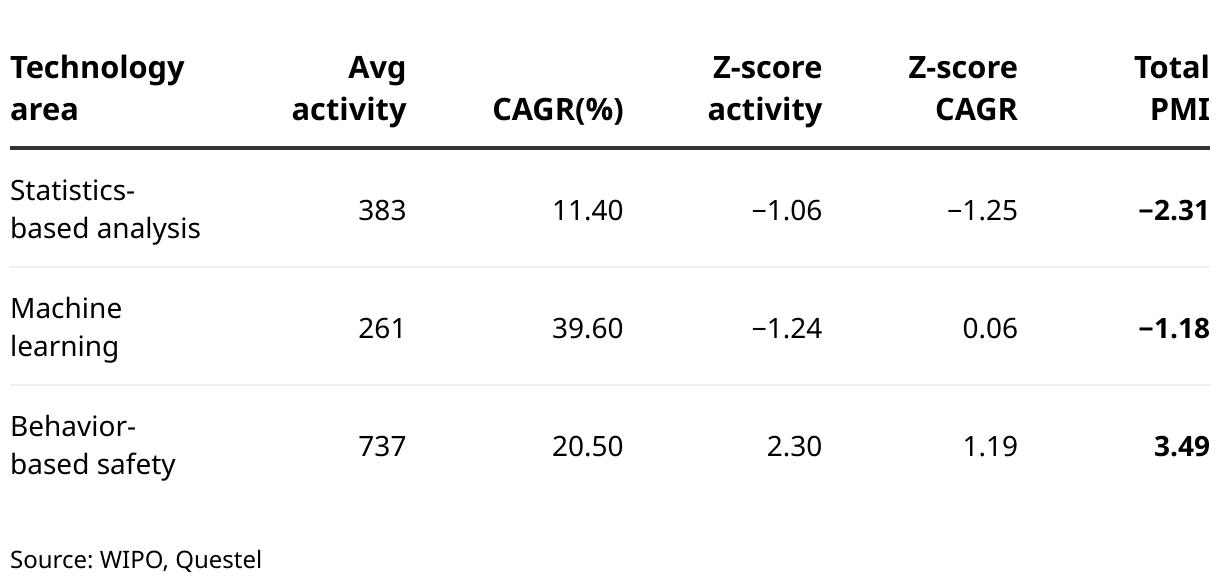
iii. Interpretation:
- Behavior-based safety leads with the strongest PMI (+3.49), reflecting both high patent volume and robust growth.
- Machine learning demonstrates rapid expansion but lower overall volume, resulting in a moderate PMI (–1.18).
- Statistics-based analysis shows steady growth yet lower volume, yielding the lowest PMI (–2.31).
This deep dive underscores how Behavior-based safety has become the dominant driver of innovation in the OHS Prediction category, offering strategic guidance for R&D focus and investment.
Example 3: PMI across OHS industries
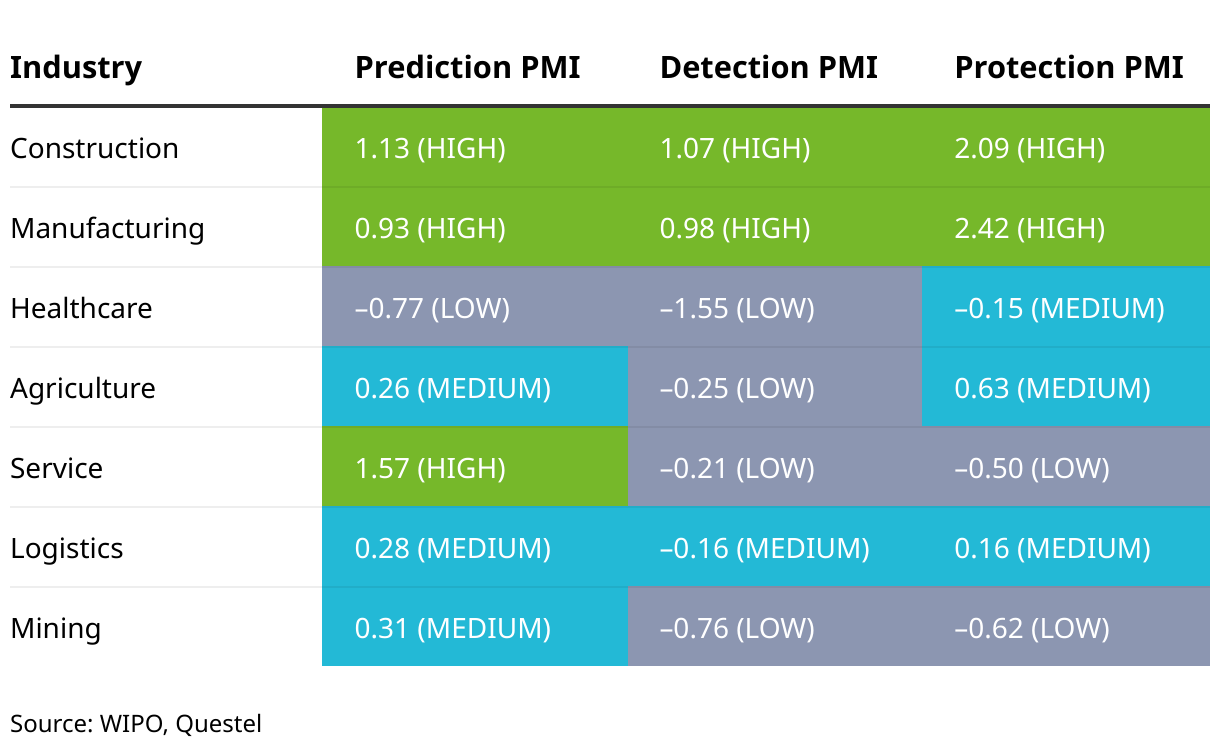
This case study explores innovation trends in OHS technologies across seven industries – Construction, Manufacturing, Healthcare, Agriculture, Service, Logistics and Mining – for each of the three OHS categories (Prediction, Detection, and Protection). Using PMI, we highlight which industries and technologies are leading the charge and where opportunities lie, based on patent filings from 2014 to 2023.
Both metrics were standardized (using Z-scores) and summed up to create the PMI score for each industry-technology pair. Scores are classified as:
- HIGH: PMI > 0.81 (top innovators)
- MEDIUM: –0.18 to 0.81 (steady progress)
- LOW: PMI < –0.18 (slower activity)
i. Results
The table below shows PMI scores and classifications for each industry-technology combination, revealing where innovation is thriving.
ii. Interpretation
Data analysis using PMI shows that the Manufacturing and Construction industries are the powerhouses for OHS technology innovation, whereas Prediction technologies in the Service sector is a growth opportunity to watch, and both the Healthcare and Mining industries appear to be lagging behind.
Conclusion
By integrating both patent activity levels and patent growth dynamics, the WIPO Patent Momentum Indicator offers a nuanced approach to tracking innovation across various technologies. Its ability to highlight fast-evolving technological fields makes it a useful tool for industry leaders, policymakers, and researchers seeking to navigate the future of innovation.
Footnote
[1] Michael Freunek and Matthias Niggli, "Introducing DynaPTI—constructing a dynamic patent technology indicator using text mining and machine learning," Frontiers in Artificial Intelligence, vol. 6, 2023, https://doi.org/10.3389/frai.2023.1136846.