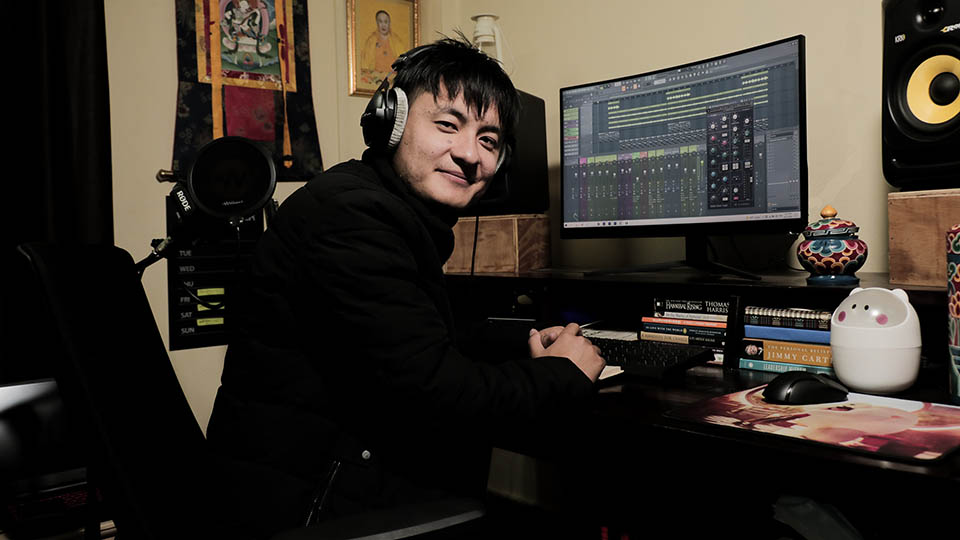
As a playback singer, Pema Deki’s voice was famous with the Bhutanese audience long before they discovered her face. Now a fully recognized independent singer, Pema uses a blend of Bhutanese heritage and Western accents in slow, evocative, and emotional songs. She is also a strong advocate of copyright and an awareness-raiser for artists.

Music has always been part of Pema’s life. She was first enthralled by the songs from Disney’s animated movies and listened to beloved old Bollywood songs, which were her father’s favorites. “We would sit in the living room and listen to those songs, even though I could not understand the lyrics,” she said.
“I never stopped singing,” she added, although like many young artists, she had to secure a steady job and went to study journalism in Bangalore, India.
Best Female Playback Singer at the 2010 National Film Award
Back in Bhutan, she took a job with a media outlet, covering fashion and entertainment, and began singing live in pubs. Pema’s talent was soon spotted by a producer from a national TV channel.
“I was singing some old English songs, and he invited me to sing on the national television,” she recalled. “I got so excited and so nervous.”

Although she never dreamed of becoming a full-time singer, since a musical career was unlikely to be economically viable, Pema’s life changed after that event. Shortly after, the movie industry, producers, directors, and composers offered her a role as a playback singer.
Playback singers, also known as ghost singers in Western productions, are singers whose voices are pre-recorded for use in films, allowing actors to lip-sync. They are widely used in Bollywood movies.
Soon, Pema was earning more from her playback singing than from her regular office job, and she switched careers. A year after she started recording, she won the National Film Award for Best Female Playback Singer in 2010.
From Playback Singer to Independent Songwriter
Being a playback singer means remaining unseen. “Nobody knew me until 2015 or 2016. I was always in the studios, but I really enjoyed it,” she said.
Pema started composing songs while in college. Away from home and lonely, she would sit by herself and concentrate on music. “Singing was my only comfort place then.” “It made me happy or emotional, and I could express those feelings.”
Although she kept those first songs tucked away in her laptop, Pema never stopped composing. She later recorded her songs and sold some of them to recording studios for use in movies.
Singing in Front of Royalty
Pema toured all Bhutanese districts and was later sent to perform with other artists in front of Bhutanese communities living in New Zealand, Australia, and Dubai, as part of the King’s birthday celebration events. “He opened doors for us, as after those events, the international Bhutanese community started inviting us to perform in countries such as the United States, Australia, India, Nepal, and Thailand.”
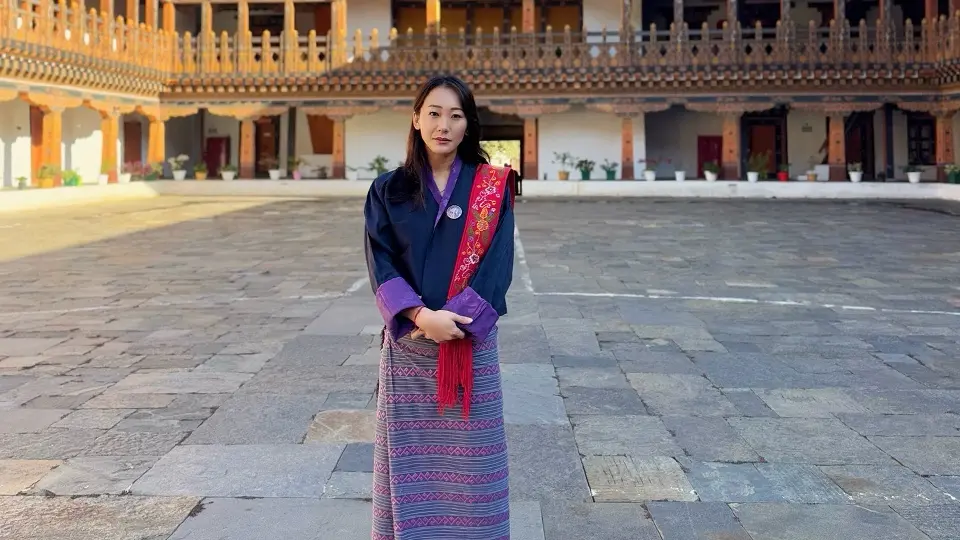
The Bhutanese public is eager to see artists on stage, she said, so they often sing live at celebrations and private gatherings. Some artists perform in front of Bhutan's King Jigme Khesar Namgyel Wangchuck and Queen Jetsun Pema for anniversaries and special occasions. “It's my biggest achievement, although it is very scary at times,” she confessed.
Placing Bhutanese Music in the Global Charts
When the Internet became available in the country, YouTube was a new outlet. She started posting her own music videos. “People got to see our faces, how we sang, how we acted.” This unveiling was not easy. “It was difficult and challenging at first to face the camera, but after a while, I got used to it.”
Bhutanese artists are still building their subscriber base. She has 24,000 subscribers on YouTube, 65,000 on Instagram, and 71,000 on Facebook.
According to Pema, Bhutanese music has crossed borders and is listened to in several neighboring countries. She noted the government is seeking to invite well-known international artists to Bhutan to connect with Bhutanese artists. “Every artist in Bhutan aims to compose songs that could become international hits.”
On 24 January, Ed Sheeran held the first-ever international concert at the Changlimithang Stadium in Thimphu, putting Bhutan on the musical world map for many. “It really helped promote our country and culture and opened the way for other international artists to come to Bhutan,” Pema said.
Dzongkha Songs with and English Pop Flavor
“My compositions are not happy upbeat songs,” she explained. “They are always emotional and sometimes carry a lot of sadness.”
“Singing lets me express my joys, my pains, and my heartaches.” Ups and downs in her life have been a source of inspiration, as well as the influence of international songwriters and singers, such as Adele, Celine Dion, and the Backstreet Boys, who are still her favorites.
She developed a unique tone that blends Western influence with Bhutanese heritage, attracting a young audience. Some say that she was instrumental in popularizing Dzongkha, but she hastily deflates the compliment, explaining that she started to sing in English, and switching to Dzongkha has been a challenge. Somehow, she said, “I made it sound like Western songs.” That blended style was immediately popular among the youth.
Promoting Music Education in Bhutan
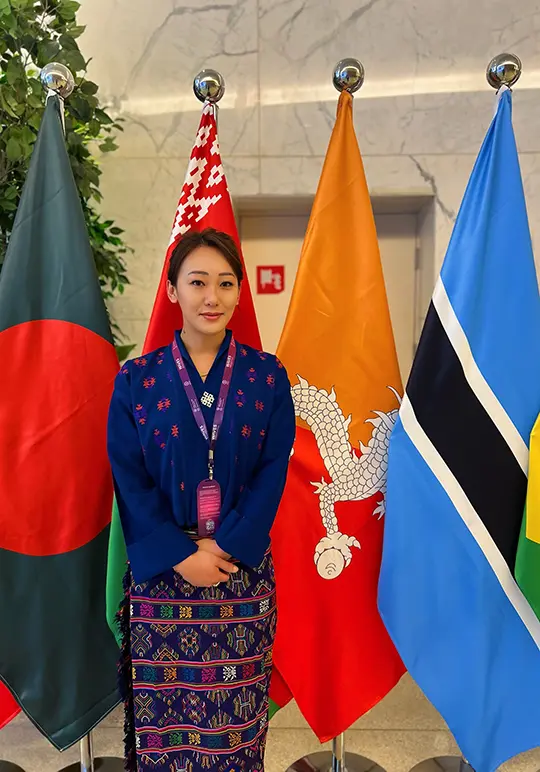
With no formal musical education, Pema is a self-made artist through work and self-training. Bhutan, a small country, had very few professional singers in the 80s and 90s, she explained. Nowadays, private music classes are available, provided by musicians specializing in instruments such as piano, guitar, or drums, but there is still a lack of vocal training.
To address this gap, Pema, with the help of Bhutan’s Department of Media, Creative Industry, and Intellectual Property (DoMCIIP), organized an intensive 10-day vocal training for 20 selected Bhutanese artists, featuring Thomas Andrews, a renowned Western classical expert from India, in September. She is advocating for making music a subject in the regular school curriculum.
From Indian Influence to Rigsar
The Bhutanese musical scene has long been influenced by India. In the late 1960s, a new genre emerged: Rigsar, which translates to “Rig” meaning a tune and “sar” meaning new. According to Pema, it began with the movie industry seeking to break free from Indian music. Rigsar, she noted, is a blend of traditional Bhutanese music and modern pop. “We make sure to keep our traditional tunes, and use traditional instruments, such as drangyen, which looks like a guitar but isn’t one, and very difficult to muster and play.” Traditional instruments also include the yangchen, a hammered dulcimer. “As soon as we use those instruments, the music automatically sounds Bhutanese.”
Pema said that many bands are now successful in the country, using a blend of Western and traditional influences.
Copyright Awareness Slowly Rising in Bhutan
As a playback singer, since it is work for hire, Pema does not retain any copyright. For the songs she writes and records, she registers with DoMCIIP.

She observed that artists are slowly becoming more aware of their rights and are increasingly cautious when granting permission for songs to be used in movies or when performing in concerts. Pema is actively involved in awareness campaigns, like the one conducted over the summer in four districts, but acknowledged that “making artists understand copyright is very challenging.” She underlined the active support of DoMCIIP and their awareness-raising initiatives.
She also pressed for the creation of a music association. “We do not have such an association because we have been singing under the movie industry,” she explained, adding that the further goal is the establishment of a collective management organization (CMO) for efficient royalty collection.
A Voice for Bhutanese Women
After performing over 1,000 playback songs, an activity that she still enjoys, Pema, who describes herself as a mother/singer/artist/composer from the land of the thunder dragon, looks to “take music to the next level.” As a single mother, she said, “Being a mother has changed my life.” “I have been in dark places, but being a mother was the proudest moment.”
Pema is a strong voice for women and children. She worked with the United Nations to produce advocacy and awareness music videos about children’s and particularly girls’ safety, and to help women stand on their own feet. She is committed to making a song once or twice a year to “wake people up.”
Pema was a speaker in the 6th session of the WIPO Live Chat on 19 December 2025, in collaboration with the Bhutan Department of Media, Creative Industry & Intellectual Property (DoMCIIP) of the Ministry of Industry, Commerce & Employment, with support from the Funds-in-Trust Korea Copyright and the Ministry of Culture, Sports, and Tourism (MCST) of the Republic of Korea.