
Design applications worldwide and by region
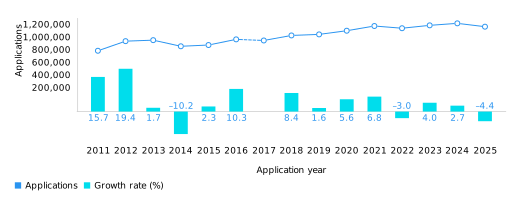 Note: From 2017 onwards, design application data provided by the IP office of China include only those applications for which the necessary application fees have been paid. Because China accounts for most of the global total, this means it is not possible to report the 2017 worldwide application growth rate. World totals are WIPO estimates using data covering 163 IP offices. Totals include applications filed directly at national and regional offices (known as the Paris route), as well as the designations received via the Hague System (where applicable).
Source: WIPO Statistics Database, September 2026.
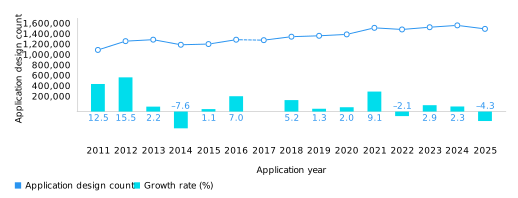 Note: From 2017 onwards, design application data provided by the IP office of China include only those applications for which the necessary application fees have been paid. Because China accounts for most of the global total, this means it is not possible to report the 2017 worldwide application growth rate. World totals are WIPO estimates using data covering 163 IP offices. Totals include designs contained in applications filed directly at national and regional offices (known as the Paris route), as well as designs contained in designations received via the Hague System (where applicable). See glossary for definition of design count.
Source: WIPO Statistics Database, September 2026.
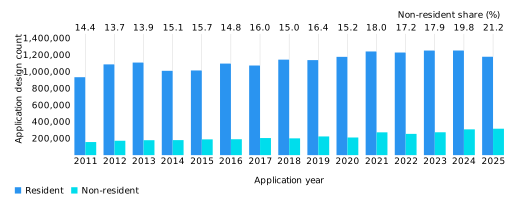 Note: World totals are WIPO estimates using data covering 163 IP offices. Totals include designs contained in applications filed directly at national and regional offices (known as the Paris route), as well as designs contained in designations received via the Hague System (where applicable). See glossary for definition of design count.
Source: WIPO Statistics Database, September 2026.

Design applications by origin
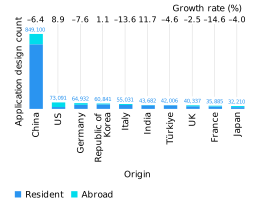
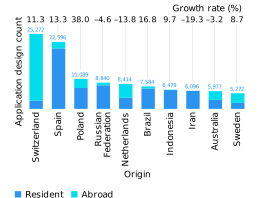 Note: Iran is the Islamic Republic of Iran and Netherlands is the Kingdom of the Netherlands. The origin of a design application is determined by the residence of the first named applicant. An application filed at a regional office is considered to be a resident filing, if the applicant resides in one of that office’s member states. See glossary for definition of design count.
Source: WIPO Statistics Database, September 2026.
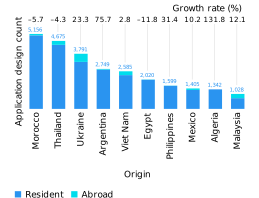
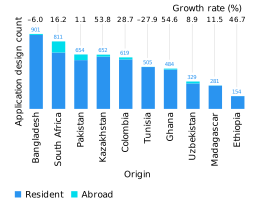 Note: The selected origins are from different world regions and income groups (low-income, lower middle-income and upper middle-income). Where available, data for all origins are presented in statistical table C39 at the end of this section. The origin of a design application is determined by the residence of the first named applicant. An application filed at a regional office is considered to be a resident filing, if the applicant resides in one of that office’s member states. See glossary for definition of design count.
Source: WIPO Statistics Database, September 2026.
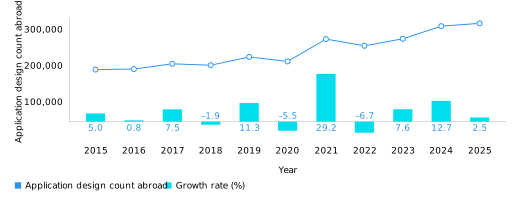 Note: World totals are WIPO estimates using data covering 163 IP offices. Totals include designs contained in applications filed directly at national and regional offices (known as the Paris route), as well as designs contained in designations received via the Hague System (where applicable). An application filed at a regional office is considered to be a resident filing, if the applicant resides in one of that office’s member states. See glossary for definition of design count.
Source: WIPO Statistics Database, September 2026.
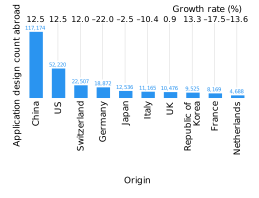
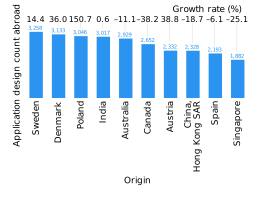 Note: Netherlands is the Kingdom of the Netherlands. The origin of a design application is determined by the residence of the first named applicant. An application filed at a regional office is considered to be a resident filing, if the applicant resides in one of that office’s member states. See glossary for definition of design count.
Source: WIPO Statistics Database, September 2026.
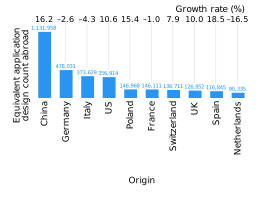
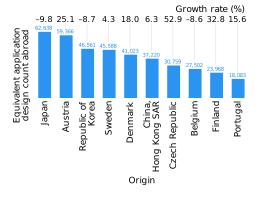 Note: Netherlands is the Kingdom of the Netherlands. The origin of a design application is determined by the residence of the first named applicant. An application filed at a regional office is considered to be a resident filing, if the applicant resides in one of that office’s member states. Applications filed at some regional offices are considered equivalent to multiple applications in the member states of those offices. See glossary for definitions of equivalent application and design count.
Source: WIPO Statistics Database, September 2026.
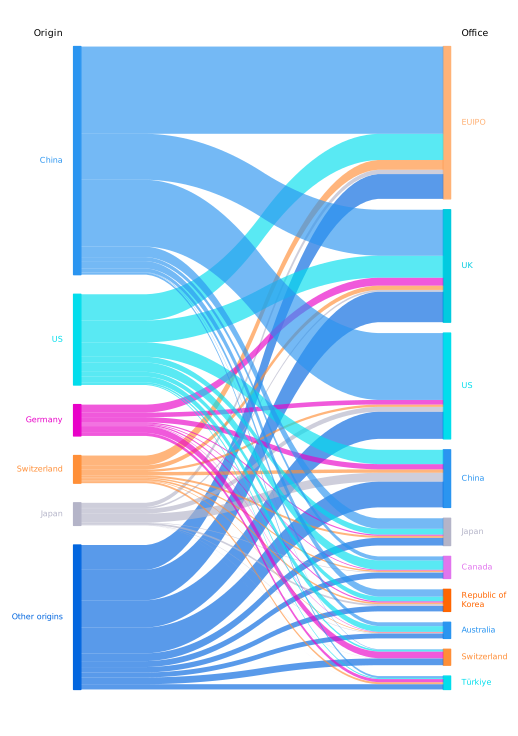 Note: EUIPO is the European Union Intellectual Property Office.
Source: WIPO Statistics Database, September 2026.
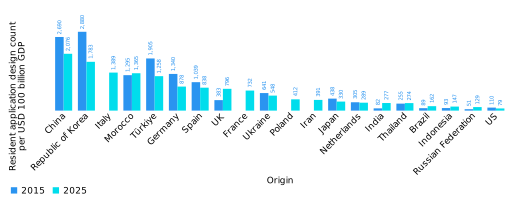 Note: Iran is the Islamic Republic of Iran and Netherlands is the Kingdom of the Netherlands. GDP data are in constant 2021 US PPP dollars. Origins were selected based on the top origins list in terms of application design count and on GDP data availability.
Sources: WIPO Statistics Database and World Bank, September 2026.
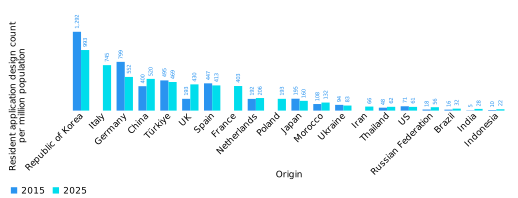 Note: Iran is the Islamic Republic of Iran and Netherlands is the Kingdom of the Netherlands. Origins were selected based on the top origins list in terms of application design count and on population data availability.
Sources: WIPO Statistics Database and World Bank, September 2026.
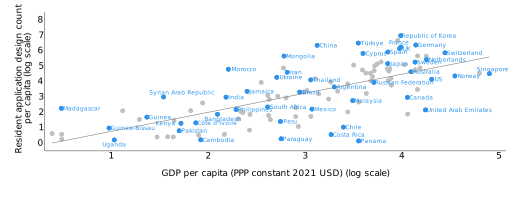 Note: Iran is the Islamic Republic of Iran and Netherlands is the Kingdom of the Netherlands. The selected origins are from different world regions and income groups.
Sources: WIPO Statistics Database and World Bank, September 2026.
Design applications by office
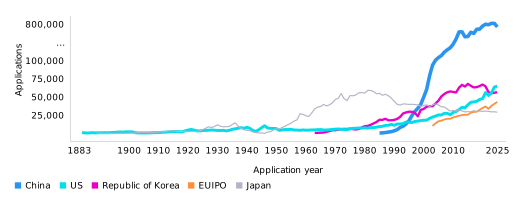 Note: EUIPO is the European Union Intellectual Property Office. The decrease in applications at the IP office of China in 2017 is most likely explained by the new way in which that office counts applications data. Starting from 2017, China’s application count data include only those applications for which the necessary application fees have been paid. Data are based on the numbers of applications filed; this means that differences between single-design and multiple-design filing systems across IP offices are not taken into account. The top five offices are selected based on 2025 totals.
Source: WIPO Statistics Database, September 2026.
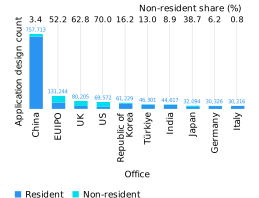
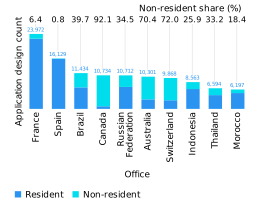 Note: EUIPO is the European Union Intellectual Property Office.
Source: WIPO Statistics Database, September 2026.
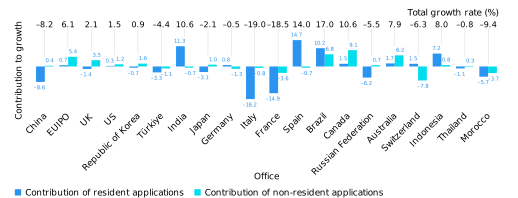 Note: EUIPO is the European Union Intellectual Property Office. This figure shows total growth in application design counts, broken down by the respective contributions of resident and non-resident applicants. For example, total design counts in Brazil increased by 17%, with resident applicants contributing 10.2 percentage points to the overall increase and non-resident applicants 6.8 percentage points.
Source: WIPO Statistics Database, September 2026.
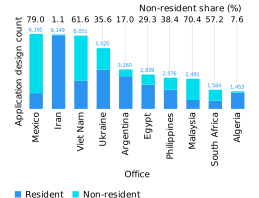
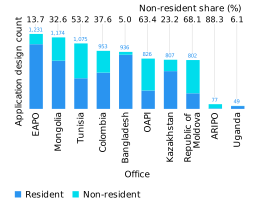 Note: ARIPO is the African Regional Intellectual Property Organization, EAPO is the Eurasian Patent Organization, OAPI is the African Intellectual Property Organization and Iran is the Islamic Republic of Iran. The selected offices are from different world regions and income groups (low-income, lower middle-income and upper middle-income). Where available, data for all offices are presented in statistical table C39 at the end of this section.
Source: WIPO Statistics Database, September 2026.
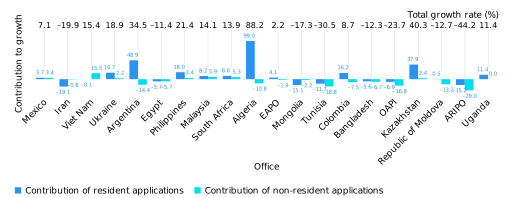 Note: ARIPO is the African Regional Intellectual Property Organization, EAPO is the Eurasian Patent Organization, OAPI is the African Intellectual Property Organization and Iran is the Islamic Republic of Iran. The selected offices are from different world regions and income groups (low-income, lower middle-income and upper middle-income). Where available, data for all offices are presented in statistical table C39 at the end of this section. This figure shows the total growth in design counts, broken down by the respective contributions made by resident and non-resident applicants. For example, the total design count at the IP office of Ukraine grew by 18.9%, with resident applicants contributing 16.7 percentage points to the overall increase and non-resident applicants 2.2 percentage points.
Source: WIPO Statistics Database, September 2026.
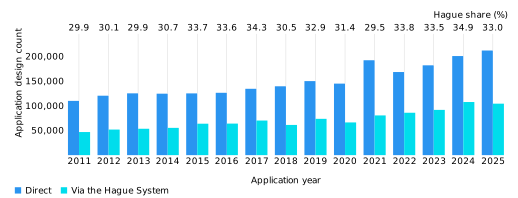 Note: This figure distinguishes between the two filing routes for non-resident activity, namely, the direct route and via the Hague System. See glossary for definition of design count.
Source: WIPO Statistics Database, September 2026.
Design applications by Locarno class and industry sector
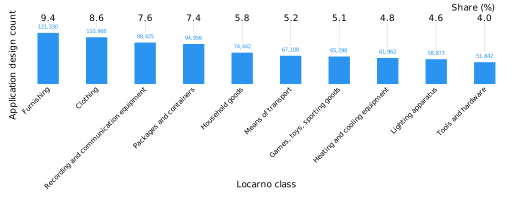 Note: See annex B for class numbers. Figures are based on data from 125 IP offices. Data for several of the larger offices are either not available or incomplete, including for the offices of Italy, Japan and Türkiye.
Source: WIPO Statistics Database, September 2026.
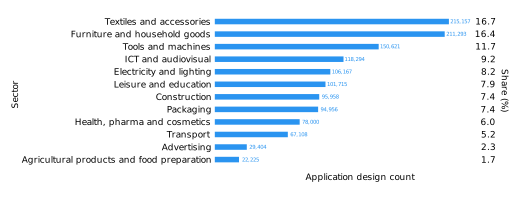 Note: A concordance table produced by the Organisation for Economic Co-operation and Development (OECD) was used to convert the 32 Locarno classes into 12 industry sectors (see annex B for definitions). Figures are based on data from 125 IP offices. Data for several of the larger offices are either not available or incomplete, including for the offices of Italy, Japan and Türkiye.
Source: WIPO Statistics Database, September 2026.
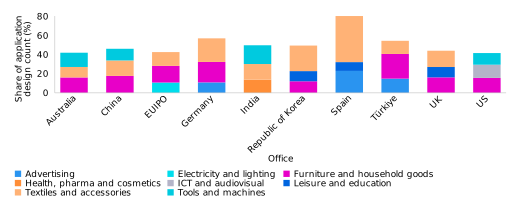 Note: EUIPO is the European Union Intellectual Property Office. A concordance table produced by the Organisation for Economic Co-operation and Development (OECD) was used to convert the 32 classes into 12 industry sectors (see annex B for definitions). The top three sectors and top 10 offices were selected based on 2025 totals. Data for several of the larger offices are either not available or incomplete, including for the offices of Italy, Japan and Türkiye.
Source: WIPO Statistics Database, September 2026.
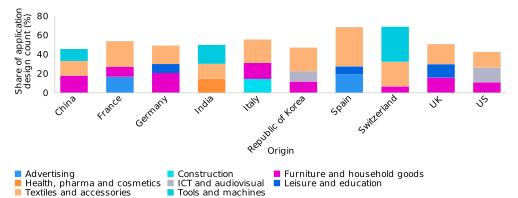 Note: A concordance table produced by the Organisation for Economic Co-operation and Development (OECD) was used to convert the 32 classes into 12 industry sectors (see annex B for definitions). Figures are based on data from 125 IP offices. Data for several of the larger offices are either not available or incomplete, including for the offices of Italy, Japan and Türkiye.
Source: WIPO Statistics Database, September 2026.
Design registrations worldwide
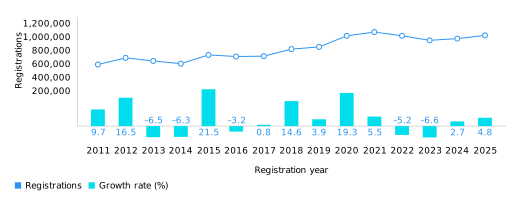 Note: World totals are WIPO estimates using data covering 159 IP offices. Totals include the registrations issued by national and regional offices for applications filed directly at offices (known as the Paris route), as well as for designations received via the Hague System (where applicable).
Source: WIPO Statistics Database, September 2026.
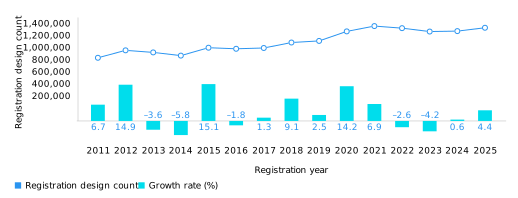 Note: World totals are WIPO estimates using data covering 159 IP offices. Totals include designs contained in registrations issued by national and regional offices for applications filed directly at offices (known as the Paris route), as well as for designations received via the Hague System (where applicable). See glossary for definition of design count.
Source: WIPO Statistics Database, September 2026.
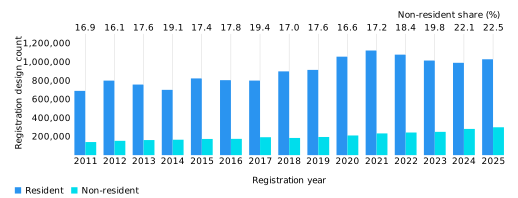 Note: World totals are WIPO estimates using data covering 159 IP offices. Totals include designs contained in registrations issued by national and regional offices for applications filed directly at offices (known as the Paris route), as well as for designations received via the Hague System (where applicable). See glossary for definition of design count.
Source: WIPO Statistics Database, September 2026.
Design registrations by origin
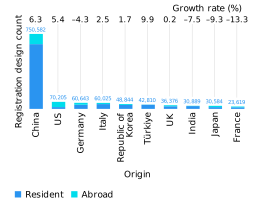
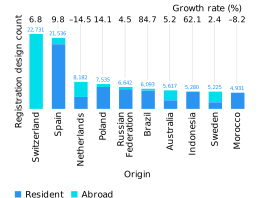 Note: Netherlands is the Kingdom of the Netherlands. Design registrations with the IP office of Switzerland are missing. The origin of a design application is determined by the residence of the first named applicant. An application registered at a regional office is considered to be a resident registration, if the applicant resides in one of that office’s member states. See glossary for definition of design count.
Source: WIPO Statistics Database, September 2026.
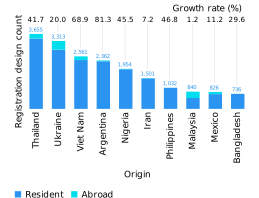
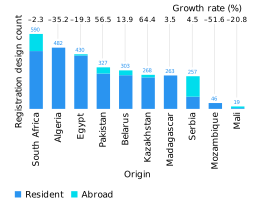 Note: The selected origins are from different world regions and income groups (low-income, lower middle-income and upper middle-income). Where available, data for all origins are presented in statistical table C40 at the end of this section. The origin of a design application is determined by the residence of the first named applicant. An application registered at a regional office is considered to be a resident registration, if the applicant resides in one of that office’s member states. See glossary for definition of design count.
Source: WIPO Statistics Database, September 2026.
Design registrations by office
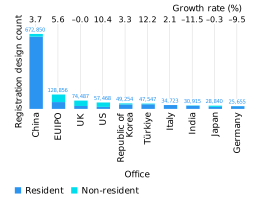
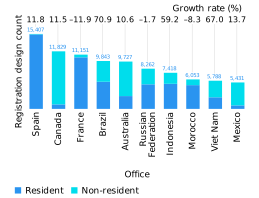 Note: EUIPO is the European Union Intellectual Property Office.
Source: WIPO Statistics Database, September 2026.
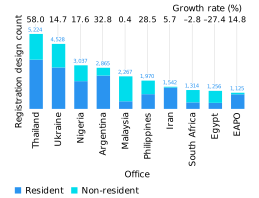
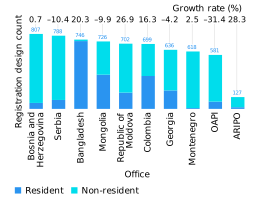 Note: ARIPO is the African Regional Intellectual Property Organization, EAPO is the Eurasian Patent Organization, OAPI is the African Intellectual Property Organization and Iran is the Islamic Republic of Iran. The selected offices are from different world regions and income groups (low-income, lower middle-income and upper middle-income). Where available, data for all offices are presented in statistical table C40 at the end of this section.
Source: WIPO Statistics Database, September 2026.
Design registrations in force
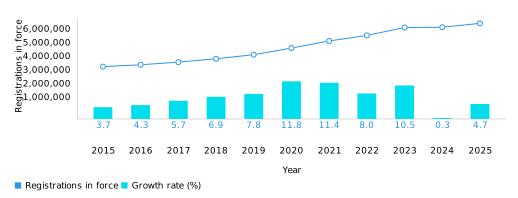 Note: WIPO estimates cover 139 IP offices and include direct national and regional applications, as well as designations received via the Hague System. Data refer to the number of design registrations in force and not the number of designs contained within those same registrations.
Source: WIPO Statistics Database, September 2026.
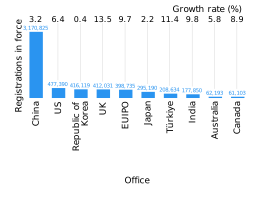
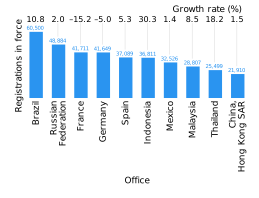 Note: EUIPO is the European Union Intellectual Property Office. Data refer to the number of registrations in force and not the number of designs contained within those same registrations.
Source: WIPO Statistics Database, September 2026.
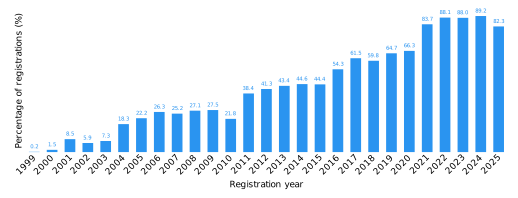 Note: Percentages are calculated using the number of applications registered in year t and in force in 2025 divided by the total number applications registered in year t. The graph is based on data from 92 IP offices (including most of the larger offices) for which a breakdown of design registrations in force by year of registration was available. Design rights generally last for up to 15 years from the filing date. In China that protection period is limited to 10 years. Because China accounts for most of the global total, it is excluded from this graph.
Source: WIPO Statistics Database, September 2026.
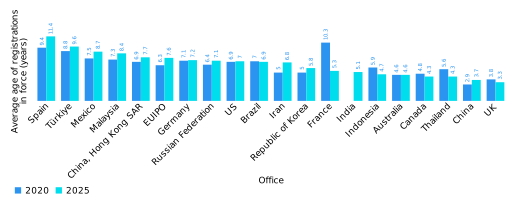 Note: EUIPO is the European Union Intellectual Property Office and Iran is the Islamic Republic of Iran. Percentages are calculated using the number of applications registered in year t and remaining in force in 2025 divided by the total number of applications registered in year t.
Source: WIPO Statistics Database, September 2026.
Design office procedural data
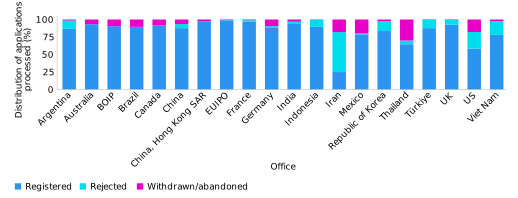 Note: BOIP is the Benelux Office for Intellectual Property, EUIPO is the European Union Intellectual Property Office and Iran is the Islamic Republic of Iran. WIPO collects data from IP offices using a common questionnaire and methodology. However, because of differences in design procedures between offices, data cannot be fully harmonized; therefore, caution should be exercised when making comparisons across offices.
Source: WIPO Statistics Database, September 2026.
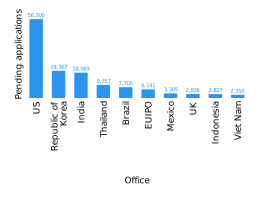
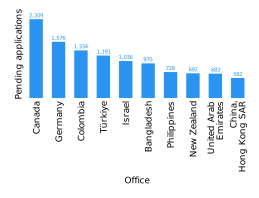 Note: EUIPO is the European Union Intellectual Property Office. WIPO collects data from IP offices using a common questionnaire and methodology. However, because of differences in design procedures between offices, data cannot be fully harmonized; therefore, caution should be exercised when making comparisons across offices. Data for some large offices are missing, including for China, Italy and Japan.
Source: WIPO Statistics Database, September 2026.
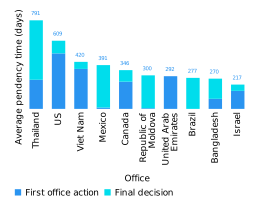
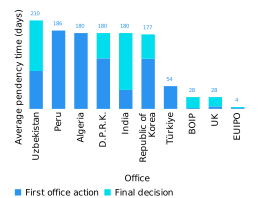 Note: BOIP is the Benelux Office for Intellectual Property, EUIPO is the European Union Intellectual Property Office and D.P.R.K. is the Democratic People’s Republic of Korea. WIPO collects data from IP offices using a common questionnaire and methodology. However, because of differences in design procedures between offices, data cannot be fully harmonized; therefore, caution should be exercised when making comparisons across offices.
Source: WIPO Statistics Database, September 2026.
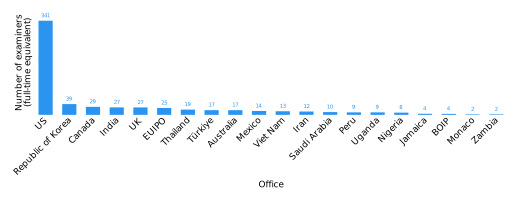 Note: BOIP is the Benelux Office for Intellectual Property, EUIPO is the European Union Intellectual Property Office and Iran is the Islamic Republic of Iran. WIPO collects data from IP offices using a common questionnaire and methodology. However, because of differences in design procedures between offices, data cannot be fully harmonized; therefore, caution should be exercised when making comparisons across offices.
Source: WIPO Statistics Database, September 2026.
Statistical tables


