
C1. The awareness index
The WIPO Pulse questionnaire was developed based on the assumption that respondents’ self-assessed knowledge of intellectual property (IP) rights may not always align with their actual understanding of how these rights apply to goods and services.
In international surveys, cross-country comparisons are often complicated by cultural response styles. In some cultures, respondents may overstate their knowledge or preferences, while in others, modesty or factual restraint is more common. These differences can distort comparisons.
To address this, a factual control question was included for each IP subject to assess actual knowledge. Self-assessed understanding and factual accuracy were then combined into a single measure — the awareness index — as outlined below.
C2. Calculation
The awareness index combines two dimensions of awareness regarding IP subject matter: respondents’ self-assessed understanding (subjective awareness) and their demonstrated knowledge (objective awareness).
Subjective awareness is measured using questions Q3a to Q3e (Annex B.1 Questionnaire):
"How would you evaluate your personal understanding of patents / trademarks / registered designs / copyright / geographical indications?"
Respondents are considered subjectively aware if they selected:
either " 3: I have heard about it but know very little about it”
or “4: I have heard about it and know it either fairly well or very well.”
Objective awareness is measured using questions Q4a to Q4f (Annex B.1 Questionnaire):
"How do you think the following things can be protected through the below intellectual property (IP) rights?"
A respondent is considered objectively aware of a specific IP right if they provided the following correct answer for the corresponding question:
Question
Correct answer(s)
Q4a. A technical invention (e.g., a completely new kind of a battery technology) can be best protected through a … ?
1: Patent
Q4b. Brand name (e.g., Coca-Cola) can be best protected through … ?
2: Trademark
Q4c. A logo (e.g., Nike logo, shown) can be best protected through … ?
2: Trademark
Q4d. The visual appearance of a product (e.g., the shape of a lamp or a chair) can be best protected through … ?
3: Registered design
Q4e. Creative works (e.g., a song or a book) can be best protected through … ?
4: Copyright
Q4f. A wine sourced and produced only in France (e.g., Champagne) can be best protected through … ?
5: Geographical indication OR 2: Trademark
To evaluate objective awareness, respondents must provide the correct answer to the respective question. Since questions Q4a to Q4f are multiple-response items, the correct option must be selected exclusively for the answer to be considered valid, that is, without any additional incorrect responses.
Each of these questions corresponds to a specific IP subject matter. A correct response to Q4a indicates objective awareness of patents. Similarly, a correct response to Q4d indicates objective awareness of registered designs, Q4e corresponds to copyright, and Q4f to geographical indications. For trademarks, objective awareness is recognized if the respondent selects the correct answer to either Q4b or Q4c.
A respondent (i) is classified as possessing qualified awareness of an IP subject matter (j) if they demonstrate both subjective (α) and objective (γ) awareness. The awareness index (AIj) for a given IP subject matter is calculated as the proportion of the target population (n), that shows both subjective and objective awareness of that subject. Formally, the awareness index for IP subject matter is defined as:
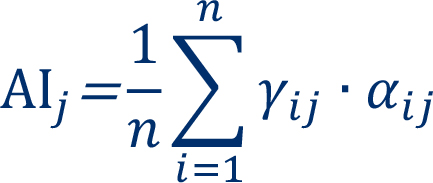
In this formula, γ equals 1 if respondent i correctly identifies the relevant protection mechanism for subject j – and equals 0 otherwise. The second term α equals 1 if the same respondent self-reports awareness of that subject j – and equals 0 otherwise. This calculation ensures that only those respondents who both claim familiarity and demonstrate valid understanding are included in the index.
C3. Relevance
The relevance of the awareness index becomes particularly clear when compared to subjective awareness, which is often the sole indicator used in other studies on the topic. Figure 17 illustrates how, in three randomly selected countries, the awareness index provides a more reliable and meaningful measure of knowledge about trademarks than subjective awareness alone.
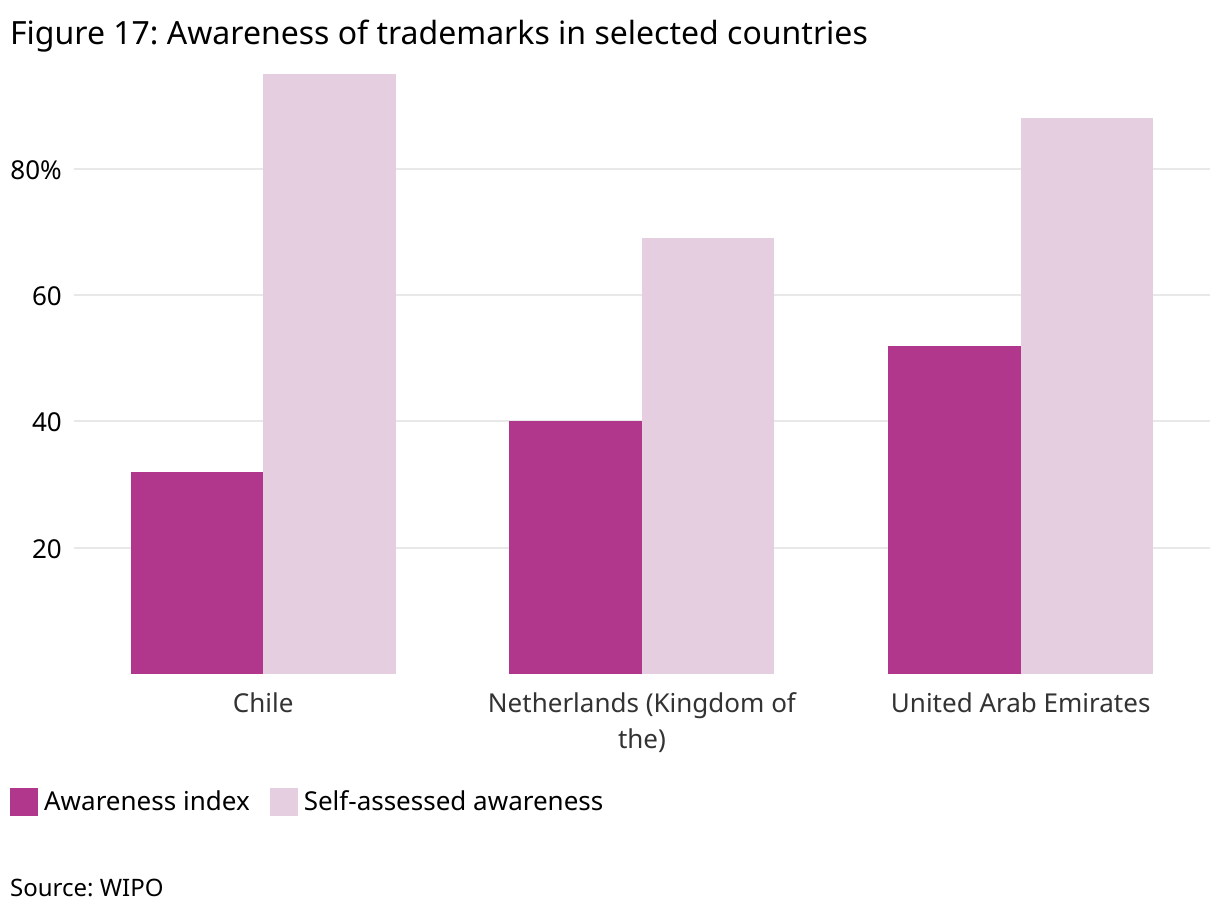
Subjective awareness levels are consistently higher than the awareness index, as they reflect respondents’ self-assessed familiarity without verifying their actual understanding. The substantial discrepancy between the two measures highlights how perceived understanding and demonstrated knowledge can diverge. This pattern is observed across all IP subject matters, regions, and countries.
By incorporating objective awareness as an additional control factor, the awareness index balances subjective self-assessments with demonstrated knowledge. This allows for a more accurate and culturally neutral measure of respondents’ understanding of IP rights. As such, the awareness index provides a robust foundation for interpreting the data and mitigating cultural bias in cross-country comparisons.