
Global growth in plant variety applications continues
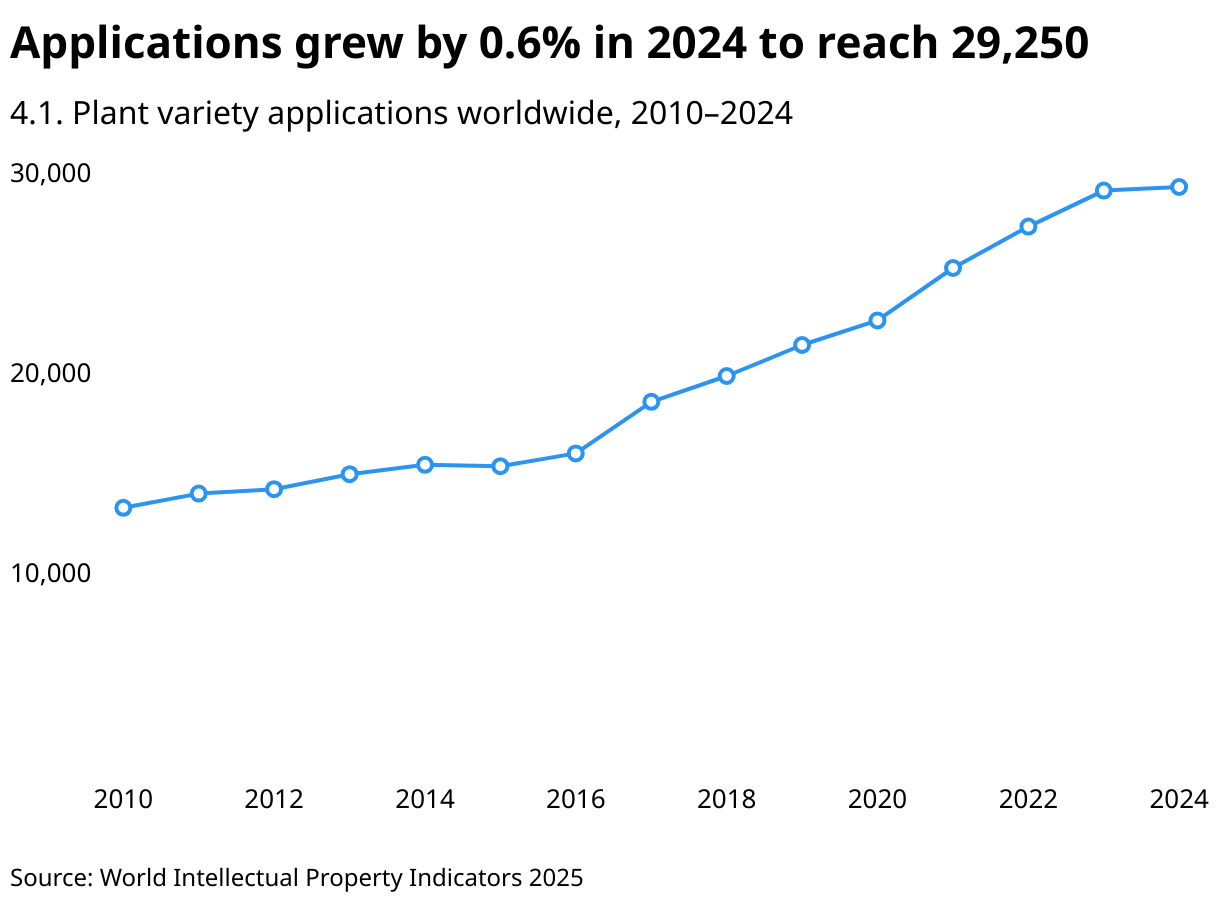
In 2024, approximately 29,250 plant variety applications were filed worldwide, representing a 0.6% increase over 2023 and marking a ninth consecutive year of growth (figure 4.1). However, this modest increase is the slowest year-on-year growth rate since 2015 and primarily due to a slowdown in filings in China.
China’s office leads, receiving more than half of global plant variety applications filed in 2024
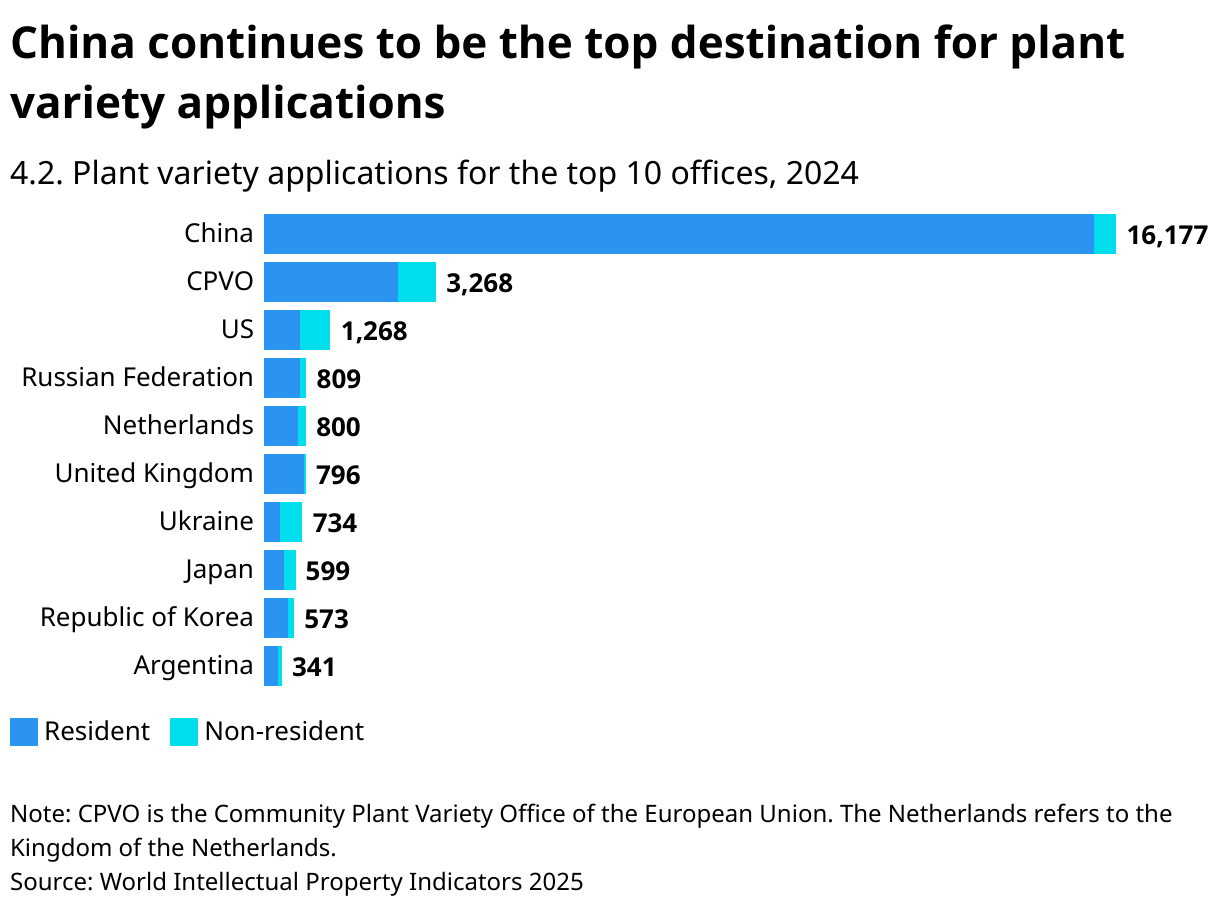
In 2024, China retained its position as the leading destination for plant variety applications, receiving 16,177 applications and accounting for 55.3% of the global total. The Community Plant Variety Office (CPVO) of the European Union (EU) ranked second, with 3,268 applications representing 11.2% of global filings. Following the CPVO were the United States of America (US) (1,268), the Russian Federation (809)and the Kingdom of the Netherlands (800) (figure 4.2). After a decade of consecutive double-digit annual growth, China’s office received seven fewer plant variety applications in 2024 than in the previous year. Among the top 10 offices, only the CPVO (+14%) and the US (+10.4%) recorded double-digit growth in 2024 (figure D6). Both offices rebounded after having experienced two consecutive years of decline. Japan (+1.4%) is the only other top 10 office to have recorded growth in 2024.
Seven of the top 10 offices experienced a decline in applications in 2024. Argentina saw a 19.8% decrease, primarily due to a drop in submissions from resident applicants. The Republic of Korea (–8.3%), the Kingdom of the Netherlands (–6.5%) and the Russian Federation (–5%) also recorded notable declines. The decrease at the office of the Kingdom of the Netherlands was largely driven by fewer domestic applications,whereas the declines at the offices of the Republic of Korea and the Russia Federation were mainly due to a reduction in filings by non-resident applicants.
In 2024, the top five jurisdictions globally collectively received 76.3% of all applications, a one percentage point increase on the year driven primarily by a rise in applications received by the CPVO and the US.
In 2024, residents filed more applications than non-residents in all top 10 jurisdictions except Ukraine. China led this trend among the top 10, with 97.4% of applications originating from domestic applicants. The United Kingdom (UK) also recorded a large proportion of resident filings at 94%. Conversely, Ukraine was unique among the top 10, with non-residents filing 56% of applications, indicating a majority of filings originated from abroad.
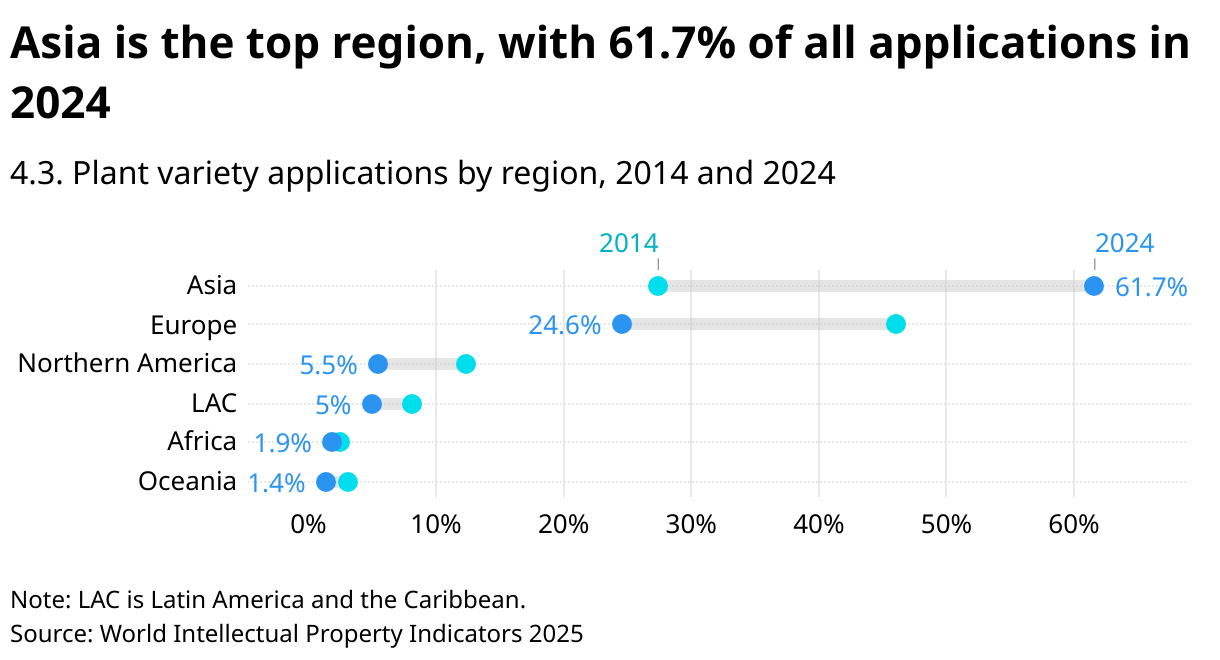
Asia is the region that received the most plant variety filings in 2024, accounting for 61.7% of all applications. A notable 15.6% annual increase in filings since 2014 has significantly expanded Asia’s global share, rising from 27.5% in 2014 to 61.7% in 2024 (figure 4.3). Europe ranked as the second largest region in terms of filing, representing about 24.6% of the global total in 2024. That said,the surge in filings within Asia witnessed during the decade has caused Europe’s collective share to decline from the 46.1% of total filings back in 2014. Over the past decade, Asia (+15.6%), Africa (+3.5%), Latin America and the Caribbean (+1.5%) and Europe (+0.2%) have all undergone positive average annual growth (table D3). In contrast, Northern America (–1.7%) and Oceania (–2%) have experienced a decline, both recording a negative average annual growth rate over the period.
China-based applicants lead global plant variety filings
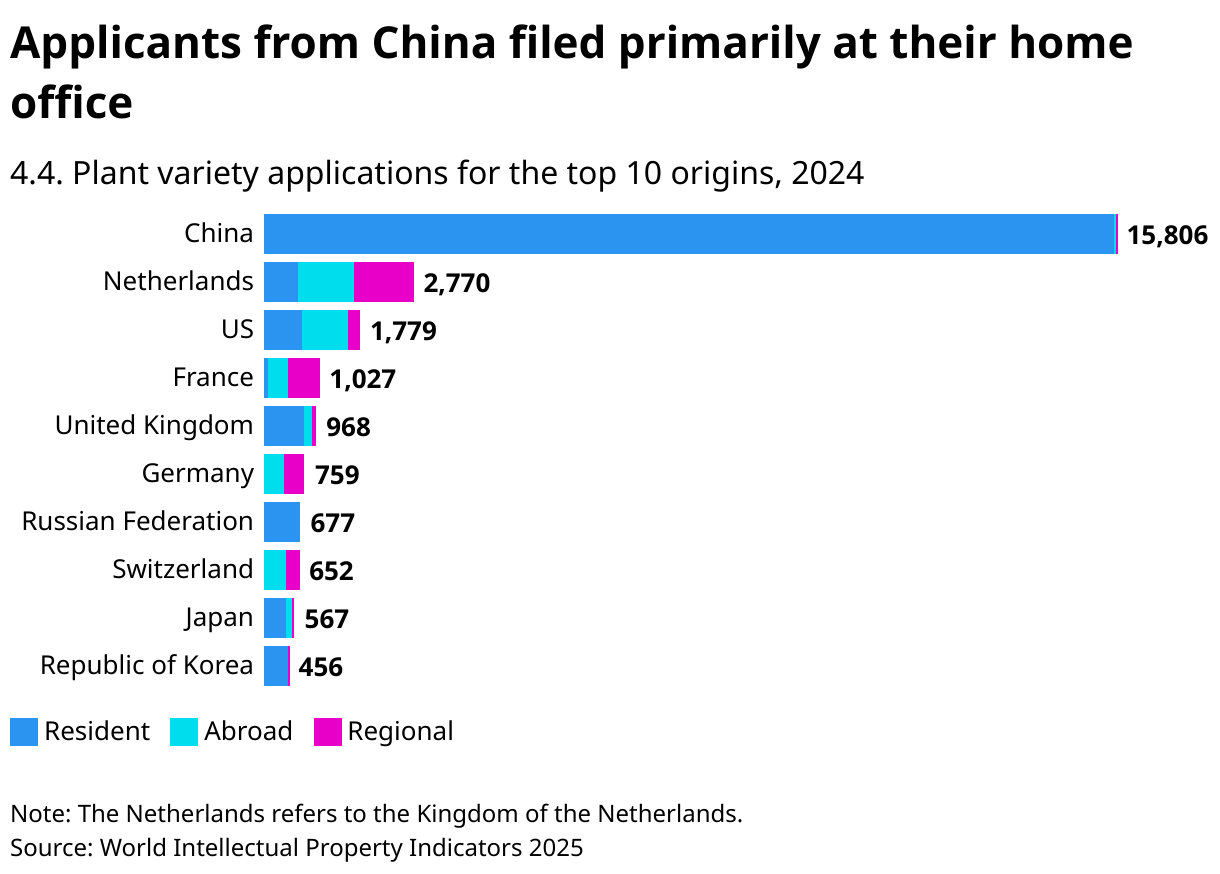
Applications received by offices from resident and non-resident applicants are referred to as office data, whereas applications filed by applicants at a national or regional office (resident applications) or at a foreign office (applications abroad) are referred to as origin data. Here, plant variety statistics based on the origin of residence are reported in order to complement the global picture. Note that for applicants domiciled within EU member states, filing at the CPVO regional office is regarded as a resident filing, when discussing office data, and such filings are regarded as regional filings, when discussing origin data.
In 2024, China-based applicants were the most active globally, submitting 15,806 plant variety applications, an increase of 1.6% on 2023 (figure 4.4). Following China, applicants from the Kingdom of the Netherlands filed 2,770 applications, reflecting 5.2% decline over the prior year. The next largest origins were the US (1,779), France (1,027) and the UK (968). Together, these top five origins accounted for 76.4% of total plant variety filings worldwide in 2024, with China (54%of the total) and the Kingdom of the Netherlands (9.5%) contributing the largest shares.
Among the top 10 origins, six experienced growth in plant variety applications in 2024 compared to the previous year. Switzerland led with a strong 19.2% increase, driven by significant growth in both regional and abroad filings. France (+3.1%), the Russian Federation (+2.9%) and the UK (+3.1%) also recorded similar modest increases in filings. Conversely, Germany (–2.6%), Japan (–4.4%), the Kingdom of the Netherlands (–5.2%), and the Republic of Korea (–6.4%) reported decreases. For each of these four origins, a decline in both resident and international filings contributed to the overall decrease.
While applicants from five of the top 10 origins primarily filed applications abroad or at a regional office, those from China, the Republic of Korea and the Russian Federation filed almost exclusively at their home office.
In 2024, plant variety titles issued decreased by 18.3%, and returned to the long-term trend
Following a considerable increase in 2023, the total number of plant variety titles issued decreased by 18.3% in 2024 (figure 4.5). This dip is partly explained by the exceptional growth in titles issued by China in 2023, which significantly increased that year’s figures.
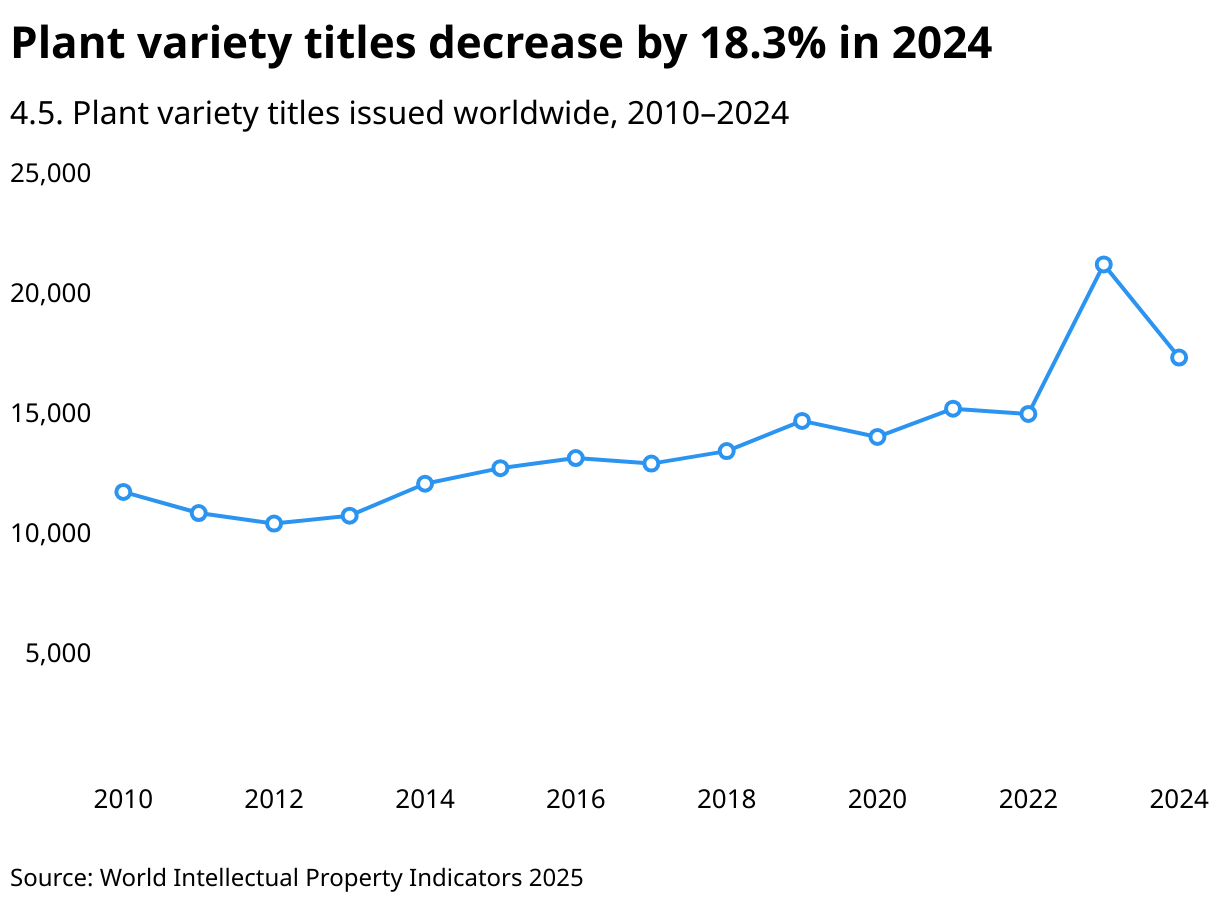
China led in 2024, issuing 6,675 titles, though this marked a 28.2% decrease from the previous year.
Following China, the top issuers were the CPVO (2,605 titles), the US (1,242), Ukraine (878) and Japan (703) (figure D9). Mirroring China’s trend, both the CPVO and Ukraine also experienced a decline in titles issued between 2023 and 2024, by 4.2% and 16%, respectively. In contrast, Japan (+41.4%) and the US (+8.1%) recorded strong growth in the number of titles issued over the same period.
Beyond these top five offices, several other countries also demonstrated significant growth in 2024. Brazil (+39.4%), Colombia (+33.8%) and Morocco (+21.3%) all registered double-digit increases. Meanwhile, Viet Nam, though starting from a lower base, recorded an exceptional surge of 193.4%. Note that the grant or registration process takes time, therefore fluctuations in the volume of plant variety titles granted may be a consequence of changes in processing capacity or procedural delay.
More than 200,000 plant varieties were in force in 2024
Around 203,760 plant variety titles were in force at the end of 2024, up 4.1% on 2023 (figure D15).China (38,849), the CPVO (31,317), the US (28,139), Ukraine (13,803) and the Kingdom of the Netherlands (9,883) had the highest number of active titles (figure D16). Other offices maintaining at least 5,000 active titles included Japan (7,505) the Russian Federation (6,992) and the Republic of Korea (6,771).