Introduction
A geographical indication (GI) is a sign identifying a good as having originated in a specific geographical area and possessing a given quality, reputation or other characteristic essentially attributable to its geographical origin. The core function of a GI is to signal a link between the distinct qualities of a product and its place of origin. World-renowned examples of GIs include “CAFÉ DE COLOMBIA” (Colombia),“BORDEAUX” (France), “KAMPOT PEPPER” (Cambodia), “PENJA PEPPER” (Cameroon) and “SCOTCH WHISKY” (United Kingdom).
GIs can be protected through a variety of legal means (e.g., sui generis systems, trademark law, regional systems, international agreements, other national legal means, etc.). In addition, the protection of GIs at a national level is often shared among several agencies. WIPO has made a major effort to gather data from all relevant sources, but in many instances, it has not been possible to obtain the necessary data from every source. For instance, many countries are unable to identify GIs protected through the trademark system. Nonetheless, the statistics gathered afford a valuable insight into how this form of intellectual property (IP) is being used in different parts of the world.
How many GIs are in force worldwide?
In 2024, an estimated 62,300 GIs were in force covering 94 national and regional authorities. To minimize double counting, GIs in force through the European Union (EU) (5,451 GIs in force) regional system and the Lisbon System (1,106) were counted once only, rather than multiplied by the number of member states party to each system. That notwithstanding, the overall total of around 62,300 will inevitably include a degree of double counting, as GIs in force through bilateral, plurilateral or multilateral agreements could potentially have been included multiple times. If GIs in force through various international agreements are excluded, then around 24,500 GIs were in force in 2024.
Of the 62,300 GIs in force in 2024, upper middle-income economies accounted for more than half (51.1%) of the world total, followed by high-income (43.7%), lower middle-income (5.1%) and low-income economies (0.1%).
Figure E1 presents the total number of GIs in force across selected national and regional 161 authorities, while figure E2 focuses on data for EU member states. In 2024, China (9,946) had the highest number of GIs in force within its territory, followed by Germany (7,661), Hungary (7,365), the Czech Republic (6,782) and Portugal (6,466) (table E8).
High rankings for EU countries can be attributed to the 5,451 GIs in force under the EU regional system being recognized in every member state. In addition, some EU members – such as the Czech Republic and Hungary – are also party to the Lisbon System; consequently, GIs in force through the Lisbon System (1,106 appellations of origin and geographical indications, excluding domestic registrations and refusals) are included in their totals.
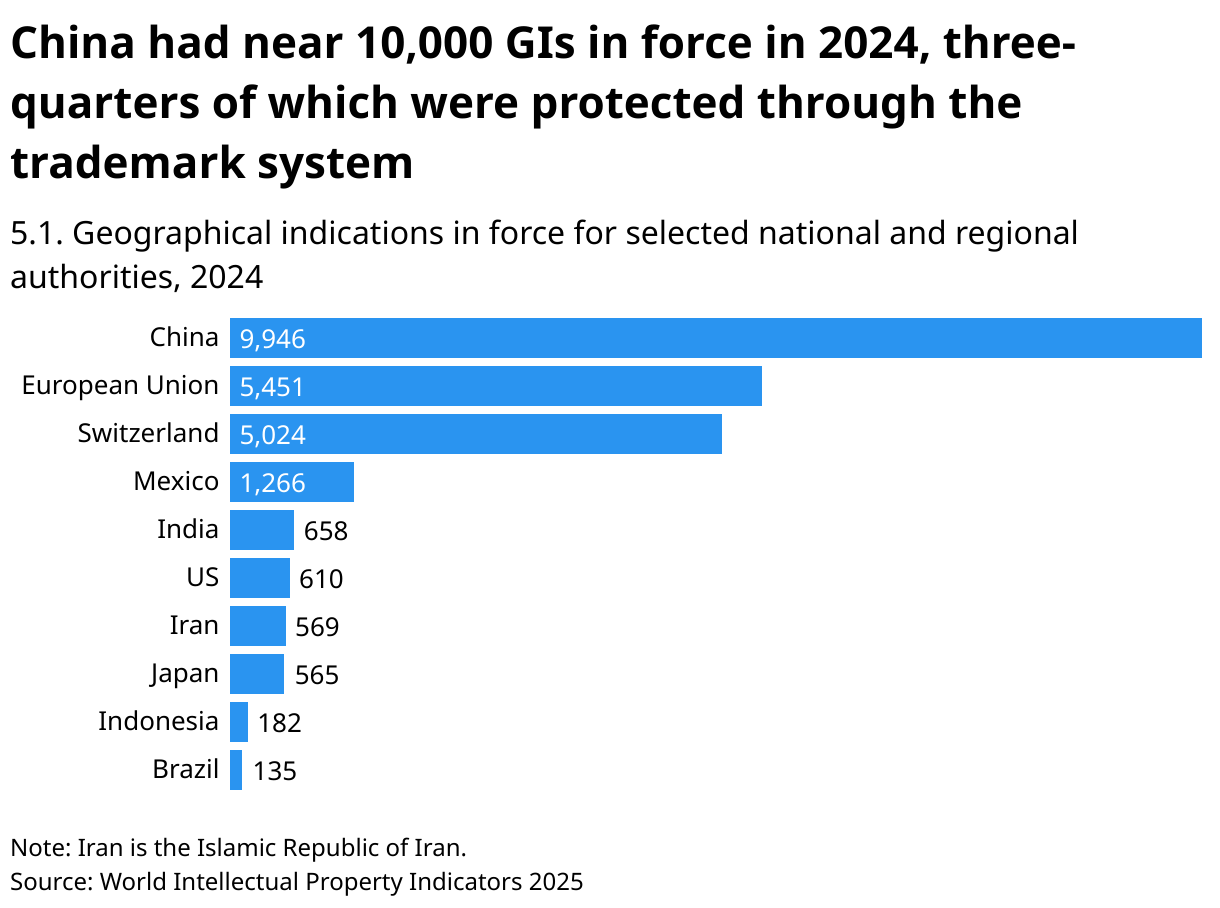
Beyond Europe, India (658), Mexico (1,266), Japan (565), the Islamic Republic of Iran (569) and the United States of America (US) (610) also reported substantial numbers of GIs in force within their jurisdictions (figure 5.1). However, variations in volume across jurisdictions partly reflect differences in membership and reporting practices: some are parties to the Lisbon System –thus include GIs protected through that system – while others are unable to report data on GIs protected via trademark systems and/or international agreements.
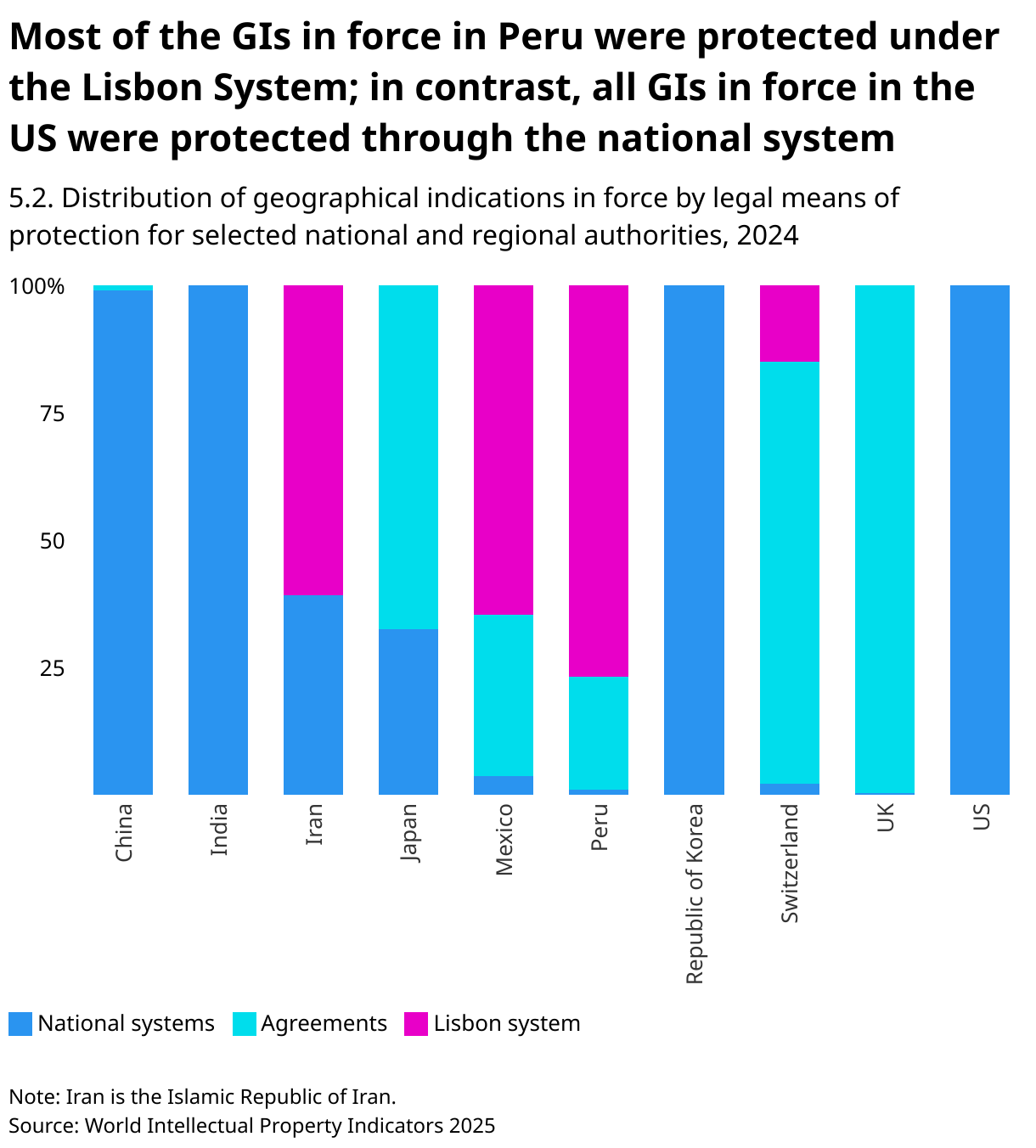
The legal means of protecting geographical indications varies among authorities. Figure 5.2 shows the total number of GIs in force broken down by the legal means of protection for selected national and regional authorities. All GIs in force in India, the Republic of Korea and the US were protected through a national system, whereas the bulk of GIs in force in the Islamic Republic of Iran (60.8%), Mexico (64.7%) and Peru (76.8%) were protected through the Lisbon System. In contrast, almost every GI in force in the United Kingdom (UK) (99.7%) was protected via international agreements.
In Brazil, China, India and Türkiye, the vast majority of GIs in forcewere national GIs
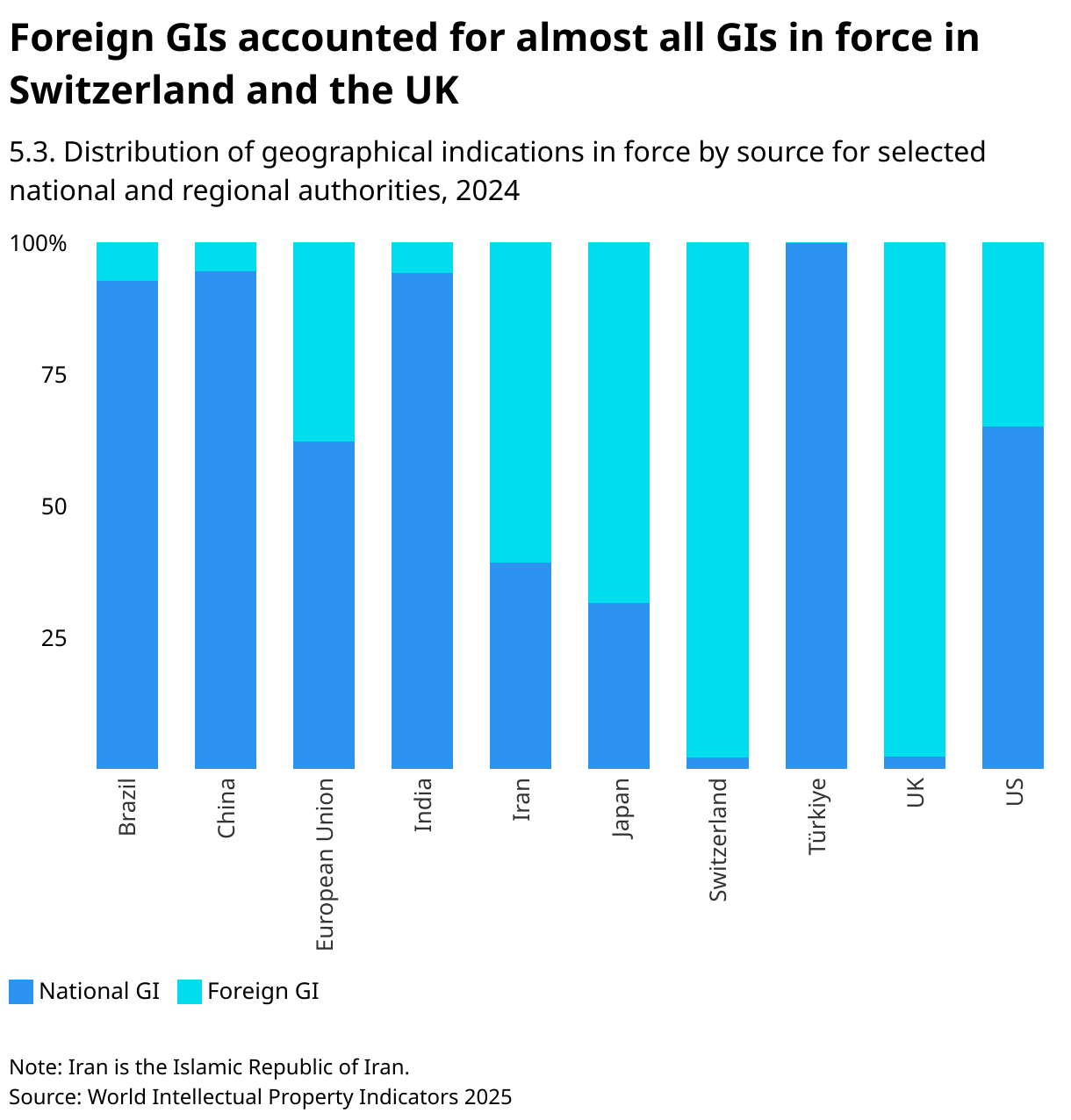
Data on GIs broken down according to source (i.e., whether they are a national or foreign GI) are available for 80 jurisdictions. Figure 5.3 shows data for 10 selected national and regional authorities. The share of national GIs ranged from as low as 2.2% in Switzerland to as high as 99.8% in Türkiye. More than 90% of the GIs in force in Brazil (92.6%), China (94.4%), India (94.2%)and Türkiye (99.8%) were national GIs, whereas almost all those in force in Switzerland (97.8%)and the UK (97.7%) were foreign GIs. Of the 80 authorities that provided data for 2024, national GIs represented more than 60% of the total in 23 authorities. In contrast, foreign GIs accounted for over 60% of the total in 55 authorities, while in two authorities the distribution between national and foreign GIs was evenly balanced.
Wines and spirits accounted for more than half (55.9%) of GIs in force globally in 2024
Geographical indications in force relating to wines and spirits (55.9%) accounted for more than half of the 2024 global total, while agricultural products and foodstuffs accounted for 38.1% and handicrafts 4.2% (see figure E6).
The GIs in force data reported here are partial and incomplete and therefore ought to be interpreted with caution. The questionnaire underlying the data collection requested information from respondents regarding GIs protected through sui generis systems, trademark systems, other national legal means, regional systems and international agreements (including GIs in force under the Lisbon System and the Madrid System). As table E8 indicates, many countries did not provide statistics on the number of GIs protected through the trademark system. This might be because the countries concerned do not use the trademark systemto protect GIs or else some countries that do use it have difficulty separating GIs (typically protected through collective or certification trademarks) from other types of trademarks. In addition, several countries could not provide data on how many GIs were protected through international agreements.
China (2,448) reported the highest number of GIs protected via the sui generis system, followed by Türkiye (1,670) and Canada (682).
The number of appellations of origin and GIs under the Lisbon System reached 1,106 in 2024, up 34% from 2010
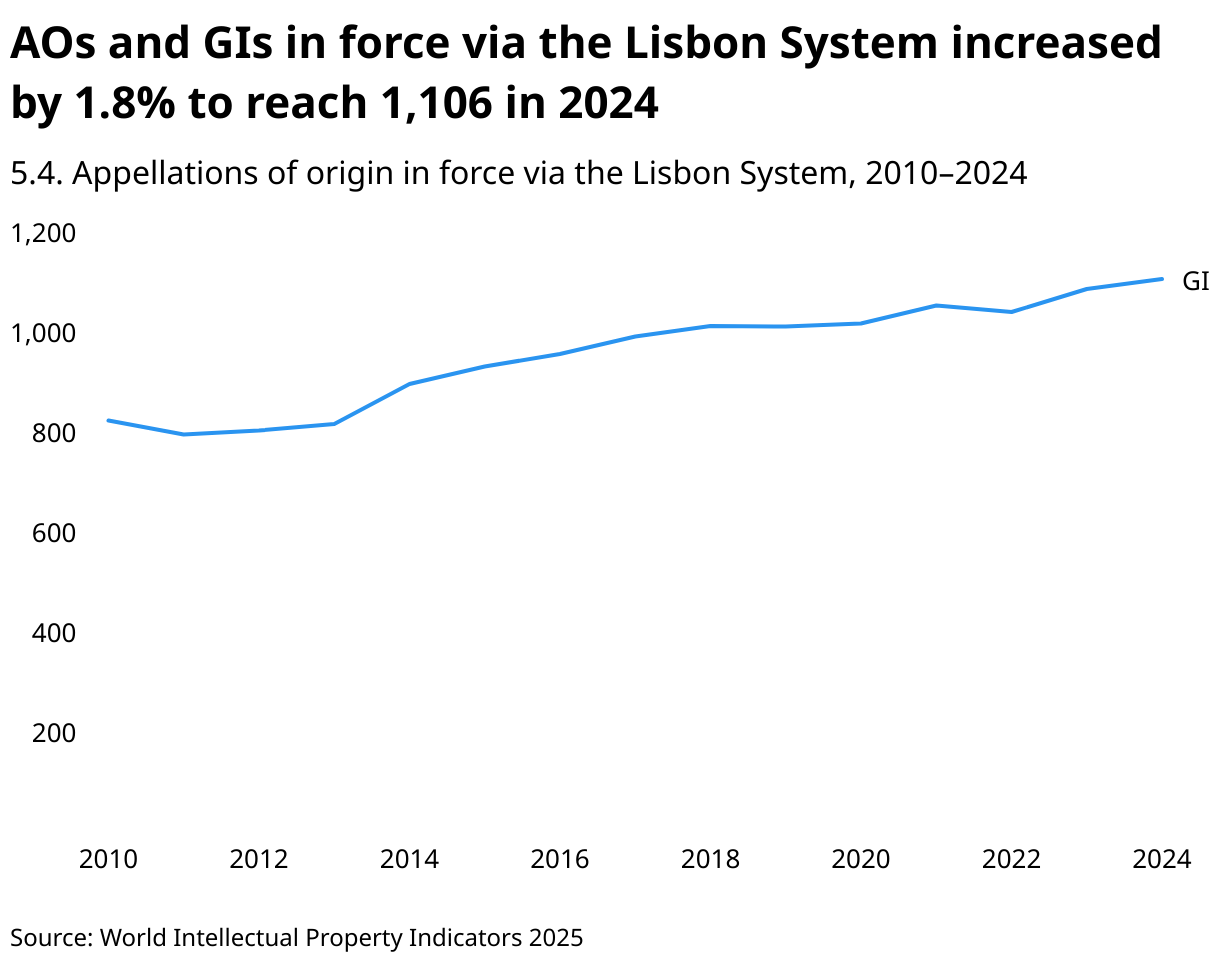
As of 2024, the Lisbon System comprised 44 Contracting Parties, after the accession of Djibouti to the System that year. The number of appellations of origin (AOs) and GIs in force via theLisbon System has increased from 823 in 2010 to 1,106 in 2024, representing 34% growth over this period (figure 5.4). The increase in the total number of AOs and GIs in the most recent pastis mainly due to an increase in registrations by the EU and the Islamic Republic of Iran.
France remains the primary user of the Lisbon System. It accounted for around one-third (34.4%)of the 2024 total, followed by the EU (22.6%), Italy (15%), the Islamic Republic of Iran (6.7%) and the Czech Republic (3.4%) (figure E7). Combined, these five origins accounted for 82% of the2024 total. The EU – a recent member of the Lisbon System – had 17 new registrations, taking its tally to 250 AOs and GIs in 2024. Albania (2 new registrations), along with Cambodia (+1), the Dominican Republic (+1) and Serbia (+1) are the four other origins with new registrations in 2024. In contrast, the number of AOs and GIs in force via the Lisbon System decreased by 2 for the Czech Republic due to cancellations of previously registered AOs.