
Understanding occupational health and safety (OHS)
Workplace safety remains a pressing global concern, with profound human and economic implications. According to the International Labour Organization (ILO), over 2.93 million people lose their lives annually due to occupational accidents or work-related disease. Additionally, 395 million non-fatal workplace injuries result in at least four days of absence from work every year, equating to more than one million injuries every day which are serious enough to disrupt livelihoods
Despite advancements in OHS measures in some regions – such as the stabilization of or decline in workplace fatalities in countries like Canada
Men face a significantly higher mortality rate (108.3 per 100,000 workers) compared to women (48.4 per 100,000); and
Geographically, Asia and the Pacific accounts for 63% of global work-related fatalities, reflecting the region’s vast population, and therefore substantial workforce. Work-related deaths also constitute 6.71% of global mortality, with Africa recording the highest attributable fraction (7.39%).
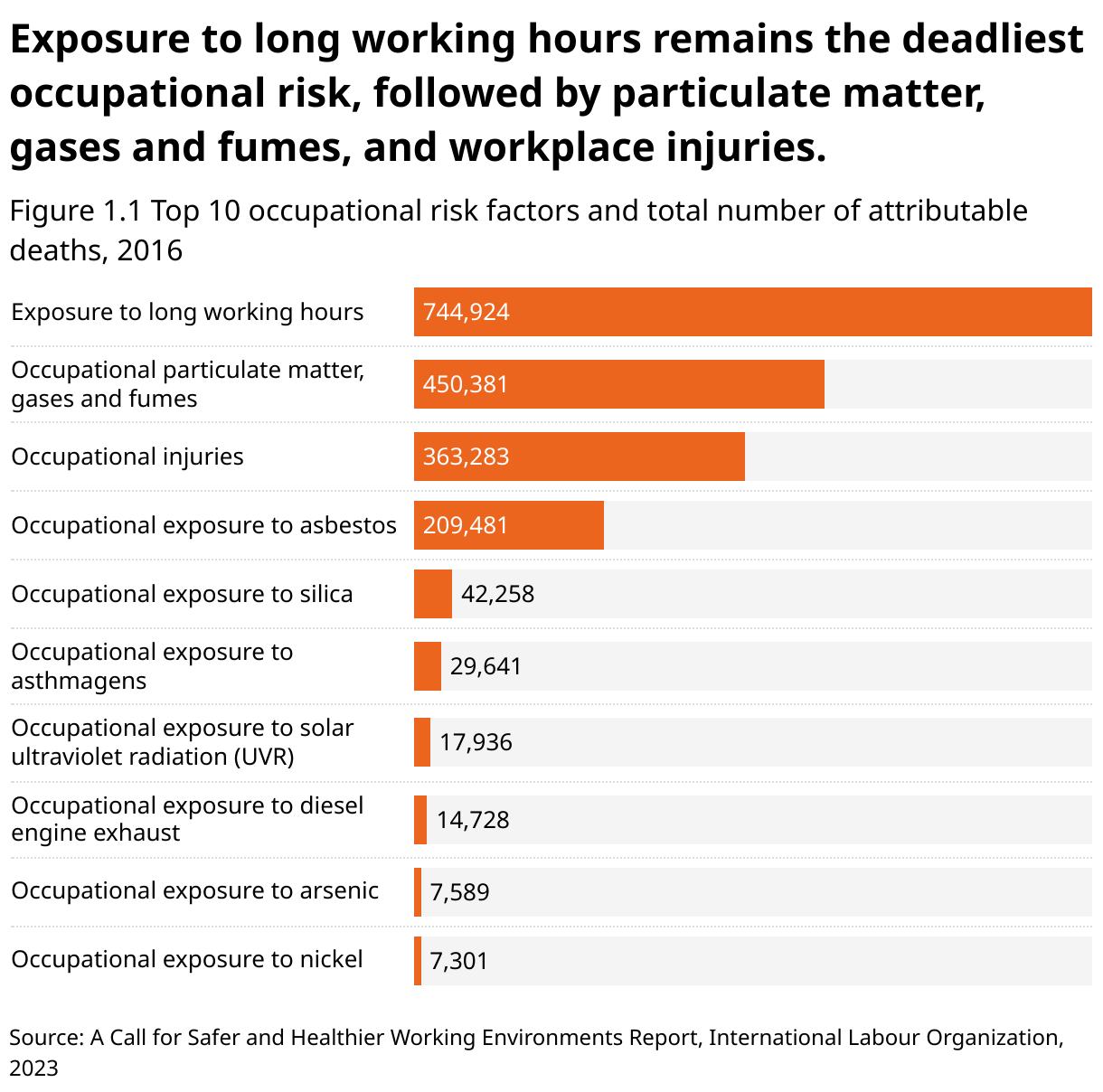
Among the leading occupational risk factors, exposure to long working hours (≥55 hours per week) is the deadliest, claiming nearly 745,000 lives in 2016. Other critical risks include exposure to particulate matter, gases and fumes (450,000 deaths) and occupational injuries (363,000 deaths). While progress has been made in mitigating such risks, emerging challenges – such as evolving work patterns, remote work, and mental health concerns – necessitate a shift toward proactive risk management and adaptation to new work environments.
At the economic level, poor OHS practices are a burden for companies and compromise efficiency. Accidents and occupational illnesses incur significant costs for employers, from medical expenses and lost productivity to legal liabilities. Such cost represents nearly 4% of global gross domestic product (GDP) annually. The ILO estimates that USD 361 billion could be saved globally by implementing improved health and safety measures to prevent injuries from excessive heat in the workplace
In this context, technological innovation is vital to improving workplace safety. However, many countries, particularly developing ones, face challenges such as limited access to suitable technologies, a lack of awareness among potential users and insufficient collaboration between key stakeholders. Intellectual property (IP) has a crucial role to play in addressing these gaps by facilitating access to existing solutions and helping the development of new technologies tailored to specific industries and risks. Enhanced collaboration among researchers, manufacturers and users of tools, machinery, and personal protective equipment (PPE) can help ensure the availability and accessibility of effective safety measures, ultimately reducing accidents and enhancing competitiveness.
This report examines patent data to explore how technological innovation is addressing these challenges. It highlights the key players and their contribution to creating safer work environments, with the ultimate goal of reducing work-related injuries and fatalities globally.
Research methodology and scope
The aim of this report is to analyze technological evolution in the field of occupational health and safety through the lens of patents filed across the world. Patents offer a unique vantage point to observe the key players in this field, highlighting those countries patenting most heavily in new technologies, as well as companies and research institutions driving innovation within the sector.
For each major technological area – Prediction, Detection, and Protection – we conducted a global patent landscape analysis, followed by a focused examination of international patent families (IPFs) to extract key trends with greater precision.
Analyzing the global patent landscape provides a broad overview of the level of investment and innovation within a chosen field. Such an analysis captures a wide array of patents, including those filed for more localized or exploratory innovations. It gives insight into the diversity of research and development efforts, ranging from foundational technologies to the novel, speculative ideas with which companies and inventors are experimenting.
To ensure a reliable and unbiased measure of inventive activity, our analysis also focuses on International Patent Families (IPFs) - representing those inventions that applicants consider important enough to seek international protection for them. This serves to highlight innovations with a universal application, control for the difference in the propensity to file multiple patent applications for a single invention between patent offices and exclude singletons of possible low value.