arrow_upward
Table of contents
Foreword
Acknowledgments
List of abbreviations
Executive summary
Introduction
1. Judicial structures in intellectual property disputes
Structural options for intellectual property disputes
Deciding among the structural options
Other issues informing structural decisions
2. Members of courts handling intellectual property disputes
3. Rules of procedure for intellectual property disputes
4. Further policy considerations
Conclusions
Introduction
Purpose of the report
Scope of the study and methodology
Jurisdictions selected
Terminology used
Authoritative date
1 Judicial structures in intellectual property disputes
1.1 Structural options for handling intellectual property disputes
Quasi-judicial bodies
Stand-alone IP courts
IP divisions or chambers, or specialized judges, within a general court
Concentration of jurisdiction in a non-IP exclusive court
General civil or commercial courts
1.2 Deciding among the structural options
Specialized stand-alone IP courts
Specialized IP divisions or chambers and concentration of cases
General civil or commercial courts
Alternative and blended approaches
1.3 Other issues informing structural decisions
Specialization at first, appellate or final instances
Territorial considerations
Exclusive and concurrent jurisdiction
Material scope of IP courts' jurisdiction
Value of the claim
Interaction with quasi-judicial bodies (including appeal boards in IP offices)
Bifurcation
2 Members of courts handling intellectual property disputes
2.1 Judges
Specialized qualifications
Specialized selection criteria
Specialized training
2.2 Technical advisors
3 Rules of procedure for intellectual property disputes
3.1 Sources of procedural law
3.2 Ratio legis of specialized procedures
Specialized IP procedures in pharmaceutical cases
3.3 Procedural provisions specific to intellectual property disputes
Production of evidence
Case management
Simplified or small claims procedures
4 Further policy considerations
4.1 Specific reasons for specialization
4.2 Types of intellectual property right
4.3 Needs of litigants and other parties
Territorial needs of litigants
Subject-specific needs of litigants and other parties
4.4 Effective litigation of intellectual property disputes
Procedural efficiency
Consistency of jurisprudence
Conclusions
Key principles
Key questions
Annex: Study participants and date of participation
Bibliography
About the authors
Copyright
Search in the publication
Match case
Exact match
Whole words
Home
Publications
Judicial Structures and Procedural Rules for Intellectual Property Disputes: A Comparative Report
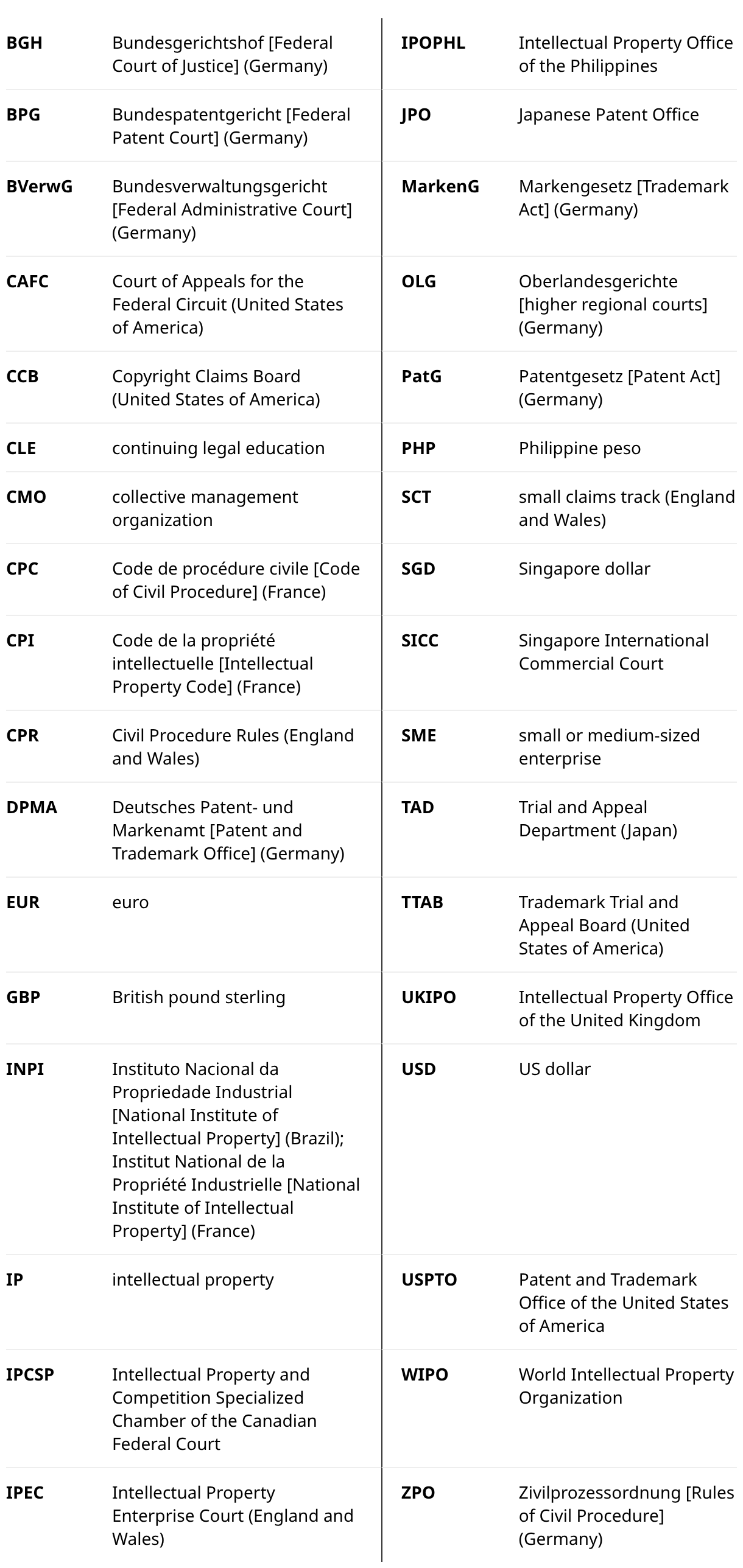
List of abbreviations
Build 2026-10-08T16-40-42.350Z