
This publication is an integral part of the World Intellectual Property Organization (WIPO) Series on Intellectual Property Valuation initiated by the Intellectual Property (IP) for Innovators Department.
WIPO has commissioned the development of this work to support life sciences innovation professionals and technology transfer managers in research-intensive universities, startups and spinouts, as well as small- and medium-sized businesses. It aims to facilitate the valuation of early-stage IP in biotechnology and pharmaceutical companies with a focus on professionals operating in early-stage innovation ecosystems. It is assumed that the techniques and approaches described herein are well understood by valuation professionals in well-established biotechnology and pharmaceutical organizations.
We navigate the process of translating early-stage IP (discovery) through clinical trials, regulatory approval and into the market, and discuss how the development process impacts the risk profile of IP and, therefore, the evolution of IP value along the way. We underpin theoretical concepts with a case study and worked examples to demonstrate how the valuation methods work in practice, and focs on how the pharrmaceutical and biotechnology sectors differ from other industries in terms of the development timeline, the structure, and the binary nature of outcomes.
The main focus is on valuation approaches used in practice in the pharmaceutical and biotechnology sectors, namely income-based approaches and the comparables method.
The guide is designed to be a helpful guide for innovation professionals who seek a fundamental understanding of the approaches used in valuating IP in the biotechnology and pharmaceutical sector. We encourage the reader to master the techniques described and seek professional advisory support when developing valuation models for IP under their management.
Introduction to biotechnology and pharmaceuticals
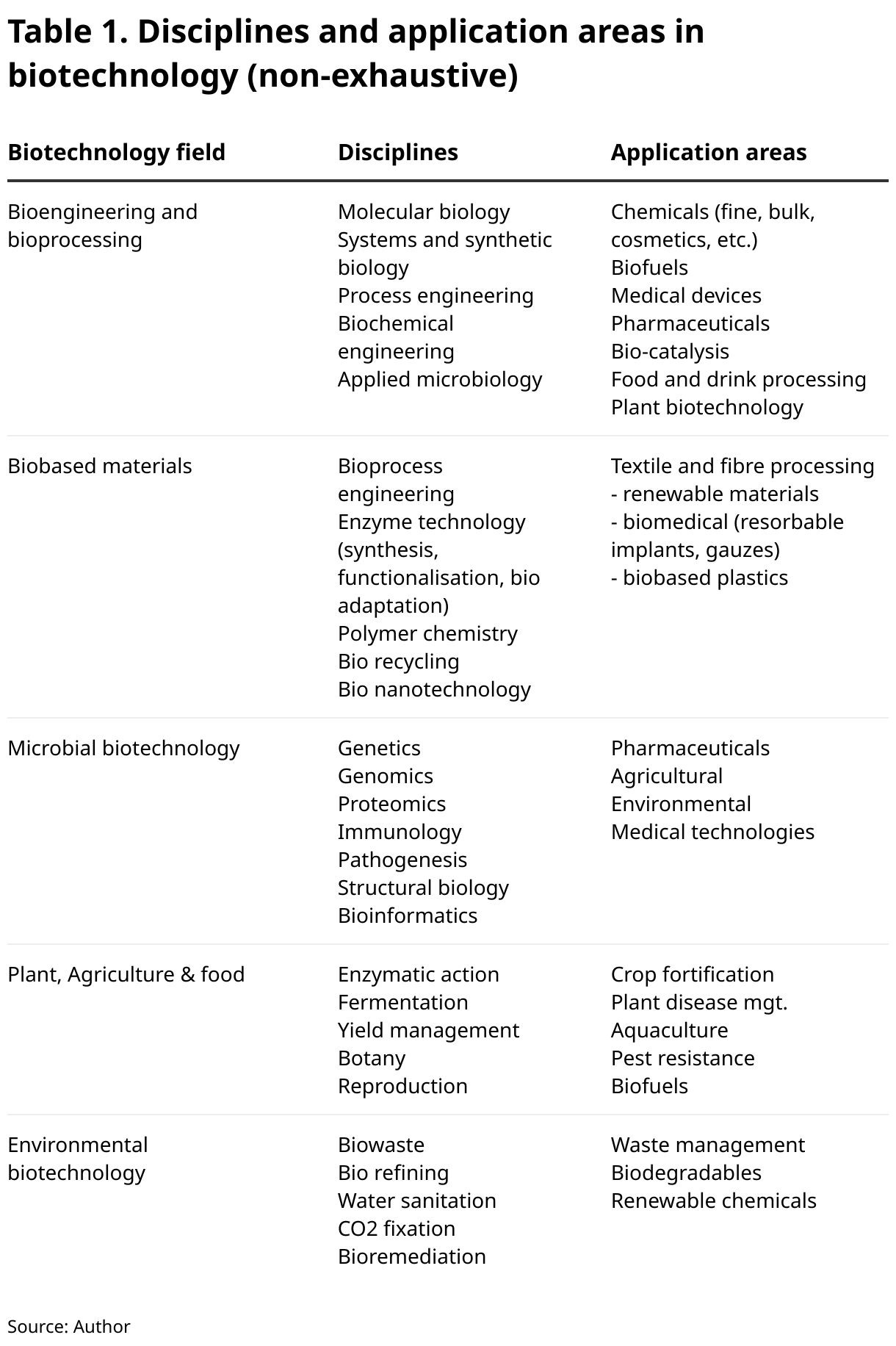
Biotechnology may be defined as the integrated use of biochemistry, microbiology and engineering sciences to achieve technological (industrial) application of the capabilities of microorganisms, cultured tissue cells and parts thereof (Table 1).
Products emerging from this field are very diverse, from yeast used in baking and penicillin as an antibiotic, to using enzymes to clean up oil spills. Pharmaceuticals can be chemically synthesized (synthetic products), formed by chemical reactions following a set of biological fermentation and extraction processes (semi-synthetic products, such as some antibiotics). Collectively, these products are called small molecule products. Or, pharmaceuticals can be manufactured through fermentation or other processes that are fundamentally biological in nature rather than chemical (biological products). These biologicals typically have a molecular size that is many times that of the synthesized organic molecules (hence the use of the term small molecule) and are produced via a variety of distinct approaches. Cell and gene therapy products are frequently referred to as advanced therapeutic medicinal products. Within this guide, no distinction will be made between biotechnology and pharmaceutical products or industries, as valuation approaches are the same within these broad life sciences domains.
How the biotechnology sector differs from others
Compared to other sectors, the drug development process follows a well-established structure as shown in Figure 1. Briefly, the process begins at discovery, where thousands of compounds are investigated as potential drug candidates. Those that meet the criteria for further development enter pre-clinical studies in which in vitro and in vivo investigations are conducted. Successful candidates enter clinical trials, characterized by phase I trials focused on safety and dosage, after which successful candidates enter phase II trials which test for efficacy in a small group of patients. Phase II trials lead to phase III, which similarly test for efficacy, but at a large scale, often involving thousands of patients. The drug candidate is then submitted for regulatory review which requires the examination of submitted clinical trial data. The focus at this stage is on the safety and effectiveness of the drug. The applicant will be required to work on developing prescribing information (labeling). After review, an approval decision is made by regulators. Once the drug has been approved for the market, it undergoes a post-market safety review focused on the long-term safety of drugs. Any changes to formulation, dosage or labeling and the development of new uses or forms (tablet, oral, injectable) are subject to new applications to the regulator(s) and require additional approvals. Regulators also ensure that advertising is aligned with the drug’s intended purpose.

In Figure 1, the regulatory process of the Food and Drug Administration (FDA), a drug that is yet to be approved for general use by regulators is known as an Investigational New Drug (IND). The analysis shown was conducted by the US-based Government Accountability Office (GAO). The drug development process from discovery to postapproval reviews can take up to 10 years or more depending on the indication. The drug under scrutiny can fail at any point in this process, which could cost billions of dollars depending on the clinical area and stage of development. Consequently, this binary nature of drug development presents a substantial risk compared to utilizing IP in other sectors where it is likely to:
Undergo a shorter development process to market.
Have more room to pivot – design around performance or functionality challenges.
Undergo a less onerous regulatory approval process, concerning data submission requirements, cost and process.
As a result, the risk profile in biotechnology necessitates careful consideration when valuing IP in this sector. In addition, the long development for biotechnology IP are often beyond the conventional return on investment timeline expectations for capital providers. For many investors, a three-to-seven-year period is typical, beyond which they would prefer to exit or evaluate their investment. In addition, drug development incurs remarkably high capital expenditure, with the average prelaunch development costs ranging from USD 161 million to USD 4.54 billion across all therapeutic areas (Schlander et al., 2021).
Intellectual property valuation methods in the biotechnology sector
Innovation professionals working in research-intensive universities, startups, spinouts or small- and medium-sized businesses understand the significance of valuing IP assets. IP valuation plays a crucial role in strategic decision-making, technology transfer, licensing, attracting investments and overall IP commercialization.
In this comprehensive guide, we will explore the most popular IP valuation methods tailored specifically for the biotechnology sector. Each valuation method offers a unique perspective on assessing the value of your IP assets, enabling you to make informed and strategic choices.
The valuation methods we will explore are the following:
Cost method – The cost method estimates the value of an IP asset based on the costs incurred in its development. It provides a starting point by considering the investment made in research and development activities, clinical trials, regulatory filings and other related expenses.
Market approach – The market approach determines the value of IP by comparing it to similar IP assets that have been recently sold or licensed. This method relies on market data and transactions to gauge the value of your IP in the current marketplace.
Income approach – The income approach assesses the value of IP by estimating its future income-generating potential. It considers factors such as projected cash flows, expected revenues, licensing fees and royalty streams to determine the present value of the IP asset.
Real options method – The real options method acknowledges the flexibility and potential future opportunities associated with IP assets. It allows you to value the strategic choices and opportunities that may arise during the development and commercialization of your biotechnology IP. By considering the uncertainty and the ability to modify the project based on new information, the real options method provides a more comprehensive valuation.
Throughout this guide, we will delve into each of these valuation methods, providing detailed insights into their application, strengths, and limitations. By understanding and effectively utilizing these valuation techniques, you will gain a comprehensive toolkit to assess and maximize the value of your biotechnology IP assets.
Valuation professionals may complement their preferred valuation method with other methods to address any perceived gaps in their approach. For instance, outputs from the income-based approach may be complemented with the comparables method of IP value, to support negotiations between IP owners and potential licensees or investors, who favor one valuation approach over others. IP valuation should be defensible and easy to articulate to both internal teams and other stakeholders. The assumptions used in the valuation process must be data-driven and, wherever possible, draw from well-established industry parameters. For a more advanced discussion on IP valuation in life sciences, we recommend the practical guide by Bogdan and Villiger (2010).
Important context and assumptions in biotechnology IP valuation
Valuing IP in biotechnology and pharmaceuticals involves significant uncertainty, particularly at early stages (pre-clinical through Phase I). Due to high risks, uncertain clinical outcomes, and the speculative nature of future markets, early-stage biotech IP valuation relies extensively on expert assumptions, forward-looking scenarios and flexible methodologies. As technologies progress through later stages of clinical development (Phase II, III, and regulatory approval), uncertainty gradually diminishes, enabling more precise, quantitative valuation methods. Readers should recognize these inherent uncertainties early to better understand and apply the methods described in this guide
Alignment with international valuation standards
The International Valuation Standards Council (IVSC) actively promotes globally consistent, transparent, and robust valuation methods. These standards suit assets with well-defined markets, predictable cash flows, and sufficient historical or comparable data – conditions more typical in later-stage biotech IP (Phase III and beyond, and regulatory approval).
For early-stage biotech assets (pre-clinical and Phase I), valuation methods though still quantitative in structure, rely heavily on qualitative, speculative, or scenario-driven inputs due to limited data and high uncertainty. At this stage, while robust methods like risk-adjusted Net Present Value (rNPV) and Real Options are employed quantitatively, the underpinning assumptions (probability of success, market penetration and pricing) are predominantly derived qualitatively through expert opinion, scenarios and judgments.
As biotech IP matures (particularly Phase II onwards), valuations begin incorporating progressively stronger quantitative inputs such as clinical efficacy data, emerging market comparables anddefined regulatory timelines, thus improving alignment with IVSC standards. By Phase III and at regulatory approval stages, valuations typically adhere more closely to rigorous quantitative standards, given the availability of concrete, quantifiable data.
This guide complements the Intellectual Property Valuation Basics for Technology Transfer Professionals by explicitly focusing on biotech-specific valuation dynamics. Practitioners are encouraged to apply iterative valuation practices, beginning with speculative and expert-informed assumptions at early stages, and gradually transitioning to more quantitatively rigorous, IVSC-aligned methods as clarity and data availability increase. This structured progression provides credible, transparent valuations at every stage of biotech innovation.