
Discounted cash flows and net present value
Discounted cash flow is a commonly used valuation method that estimates the value of IP by determining the expected future cash flows resulting from the development and commercialization of said IP. In this chapter, we will introduce cash flow statements and how they are used to monitor the financial health of an asset, which in this case is IP. In addition, we will discuss the concept of discounting, which allows us to determine the net present value (NPV) of future cash flows.
With this conventional valuation approach, the valuer determines the nature of cash flows for the project under development. Cash flow is the movement of money in and out of the company, typically to develop, produce, and sell goods and services. The cash flow statement summarizes a company’s cash inflows and outflows over a specified period. Cash flow statements and other financial reports allow companies, investors and analysts to determine the financial health of a company. An example of a cash flow statement is shown in Table 3.

In Table 3, the small business starts with USD 20,000 in hand and in the first month makes USD 25,000 in sales. The business has several expenses including advertising, labor, and utilities. In addition, there is an outstanding loan that is steadily repaid each month. The company also pays monthly for some capital purchases.
In this example, the business has a net positive cash flow at the end of each month. The cash flow statement allows the small business to monitor its financial health. Similarly, when considering IP commercialization, we must consider the costs of development, any investments raised to support exploitation and, eventually, inflows of cash due to sales. It is important to note that loan repayments and capital purchases, while contributing to overall cash outflows from the business, are segregated to provide clarity and transparency. In the case of the loan for example, this separation allows users of the financial statements to analyze the impact of borrowing and repayment activities on the company’s cash flows separately from other activities.
For IP valuation, we assume that the IP under review is at an early stage and therefore either at discovery, pre-clinical or phase II trials. The cash flow developed addresses the remaining development process as the IP undergoes clinical trials and regulatory review, to market entry. Post-market cash flows span the IP’s useful remaining lifetime, which is typically the period up to patent expiry or peak sales.
The process may take the following steps:
Step 1: Determine pre-commercialization cash flows
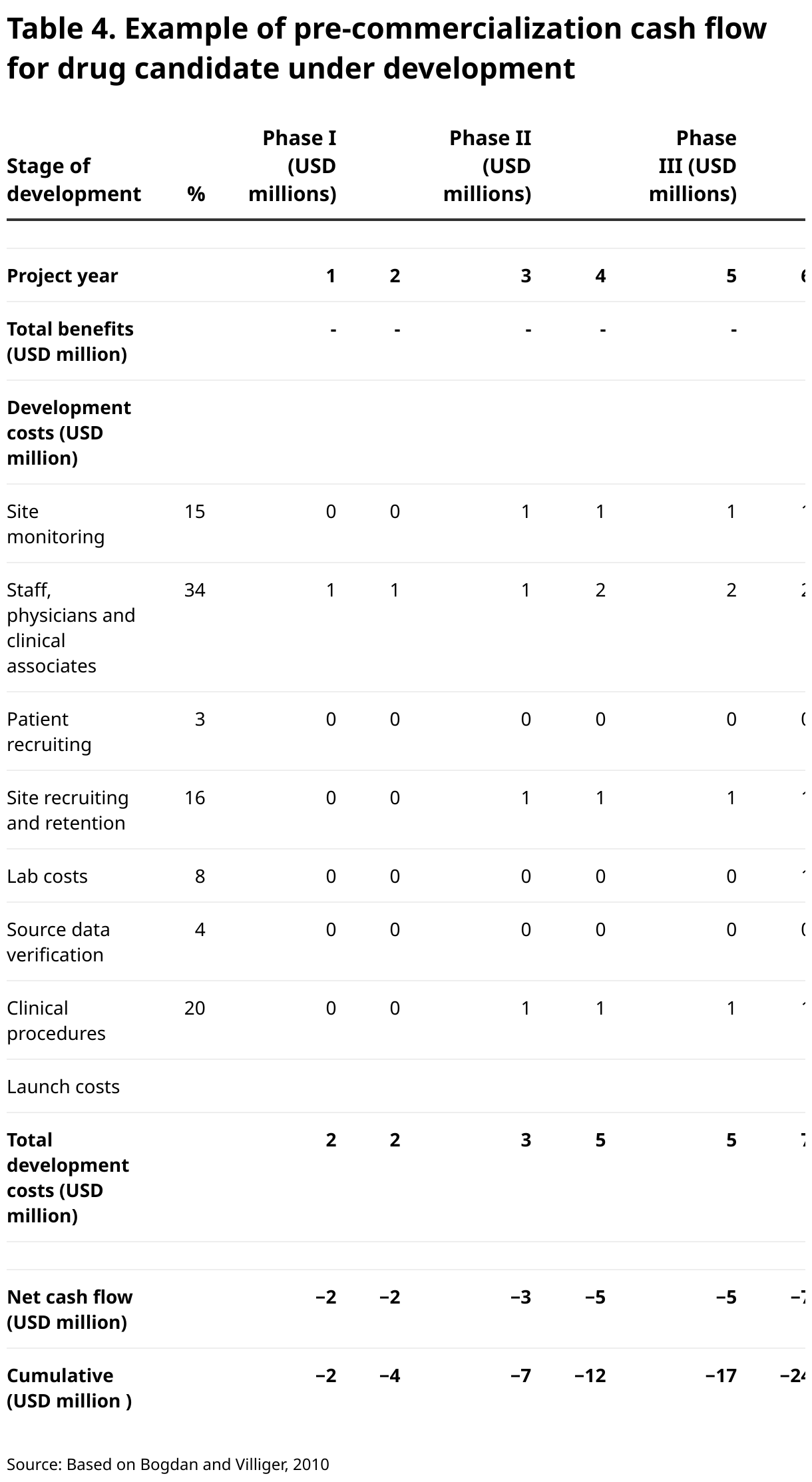
We need to consider the costs of acquiring IP, in case it has not been developed in-house, as well as pre-clinical and clinical studies, operations, and administrative costs. To appropriately estimate these costs, it may be necessary to simulate different scenarios to account for higher-than-expected costs, delays in conducting studies and fluctuations in operational and administrative costs. Cash flows are typically negative (Clinical Research, 2019) in the pre-market phase of the project, as shown in Table 4.
Step 2: Determine post-commercialization cash flows
After market entry, cash flows inflect positive due to revenues from product sales. Here, we must consider product sale evolution where product sales grow from a low base, peak over time and eventually depreciate as market capitalization is lost due to product obsolescence, competition, and other factors. Estimation of sales can be challenging due to the wide range of value drivers in the marketplace. These include the size of the target patient population, our drug pricing, uptake rates in various target markets, dosing requirements, competition (including from non-medical solutions), growth forecasts, obsolescence, competing drugs entering the market or as our product approaches the end of its useful life.
Figure 2 shows an overview of the forecasting approach typically used in the biotechnology and pharmaceutical sectors (Cook, 2016). Typically, we start with estimating the number of people who suffer from the condition that our therapeutic agent can treat. We then determine from this figure how many are likely to take remedial therapies. We assume that this subset of the population has been diagnosed and may be symptomatic. From this group, we further estimate the number that may have access to relevant drugs that have been approved in the region we are scrutinizing. At this point, we can consider the existing market for the drug under scrutiny and its competitive landscape. We can then consider how this figure (patients on drug X) converts into sales for the drug developer. Drug pricing is complex and subject to negotiations between pharmaceutical companies and national health services as well as the highly fragmented private health care sector comprising insurers, pharmacy benefit administrators, and other stakeholders. The situation is further complicated by the trend toward value-based pricing for prescription drugs.

Step 3: Discounting each cash flow
The cash flows estimated in steps 1 and 2 not only occur at different points in time, but they also carry an element of unpredictability in terms of size and the likelihood of occurring. Once we estimate these future cash flows, we discount and sum them to determine the NPV of the IP. Discounting refers to the process of determining the present value of an opportunity, which is realized at a future date. The discount rate applied is a single value, which combines several factors including:
Time value of money – The concept that money today is worth more than money tomorrow.
Cost of capital – The rate of return a company must earn before generating value.
Probability of success – Estimating uncertainty or risk of the cash flows.
We will first explore the concept of time and value of money. For example, a dollar today is worth more than a dollar will be worth in one year. We must apply an interest rate to address the depreciation of the dollar, to preserve its present value. This is like applying an interest rate to a dollar in a savings account. Typically, interest rates compound over time, such that if we applied a 10 percent interest rate on the dollar, it would be worth USD 1.10 after the first year and USD 1.21 after the second year. For the purposes of valuation, the interest rate applied comes from national treasury bonds with long maturities in the country (e.g., the United States of America) or region (e.g., the European Union) of interest for the valuation activity.
To discount each cash flow the formula shown in Equation 1 is typically used.

The cost of capital is partly dependent on the company’s profile from an investor’s perspective. For example, a well-established biotechnology company with a history of successfully taking drugs to market may be considered lower risk than a startup established to develop and market one drug candidate. In the latter case, the company is likely to be considered high risk, and as a result may be subject to higher-than-average costs of capital. A positive NPV or discounted cash flow indicates that the project exceeds the firm’s discount rate and would be valuable to pursue. A negative NPV indicates that the project will not make a sufficient return to cover the discount rate and should be abandoned.
Some valuation professionals argue that using a single value to accommodate several variables masks the complexity of the drug development process and therefore outputs a less accurate valuation than when a risk-adjusted approach is used (Avance, 2021a).
Cost of capital is an important factor to consider in IP valuation and it is helpful to understand its components and their relationships. The rate on long-term government bonds is often perceived as a risk-free rate by financial market participants. This rate serves as a baseline for riskier financing activities conducted by companies. Large companies typically raise funds by issuing shares and taking on debt through corporate bonds, both of which incur costs.
In an equity issue, an investment bank facilitates the issuance process and existing shareholders may have the option to purchase new shares. On the other hand, when issuing corporate bonds, the company must pay interest based on the current risk-free rate and the projected rate over the bond’s lifespan (which can extend up to 10 years). Additionally, a risk premium is included to account for the market’s assessment of the firm’s activities. The cost of capital for a company is the culmination of these charges, blended based on the company’s equity (share) and bond (debt) composition.
For many large pharmaceutical firms, the cost of capital has ranged from 7 to 9 percent over the past 15 years. Analysis reports produced by prominent investment banks often provide the cost of capital rate for specific firms, serving as valuable references. However, small biotechnology firms may face substantially higher costs of capital. Raising new equity can be challenging and expensive for them and traditional debt financing may not be a viable option.
Understanding the cost of capital is essential in determining the appropriate discount rate for cash flows in IP valuation. It reflects the return expected by investors for the level of risk associated with the investment. By considering the specific circumstances of the firm and its industry, including the size, stage of development and market conditions, a realistic and customized cost of capital can be determined, enabling a more accurate valuation of the IP assets.
Project risk is a crucial aspect to consider in IP valuation and it is closely related to the concept of the risk-free rate and the cost of capital. The risk-free rate represents the time value of money for a project that carries no risk, while the cost of capital reflects the time value of money for a project with the same level of risk as the average project within a firm. In practice, many large firms establish a corporate rate at the beginning of the year, which serves as a benchmark for most valuations, enabling clear comparisons among competing projects. However, for projects perceived as high risk, a higher discount rate may be applied to account for the elevated level of risk.
Determining the appropriate discount rate to reflect project risk is a challenging task. It requires a careful assessment of the specific risks and potential outcomes associated with the project. The use of a higher discount rate for riskier projects aims to capture the additional compensation required by investors for taking on greater uncertainty. However, one major drawback of solely adjusting the discount rate to account for project risk is that the effects of risk are not explicitly visible in the valuation output. Users of the valuation information may not easily discern the separate impacts of the cost of capital and risk on project value.
To address this issue, a more effective approach is to adjust the cash flows (the numerator in the valuation equation) to incorporate project risk separately from the cost of capital (the denominator). By doing so, observers can clearly see and evaluate the influence of each factor, promoting a more comprehensive understanding of the expected cash flows and risk implications. Determining the expected cash flows requires careful consideration and judgment by the project team. However, relying solely on one scenario may limit the assessment to a single set of outcomes. Therefore, the rNPV approach is highly valuable, as it explicitly considers a range of future scenarios, providing a more comprehensive evaluation of project value.
Considering project risk and using the rNPV approach allows decision-makers to assess the potential impact of different outcomes and make informed decisions based on a more comprehensive understanding of the project's value. It encourages a thorough examination of the expected cash flows under various scenarios, ultimately leading to a more robust and realistic valuation. The rNPV is described in detail in the following section.
Risk-adjusted net present value
The rNPV, also known as the probability-weighted expected return method or expected NPV method, is a refinement of the discounted cash flow approach, where future cash flows are adjusted based on their probability of success. Here, we separate the cost of capital from the probability of success of the project development. The rNPV is the most popular, and therefore de facto valuation method for biotechnology assets and firms, and can be calculated using the formula in Equation 2.

The process may take the following steps:
Step 1: Determine the probability of success
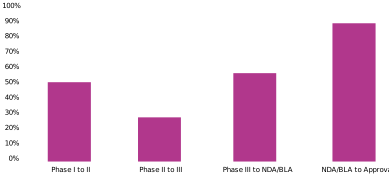
Due to the well-established structure of drug development, attrition rates (or inversely, probabilities of success) during clinical trials and at regulatory approval are well documented across different indications, as shown in Figure 3 (Biotechnology Innovation Organization, 2021).
 Note: NDA, New drug application; BLA, Biologicals license application.
Note that the data shown in Figure 3 shows attrition rates across several indications. When developing valuation models for a particular indication you should source more precise data relevant only to the indication of interest.
Step 2: Determine influential factors
Other factors play a part in the valuation of biotechnology IP, including partnerships and how useful the product remains during the lifetime of the IP.
Partnerships
Often drug development is conducted through research and development collaborations, which may require the use of background IP or know-how developed by consortia members. The arising, or foreground, IP (candidate molecules) may therefore be co-owned by the collaborators. In addition, partners may share the risk by funding both clinical trials and later marketing activity.
Remaining useful lifetime of IP
Due to the long development timeline in the biotechnology sector, the IP protection strategy must be robust. Applying for patent protection early in the process (e.g., at discovery) may be unwise since it may be more than 10 years before the product enters the market, at which time the remaining useful time is severely diminished. It may be beneficial to delay the patent application to allow the IP owner(s) the opportunity to appropriate as much future value of the product as possible; however, two key risks need to be assessed: the possibility of inadvertent disclosure (which is in the control of an organization, to a significant degree) and the potential for a similar patent application being filed by a competitor (which is outside of the organization’s control).
Typically, well-established biotechnology and pharmaceutical companies rely on methods such as trade secrets, and robust non-disclosure clauses in their employment contracts to mitigate disclosure risks, but the second risk cannot be mitigated and is always an issue. Consequently, many large firms will file at a specific point in the 14- or 15-year development cycle (e.g., shortly ahead of the candidate selection – the identification of a lead molecule – at approximately 8 to 10 years from potential market launch).
Most research-intensive universities, which are a rich source of early-stage IP (discovery and pre-clinical stage), do not have the resources to develop IP beyond the pre-clinical stage. They are also obligated to pursue academic capital by publishing research outputs, some of which may reveal commercially sensitive insights. These factors make it more challenging for universities to appropriate a significant portion of the future value of IP, compared to biotechnology and pharmaceutical companies with the resources to operate downstream (clinical trials and market entry).
Considerations when using rNPV
There are several points to consider when using rNPV:
Assumptions used in cash flow development must be data-driven. One must rely on verifiable information on attrition rates for the indication, project type, and stage of development. The use of external references enables the valuation to be defended internally, within the organization, and potentially, to an external party in a deal negotiation. Some core assumptions and ranges of valuation outputs may be shared in negotiation discussions to support a position on deal terms.
The rNPV approach is widely accepted by valuation professionals in biotechnology and pharmaceuticals (Avance, 2021b) and should constitute a core method for all practitioners.
For early-stage IP, the use of comparables is helpful, particularly when preparing to raise finance. Source comparables from recently completed merger and acquisition deals or the financial records of similar public companies.
When considering collaboration partners or in-licensing IP, focus on how the rNPV is shared between parties. This element is a key part of negotiation discussions in these situations.
Some firms structure expected NPV and rNPV calculations using a decision tree approach. This provides a graphical method for detailing the problem and illustrating the results in relation to the valuing of a phase I drug candidate, as is explored in Case study 2.
Pharmacorp, a large pharmaceutical company, has recently failed to secure regulatory approval for a cancer drug and, consequently, shareholder confidence is low. To strengthen its pipeline and reassure shareholders, the company is looking for in-licensing opportunities from universities and biotechnology companies.
BioTech is a mid-sized biotechnology firm with two major projects in its pipeline. One is a phase I cystic fibrosis project while the other is a flagship platform for cancer treatment (TumaBlok). BioTech needs to secure funding to support operations for the next 24 to 30 months.
Pharmacorp encountered BioTech at an industry conference and held some initial discussions about BioTech’s pipeline. Pharmacorp thinks that the CF project may be an attractive licensing opportunity.
Due diligence The candidate CF treatment seems promising from an efficacy perspective. It is a proposed cure for CF, which would be the first of its kind since patients typically undergo lifelong treatment and care. The market is large, at approximately USD 6 billion a year globally. BioTech is keen to out-license the CF drug to allow the company to focus its efforts on the cancer treatment. Pharmacorp’s analysts and finance specialists have estimated the following forward-looking costs for the development of the CF project (Table 5) and the expected sales curve (Figure 4).


Based on the data in Figures 4 and 5, and utilizing a discount rate (r) of 10 percent, Pharmacorp’s analysts have built a risk-adjusted discounted cash flow model to assess the value of IP as a basis for deal negotiation (Table 6).

Pharmacorp’s analysts have valued the CF opportunity as if it were an internal project, resulting in the data shown below.
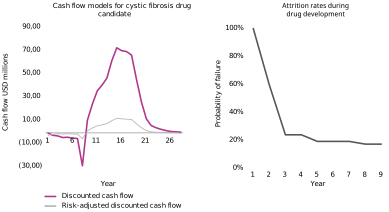
Based on this model, Pharmacorp’s analysts can determine two key indicators of deal performance: the expected NPV of the deal and the internal rate of return (IRR). These indicators are used to compare this opportunity against others available to Pharmacorp. Due to the sharp decline in sales predicted (Figure 5), the rNPV of the project is calculated only up to peak sales (project year 18), by summing the yearly risk-adjusted discounted cash flows for each year up to year 18. This yields an rNPV of USD 70.45 million. It is worth reiterating the approach used to determine the rNPV. One may take the following steps:
Estimate the expected cash flows: Start by estimating the expected cash flows associated with the drug candidate’s development and commercialization. Consider factors such as research and development costs, regulatory expenses, manufacturing and production expenses, marketing and sales costs, and projected revenues, for different potential outcomes, over the drug’s lifecycle.
Assign probabilities to different scenarios: Assess the probabilities of various scenarios that may impact the drug’s success and commercialization. This could include factors such as clinical trial results, regulatory approval, market acceptance, competition and patent expiration. Assign probabilities to each scenario based on expert judgment, historical data or industry benchmarks.
Calculate the risk-adjusted cash flows: Multiply each expected cash flow by its corresponding probability. This step accounts for the likelihood of each scenario occurring and adjusts the cash flows accordingly. Higher-risk scenarios may be assigned lower probabilities, leading to lower weighted cash flows.
Discount the risk-adjusted cash flows: Apply a discount rate to the risk-adjusted cash flows using the organization’s standard discount rate (which reflects its cost of capital). The discount rate should not reflect the drug’s specific risk profile, including factors such as the stage of development, market potential and regulatory uncertainties, as these factors have been incorporated into the set of cash flows and probabilities. Discounting the cash flows reflects the time value of money to the specific organization that is evaluating the project and provides the present value of the expected future cash flows.
Sum up the risk-adjusted present values: Sum up the discounted cash flows to determine the rNPV. A positive rNPV indicates that the drug candidate’s expected cash flows, after considering the associated risks, outweigh the costs and meet the required return on investment. A negative NPV suggests that the drug candidate may not generate sufficient returns to justify the investment.
One feature of this approach is that a large pharmaceutical firm and a biotechnology company may have different valuations of the same project since, in most cases, the cost of capital to the two firms is different. From one perspective, this may seem illogical – surely a project has a specific value? However, the NPV and rNPV methods do not determine a true or market average value of a project, it uses a specific discount rate that is linked to a particular firm and so it assesses the value of the project to the firm that is undertaking it. Positively, in the usual business context of internal evaluation and review, this is the information that is required by the commercial team and by senior management. In large firms, tax effects are often considered in NPV or rNPV valuations as a final stage in the analysis.
By applying the rNPV approach, decision-makers can better evaluate the value of an early-stage drug candidate, considering the inherent uncertainties and risks in drug development. This analysis helps assess the potential profitability, make informed choices regarding resource allocation, licensing agreements, partnerships or further development decisions, and compare different investment opportunities based on their risk-adjusted profitability. Incorporating risk adjustments into the NPV calculation provides a more realistic assessment of the investment’s value, considering the uncertainties and risks involved, and helps evaluate whether the expected returns adequately compensate for the perceived risk.
From this analysis, we observe that the effect of risk adjustment becomes clear, with cash flows heavily modulated by the probability of success, thereby diminishing the chances of market entry. Notably, we modulate costs by the cumulative probability, as subsequent costs of development will not be incurred if the project fails a developmental milestone.
Next, we calculate the IRR for the project, by iterating the discount rate until the rNPV at peak sales equates to zero. By doing this, the analysts are determining the rate of return of the project compared to the discount rate and, provided the IRR is higher than the discount rate, the project is financially attractive. The analyst’s model yields an IRR of approximately 35 percent, significantly above Pharmacorp’s 10 percent discount rate.
The internal rate of return
IRR is a metric commonly used in financial analysis to estimate the profitability of a potential project or investment and as a way of comparing multiple opportunities. The IRR is the discount rate at which the expected NPV, i.e., the sum of risk-adjusted discounted cash flows, equals zero. If the calculated IRR is above the cost of capital (discount rate) for the company evaluating the project, then in theory the project is profitable. If the IRR is lower than the cost of capital (discount rate), then it would theoretically cost more to fund the project than the expected returns from it, making it unprofitable.
The advantage of using IRR to evaluate investment opportunities or potential projects is that it allows for the comparison of multiple projects through a single value. Although IRR is a popular way of estimating the returns and profitability of a project or investment, it is typically used in conjunction with other factors when evaluating an investment decision.
To understand the concept of IRR, let us consider an example. Suppose you are considering investing in a biotechnology project to develop a new drug. The project requires an initial investment of USD 1 million and is expected to generate cash inflows of USD 300,000 per year for five years. You want to determine the IRR of this investment.
To calculate the IRR, you need to find the discount rate at which the present value of the cash inflows equals the initial investment. You can start by assuming a discount rate, for example, 10 percent. You discount each cash inflow to its present value using the discount rate and then sum up these present values. If the sum is equal to the initial investment, then the assumed discount rate is the IRR. If not, you adjust the discount rate and repeat the calculation until you find the rate that makes the NPV zero.
Let us say you calculate the present value of the cash inflows at a 10 percent discount rate and find that the sum is USD 700,000. Since this is less than the initial investment of USD 1 million, you know that the IRR must be higher than 10 percent. You adjust the discount rate to 15 percent and repeat the calculation. This time, you find that the sum of the present value is USD 1.2 million, which is higher than the initial investment. Therefore, you can conclude that the IRR is between 10 and 15 percent.
In this example, the IRR represents the annualized rate of return that would make the project’s NPV equal to zero. If the IRR is higher than the required rate of return or the cost of capital, it indicates that the investment is potentially profitable. On the other hand, if the IRR is lower than the cost of capital, it suggests that the project may not meet the required return threshold and could be considered less attractive.
The relationship between the discount rate and IRR is that the discount rate is used to calculate the present value of cash flows, while the IRR is the rate at which the present value of cash inflows equals the initial investment. The IRR provides a way to compare the potential returns of an investment with the discount rate or the cost of capital to determine its feasibility and profitability.
The IRR is a useful metric for assessing the rates of return and relative attractiveness of different projects. However, it has certain limitations. The IRR does not provide information on the magnitude of potential cash returns, as it focuses solely on the percentage rate of return. On the other hand, the NPV and rNPV methods evaluate cash returns at a fixed discount rate, offering insights into the size of potential cash returns to the firm. These different characteristics drive the application of these techniques in specific contexts.
The IRR is commonly used in measuring the returns of venture capital and private equity funds. In such cases, potential investors, like pension funds, are interested in knowing the return that could be generated for each million pounds invested, making the rate of return an appropriate metric. On the other hand, NPV is widely employed in large firms as the primary valuation approach, enabling the comparison of potential returns across different projects conducted over time, by evaluating their value in terms of cash today, which is typically the most relevant information.
However, there are drawbacks associated with using the IRR approach. If the cash flows change signs (positive to negative or vice versa) more than once throughout the project's lifespan, the calculation may yield multiple answers, causing confusion in interpretation. Additionally, two projects with different cash flows and profitability in terms of cash returns may have the same IRR, depending on the sequencing of the cash flows.
It is important to consider these limitations and select the appropriate valuation method based on the specific context and objectives of the analysis. While IRR can provide insights into relative rates of return, NPV and rNPV offer a more comprehensive assessment of the potential cash returns and the value of these returns to the firm.