
Regional breakdown: space total
Based on the number of patent family publications, Asia is the most important research region for space exploration technologies. Between 2000 and 2023, there were 52,105 patent families published by inventors based in Asia (Figure D6). This represents 70% of all patent families identified. North America (17,342) and Europe (7,366) are other important research regions. The number of patent families from other regions (Africa, Latin America and the Caribbean (LAC) and Oceania) remains rather low.
Top inventor countries: space total
China and the United States are the leading research countries in space transportation technologies. Between 2000 and 2023, inventors from China published more than 38,000 patent families in these technologies, whereas inventors from the United States were responsible for the publication of almost 17,000 patent families (Figure D7).

China has become a leading nation in space technology research over the past few decades. The Government of China has consistently prioritized space exploration as a key aspect of its national development strategy. Central to these efforts is the China National Space Administration (CNSA) established in 1993, which oversees the nation's space missions and research initiatives. China's space program has made significant progress, including manned space flights, lunar exploration and the development of its own space station, Tiangong. These milestones are supported by a robust launch vehicle program, including the Long March rocket series.
Key players in China's space technology landscape extend beyond the CNSA to include aerospace companies and research institutions such as the China Aerospace Science and Technology Corporation (CASC), the China Academy of Space Technology (CAST) and the China Academy of Launch Vehicle Technology (CALT). The integration of academic research, state-owned enterprises and government policy has fostered a cohesive ecosystem that supports innovation. China has ambitious goals for the future in space such as building a permanent lunar research station.
The United States has been at the forefront of space technology research since the mid-20th century. The country has long been the most prominent actor in the global space sector with the highest annual public space budget.
The role of the private sector has become increasingly important in US space efforts, with companies such as SpaceX, Blue Origin and Boeing playing key roles.
Japan has carved out a significant role in space technology. This is reflected in patent numbers, with Japan having published more than 6,500 patent family publications since 2000 (Figure D7). Japan's space technology ecosystem is bolstered by a combination of governmental agencies, academic institutions and private companies. The Japan Aerospace Exploration Agency (JAXA) established in 2003 is the primary body overseeing Japan's space exploration activities. Private companies like Mitsubishi Heavy Industries, which is responsible for the H-IIA and H-IIB launch vehicles, play a crucial role in launching satellites and other payloads into space.
The Republic of Korea is ranked fourth in terms of patent family publications, with around 4,500 publications between 2000 and 2023. The Korea Aerospace Research Institute (KARI), established in 1989 is the central agency driving the country’s space ambitions.
France and Germany are the leading European locations in space technology research. Both countries have published more than 2,100 patent family publications since 2000 and deliver substantial financial and technological contributions to the European Space Agency (ESA), and also have their own national space programs. Both countries have a strong heritage in aerospace engineering and science, supported by extensive government funding and industrial capability. Germany has made a significant contribution, particularly in areas such as satellite development and space robotics. The German Aerospace Center (DLR) is the key player in Germany. France is a leading contributor to the Ariane launch vehicle program. CNES (Centre national d’études spatiales) is the top space research institution in France. CNES has developed a series of highly successful satellites, including the SPOT series for Earth observation and the HELIOS series for military reconnaissance. Key private players include major aerospace companies such as Airbus Defence and Space and Thales, which have significant operations in both Germany and France.
Other important countries for space research are the Russian Federation (1,762 patent family publications since 2000) and the United Kingdom (UK) (1,444). Canada (896) and India (514) rank ninth and 10th, respectively.
Development and patent growth since 2000
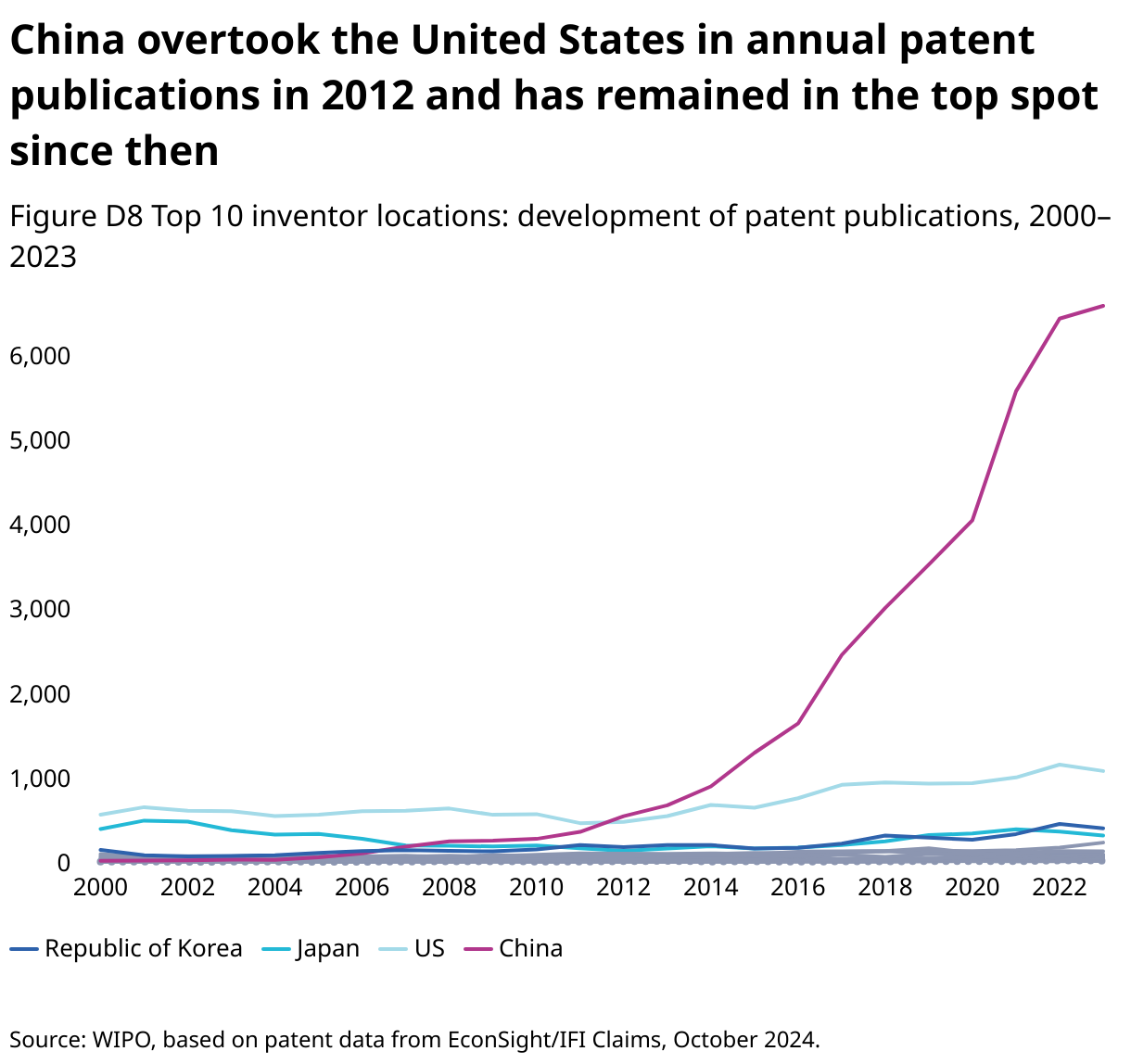
Figure D8 illustrates the impressive growth of Chinese research efforts in the field of space exploration over the last two decades. From a mere 15 patents in 2000, the number of patent family publications from China had multiplied to almost 6,600 in 2023. In the process, China overtook the United States in terms of annual patent publications as early as 2012 and has held top spot ever since. In the United States, the number of patent family publications in space science has grown at a more modest rate, from 560 in 2000 to 1,076 in 2023. In contrast, patent family publications stagnated in Japan and even decreased in the Russia Federation between 2000 and 2023.
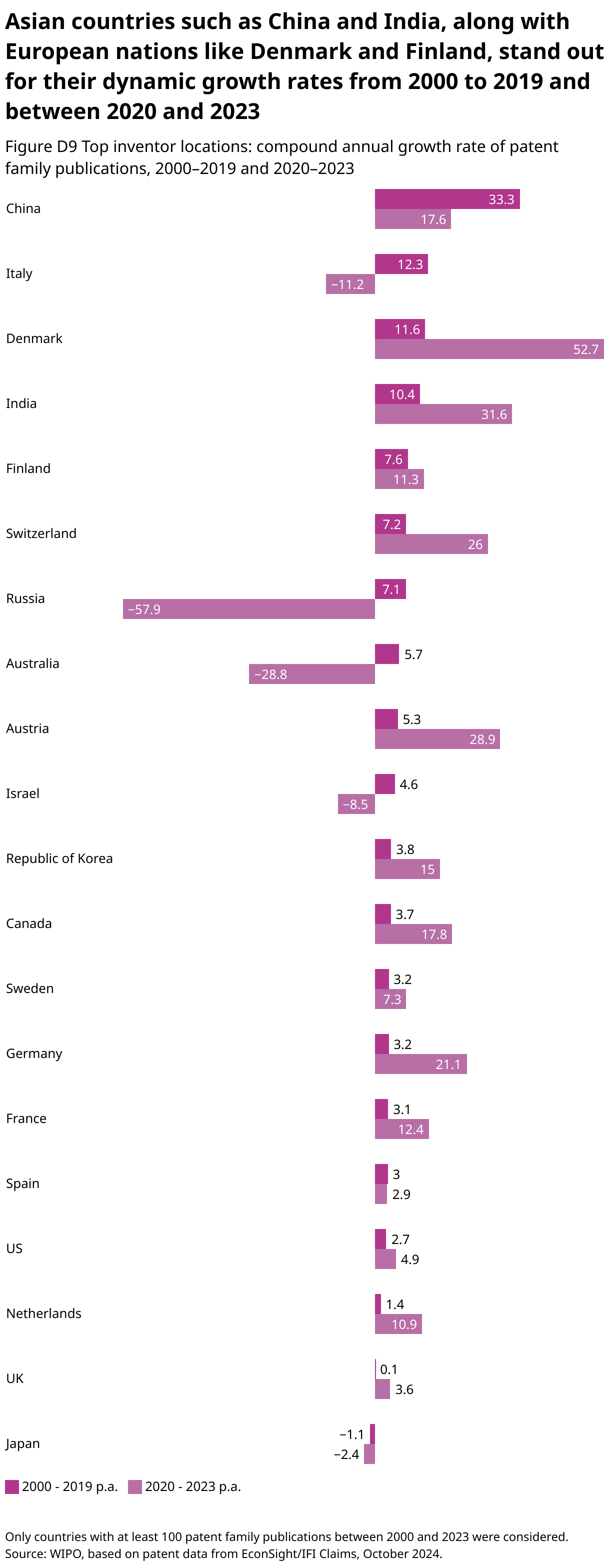
Regarding the growth rates of patent families, Asian countries China and India plus the European countries Denmark and Finland stand out, with very dynamic growth rates both between 2000 and 2019 and between 2020 and 2023 (Figure D9). In Italy, patenting activity grew at a dynamic rate between 2000 and 2019, but has been declining since then. The same is true for the Russian Federation, Australia and Israel.
Research priorities: countries
A closer look at research priorities at country level shows that the technology trend Communication and Security is the dominant research focus for all top researching countries (Figure D10 and Table D1). However, there are some differences in respect to the other three technology trends. For example, an above-average focus on the development of Sustainable Propulsion for spacecraft is observed in Switzerland, Austria, Germany and the Russian Federation. Austria also has above average patenting activity in Automation and Circularity. Australia and the Kingdom of the Netherlands have the largest share of patent families published in Human–Machine Interface technologies compared to all patents.


Top inventor locations in the four technology trends
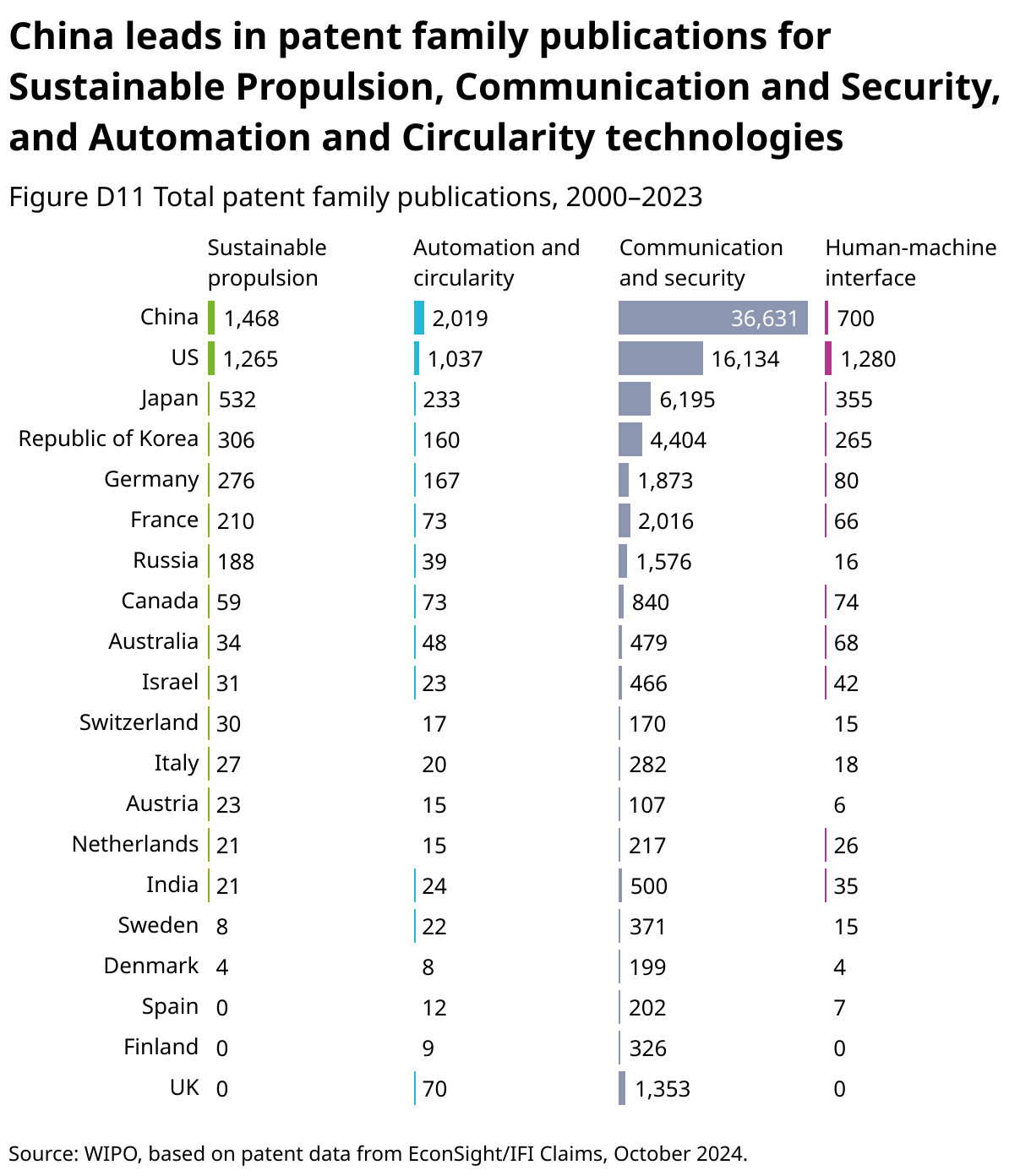
At the level of the four technology trends, China leads in Sustainable Propulsion, Communication and Security and Automation and Circularity technologies in terms of patent family publications (Figure D11). The United States ranks first in Human–Machine Interface technologies.
Relative Specialization Index
The Relative Specialization Index (RSI) is a measure that compares a country's (or company's) patenting activity in a specific research field with its overall patenting activity. It shows how specialized a country is in a particular field compared to its overall research profile. A positive RSI indicates that a country is more specialized in a particular field than the world average, whereas a negative RSI indicates that a country is less specialized in a particular field than the world average.
The RSI for space transportation technologies illustrates the extraordinary importance of space research in Finland and Denmark (Figure D12). The RSI in both countries has increased significantly since 2000.
At the other end of the ranking of the top 20 countries in space transport research are the Kingdom of the Netherlands and Japan, where a negative RSI value indicates a low degree of specialization.
