
Blockchain technology in satellite communication represents a transformative approach to enhancing the security, efficiency and management of satellite networks.
Alternative cybersecurity technologies that could be employed alongside or in place of blockchain include quantum encryption and artificial intelligence (AI)-driven anomaly detection. Quantum encryption uses quantum keys that are theoretically impossible to replicate, thus enhancing data protection between satellites. Meanwhile, AI-driven anomaly detection monitors satellite behavior to detect suspicious activity and potential threats in real time, offering an adaptive and proactive layer of defense. Such technologies may not, however, offer the same degree of decentralized trust and traceability that blockchain provides, making blockchain a uniquely effective choice for the current and evolving needs of space communication networks.
Blockchain technology is highly relevant to satellite communication owing to its ability to address critical security challenges.
The efficiency of satellite network management is also greatly improved through the use of blockchain. In satellite constellations and swarms, where multiple satellites need to communicate and coordinate their activities, blockchain can automate and streamline such processes.
Additionally, blockchain technology enables the creation of secure and virtual trusted zones in space. This capability is crucial for the management and operation of satellite swarms, which require precise coordination and secure data sharing across different orbits. By using blockchain, satellite operators can assure that all communications within the swarm are secure and that any data shared is authentic and has not been tampered with.
There are several types of blockchain implementation in satellite communication, according to de La Beaujardiere and colleagues.
The integration of blockchain in satellite communication offers numerous benefits. Enhanced security is one of the most significant, with blockchain providing robust encryption, tamper-proof records and decentralized control that collectively reduce the risk of unauthorized access and cyberattack.
However, the application of blockchain in satellite communication is not without challenges. Satellites have limited computational power, storage capacity and energy resources, which can constrain the implementation of blockchain technology that typically requires significant computational resources.
Blockchain in satellite communications: scientific publications
The analysis of scientific publications in the field of blockchain in satellite comunication underscores a dynamic and rapidly evolving field, marked by intense research activity followed by signs of stabilization or shifts in focus. The global distribution of research output highlights not only the technological ambitions of leading nations, but also the strategic importance of blockchain technology in securing satellite communications on a worldwide scale. This global perspective is crucial for identifying potential areas for international collaboration and understanding geopolitical dynamics in technological development.
Figure D56 detailing the annual publication trends from 2017 to 2024 reveals a significant growth in research and publications up until 2023, followed by a notable decline in 2024. This trend suggests an initial period of heightened interest and activity in the field, likely driven by an increasing recognition of blockchain's potential to enhance the security and efficiency of satellite communications. The sharp increase in publications reflects ongoing development and exploration within the field, indicating a robust phase of innovation and theoretical exploration.

Figure D57 shows the geographical distribution of publications and emphasizes the global interest in blockchain applications for satellite communication, with significant contributions from a diverse set of countries. China leads in the number of publications, highlighting its strategic emphasis on space and communication technologies as part of its broader technological advancement goals.

Other major contributors include India and the United States, indicating the existence of a strong research capability and interest in these countries as well. The participation of countries like Saudi Arabia and the United Arab Emirates reflects a growing interest in cutting-edge technologies within the Middle East, likely driven by recent initiatives aimed at economic diversification and technological independence.
Blockchain in satellite communications: patent data
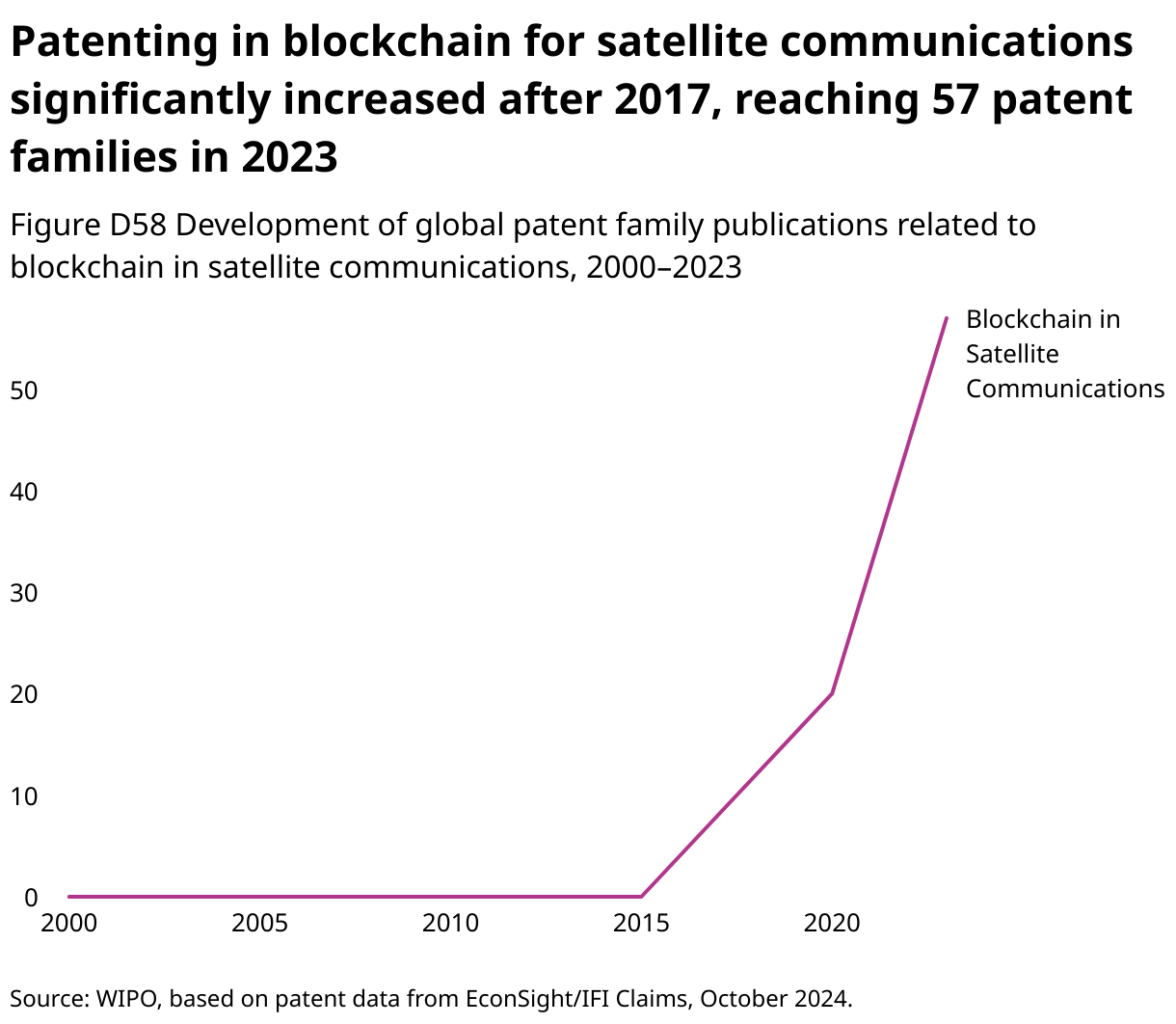
Patenting activity in the field of blockchain in satellite communications only began to increase notably after 2017. In 2023, the number of published patent families reached 57 (Figure D58).
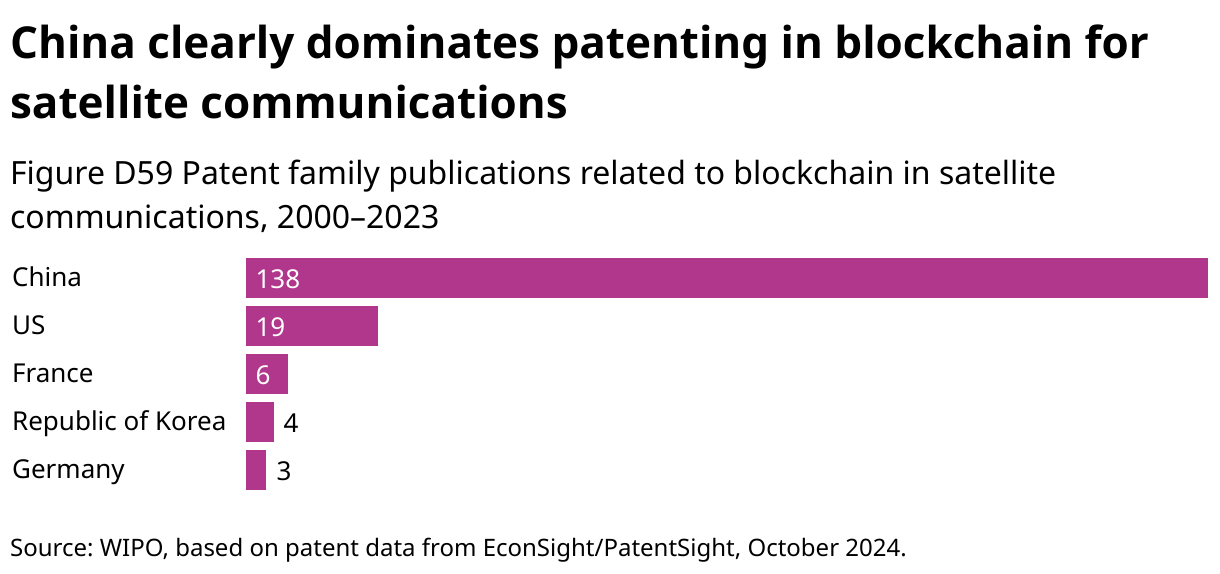
China and the United States clearly dominate research activity related to the use of blockchain in satellite communications (Figure D59). China has published 138 patent families in this field since 2000, the United States ranks second with 19. France, in third place, has published only 6 patent families during the same period.
Blockchain in satellite communications: patent example
In the early years of blockchain technology, Lockheed had already invented under EP3766190A1 a system for managing data storage on a satellite platform using blockchain technology. The core idea involves a network of satellites working together to maintain a blockchain ledger. When a first satellite identifies a request for a ledger entry in the blockchain, it distributes this entry to other satellites within the network, which act as full nodes for the blockchain. The receiving satellites verify the ledger entry and, if verified, they enter the ledger entry into their individual ledgers. If the entry is not verified, it is not recorded. This decentralized system ensures that multiple satellites participate in maintaining and verifying the blockchain, thus enhancing data integrity and reliability.
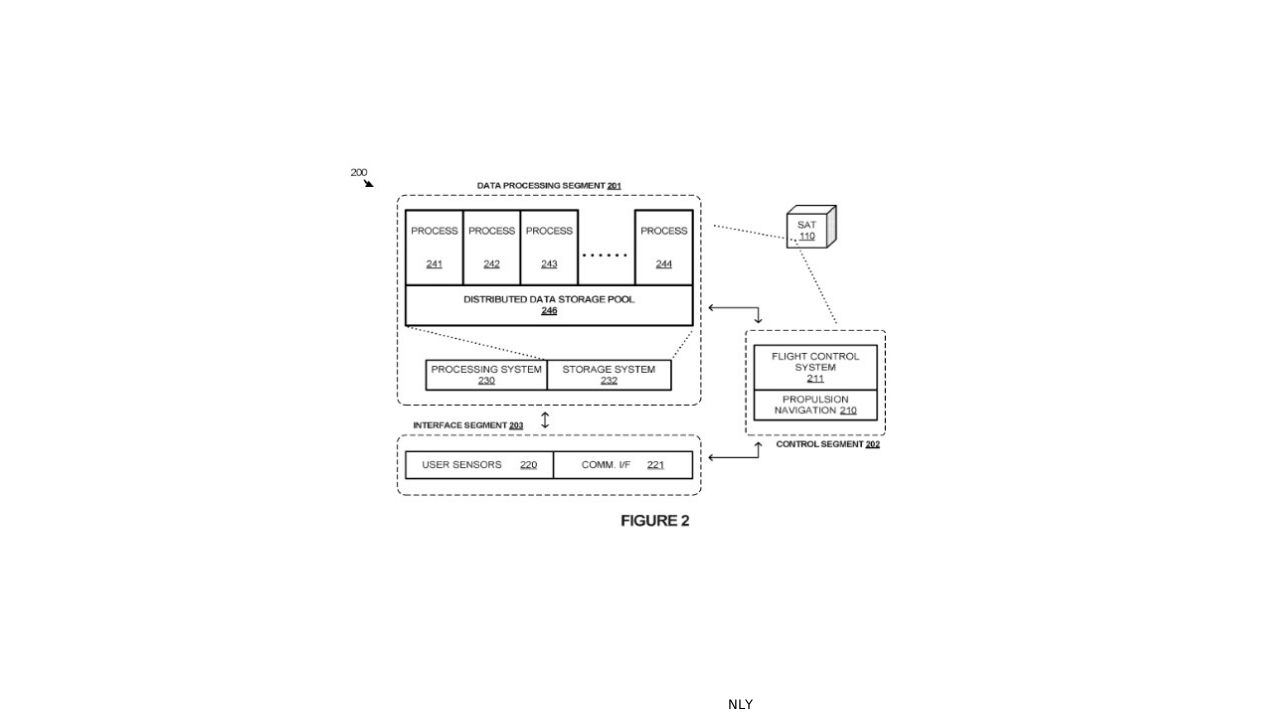
Additionally, the blockchain can be part of a distributed application running on multiple satellites, processing requests from ground systems, sensors or other satellites. Overall, the invention leverages blockchain technology to enhance the reliability and integrity of data storage and management across a network of satellites.
A patent from Lockheed describes a system in which satellites work together to maintain a blockchain ledger, by verifying and distributing ledger entries among themselves. A patent from China Mobil (CN117155458A) focuses on a low Earth orbit satellite internet of things (IoT) communication method that uses blockchain to securely collect, encrypt and transmit group data from ground-based IoT terminals to satellite consensus nodes, thus enhancing data transmission efficiency.
The invention relates to the field of communication and discloses a low Earth orbit (LEO) satellite IoT communication method and system based on blockchain technology and a storage medium. The method involves collecting terminal data from a group of terminals within the ground IoT system through a service node of the terminal group, resulting in group data. The terminal group, comprising service terminals and other terminals, is determined after grouping the ground IoT terminals. The service node is a service terminal registered to a space chain.
The collected group data is encrypted to produce encrypted data. These encrypted data are sent via the service node to a consensus node within the LEO satellite constellation in the satellite IoT system. These consensus nodes are consensus satellites registered to the space chain and are preset in various orbits of the constellation. This process aims to address the issue of low data transmission efficiency in LEO satellite IoT systems.
The method includes further steps to assure the proper transfer and verification of data. If no consensus node is within the visible range of the service node, the encrypted data are sent to a visible satellite node, which forwards it to a consensus satellite node in the same orbit. When a consensus node is within range, the data are sent directly to it. The consensus nodes verify the encrypted data and, upon validation, sign them to generate interactive data, which are sent to the system’s control center.
Additional processes include the determination of service terminals, generation of service authentication keys and registration of service nodes to the space chain. The encrypted data are obtained by compressing the group data and encrypting them using the service node's public key, followed by signing with the private key. The system can detect abnormalities and remove malfunctioning nodes from the space chain. This blockchain-based communication method for LEO satellite IoT systems involves a combination of ground-based IoT and LEO satellite constellations, so as to enhance data transmission efficiency and reliability by leveraging blockchain technology for secure and verified data transactions.