
As TISC networks expand, providing more services to local innovators, WIPO continues to support them with knowledge and learning resources, as well as effective management resources. These include:
public-private partnerships, facilitating access to technological information and knowledge;
WIPO INSPIRE platform, providing researchers and innovators with access to a unique blend of information and knowledge on IP and innovation, in particular on
patent databases
patent registers
patent analytics
technology transfer
institutional IP policies; and
dedicated training activities and publications.
To support TISCs in building their capacity to meet the evolving demands of the innovators they serve – so they can turn IP into real economic value – additional resources are gradually being offered to TISCs on patent drafting, IP commercialization, IP valuation and IP financing.
A virtual TISC Project and Performance Management Platform (TPPM) also supports TISC focal points and staff in managing their activities, collecting data and monitoring results and impact.
Ultimately, the support provided by WIPO aims to ensure that TISCs can become fully autonomous and self-sustaining in providing high-quality services to innovators.
Digital platforms and tools to enable TISC management and operations
Access to Research for Development and Innovation
Coordinated by WIPO in partnership with the publishing industry, the Access to Research for Development and Innovation (ARDI) program enhances the availability of cutting-edge research for institutions in eligible countries by providing free or low-cost access to more than 30,000 leading scientific and technical journals, books and publications. ARDI supports education, R&D and evidence-based innovation by enabling researchers to use the latest knowledge.
ARDI is an active partner of Research4Life, a collaborative initiative involving five United Nations agencies (World Health Organization, the Food and Agriculture Organization, the UN Environment Programme, WIPO and the International Labour Organization), leading academic institutions such as Cornell University and Yale University, and more than 200 publishing partners. In conjunction with its Research4Life partners, ARDI provides access to some 253,000 resources in areas such as health, food and agriculture, applied and environmental sciences, law and social sciences.
In 2025, more than 12,000 institutions were registered to access the resources available through Research4Life (see figure 5), with 468,736 users logging in to use these resources.

Access to Specialized Patent Information
The Access to Specialized Patent Information (ASPI) program supports academic and research institutions in eligible countries by offering free or low-cost access to advanced patent databases. This program, facilitated through a unique public-private partnership with leading commercial providers, allows researchers to analyze patent data using advanced tools.
The participation of academic and research institutions in the ASPI program fosters smarter innovation and sustainable development. By bridging the knowledge gap in developing countries, ASPI encourages the use of high-quality technical information contained in patent databases to support the development of innovation ecosystems.
A significant number of institutions registered with ASPI are universities and research institutions, national IP offices and TISCs in eligible countries. Following steady growth in interest, there has been a notable increase in registrations for the program in recent years (see figure 6).

WIPO INSPIRE
WIPO INSPIRE assists innovators, entrepreneurs, patent professionals and TISCs in their innovation support activities. This global knowledge platform is designed to provide innovators with everything they need in one place, for every stage of the innovation journey, directing them to the best resources for their IP and technology information needs.
A comprehensive, trusted source of information on IP and innovation data, WIPO INSPIRE supports users in selecting and using effectively patent databases and patent registers, generating IP insights through analytics, and facilitating technology transfer. It equips them with the knowledge and tools they need to succeed, whether conducting research or tracking industry trends.
In 2025, the platform continued to attract significant interest, with close to 120,000 users, an increase of more than 30 per cent compared with the previous year, demonstrating its growing role as an essential, impactful resource (see figures 7 and 8).


Designed to help innovators access and use IP and technology information effectively, WIPO INSPIRE directs them to the following key resources:
Patent database reports
The Patent Database Reports Portal within WIPO INSPIRE is a comprehensive, powerful resource for navigating patent databases. It delivers clear, unbiased insights to help users choose the most appropriate database for their specific needs. With 50 in-depth reports covering national and commercial databases, the portal attracted more than 70,000 users in 2025, each leveraging its expert analysis to sharpen patent strategies and stay ahead of the competition.
Patent registers
The Patent Register Portal in WIPO INSPIRE is a dynamic gateway to global patent legal status information, connecting users to key online registers and gazettes across more than 200 jurisdictions. Designed for patent professionals, businesses and researchers, it features an interactive search and detailed jurisdiction files with information on where and how to access legal status data, and search tips. In 2025, more than 16,000 users accessed the portal.
IP analytics
WIPO INSPIRE offers a reference point for access to IP analytics resources, in particular, patent landscape reports (PLRs) and WIPO Technology Trends reports, which track the development of technologies through the analysis of IP data on innovation activities. These help inform policy discussions, strategic research planning and technology transfer.
Through the platform, users can access 22 PLRs prepared by WIPO and some 320 PLRs prepared by other organizations, as well as the technology trends reports on AI, assistive technology and the future of transport, which were downloaded more than 450,000 times between 2019 and the end of 2025.
Technology transfer and institutional IP policies
The Knowledge and Technology Transfer webpage, accessible via WIPO INSPIRE, serves as a central resource for information. It provides direct access to WIPO’s Institutional IP Policies Database, with links to existing IP and related policies from universities and research institutions worldwide, including policies on consulting, copyright, conflicts of interest, software, open access and spin-offs. In 2025, the webpage was refreshed with a new design and structure to enhance user experience.
eTISC
Through WIPO INSPIRE, users can also access eTISC, a virtual platform designed to provide a dedicated space for the TISC community and IP professionals to exchange knowledge and strengthen their capacity to deliver high-quality IP advisory and support services. Key features of the platform include:
thematic Ask the Expert sessions, offering interaction with specialists in areas such as patent information and technology transfer;
group and forum discussions, sharing knowledge and experiences; and
news and events, informing users of latest developments.
In 2025, the Ask the Expert sessions focused on IP policy management, specifically IP policies in academia and public research institutions. Spanning five months, the sessions explored the practical challenges and real-world considerations involved in developing institutional IP policies. The series covered the following topics:
The eTISC platform received 32,000 visitors in 2025, a significant increase on the previous year (see figure 9).

TISC Project and Performance Management Platform
The TISC Project and Performance Management Platform (TPPM) supports the effective design and monitoring of TISC projects. It helps define objectives, outcomes, outputs and indicators, while enabling structured tracking of activities and progress.
The platform fosters stronger collaboration between countries and WIPO by allowing seamless tracking of TISC projects. Through real-time insights, it supports timely interventions, capacity-building and targeted assistance, which allows TISC networks to operate more effectively and maximize their impact. Several meetings were held in 2025 with focal points from national TISC networks to support adopting and using this tool.
Inventor Assistance Program
The Inventor Assistance Program (IAP) helps inventors and small businesses with limited resources turn their innovations into commercial assets by matching selected beneficiaries with volunteer patent specialists, who guide them through the patent system at no cost. The program supports IAP beneficiaries in securing patent protection domestically and in selected jurisdictions. From 2025, IAP volunteers also provided guidance in commercializing patents filed through the program.
Local TISCs play a key role in promoting IAP and in providing additional services in many participating countries. For example, in Colombia, the IP office collaborates with TISCs to promote the program across national regions; in Morocco, TISC focal points volunteer their patent drafting services for IAP beneficiaries; and in the Philippines, TISCs are considered part of the IAP, offering inventors practical advice, prior art searches and patent drafting services.
In 2025, the IAP celebrated its 10th anniversary with the IAP Best Practice Summit in September, showcasing its achievements and impact. The event brought together representatives from patent offices, volunteers and inventors from 10 IAP participating countries. It provided an opportunity to share good practices, celebrate local innovation success and acknowledge the dedicated work of IAP volunteers and focal points. High-quality assets, including testimonial interviews capturing authentic stories, were created to support local outreach efforts.
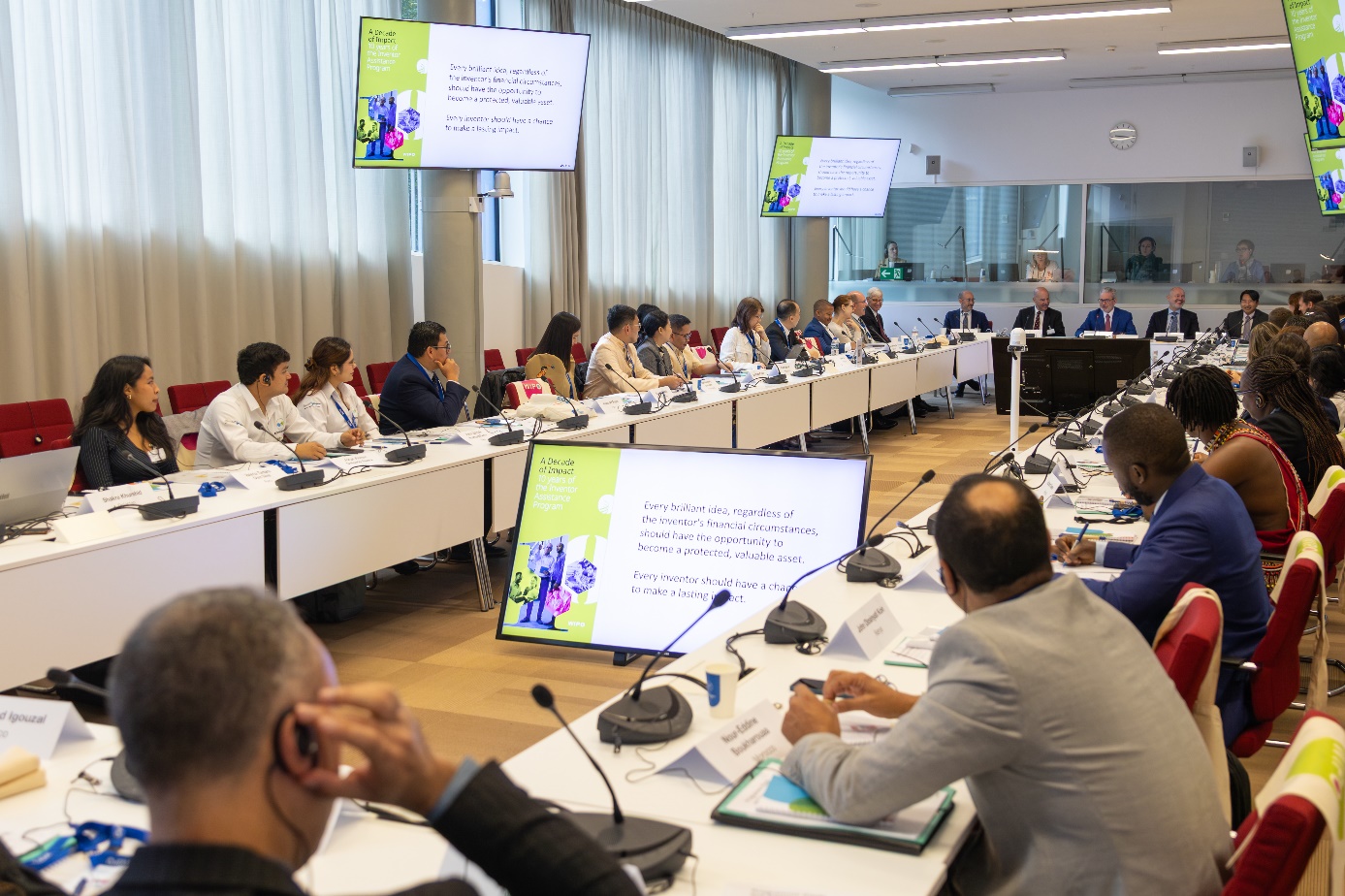 IAP Best Practice Summit, WIPO Headquarters, September 16 and 17, 2025, Geneva. Photo: WIPO
A significant milestone was achieved with the granting of the third patent under the IAP in the Philippines. With the assistance of Dr. Armando Reosura, an active TISC (known in the Philippines as an ITSO) and IAP pro bono agent, veterinary medicine graduating student and entrepreneur Mariam A. El-estwani was awarded a patent for her innovative device designed to safely secure and lift large dogs. The technology improves efficiency and reduces risks during veterinary procedures and mass vaccination drives.
 Award ceremony, Department of Trade and Industry (DTI) Caraga Office, October 20, 2025, Butuan City, Philippines. From left to right: Ms. Lea Garay, IP Regional Office Division staff member, IPOPHL), Mr. Dindo Dumali, IAP co-focal point, IPOPHL, Dr. Armando Reosura (IAP pro bono agent, ITSO manager, Carlos Hilado Memorial State University, Asst. Director Chamlette Garcia (IAP focal point, IPOPHL), Ms. Mariam El-estwani (IAP beneficiary, inventor of the granted patent), Director Gay Tidalgo (DTI Caraga Office), Dr. Ferdinand Dumalagan (Vice-President for Research, Innovation, Development and Extension Affairs, Agusan del Sur State University, formerly Augusan del Sur State College of Agriculture and Technology) and Mr. Anthony El-estwani (brother of the inventor). Photo: Ms. Lea Garay
IP and innovation collaboration
The Development Agenda Project on Intellectual Property and Innovation Collaboration as a Foundation for Technology Transfer and Bringing Research Output to Market was launched in January 2025. The project aims to identify effective institutional frameworks and practices for establishing and managing decentralized innovation collaboration initiatives similar to the Human Genome Project and building the capacity of technology creators and intermediaries (including TISCs) to establish and manage such initiatives.
Seven collaboration initiatives, spanning a range of geographical regions and fields of technology, were selected for case studies to analyze their structure, characteristics and IP management practices, and explore experiences and lessons learned. The studies will serve as the basis for tailored reference and training materials, providing practical guidance on innovation collaboration and IP management.
Arbitration and mediation
The WIPO Arbitration and Mediation Center provides time- and cost-efficient alternative dispute resolution options, including mediation, arbitration, expedited arbitration and expert determination, to help private parties settle domestic or cross-border commercial disputes. TISCs receive a 50 percent reduction in registration and administration fees for the alternative dispute resolution services, offering a cheaper alternative to court litigation for resolving IP and technology disputes.
Training to expand knowledge and skills
To increase the capacity, knowledge and skills within TISCs, WIPO provides training through onsite and online workshops, WIPO Academy distance learning courses and specialized learning resources on patent searches, including state-of-the-art, novelty and freedom-to-operate searches, patent analytics and technology transfer.
In the area of technology transfer, IP management and IP commercialization, training programs focus on developing human capital regarding the core pillars of the innovation ecosystem, such as institutional IP policies, establishing and managing technology transfer structures, and capacity-building in IP marketing, licensing and valuation.
TISC Staff Certification Program
The TISC Staff Certification Program is a two-level, competency-based training certification initiative to train personnel. Comprising a Foundation Certificate Course and multiple tracks of Specialization Certificate courses, it is designed to equip TISC staff with a strong grounding in IP and innovation support services, which can be developed into specializations in areas of TISC work.
The 2025 global launch of the Foundation Certificate Course was a breakthrough. Applications poured in from 38 of the 93 TISC national networks (41 percent of the global network), with 22 countries, from Argentina to Zambia, participating for the first time. Of the 259 participants who enrolled, 161 successfully completed the course and are now officially recognized as certified TISC staff, with verifiable credentials. Since the pilot run in 2024, this brings the total number of certified staff to 197, across 28 TISC national networks.
But more than the impressive numbers is the program’s huge impact. Participants spanned all career stages, from new recruits to TISC veterans of five-plus years. Across every module, the overwhelming majority, regardless of experience, reported learning ‘a lot’ of new material. Measured knowledge gains confirmed it. As one participant said:
“I learned this topic the hard way and by myself during three years as a TISC staff [member]. Here, it was explained what mistake I was committing, why, and how to overcome it.”
The momentum does not stop here. The French-language version of the foundation course is in development, set to open the program to Francophone networks across Africa and beyond. The first specialization certification, in patentability search, is also in development, with a pilot offering targeted for launch in the latter part of 2026. It is designed to take foundation graduates deeper into the search skills that define high-quality TISC service delivery. And the program’s assessment infrastructure continues to grow, with an expanding questions databank and competency-based metrics that will ensure rigor and integrity as the program scales further.
In two years, the TISC Staff Certification Program has moved from ambition to architecture to achievement. It is no longer a new initiative. It is a growing global professional standard, one that is raising the quality of innovation support services for the researchers, inventors and entrepreneurs that TISCs exist to serve.
“Empowering innovation begins with empowering people. The TISC staff foundation certification equips innovation support professionals with the practical IP knowledge they need to guide inventors effectively – turning ideas into assets and ambition into impact.”
National and regional training for TISCs
In 2025, 15 training seminars and six Ask the Expert webinars on institutional IP policies were conducted for national TISC networks to develop the technical skills needed to provide high-quality support services to local innovators. Additionally, four regional meetings were organized for TISC networks in ARIPO member states, in ASEAN, select networks in the Arab region, and CATI-CARD (see figure 10).

IP analytics training
To help TISCs enhance their patent analytics skills, several dedicated training programs were held in 2025, including a WIPO National Seminar on Patent Technology Information and Patent Analysis for TISCs in Santiago, and a dedicated session on patent analytics as part of the online TISC regional meeting for the Group of Central Asian, Caucasus and Eastern European Countries (CACEEC) and the Arab region.
Following the successful launch of the WIPO Patent Quest: Navigating Innovation Horizons board game for patent analytics in 2024, it is now available in Spanish as well as English, with the Spanish version launched at the TISC training in Santiago. The interactive, experiential learning approach continues to receive excellent feedback, given it teaches specific technical concepts and skills while maintaining intrinsic motivation and engagement, a gold standard of game design. This makes the learning more enjoyable and effective.
In September 2025, WIPO launched the second version in the Patent Quest series, Patent Quest: Beyond the Innovation Horizon. This advanced version of the original is designed to engage experienced participants in patent analytics through interactive, knowledge-sharing gameplay. Both the original (beginner) and advanced versions are now available for WIPO TISC training activities.
New trademark and industrial design search training materials
A set of reference guides and training materials on trademark and industrial design search have been developed with the International Trademark Association (INTA) in alignment with a commonly accepted competency framework and the specific context in which TISCs operate. These resources will enable TISCs to expand their service offering and support entrepreneurs and designers in building trusted brands and gaining value from their designs.
Patent drafting training
Transforming inventions into well-crafted patent applications requires a combination of knowledge and skills that are best acquired through hands-on experience. To this end, WIPO offers the International Patent Drafting Training Program. Learning from experienced practitioners, users can enhance patent drafting skills to secure the best available protection for their inventions.
Demand for the program, developed in cooperation with the International Federation of Intellectual Property Attorneys (FICPI), continues to be robust. More than 120 participants from some 60 countries have benefited from the course, including several TISC staff (who are among the program’s targeted audience). The program is currently conducted in English, with a Spanish edition to be rolled out in 2026.
Countries can officially recognize the program through a MoU, integrating it within their domestic qualification and training for patent professions, which gives local participants an extra benefit.
Technology transfer and IP commercialization training
To help TISCs improve their ability to meet evolving innovator needs, WIPO is gradually introducing additional training on knowledge and technology transfer, and IP commercialization. This includes training on IP management, IP marketing and commercialization strategies, technology licensing, IP valuation, IP financing and institutional IP policies.
To build capacity, seminars on IP valuation were organized in the ASEAN region. A national training seminar was conducted in Viet Nam, and a subregional seminar in Thailand, with participants from Brunei Darussalam, Cambodia, the Lao People's Democratic Republic and Thailand. The sessions were an opportunity to gain insight and knowledge on IP valuation from local and international experts. Participants engaged in hands-on exercises, group discussions and case study analyses, a practical approach that provided them with actionable skills.
In Central America, WIPO hosted a three-day virtual seminar in June on IP management for the TISC networks of Guatemala, Honduras and Nicaragua, bringing together approximately 80 participants. It focused on strengthening institutional IP management practices, enhancing technical competencies and promoting regional collaboration among TISC focal points.
Further to the launch of the Scale Up Your IP Program in 2025, which focused on providing cost-effective IP commercialization insights for deep-tech ventures through six modules, a three-day intensive training program was organized in March in Cape Town, South Africa.
The objective was to show deep-tech entrepreneurs and spinouts (a new, independent company created by a parent organization) how to integrate IP into their go-to-market strategies, bringing their technologies from lab to market and eventually scaling up.
The program was organized in collaboration with four universities (University of Cape Town, University of Stellenbosch, University of the Western Cape and the Cape Peninsula University of Technology) and brought together 62 participants from 25 South African ventures and 15 technology transfer managers. The training was also attended by 22 TISC representatives with a view to aligning objectives in raising awareness with IP commercialization services. Participants took part in a series of lectures, interactive exercises and roundtable discussions covering topics such as validating your unique selling point, brand strategy, software licensing, and commercialization and negotiation techniques for early-stage ventures with growth potential.
Training on institutional IP policies
For more than 10 years, WIPO has provided dedicated support to universities and research institutions in developing institutional policies for effective IP management, and knowledge and technology transfer. The IP Policies for Universities and Research Institutions initiative has three main components:
WIPO IP Policy Toolkit;
national and regional customized versions of the toolkit; and
project-based coaching/technical assistance for individual institutions in developing tailored IP policies.
The WIPO IP Policy Toolkit serves as a starting point, helping academic and research institutions address key issues such as ownership of IP and rights of use, IP disclosure, management, commercialization, incentives for researchers, recordkeeping, accounting and conflicts of interest. The toolkit includes an IP Policy Writer’s Checklist, IP Policy Template for Academic and Research Institutions, and Guidelines for Customization of the template (see the "Focus on institutional IP policies" of this report for more on this initiative).
National and regional institutional IP policy models (that is, a framework universities or research institutions put in place to address IP issues) integrate local laws, regulations and practices, and are tailored to the country or region’s socioeconomic context. They facilitate policy adoption at institutional level and promote harmonization across institutions at national or regional level to enable more effective academic-industry collaboration.
National IP policy models have been developed for 11 countries, with more in progress. At regional level, an ASEAN Regional IP Policy (ARIPP) Model was developed in 2023 through a WIPO project with the ASEAN Secretariat, supported by the Japan Industrial Property Global Funds-In-Trust. Building on this, WIPO provided mentorship-based support to eight institutions from Brunei Darussalam, Cambodia, the Lao People's Democratic Republic and Thailand in 2024, and seven institutions from Indonesia and the Philippines in 2025, to help implement the model at institutional level.
Additionally, the Regional Training Seminar on Institutional IP Policies for ASEAN TISCs and TTOs equipped institutions with the knowledge and tools to formulate and implement policies based on the ARIPP Model. The seminar, held in Cambodia in February, included:
key findings from the mentorship program;
best practices in university IP policy development;
hands-on drafting exercises for IP policy clauses; and
WIPO resources available for ASEAN institutions.
In Latin America, universities and research institutions in the CATI-CARD regional TISC network collaborated to develop the first regional institutional IP policy model of its kind in the region. The model was elaborated through a coordinated process involving representatives from seven countries, designated by their respective national IP offices, and formally consolidated during a meeting in May in Santo Domingo, the Dominican Republic.
The next phase will focus on supporting participating institutions in adapting and implementing the regional model to develop their own tailored institutional IP policies.
Targeted assistance is also offered to individual institutions. In 2025, WIPO finalized a project with the University of Global Health Equity (UGHE) in Rwanda to develop a customized institutional IP policy.
WIPO Academy distance learning courses for TISCs
To strengthen the capacities of TISCs, WIPO offers distance learning courses through the WIPO Academy, providing accessible training in areas such as patents and patent searches, trademarks and industrial designs, and IP management, just to name a few.
The e-tutorial on using patent information, launched in 2020 as a distance learning course (DL-177) through the WIPO Academy platform, is a self-paced course specifically developed for TISCs. The course comprises three learning modules: patent basics, patent search and retrieval, and patent analysis. It is available on the platform in Arabic, English, French, Russian and Spanish (see figure 11).

In 2025, 4,198 TISC staff enhanced their skills through distance learning courses offered by the WIPO Academy, including in advanced specialized fields (see figure 12).
A significant share (more than 70 percent) continued to focus on patent-related courses (essentials of patents, patents, patent information search and patent drafting), reflecting the ongoing need for TISC staff to provide high-level support to local researchers, inventors and entrepreneurs navigating the patent system. But there was also strong engagement in advanced training on trademarks, industrial designs and geographical indications, traditional knowledge and traditional cultural expressions, copyright and related rights, and access to medical technologies and innovation, indicating a growing demand for broader IP knowledge. The advanced course on IP management, only available as a self-study course in 2025, also received strong interest from TISC staff, with 88 enrollments.
Overall, 60 percent of TISC participation was in advanced courses (including 14 percent who enrolled in self-study advanced courses), with the rest in general courses (5 percent enrolled in the e-tutorial on using patent information). The gender distribution was 54 percent female and 46 percent male (see figure 13).


Publications to support training and reinforce learning
Training is reinforced by publications developed for TISCs. These publications are key reference sources on a range of subject areas such as patent documentation and databases, patent searches, patent analytics, patent drafting, technology transfer, and IP management and commercialization. They are available in multiple languages.
The WIPO Guide to Using Patent Information and the Understanding Industrial Property booklet are essential resources for TISCs staff, helping them strengthen their knowledge and support them in providing services, such as assisting with using patent databases and conducting patent searches.
Following publication of the WIPO toolkit on new product development and inventions in the public domain in 2024, which is designed to guide systematic decision-making throughout the product development process, it was translated into Arabic, Chinese, French, Russian and Spanish in 2025. These materials will gradually be made available online to support self-learning.
IP analytics publications
The WIPO Technology Trends reports are flagship publications that track trends by analyzing patent and other data to provide empirical evidence on innovation in specific fields. The resulting knowledge helps business leaders, researchers and policymakers in their decision-making. The first report in the series was published in 2019 and focuses on AI. The second, published in 2021, was the first large-scale overview and analysis of patenting and technology trends in assistive technology, and provides information about the state of play in technologies that assist people living with physical or cognitive impairments.
The third report, published in 2025, focuses on the Future of Transportation. By investigating the latest transport patenting trends, it identifies the most innovative countries, companies and institutions using a data-driven approach, combining traditional patent searches with AI-powered topic extraction. The three editions to date were together downloaded more than 210,000 times between 2019 and the end of 2025.
Patent landscape reports (PLRs) prepared by WIPO over the years have covered topics of particular relevance to member states such as public health, food security, climate change and the environment. In 2025, a new PLR was published focusing on occupational health and safety technologies. In addition to the 20-plus WIPO PLRs, WIPO also maintains a database providing access to more than 320 PLRs prepared by other organizations.
A new publication series, the WIPO Technology SPARK (Short Pieces of Analysis, Research and Knowledge) reports, was launched in October 2025. The series is designed to provide focused analyses of topical or emerging technology areas. Unlike the broader WIPO Technology Trend reports or PLRs, WIPO Technology SPARK publications offer concentrated examinations of specific innovation ecosystems. The first report, focusing on Technologies for Mine Action, was conducted in close collaboration with the Geneva International Center for Humanitarian Demining and looks at the global patent landscape surrounding demining solutions, a critical field addressing the global humanitarian challenge posed by landmines and explosive remnants of war.
Several learning resources and tools to build capacity and develop the patent analytics skills of researchers and innovators have also been developed over the years. Methodological guidelines for preparing PLRs have been formalized in the WIPO Guidelines for Preparing Patent Landscape Reports, the WIPO Manual on Open Source Patent Analytics and the WIPO Patent Analytics Handbook, the last two being revised and updated in recent years.
Technology transfer and IP commercialization publications
Technology transfer capacity-building continued through the development and dissemination of practical tools and resources. In the tools and resources work area, two guides on IP valuation were published. The first, Intellectual Property Valuation Basics for Technology Transfer Professionals, provides a strong foundation in IP valuation to support effective knowledge and technology transfer. The second, Intellectual Property Valuation in Biotechnology and Pharmaceuticals, presents methods such as risk-adjusted net present value and real options analysis, aligned with the multistage development cycles typical of these sectors, and uses real-world case studies to support the evaluation of licensing deals, milestone payments and market exclusivity scenarios.
In addition, a Primer on Technology Transfer in the Biotechnology Sector was published and complemented by in-person training activities aimed at strengthening practical technology transfer and commercialization skills. This guide offers user-friendly templates, model clauses and sample agreements, helping biotechnology stakeholders navigate IP, licensing, and commercialization processes more effectively.
The WIPO Patent Drafting Manual helps inventors and their advisors acquire the technical skills needed to prepare and file well-drafted patent applications. Covering theory and practice, the manual takes the user through the process of preparing, drafting, filing, amending and prosecuting patent applications. The drafting of both claims and descriptions is explained in detail, with tips and illustrations. The manual is now available in all six United Nations official languages. It was complemented in 2025 with a WIPO Patent Drafting Exercise Book and sample answers designed to build readers’ capabilities as novice patent drafters.
The Hands-on IP Finance Series of guides is a resource for creators, innovators and businesses to unlock the full potential of their IP assets for finance. By focusing on key IP assets such as software, technology, brands and creative works, these guides empower IP owners to articulate their value to potential lenders, financiers and investors. The series provides strategic insights and offers practical templates, equipping IP owners with the tools they need to leverage their assets for securing finance and raising capital. The first guide, Securing Loans with Your IP Assets, was published in 2024. It facilitates discussions between IP owners and lenders, providing insights into the lending process. The guide includes practical checklists and templates to help businesses and IP owners negotiate financing arrangements, maximize the value of their intangible assets, and facilitate favorable financing terms.
As part of WIPO’s IP Finance Dialogue, a discussion paper Moving IP Finance from the Margins to the Mainstream was published in 2025. The paper describes challenges and opportunities in using IP as a financial asset.