
Universities and research institutions create IP every day. New discoveries are made, software is developed and innovative processes are designed. Yet without clear rules governing ownership and use, much of this valuable research never reaches society. Institutional IP policies provide the framework needed to manage, protect and translate research outcomes into real-world impact.
For more than a decade, WIPO has supported member states and their academic institutions in developing institutional IP policies. In 2025, this work expanded significantly. Two regional model institutional IP policies were developed, implementation support was provided to eight institutions across the ASEAN region, and the WIPO Institutional IP Policies Database was comprehensively upgraded.
Well-designed IP policies, aligned with an institution’s current context, mandate and priorities, can greatly enhance the effectiveness of TISCs based in these institutions. Such policies provide a clear framework within which innovators inside the institution and partners outside it can confidently access, share and use knowledge, technology and IP, and to which TISCs can systematically contribute.
What is an institutional IP policy?
An institutional IP policy is a formal document that sets out how a university or research institution manages IP from creation to commercialization. It defines the rights and obligations of everyone involved: staff, students, visiting researchers and external partners.
Every policy must comply with national law and be consistent with other institutional policies on research collaboration, confidentiality and spin-off creation. Beyond those requirements, each institution shapes its own approach. Legal context, research mandate and stakeholder interests all influence the result. There is no universal template. What matters is that the policy works for the institution and the people it covers.
Why are institutional IP policies important?
A clear institutional IP policy serves everyone involved in research, though in different ways:
For researchers, it establishes ownership rules and fair benefit-sharing. This encourages early disclosure of inventions, the entry point to technology transfer. Without disclosure, institutions cannot protect or valorize their research outputs.
For institutions, it provides the governance framework needed to manage IP assets, reduce legal risk and enter into research agreements on sound terms. It also helps prevent disputes before they arise.
For industry and other external partners, it is predictability. Uncertainty over IP ownership is one of the most common barriers to university-industry collaboration, and a well-drafted policy removes it.
At a broader level, institutional IP policies help translate publicly funded research into economic and social benefit, ensuring revenues are shared fairly and contribute to building sustainable national innovation ecosystems.
How is an institutional IP policy structured?
Most policies address the same core issues, though the choices made within each area reflect the institution's legal context, research profile and objectives. The WIPO IP Policy Template for Universities and Research Institutions, used as the basis for WIPO’s support to member states, covers ownership of IP and rights of use, IP disclosure and evaluation, protection decisions, commercialization pathways, revenue sharing and inventor incentives, rules for collaborative and contracted research, and governance arrangements.
In practice, ownership is almost always the most consequential section, as it establishes who holds rights to what is created and under what conditions. Revenue sharing is equally critical. Poorly designed incentive structures are one of the most common reasons IP policies fail to achieve their objectives, because researchers who do not see a fair return have little reason to engage with the IP system in the first place.
How is an institutional IP policy developed?
Developing an IP policy takes time, and stakeholder engagement, realistic expectations and patience are essential throughout. To support institutions at each stage, WIPO has developed a range of practical tools, including:
The IP Policy Writer’s Checklist guides institutions through each stage of policy development, from preparation and drafting to implementation and review.
IP Policy Template for Academic and Research Institutions provides a comprehensive model document that can be customized to national and institutional contexts.
Guidelines for Customization offer practical advice on adapting the template to local legal frameworks and institutional realities.
The Incentives in Technology Transfer guide addresses one of the most important but frequently overlooked aspects of institutional IP management: motivating researchers to engage with the IP system in the first place.
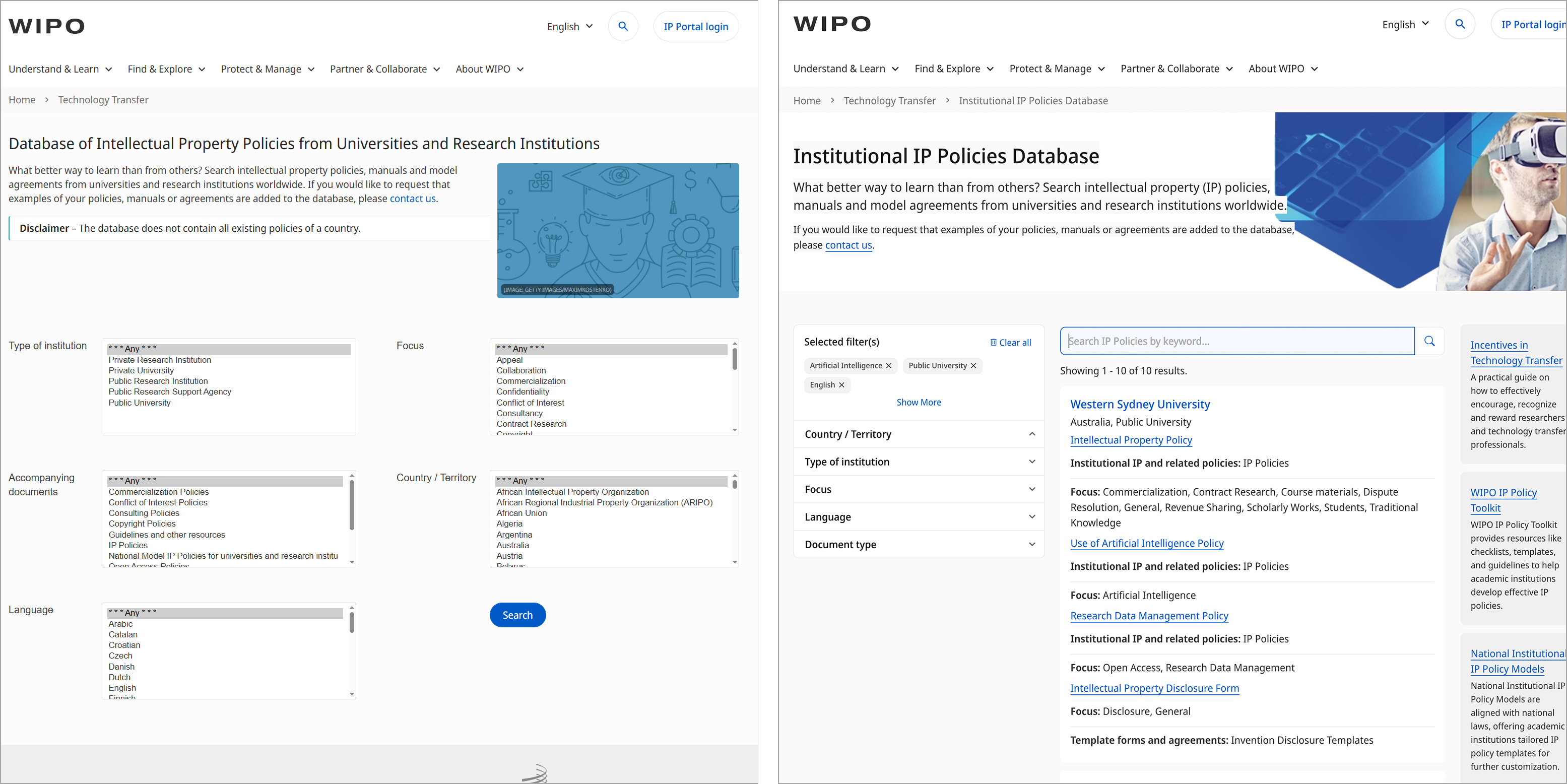
The Institutional IP Policies Database provides access to more than 1,500 policy documents from 718 institutions in some 90 countries, serving as a source of inspiration for other institutions looking to develop or strengthen their own IP policies.
WIPO Institutional IP Policies Database update
In 2025, the Institutional IP Policies Database was successfully revamped and relaunched, significantly enhancing its functionality and value for users. The upgrade included migration to a modern content management system (Liferay DXP), improving stability, scalability and overall performance. The search functionality was enhanced, providing faster, more intuitive and user-friendly navigation (see figure 14).
In parallel, extensive data refinement was undertaken, including the review and update of existing entries to ensure greater accuracy and relevance of content and links. The database was further expanded, with more than 1,500 institutional IP policy documents from 700-plus institutions reviewed and updated, including newly added policies and guidelines addressing emerging areas such as AI. This further strengthens its role as a comprehensive resource for universities, research institutions and policymakers.
National models of institutional IP policies
National models of institutional IP policies have been developed in Algeria, Jordan, Kyrgyzstan, and Morocco, among others. At institutional level, recent support has been provided to the National Autonomous University of Mexico (UNAM), University of Science and Technology of Algeria, University of Global Health Equity in Rwanda, Iberian Nanotechnology Laboratory in Portugal and several institutions across ASEAN. Work with the Rwanda Biomedical Center is underway.
The Jordan experience
WIPO’s project in Jordan illustrates how this operates in practice. Working with the national IP office, WIPO guided the process through nine structured phases. National legal analysis came first, giving institutions a clear compliance baseline. Individual institutions then drafted their own policies with support from WIPO’s toolkit. Common elements across drafts were identified and became the pillars of the National Model IP Policy, which the Ministry of Higher Education approved and circulated to all universities in the country (see figure 15).

The experience demonstrates a key principle: top-down national coordination and bottom-up institutional drafting reinforce each other. The process does not end with approval either. Institutions continue to adapt and improve their policies over time, and the national framework evolves with them.
Regional models
Regional model IP policies reduce the cost of policy development for individual institutions and support harmonization and cross-border collaboration. Two regional models, developed with WIPO support, illustrate what this looks like in practice.
CATI-CARD regional institutional IP policy model
Universities and research institutions from the CATI-CARD regional TISC network have collaboratively developed the first regional model institutional IP policy in Latin America.
Formally consolidated in Santo Domingo in May 2025, it provides institutions across the subregion with a shared baseline for IP ownership, disclosure, valorization and benefit-sharing, adapted to regional legal realities.
The next phase will focus on supporting participating institutions in developing their own tailored policies based on the model.

“Participating in the regional model institutional IP policy project was an experience that allowed me to grow professionally. The model developed is a highly valuable tool for universities in general, as well as for other organizations such as specialized research centers
The consultants and WIPO staff members who formed the working team responsible for developing the project were exceptional. They are all outstanding professionals with extensive knowledge and experience in matters related to IP policy and management systems, both at a general level and specifically within higher education institutions, which was the focus of the project.
The model developed as a result of the project represents a valuable resource for public higher education institutions in the member countries of the CATI-CARD TISC network. It is a replicable model that can be adopted by any other university. The way in which the model was designed is highly versatile and allows universities to implement it by adapting it to their level of maturity in institutional IP management. It is highly functional for universities that need to initiate this type of management from the ground up, as well as for universities with extensive experience in the field.”
– Eng. Ana Cristina Rivas Bustos, liaison manager specializing in IP, Costa Rica Institute of Technology.
ASEAN regional institutional IP policy model
The ASEAN Regional IP Policy (ARIPP) Model was developed in 2023 under a WIPO-ASEAN project funded by Japan through the Funds-in-Trust program. Survey work had identified gaps, including low adoption of national IP guidelines, limited IP management capacity and lack of clarity around commercialization.
To address this, a team of experts from six ASEAN member states spent six months reviewing 58 laws and regulations and more than 60 institutional IP policies. The result was a model grounded in regional practice, covering ownership by all categories of creators, copyright, research contracts, commercialization pathways, revenue sharing, genetic resources and traditional knowledge, and conflict of interest.
The model is designed for adaptation rather than wholesale adoption; institutions select and modify its provisions to fit national law and their own context.

"Participating in the IP Policy Mentoring Program was an enriching and meaningful experience for our institution. Together with our unit heads, Innovation and Technology Support Office (ITSO) and Technology Transfer and Commercialization Office (TTCO), we gained valuable knowledge and clearer direction in strengthening our institutional IP policy through the guidance of the mentors and the WIPO ASEAN IP Policy Model. The program reminded us that strong IP policies are not only about compliance, but also about empowering researchers, innovators, faculty and students to create, protect and share meaningful innovations.
The mentors were very approachable, encouraging and generous in sharing their expertise, making every session a valuable learning opportunity that inspired collaboration, growth and continuous improvement within our institution. We also truly appreciated their patience and understanding, especially in accommodating schedule adjustments and institutional commitments.
More importantly, the mentoring program strengthened our commitment to building a culture that values innovation and collaboration. As part of the Philippine academic community, we hope more institutions across the country will continue to participate in initiatives like this, as programs such as these help strengthen innovation ecosystems and inspire institutions to move forward with greater purpose and impact.”
– Ma. Windie C. Velarde, Director, Innovation, Eastern Visayas State University, Philippines.
Through the eTISC platform, WIPO supports a growing community of practice around institutional IP policies, a space for practitioners to share experiences, work through common challenges, and learn from each other. In 2025, a dedicated thematic series brought together experts from around the world to explore the practical realities of policy development and implementation. The series covered the following topics:
Global trends in institutional IP policies: Insights from WIPO’s IP policies database.
Regional IP policy models, including examples from Africa, ASEAN and CATI-CARD.
Future plans
Work on institutional IP policies is expanding. WIPO is supporting institutional IP policy development in Africa and Latin America and the Caribbean (regions where TISCs play a key role in building local innovation ecosystems), with further initiatives planned in other regions.
At international level, WIPO is developing an Institutional Capability Framework, a tool to help institutions assess and strengthen their readiness for IP management and technology transfer. The WIPO Institutional IP Policies Database will further expand as the global community of practice grows.