
Healthcare overview
Bangladesh is the eighth-most populous country in the world,
In Bangladesh, there are 0.7 physicians per 1,000 people.
Each year, Bangladesh spends about 2 percent of its GDP, or around USD 10 billion, on healthcare.
About one fifth of the population lives below the poverty line.
Bangladesh’s national health policies have focused on addressing the high burden of maternal and child deaths, malnutrition, communicable diseases and the recent rise in NCDs. The top causes of death in Bangladesh currently are stroke, ischemic heart disease, chronic obstructive pulmonary disease, neonatal conditions and tuberculosis.

The disease pattern in Bangladesh is swiftly transitioning from communicable diseases toward NCDs like cancer, diabetes and heart disease. NCDs were responsible for 43 percent of all deaths in the country in 2000 but accounted for 59 percent of deaths by 2010 and 70 percent by 2019.
Efforts to increase health insurance coverage, which can affect the ability to access health technologies, are underway in Bangladesh, driven by rising healthcare costs and the need for financial protection against medical expenses. Bangladesh is committed to achieving universal health coverage by 2032 and is actively preparing to expand access and enhance the quality of medical services.
Despite challenges, Bangladesh’s healthcare industry has made significant strides in recent years. Growing at a compound annual rate of 10.3 percent since 2010, the healthcare industry in Bangladesh has expanded substantially. In 2012, Bangladesh launched the Bangladesh Healthcare Financing Strategy.
In addition to the formal public and private healthcare sectors, traditional medicine is still widely practiced and alternative care options are often pursued. Around 700,000 Bangladeshi citizens travel abroad for medical care each year, accounting for over half of India’s medical tourism.
Industrial policy
The 2023 National Industrial Policy of Bangladesh has as its main objective “to economically enrich Bangladesh, increase sector-wise productivity and achieve excellence in the quality of manufactured products by embracing technology advantages.
Bangladesh’s national industrial policy highlights the progress achieved in the pharmaceutical industry. Bangladesh currently manufactures 98 percent of the medicines needed to meet domestic demand. This advancement in manufacturing has made medicines more accessible because domestically made medicines are cheaper than imported ones
Bangladesh’s national industrial policy does not currently include specific provisions on medical technologies. In contrast to the pharmaceutical sector, the medical device industry in Bangladesh remains less developed. Insights gathered from the interviews conducted with MedTech stakeholders in the country underscore the potential to incorporate a strategic focus on MedTech into Bangladesh’s national industrial policy in the same “triple helix” way that the government encouraged the pharmaceutical industry.
Many of the interviewed stakeholders indicated that this could bring substantial benefits by enhancing healthcare infrastructure, fostering economic growth, leveraging existing strengths, promoting innovation and addressing public health needs. Achieving these benefits would ultimately position Bangladesh as a significant player in the global MedTech industry.
MedTech imports/exports
About 85 percent of medical devices in Bangladesh are imported.
The MedTech manufacturing sector in Bangladesh comprises several homegrown companies, such as Bi-Beat Ltd, CMED Health and joint ventures between local and multinational companies such as Nipro JMI Pharma Ltd.
Bi-Beat Ltd., a technology company focusing on health and well-being, manufactures various kinds of equipment, such as electrocardiogram (ECG) circuit trainers (educational or training devices used to simulate, analyze and understand ECG signals and circuits) and muscle and nerve stimulators, on a smaller scale. CMED Health Ltd., an AI and Internet of Things-based MedTech company, aims to transform healthcare in Bangladesh with its end-to-end, multi-layered, scalable, smart-health platform Susastho, to reduce health risks, costs and time and contribute to achieving UHC.
Addressing the lack of access
Leveraging the Fourth Industrial Revolution technologies, as represented by the fusion of digital, physical and biological systems, CMED addresses the lack of access to health services in Bangladesh. It does so by providing affordable, quality healthcare through its digital healthcare platform, which connects patients with health services such as diagnoses and referrals for interventions.
Over the past decade, new companies like Getwell Ltd. and ANC Medical Device Bd. Ltd. have entered the market for consumables (disposables and surgical equipment), while others are focusing on radiological, electromedical, orthopedic and diagnostic devices.
Bangladesh reported modest manufacturing figures of less than USD100 million in FY 2020-21 for medical equipment and devices, with over 70 percent comprising medical disposables (e.g., syringes and needles).
Bangladesh has also begun to export medical devices, with FY2020-21 seeing exports worth USD 48.8 million, including ophthalmic and orthopedic devices, consumables and respiratory instruments.
Bangladesh also exports orthopedics, prosthetics and other medical devices (wheelchairs, etc.), primarily to the United States and the Republic of Türkiye.
Foreign companies wishing to operate in Bangladesh must establish a liaison or representative office, a branch office, a joint venture company, or a fully foreign-owned company under the Companies Act of Bangladesh.
Certain drugs and medical devices are exempt from import tariffs and the maximum most-favored-nation applied tariff rate is 25 percent.
MedTech challenges and enablers in Bangladesh
According to interviewees, MedTech imports and exports in Bangladesh face several challenges, such as customs clearance delays and rising shipping costs, which are exacerbated by challenges regarding utilities and logistics. Skills shortages and challenges in the R&D space can further hinder innovation, while the lack of local repair options for imported MedTech leads to underutilization. The absence of dedicated testing labs and supporting industries, such as mold and die manufacturers, along with restricted access to finance, further complicate the development of a strong MedTech innovation ecosystem.
Intellectual property
Bangladesh, a founding member of the WTO, has a long history of protecting IP. The country has been gradually liberalizing the protection of IP since it gained independence from Pakistan in 1971,
The Department of Patents, Designs and Trademarks (DPDT) is the central office that administers laws related to industrial property in Bangladesh. It accepts and processes applications for the protection of industrial property, including patents, trademarks and industrial designs. Bangladesh has more IP filings than other LDCs, significantly driving the average filings for the group, indicating that it is performing better than other LDCs.
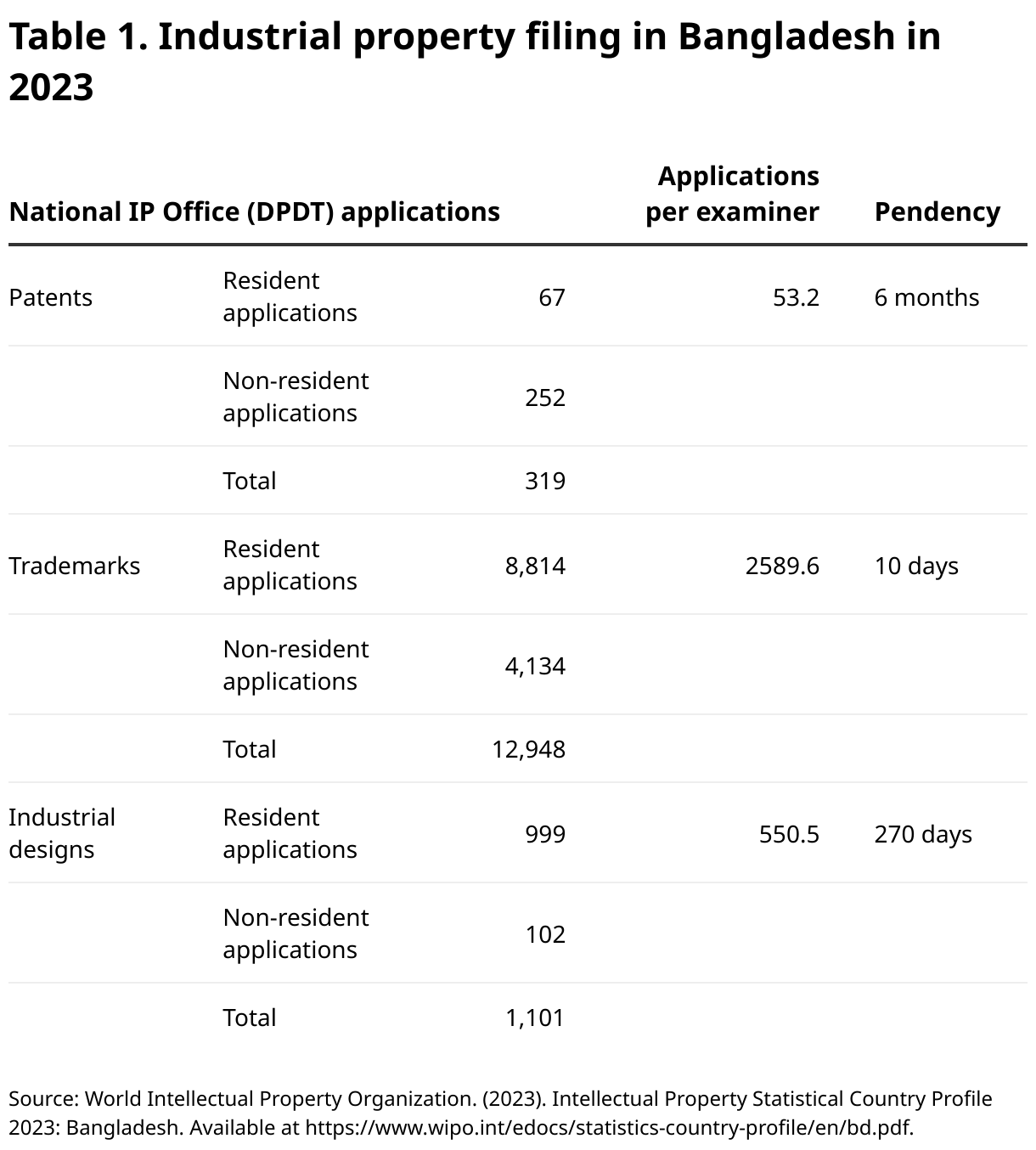
Table 1 shows that the number of filings in Bangladesh is low, and processing times are short. MedTech is not one of the top technical fields for patent applications in Bangladesh. However, a review of patent applications published by the DPDT in 2023 and 2024 indicates that some MedTech innovations have been translated into patent filings. Examples include patent applications for a device for collecting human excreta through a stoma (an opening in the body),
Bangladesh protects trade secrets through contract law, antitrust law, criminal law and tort law.
IP seen as key to advancement
Bangladesh’s National Innovation and Intellectual Property Policy, 2018
Establishment of mechanisms through IP offices and institutions to coordinate innovation, creativity, commercialization and valuation of IP in different public sector research facilities, inter alia, those focused on health.
Establishment of technology transfer organizations (TTO), technology and innovation support centers, research and development centers, innovation hubs, labs.
Supporting startups and individual innovators to enable them to leverage intellectual property rights and provide access to financial assistance for the same.
Establishment of a national innovation fund for promotion, protection, preservation and commercialization of home-grown innovators.
Allocating adequate funds in the national budget to promote science and technology, innovation, creativity and overall development of a national innovation ecosystem in the country.
Launching educational and awareness programs on intellectual property for schools, colleges, universities and other relevant stakeholders, organizations and institutions.
Revitalizing and strengthening Bangladesh’s Anti-Piracy Task Force to address the violation of patents, designs and trademarks.
The IP policy outlines a 10-year implementation timeline, marking a decade dedicated to innovation. The IP policy lays the groundwork for supporting the development of the country’s MedTech sector, among others. A significant advancement in implementing the IP policy was the enactment of the Patent Act of 2023 in Bangladesh, which replaced the Patent Act of 2022.
Bangladesh passed the Patent Act, 2022, repealing the earlier Patents and Designs Act, 1911, to make its IPR protections compliant with the TRIPS Agreement. The Patent Act, 2022, was replaced by the Patent Act, 2023
It offers clearer definitions of invention and patentability criteria to enable a more comprehensive patent examination.
(50)Patent Act, 2023. Law No. 53 of 2023. (Bangladesh). Section 2, 4 and 6. It provides that the patent claims must be clearly and fully described to allow evaluation and implementation by someone skilled in the relevant field.
(51)Patent Act, 2023. Law No. 53 of 2023. (Bangladesh). Section 8 (6). It sets a three-year deadline for filing divisional applications, which are used to separate claims from an earlier application covering multiple inventions, and limits these to three per original application. This change is expected to improve clarity and certainty regarding patent coverage and processing times, enabling competitors to conduct more accurate freedom-to-operate analyses.
(52)Patent Act, 2023. Law No. 53 of 2023. (Bangladesh). Section 14.
The Patent Act, 2023, advances Bangladesh’s goal of building a stronger innovation ecosystem and could benefit the MedTech sector by offering clearer patentability criteria and streamlined processes.
Bangladesh also has a strong IP enforcement framework. An aggrieved person can initiate civil action for IP infringement in Bangladesh in the appropriate civil court under the relevant statute or common law. Additionally, the owner of a registered IP right can apply for the right to be recorded with the customs authority. The customs authority is empowered to suspend the release of goods if it suspects that they are infringing a registered IP right recorded with them.
The statutes also provide options for initiating administrative proceedings to pursue pre-grant and post-grant challenges for industrial property before the DPDT.
Progress to date and suggested measures
A number of stakeholders who were interviewed said they believe that significant progress has been made with the introduction of new IP laws and enforcement rules, while others suggested additional measures be taken to build a stronger innovation culture.
Specifically, interviewed stakeholders in Bangladesh have highlighted the following additional opportunities for improvement:
TTOs and research centers in universities have the potential to drive innovation. Stakeholders indicated that there are some innovations coming out of universities in Bangladesh, such as a continuous positive airway pressure (CPAP) machine (a device prescribed to treat sleep apnea) from a team at Bangladesh University of Engineering and Technology under the trademark OxyJet.
(55)BUET. (2021). OxyJet: A Low-cost CPAP system; available at: https://bme.buet.ac.bd/project/oxyjet-a-low-cost-cpap-system/. Strengthening TTOs and research centers through government as well as private-sector support will create an environment conducive to innovators and can thereby help bring new technologies to market. Mechanisms and policies for IP financing can serve as powerful catalysts for innovation. Additionally, there is a need to invest further in research facilities in Bangladesh, such as:The Research and Innovation Centre for Science and Engineering in Bangladesh University of Engineering and Technology
The Institute of Research, Innovation, Incubation & Commercialization in United International University
Hi-Tech Park Authority
Investment is needed to develop a more user-friendly IP database and comprehensive guidance for patent filing in universities, incubation centers and startups. For instance, search tools for patents, designs and trademarks are not available on the DPDT website. Additionally, most information is provided only in Bengali, making it difficult for non-Bengali speakers to access fundamental information and forms. For comprehensive searches, MedTech innovators typically have to rely on local law firms specializing in such services.
Lastly, raising awareness about IP is a must among innovators, judges and government officials for overall improvement of the IP ecosystem in Bangladesh.
Regulatory systems
In Bangladesh, the Directorate General of Drug Administration (DGDA) regulates the registration, manufacturing, importation, distribution, quality, pricing and safety of pharmaceuticals and medical devices. The DGDA practices regulatory reliance with Australia, France, Germany, Japan, Switzerland, the United Kingdom and the United States,
There are different routes of approval for new drugs and medical devices in Bangladesh. Not all regulatory pathways require the same level of review or follow the same timelines. As noted above, Bangladesh applies regulatory reliance and harmonization approaches for pharmaceuticals. The traditional pathway (see Box 6) is laid out in the Drug and Cosmetics Act of Bangladesh
The inclusion of medical devices in the amended DC Act means that regulatory scrutiny now extends to diagnostic tools, treatment and monitoring equipment, setting rigorous standards for their approval and use.
The amended DCA Act also outlines detailed regulations for vaccine release, including provisions for accelerated approval processes during public health emergencies, ensuring that critical medical supplies can be deployed quickly when needed.
Despite these significant improvements, the concrete impact of the amended DC Act on the MedTech sector is still emerging. The regulatory framework has undoubtedly established higher standards for product safety and quality control that should, in theory at least, lead to improvements in the quality and safety of MedTech products. However, the industry is in the process of adapting to these new requirements and it will take time to fully gauge the effectiveness of these changes.
To determine the true impact of the amended DC Act, it will be essential to monitor how well these new regulations are being implemented and enforced, including whether the increased regulatory rigor translates into tangible improvements in product quality and safety. Additionally, ongoing feedback from industry stakeholders, including manufacturers, healthcare providers and regulatory authorities, will be crucial in assessing the practical benefits of the amended DC Act and identifying areas for further refinement.
On 18 September 2023, the amended DC Act entered into force. It formalizes the requirements for, among other things, in-vitro diagnostics, reagents and medical devices. In the amended DC Act, the term “software’ was included under the definition of medical devices.
Production of medical devices under license agreements, loan licenses and contract manufacturing
Subject to public health protection conditions, the licensing authority may grant permission to any foreign establishments to manufacture medical devices within Bangladesh under a license agreement with any pharmaceutical manufacturing establishment of Bangladesh.
Under a written agreement, a medical device manufacturing company in Bangladesh can be granted authorization to manufacture medical devices with a medical device manufacturing company of the same type.
For the purposes of export only and under contract manufacturing
In an effort to standardize and harmonize the regulatory system of medical devices in Bangladesh, the Directorate General of Drug Administration introduced, in 2015, the registration guidelines for medical devices. The guidelines apply to all medical devices, as decided by the government, and provide instructions for registration of medical devices for manufacture and import into Bangladesh and classification rules for medical devices and in vitro diagnostics. The guidelines follow a regimen that classifies devices into four categories (A, B, C, D) based on risk level, with Class A being lowest risk and Class D highest risk, requiring registration for higher-risk categories (B, C, D) before importation or manufacturing. The registration process involves detailed application submissions, including product details, manufacturing processes and plans for marketing and after-service, along with DGDA inspections to ensure product safety and efficacy.
Since the introduction of the above-mentioned guidelines a decade ago, the MedTech sector in Bangladesh has experienced both benefits and challenges. On the positive side, the guidelines have brought much-needed regulatory clarity, standardized medical device approvals and improvement in the quality of devices in the market. This has boosted confidence among healthcare providers, patients and international companies; facilitated better healthcare outcomes; and attracted foreign investment.
However, according to experts interviewed for this study, the sector has also faced significant challenges. The registration process can be lengthy and cumbersome, with complex documentation requirements that can be particularly burdensome for local manufacturers. Additionally, there can be delays in processing applications and challenges in compliance monitoring. The current capacity for regular inspections and post-market surveillance presents opportunities for enhancement within the regulatory framework, particularly in ensuring ongoing device safety and quality. With additional focus and resources in these areas, the effectiveness of the system could be further strengthened to better support the MedTech sector’s growth and innovation.
Regulatory challenges
Regulatory authorities are vital for the effective implementation of health policies and regulations.
Financial incentives
A recurring theme in the interviews was the pressing need for financing for research and development; production of raw materials; and a reduction of Bangladesh’s dependency on imports. The Bangladesh government has introduced several incentives to promote growth in the healthcare sector. Hospitals outside major cities like Dhaka, Narayanganj, Gazipur and Chittagong are granted 10-year corporate tax exemptions, subject to conditions (SRO 169/Law/Income tax/2021). Institutes providing technical training for healthcare-related skills development receive similar tax exemptions (SRO 168/Law/Income Tax/2021). MedTech manufacturers benefit from concessional import duties on raw materials, including those used for items related to COVID-19. Exporters of MedTech enjoy incentives such as a 50 percent tax exemption on export income, no VAT on exported goods and a 10 percent cash incentive based on export value.
Experts interviewed for this study said that most consumer insurance, public or private, does not cover medical devices. Without insurance coverage, patients must bear the entire cost of medical devices, which leads to high out-of-pocket expenses. This financial burden could deter consumers from purchasing the devices they need, reducing overall market demand. The government has committed to implement a national health insurance scheme covering the entire population by 2032. It will be important to give due consideration to medical devices and diagnostics in this scheme.
To further develop the country’s high-tech industries, the Bangladesh Hi-Tech Park Authority Act of 2010 was introduced with the objective of developing an investment-friendly environment. Since then, several Hi-Tech parks have been set up. These parks act as incubators for startups and other companies and help foster a robust ecosystem in industries, including engineering, electronics, telecommunications and biotechnology.
The government is also working on a 10-year plan to build in Dhaka a “health city” that would include three educational institutions and two hospitals.
The government also has backed the creation of the Innovation Design and Entrepreneurship Academy, an accelerator providing tech startups with an ecosystem of entrepreneurs, investors, mentors and advisors. The academy has already supported multiple MedTech startups as part of its “Corona Initiative.”
In 2020, the government-backed venture capital fund Startup Bangladesh was founded. This fund provides support to technology-based innovations, specifically by providing investments to seed-stage and growth-stage startups.
Local MedTech industry capacity
Bangladesh domestically manufactures roughly five to seven percent of the medical devices used in-country.
In Bangladesh, managing MedTech and ensuring after-sale service presents significant challenges due, for example, to resource constraints and import delays, affecting the already complex healthcare landscape. Interviewees referred to the scarcity of medical parts, delays in importation, limited access to repair services and shortages of skilled technicians. Suboptimal infrastructure and management challenges also contribute to disruptions in device maintenance and repair services, which in turn affect patient care.
From a regulatory standpoint, interviewees said that the medical technology industry in Bangladesh would benefit by addressing current challenges in a number of areas, including streamlining the product registration process and examining pricing regulations.
VAT disparities and high import duties hinder local manufacturing competitiveness. Customs clearance delays and rising shipping costs add strain, exacerbated by challenges in the area of reliable utilities and logistics. Skill shortages and the lack of local repair options for devices can also lead to underutilization.
Ending the “brain drain”
Interviewees noted that, while Bangladesh recognizes the importance of, and invests in, medical education, it has not held a forward-looking focus on MedTech as a subject. Both physicians and entrepreneurs alike may find it difficult to identify unmet needs and work with the ecosystem to develop solutions to address these needs.
Although some universities in the country have biomedical engineering technology departments, these are relatively new and require more support to focus on research and innovation. Academics can play a crucial role in developing the curricula, encouraging students to pursue research and ultimately contributing to the local capacity for innovation in the MedTech industry. This would help students understand the opportunities in the sector and enable them to utilize their research and innovation skills to support the development of this sector in Bangladesh.
A number of stakeholders recommended increasing the number of biomedical technology departments in universities and creating incentives to address talent loss, commonly referred to as “brain drain.”
The absence of dedicated testing labs and supporting industries further complicates matters, along with restricted access to finance, constraining industry growth and development.
Potential to expand MedTech manufacture
Many interviewees said they felt that the potential to expand the manufacture of medical devices and equipment in Bangladesh is immense. Demand-side dynamics present a significant opportunity, with the market size projected to exceed USD 800 million by the end of 2025.
It is clear that Bangladesh is on the path to promoting MedTech innovation and developing the MedTech ecosystem domestically. The country has laid important foundations, such as building major hospitals in Dhaka and Chittagong, increasing local production of basic medical supplies, and establishing government initiatives like the Digital Bangladesh program, which seeks to integrate technology into the healthcare system. Private hospitals and health-tech startups are increasingly contributing to the sector and events like the International Conference on Medical Engineering, Health Informatics and Technology, held in 2016, have helped to foster the exchange of ideas and collaboration, harnessing the multiple disciplines that contribute to the MedTech industry.
Despite these promising steps, several critical elements still need to be developed, including dedicated R&D facilities, funding for innovation and MedTech-focused incubators and accelerators.
Establishing dedicated R&D facilities and funding for innovation, and MedTech-focused incubators and accelerators is essential to supporting the entire innovation lifecycle, from idea generation to prototype development, clinical trials and commercialization.
In Bangladesh, the lack of clinical trial infrastructure for MedTech poses a significant challenge. Setting up these facilities would not only ensure the safety and efficacy of locally produced technologies, but would also accelerate their market entry.
Strengthening collaboration between academia and industry, streamlining regulatory processes, and increasing the availability of venture capital will further enhance the sector’s growth and development.