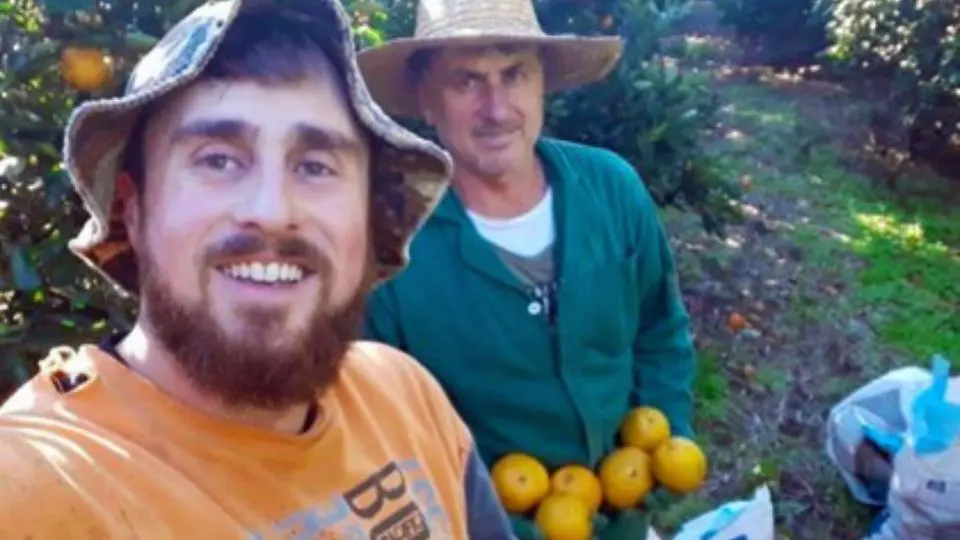
The Balbinotti family has been farming the same land in southern Brazil for five generations. When Ede Balbinotti's great-great-grandfather arrived from Italy and put down roots in the hilly interior of Rio Grande do Sul, the farm was built around survival.
Today, Ede: a young farmer with a degree in sustainable development, runs a 14-hectare mixed operation cultivating maize and oranges, alongside raising pigs. The crops have changed. The pressures have intensified. But his family commitment to the land remains unbroken.
"It's been five generations, since my great-great-grandfather to me.” Ede says. "We've always followed this path."
The farm has shifted and grown with each generation. His grandfather grew yerba mate: the bitter leaf tea beloved across southern South America, before switching to oranges as land, labour and markets rearranged themselves over the decades. Maize and pigs came to anchor the operation, corn feeding the animals through the year while the pigs in turn enriched the soil with organic matter.
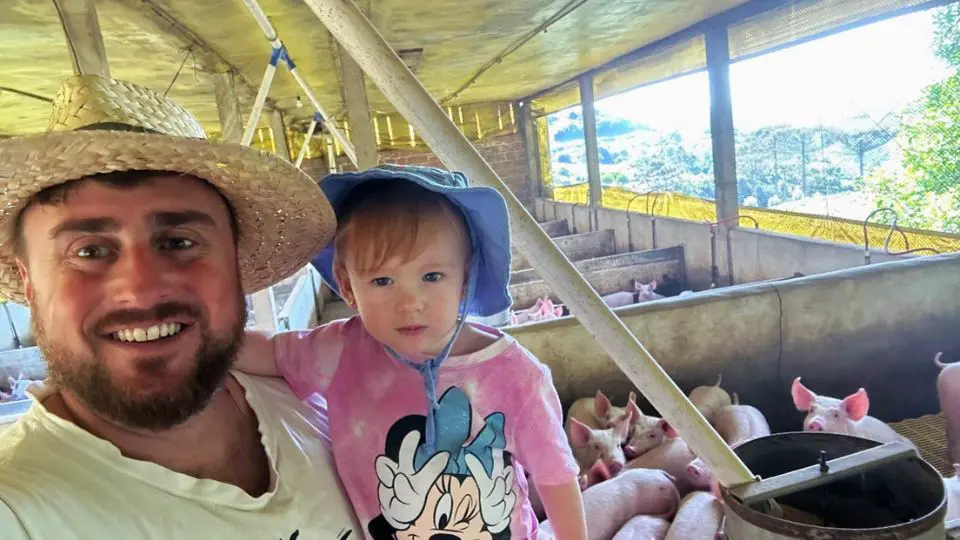
Figure 2 Ede Balbinotti with his daughter on the pig farm
What has changed most sharply in recent years is the climate. Rio Grande do Sul: Brazil's southernmost state and one of its most productive agricultural regions, has experienced increasingly erratic rainfall over the past decade. Droughts that came once in a generation now arrive almost seasonally.
“The extreme droughts in recent years have got us looking for new varieties that in addition to productivity, have better climatic adaptation; this is to ensure sufficient yielding in the face of adverse conditions” Ede Balbinotti
Ede's response has been methodical. Every year, he attends demonstration field days in his region. These are events where plant breeders present multiple different protected new varieties of maize side by side, each tested under local conditions. He watches which plants hold up when the rain is sparse, which recover fastest after stress. "We go to the field day, and you can often see which variety performs best” he explains. It is a practice his father never missed either, and one Ede has carried forward.
The results speak for themselves. In good years, when the weather aligns and the organic matter from his pig operation enriches the soil, Ede can harvest up to 12 tonnes of maize per hectare, a figure that places him well above Brazil's national average of around 5.7 tonnes per hectare according to Companhia Nacional de Abastecimento (CONAB, 2024)- Brazil's National Supply Company.
Ede has been buying certified seeds of protected varieties every year for 25 years. He explains that for his small diversified farm juggling pigs, oranges and maize across 14 hectares, producing and storing quality seed at home is not a viable option for him.

Developing a new rice variety is rarely the result of a single breakthrough; it is the outcome of years, often decades, of crossing, selection, field trials, and refinement. Each breeding cycle requires investment in research infrastructure, scientific expertise, and multi-season testing to ensure a variety is distinct, uniform, stable, and adapted to real farm conditions.
The ST lineage itself reflects this cumulative effort: from ST1 through more than 20 successive iterations, each was evaluated and refined before ST25 achieved its combination of fragrance, performance, and resilience.
In such a long and resource-intensive process, plant variety protection (PVP) provides essential legal and commercial certainty.
Viet Nam's membership to the International Union for the Protection of New Varieties of Plants (UPOV) in 2006 aligned national legislation with international standards, strengthening plant variety protection (PVP) across the country.
By granting breeders exclusive rights for new varieties, PVP enables them to recoup years of investment and reinvest in further research. According to the UPOV Plant Variety Database (PLUTO) plant variety rights for ST25 were granted in Viet Nam in March 2020.
Following the 2019 award, demand for ST25 surged in Viet Nam. The enterprise launched the consumer brand and trademark "Gạo Ông Cua" meaning Mr. Cua's Rice, to distinguish authentic products.
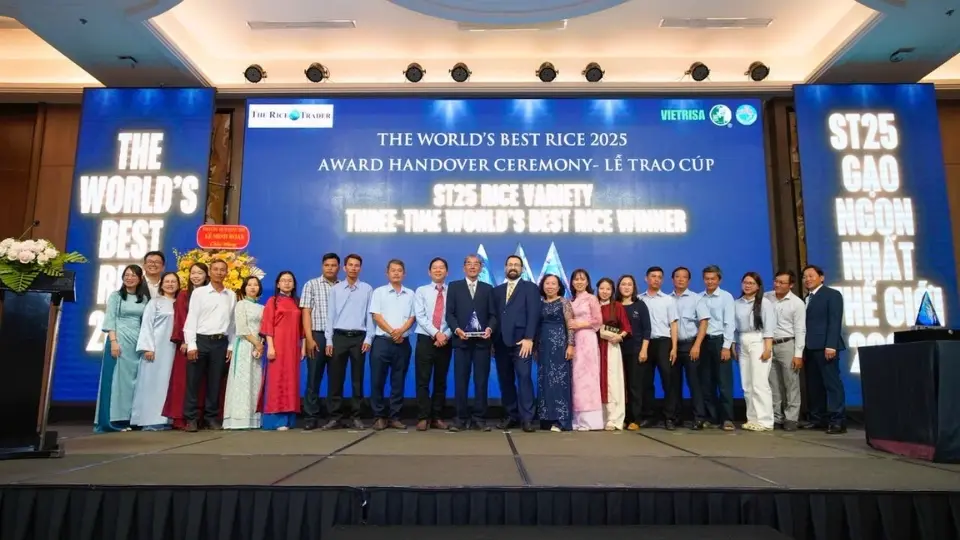
Figure 3 Staff and management of Hồ Cuang Tri receiving the 3rd consecutive award for the 'World's Best Rice.'
The Hồ Quang Trí enterprise today operates with a core research and engineering team of almost 50 people and around 150 employees in total. It works with more than 1,000 farmers through group leaders, supplying certified seeds, beneficial bacteria, and technical guidance while guaranteeing purchase of their harvest.
The enterprise also promotes practices compatible with rice-shrimp farming systems, including Alternate Wetting and Drying, which can reduce methane emissions by up to 50 percent and water use by approximately 30 percent compared to continuous flooding.
Media reports suggest that the protected varieties ST24 and ST25 are now estimated to contribute approximately US$88 million in incremental annual farmer revenue - a figure that reflects the economic impact plant breeding can have on farming communities
Mr. Trần Quang Vũ, son-in-law of Hồ Quang Cua and representative of the Gạo Ông Cua brand, describes what is now at stake:
"We are building on a foundation of trust that reaches from the muddy fields of the Mekong Delta to the kitchen tables of families across the globe. By protecting the ST25 legacy, we are protecting the livelihoods of thousands of farmers, the trust of our partners, and a profound sense of national pride that belongs to all of Viet Nam."
The wider picture reflects that ambition. According to the International Rice Research Institute (IRRI), Viet Nam has risen to become the second biggest exporter of jasmin rice, commanding nearly 40% of the global market share.
The Southeast Asian nation also boasts a historic 8 million tons of total rice exports in 2023 - worth $4.6 billion and the highest volume since 1969. (Source: Statista )
What began as a response to saline intrusion and rural vulnerability has since evolved into a case study in strategic agricultural development backed by effective plant variety protection. One that continues to unfold in the fields of the Mekong Delta.

Drying, cleaning, treating and keeping seed vigorous requires storage, infrastructure and time that small farms simply do not have. "I can't just keep seeds at home," he says plainly. "I have no way to dry them, no way to clean them." What he can do is select well, invest in certified material, and extract maximum productivity from the land he has.
The same philosophy guides his citrus operation. With support from EMATER: the state agricultural extension service, and EMBRAPA: Brazil's federal agricultural research corporation, Ede sources grafted orange seedlings of Navel and Valencia varieties, chosen for vigour and disease resistance. He grows his oranges with minimal inputs, relying on organic treatments and the natural resilience of quality rootstock. "We were only able to achieve this because we also have high-quality plantlets," he notes. "If you start with a diseased plantlet, the plant won't yield, no matter what."
Brazil formalized its commitment to the system that enables this kind of innovation in 1999, when the country acceded to the International Convention for the Protection of New Varieties of Plants (UPOV Convention) — the international framework that underpins plant breeders' rights in 99 states worldwide.
Brazil's Plant Variety Protection Act had come into force two years earlier in 1997, establishing the legal foundation for breeders to invest in research knowing their work would be recognized and rewarded. The continuous pipeline of improved varieties that Ede selects from each season at demonstration plots is, in part, a downstream consequence of that policy choice.
For Ede, none of this is policy language. It is the simple arithmetic of keeping a fifth-generation farm productive in a climate that no longer behaves the way his grandfathers did.
The new varieties available to him today: more resilient, more productive under stress than anything his grandfather planted, are the reason the Balbinotti farm is still growing.
"Every year we hammer home the point: produce more with the same amount of land," he says. For him, the seeds of new protected varieties he buys are not a cost. They are the investment that makes everything else on the farm possible.