
Urban air taxis represent a significant advancement in urban air mobility (UAM), providing a new mode of transportation aims at alleviating urban congestion and reducing travel times in densely populated areas. Urban air taxis, often referred to as eVTOLs (electric vertical takeoff and landing aircraft), are designed to operate within urban environments, offering an efficient and sustainable alternative to traditional ground transportation. The adoption of urban air taxis is crucial for transforming urban transportation, reducing emissions and enhancing the overall efficiency of city travel.
Currently, demand for urban air taxis is growing, with various companies and research institutions actively developing and testing eVTOLs. However, significant challenges remain in terms of infrastructure development, regulatory frameworks and public acceptance. Manufacturers and operators are increasingly conducting test flights and demonstrations to showcase the feasibility and benefits of urban air taxis. Planned production capacities are expected to ramp up over the next decade, but widespread adoption will require substantial investment and supportive policies.
There are several types of urban air taxis currently under development, each with unique characteristics and technologies (Figure C62).
Vectored thrust: Such powered lift eVTOL aircraft utilize all of their lift/thrust units for both vertical lift and cruising. This is achieved by rotating (vectoring) the resultant thrust points against the direction of motion. Such thrust vectoring can be accomplished in several ways: by rotating the entire wing-propulsion assembly (tilt wing), by rotating the lift/thrust unit itself (tilt fan for ducted fans and tilt prop for propellers), or by rotating the entire aircraft frame pivoted about the fuselage (tilt body or tilt frame). An example of this configuration is the Lilium jet, which utilizes ducted and vectored thrust through distributed electric propulsion (DEP).
Wingless: This configuration is relatively simple and can be very efficient during vertical take-off, landing and hovering, because of low disc-loading. However, without wings, multicopters lack cruise efficiency, which limits their application to urban air mobility markets only. An example of this category is the Volocopter VC2X, which runs on nine independent batteries, powering 18 electric motor-driven variable-speed/fixed-pitch propellers. The resultant redundancy ensures stability in the event of a component failure.
Lift plus cruise: Such aircraft combine the capabilities of a multicopter for vertical takeoff and landing with those of a standard aircraft for cruising in flight. This integration enables the aircraft to achieve both efficient vertical takeoff and landing as well as efficient cruise performance. To optimize the range of such concepts, the propellers required for VTOL are designed with fewer blades and shorter chords, so as to minimize drag when cruising in flight. However, the small size of the propellers used for VTOL operations presents a notable challenge in terms of the noise emissions, mainly resulting from and increased blade tip speeds. The Kitty Hawk Cora is an example of this configuration.
Tilt rotor: This configuration involves either the wing and propellers or the propellers alone (tilting). This enables the propeller axis to rotate by 90 degrees as the aircraft transitions from hover to forward flight. This architecture generally allows for the design of a more optimized propeller compared to a lift and cruise aircraft configuration. However, it comes with the trade-off of higher technical complexity and larger overall size and weight owing to the inclusion of tilt and variable pitch mechanisms. Joby S4, developed by Joby Aviation, is an example of this category of aircraft and is expected to be commercialized by 2024.

The adoption of urban air mobility can also lead to substantial economic benefits. According to Deloitte, the implementation of air taxi services can create new job opportunities in vehicle maintenance, operations management and pilot training. Additionally, urban air taxis can stimulate technological advancements in battery technology, autonomous flight systems and air traffic management.
Despite their advantages, urban air mobility has several current limitations. The development and certification of eVTOLs is complex and requires significant investment. Additionally, there are technical challenges related to battery technology, flight safety and noise reduction. Ensuring the reliability and safety of urban air taxis in various operating conditions is critical.
Rajendran and Srinivas highlight that one of the key challenges is the development of efficient ride-matching algorithms and pricing strategies to optimize the use of air taxi services. Additionally, vehicle maintenance scheduling and pilot training and recruitment are critical areas that need to be addressed to ensure the scalability and reliability of urban air mobility.
Urban air mobility: scientific publications
The scientific community has shown an increasing interest in urban air taxis, as evidenced by the growing number of publications on the topic. Research focuses on improving eVTOL technology, assessing environmental impacts and enhancing the safety and efficiency of urban air mobility (Rajendran and Srinivas, 2020).
Figures C63–C65 illustrate the trends in scientific publications related to urban air taxis from 2004 to 2024 and the leading countries contributing to this research. Figure C63 shows there has been a steady increase in publications, with a significant surge starting around 2017. This trend indicates a growing interest in urban air taxis and their potential to transform urban transportation.
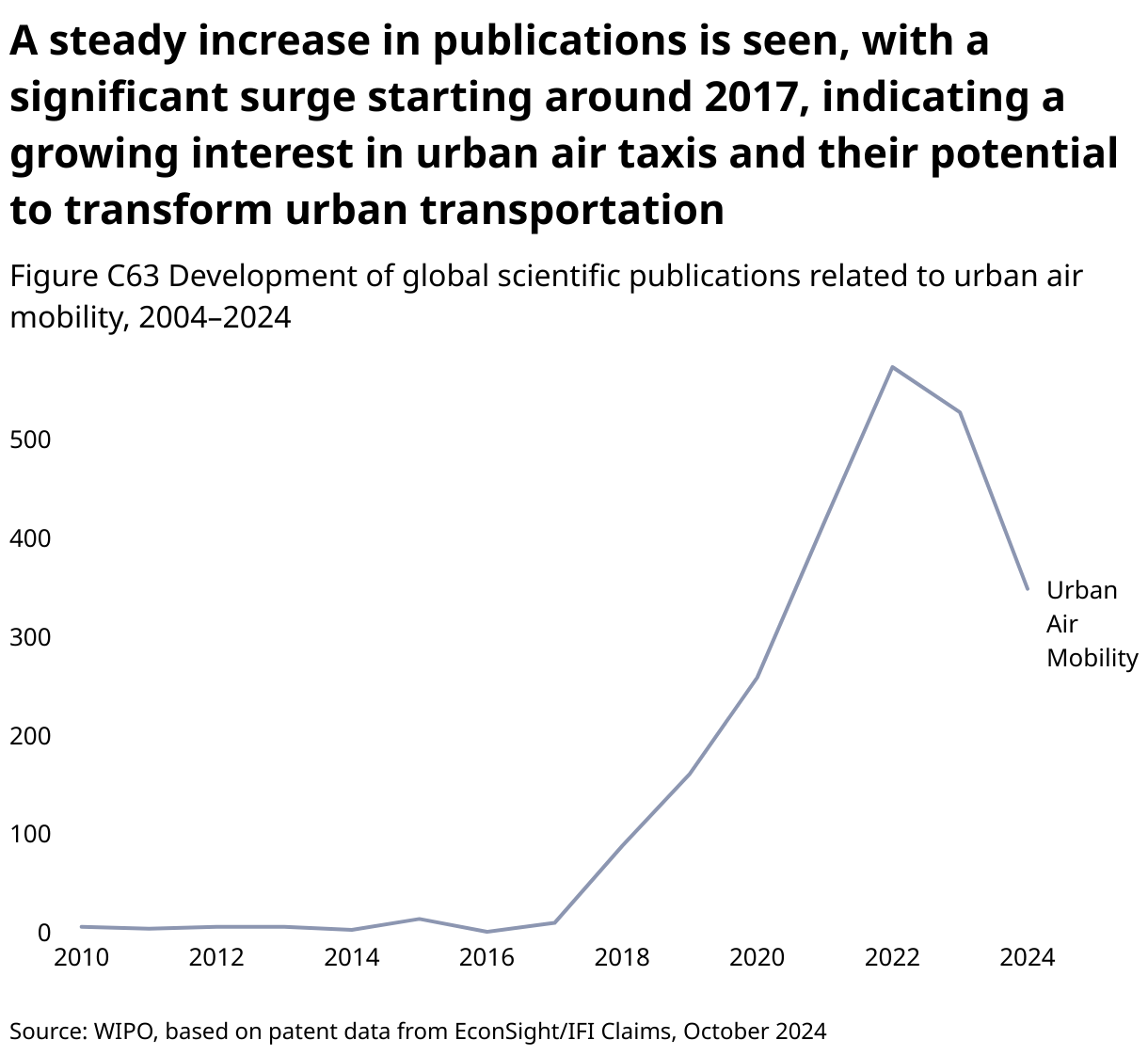
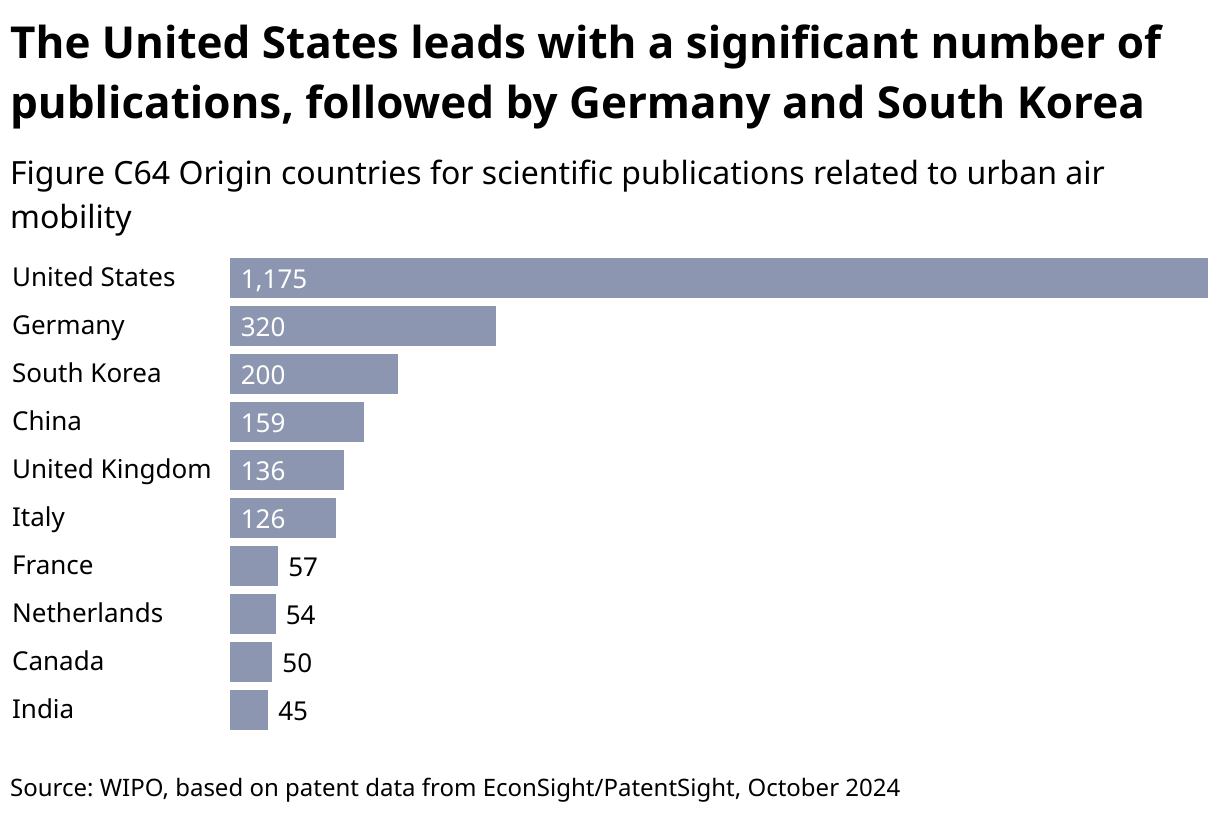
Figure C64 highlights the number of scientific publications related to urban air mobility by country. The United States leads with a significant number of publications, followed by Germany, the Republic of Korea, China, the United Kingdom, Italy, France, the the Kingdom of the Netherlands, Canada and India. This distribution reflects a global interest and investment into developing urban air mobility solutions.
Urban air mobility: patent data
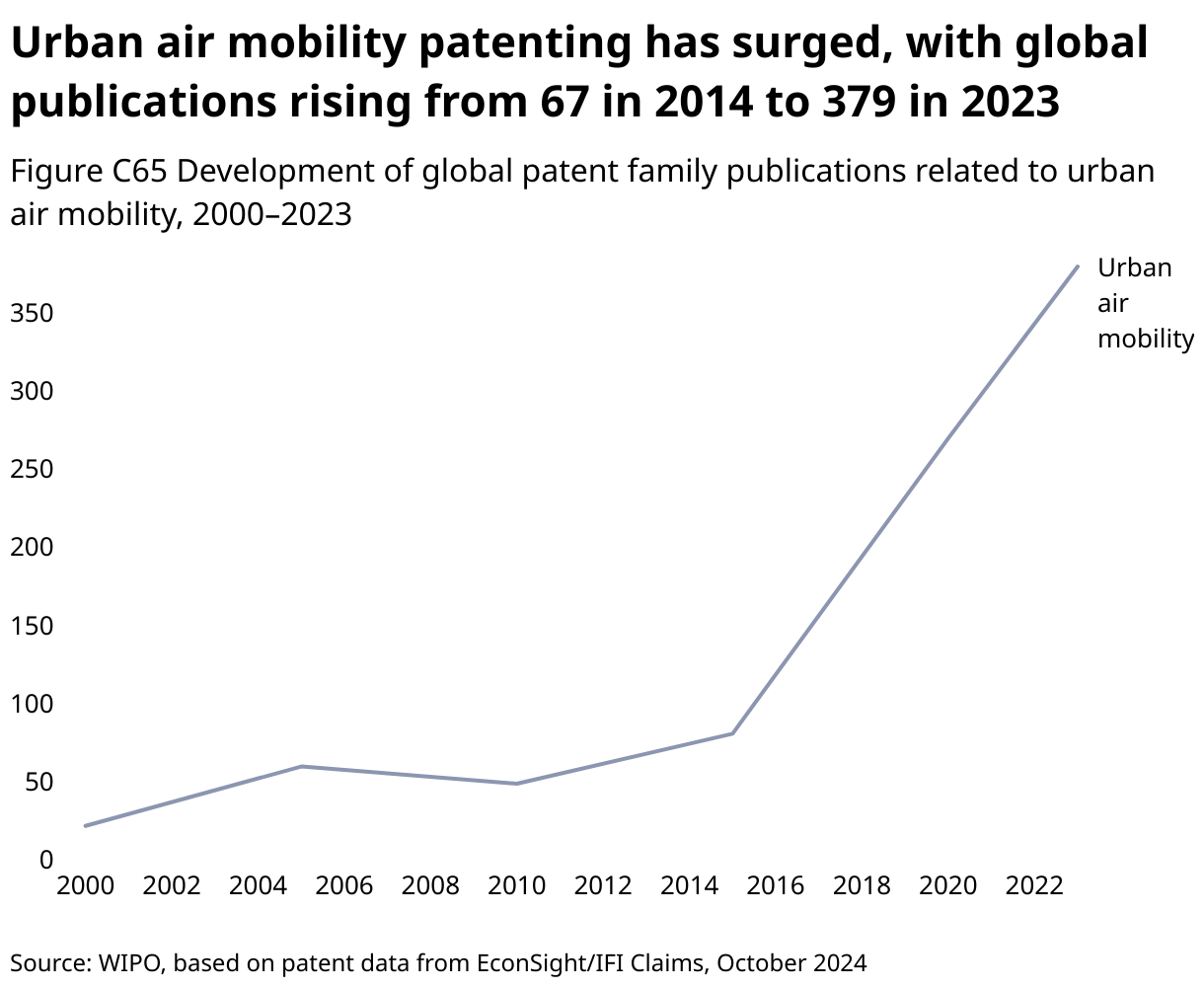
Patenting activity in the field of urban air mobility has picked up speed significantly over the last 10 years. The number of global patent family publications has jumped from 67 in 2014 to 379 in 2023 (Figure C65).
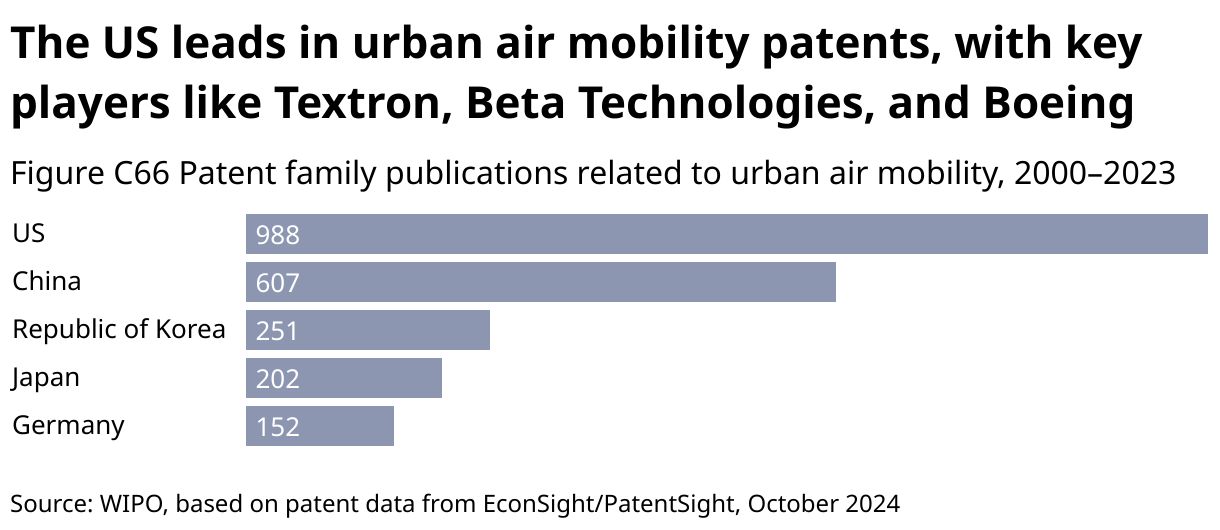
At a country level, most patent family publications were developed in the United States (988) (Figure C66). Textron, Beta Technologies and Boeing are key US research players that are developing eVTOLs. China, the Republic of Korea and Japan and Germany are other important research locations.
Urban air mobility: patent examples
Recent developments from Lilium (EP3998191A1) include a vertical takeoff and landing (VTOL) passenger aircraft, emphasizing easy luggage access and energy efficiency. This VTOL aircraft combines helicopter-like capabilities for limited space takeoffs and landings with the high-speed and efficient cruising of conventional aircraft, aiming to reduce energy consumption, especially in electrically-powered(eVTOL) models. It includes a fuselage with a passenger cabin and a rear-accessible cargo bay, featuring an upward-opening door for efficient luggage loading without hindering passenger movement. The cargo bay is optimally positioned and sized to balance weight distribution and minimize aerodynamic drag. This design supports urban air taxi services, offering convenient regional mobility with sufficient luggage capacity and rapid access.

Another recent development from Joby Aviation (EP3535185A1) describes a VTOL aircraft that utilizes fixed rotors both for vertical takeoff and landing and for forward flight operations. The key feature of this aircraft is the use of a "synthetic wing" formed by an array of rotors. These rotors are positioned along the span of the wing to achieve high a span efficiency and an even lift distribution. The synthetic wing also includes narrow front and rear airfoils that provide additional structural support and lift during forward flight. The rotors are designed to tilt forward during horizontal flight, thus providing forward propulsion. This design aims to simulate the aerodynamic benefits of traditional aircraft wings, including even lift and controlled downwash, with concentrated vorticity at the wingtips.

The first patent is geared toward creating a practical and efficient VTOL aircraft for urban air taxi services, with a strong emphasis on passenger convenience and efficient luggage handling. The second invention focuses on aerodynamic innovation, using fixed rotors to form a synthetic wing that provides efficient lift and propulsion, optimizing the aircraft's aerodynamic performance. While both designs address the need for efficient VTOL operations, their primary focus and structural approach differs significantly.
The adoption of urban air mobility is influenced by evolving regulations and standards aimed at promoting safety, sustainability and efficiency. Organizations like the Federal Aviation Administration (FAA) and the European Union Aviation Safety Agency (EASA) are working on developing standards specific to eVTOLs, addressing certification processes, operational guidelines and air traffic management systems to ensure their reliable integration into urban airspace.