
The critical points in the value chain that have high environmental impact are agriculture/fiber extraction, textile processing, transportation and end of life (Niinimäki et al., 2020). Textile raw materials are derived from natural or synthetic fibers, with cotton being the most commonly used natural fiber and polyester the leading synthetic fiber and the most commonly used material overall (Textile Exchange, 2022). The extraction of synthetic fibers requires significant energy, as they are derived from polymers, which are primarily sourced from petroleum.
Outsourcing of environmental responsibility
Negative environmental impacts are concentrated in textile- and garment-manufacturing countries, and those countries that import secondhand clothing. This is the result of the vertical disintegration of the industry and mass outsourcing of production and waste management to countries with lower labor cost.
To achieve economies of scale and scope, the various processes in industrial production are carried out by a network of different companies and suppliers, rather than by one company. Fashion brands and retailers rarely own factories but are solely engaged in the design, sourcing and distribution of products, with the manufacturing of textiles and garments carried out by independent subcontractors.
One of the consequences of this structural change is a shift in the balance of power in the supply chain from manufacturers to retailers, who can outsource accountability for environmental responsibility and place the negative externalities of production on suppliers in developing countries.
There are many examples of environmental pollution and degradation resulting from industrial production in developing countries, but such industrial activity is likely to be part of an extensive supply chain. Therefore, a systemic approach looking at the whole textile value chain needs to be taken to analyze the externalities of its production and consumption process. Evolving legislation on due diligence will address this issue by placing the onus on fashion companies to assume responsibility for their supply chains.
Harmful chemicals and water usage
Environmental degradation can have severe socioeconomic effects on the health, well-being and quality of life of people affected by textile production. Harmful chemicals in pesticides used in conventional cotton farming leach into the waterways and can lead to neurological and reproductive health problems. For example, the use of agrochemicals in Indian cotton farming villages creates toxic landscapes that cause physical and mental suffering and distress in farmers, with significantly higher suicide rates than the national average (Kannuri and Jadhav, 2018).
Vast amounts of water are needed for growing cotton, and for textile dyeing, processing and finishing. In Bangladesh, the world’s second biggest ready-made garment exporter and manufacturing hub, supporting 4 million workers, alarming depletion in groundwater levels has been attributed to the garment industry, due to the high use of water by many textile mills (Ahmed and Jaiswal, 2023).
Toxic chemicals used in textile processing, if not contained within a closed-loop system, present a risk to the environment, workers and communities as they can be bio-accumulative, hormone-disruptive and carcinogenic to both humans and wildlife (Perry, 2017).
Dyeing cotton involves a substantial demand for water, with an estimated usage of approximately 125 liters per kilogram of cotton fibers during the dyeing and finishing processes. In addition to the volume of water required, significant energy is consumed to heat water and generate steam for achieving the desired finish.
Synthetic textiles are a major source of microplastics, which pervade global ecosystems and are present in marine and land animals and humans (Boucher and Friot, 2017; European Environment Agency, 2021). Microplastics are shed throughout the life cycle of synthetic textiles but most are shed during the consumer use phase, after domestic washing of garments (Periyasamy and Tehrani-Bagha, 2022). Current solutions focus on the consumer use stage (filters for domestic washing machines), while innovations for adapted textile construction remain exploratory.
An energy toll of fashion through energy usage and greenhouse gas emissions
Critical stages for high energy usage are the extraction of synthetic fibers and cultivation of natural ones, and the subsequent textile production process. Synthetic fibers require more energy than natural fibers during extraction and production (Niinimäki et al., 2020; Sadowski et al., 2021) and the EU Textile Strategy (European Commission, 2022) notes that growing demand for textiles fuels inefficient use of nonrenewable resources, such as fossil fuels for production of synthetic fibers.
There is a well-established link between the growth of synthetics, which account for 69% of fiber production, and the fast-fashion business model (European Commission, 2022). Traditional wet processing for textile production requires high levels of thermal energy to heat up vast tanks of water for pretreatment, dyeing, printing and finishing. A shift to dry processing would significantly reduce emissions during textile manufacture (Apparel Impact Institute and Fashion for Good, 2021).
Fashion’s high carbon footprint is a result of high energy use in production processes and is influenced by the source of the energy used, for example coal or renewable sources (Niinimäki et al., 2020). The energy grid of most production countries is coal-based, with year-on-year growth in electricity generation from coal in major production countries including the People’s Republic of China, Bangladesh, India and the Socialist Republic of Viet Nam from 2010 to 2021 (Stand.Earth, n.d.).
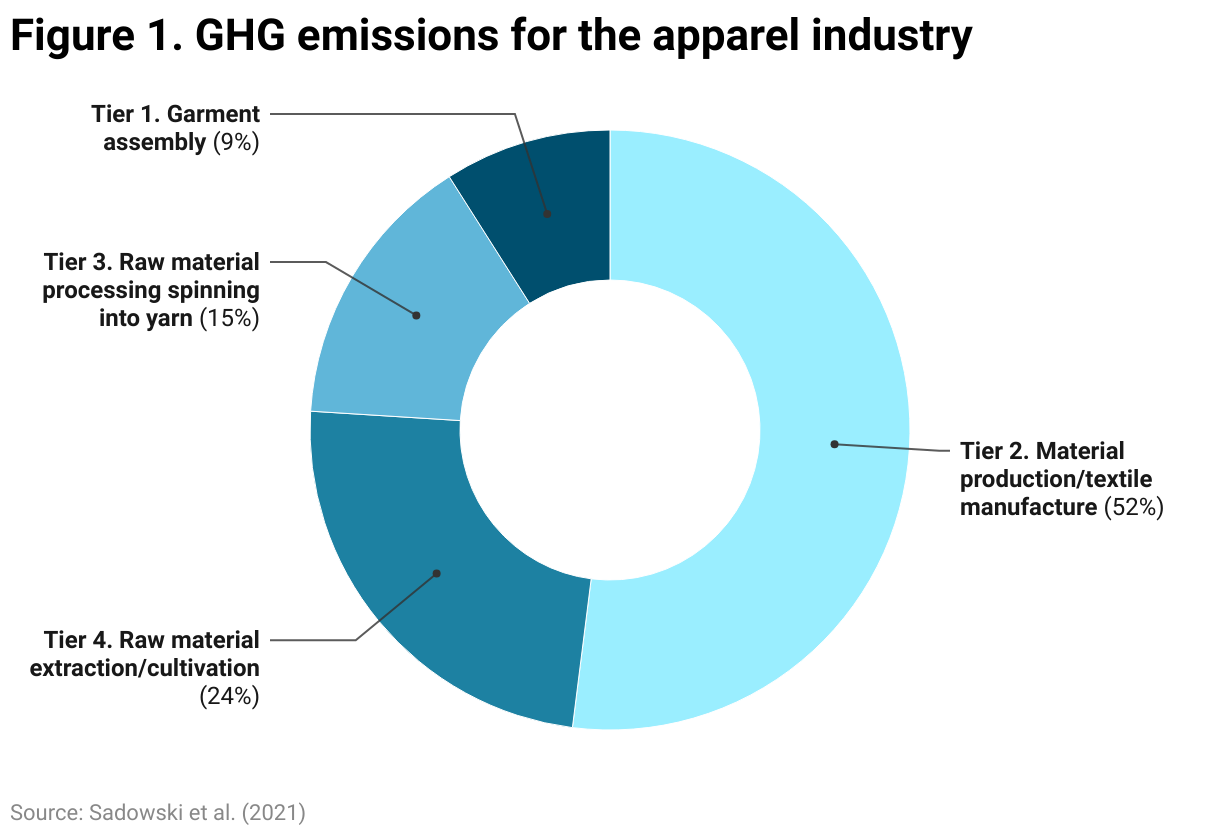
In their working paper, Sadowski et al. (2021) estimated the total GHG emissions for the apparel industry in 2019 using data from the Sustainable Apparel Coalition, Higg and Textile Exchange, split by proportion into each supply chain tier as displayed in Figure 1.
Challenges with leather
Industrial mass consumption of animal leather has a significant environmental impact in terms of carbon emissions, deforestation, water pollution and land overuse (Common Objective, 2021).
Leather is a by-product of the meat industry, as the greatest value of livestock is in the meat not in the hide, so the carbon footprint of cattle rearing is usually attributed to the meat industry not the fashion industry. Most leather for footwear and clothing comes from cows (Common Objective, 2021), and beef has the highest carbon footprint of all foods (Poore and Nemecek, 2018).
The most popular way of tanning leather uses chromium, a type of heavy metal which in some forms has been declared carcinogenic, or cancer-causing. The waste from chrome tanning, which contains leftover chromium, often ends up polluting waterways, posing a risk to the health of leather workers and local communities (Common Objective, 2021). While metal-free leather tanning is possible and gaining traction, it is a less popular system than chrome tanning owing to its costs and energy-intensity.
Fragmented supply chains increase transportation carbon footprints
Mass outsourcing of production to benefit from lower labor costs has led to a geographically fragmented supply chain with various operations situated in disparate locations, so there is a higher carbon footprint from the transportation of goods during their processes of transformation from fiber to finished product.
In order to make finished products available for consumers to buy as quickly as possible, air freight is an increasingly popular transportation method for fashion, but this has a significantly higher carbon footprint than sea freight (Niinimäki et al., 2020). However, the carbon footprint of garment transportation is relatively insignificant compared to that of production processes such as fiber extraction, yarn spinning and textile manufacture (Peters et al., 2021).
Less than 1% of textiles are recycled into new textiles
Textile waste management is an increasing problem, as most is incinerated, sent to landfill or exported to developing countries, where it may end up in landfills or open dumps (United States Environment Protection Agency, 2023; Changing Markets Foundation, 2023; National Geographic, 2024). In Europe alone, over 15 kilograms of textile waste is generated per person, of which 85% is discarded clothes and home textiles from consumers.
In 2022, still less than 1% of the global fiber market comes from pre- and post-consumer recycled textiles (Textile Exchange, 2023). The potential for improvement is vast, with some projections suggesting that fiber-to-fiber recycling could reach 18 to 26% of gross textile waste by 2030 (McKinsey & Co., 2022).
Recycling does not mean “new textiles.” While the reuse of textiles as feedstock for other industries may provide certain economic advantages, it does little to advance the circular fashion economy. More specifically, the current trend of using plastic waste to manufacture fashion products – often framed as “sustainable” – in reality neither addresses the industry’s own waste problem nor mitigates the negative environmental consequences of using plastic textiles. These clothes and garments continue remaining synthetic, thereby shedding microplastics into ecosystems and human bodies alike.
A major challenge to meaningfully incorporating recycling within this industry is the broad-based use of blended textiles. For example, materials like elastane, which is a common addition to fabrics, used to improve flexibility and fit, are almost impossible to separate and recycle, and no viable methods currently exist to process them at scale.
Even when recycling is made technically feasible, the process carries forward the industrial chemicals embedded in the original fabric, which in turn perpetuates their presence in new garments. In addition to this, the accelerating trend, largely driven by fast fashion, of combining multiple raw materials in a single garment adds a further layer of complexity. While intended to enhance the garment’s texture and cost efficiency in production, it makes separation and recycling prohibitively complex.
High online shopping return rates
Online shopping has a high returns rate, with clothing the most returned category of goods bought online (Statista, 2023a). Between 25% and 50% of clothing items bought online are subsequently returned to the retailer, depending on the type of clothing and time of year (Butler, 2022; Circular, 2023). In 2022, the highest online fashion returns rates in Europe were seen in Switzerland, with 45% of all online fashion orders subsequently returned (Statista, 2023b). Returns increase carbon emissions owing to the extra transportation for returning items and textile waste, as returned items may end up in landfill (Renwick, 2020) rather than being resold.
Prevalence of linear business model
The fast-fashion business model obstructs progress toward a circular fashion economy. The ever-changing nature of fashion trends means there is a dual focus on speed to market and low cost in supply chain operations. This means that commercial interests supersede environmental and social concerns, resulting in corners being cut and a preference for cheaper and/or less sustainable options such as virgin polyester over recycled polyester, or air freight over sea freight.
Coupled with overproduction – an estimated one-third of all clothing produced is never sold (Niinimäki et al., 2020) – high resource consumption and GHG emissions are inevitable in the fashion industry’s current business model, resulting in significant threats to environmental sustainability.
The linear system of production and consumption – that is, using finite virgin resources to make items that are not used to their full potential before being disposed of, and low-quality, disposable clothes ending up incinerated, landfilled or dumped in the natural environment – remains prevalent.
In a circular system, products are designed to last, and existing products and materials are kept in use for as long as possible at their highest value, through sharing (swapping/renting/reselling), repairing, reusing, upcycling or recycling.
Mitigating fashion’s environmental impact
Increasing awareness of the scale of fashion’s negative environmental impact and the limitations of voluntary initiatives has spurred policymaker scrutiny to mandate action and reporting across the supply chain (Business of Fashion and McKinsey & Co., 2023).
Increasing awareness by consumers, businesses and policymakers has put environmental sustainability in the fashion industry at the forefront of the public agenda. Environmental sustainability that supports the transition to a low-carbon, resource-efficient economy is governed by a number of voluntary initiatives (for example, the UN Fashion Charter and Sustainable Apparel Coalition), environmental, social, governance (ESG) reporting for investors, and increasingly regulation and legislation.
Tracking the origin of resources used in the fashion industry dates back to the Dodd–Frank Act on conflict minerals in 2012 in the US, and legislation continues to evolve with compulsory mapping and disclosure requirements. As self-regulation and voluntary initiatives have not achieved the desired transformation, new EU and US legislation has and will soon come into force that requires brands and manufacturers to intensify initiatives to reduce carbon emissions and waste (Business of Fashion & McKinsey & Co., 2023).
The Corporate Sustainability Reporting Directive, a new piece of EU legislation that comes into force in 2024, requires all large companies to publish regular reports on their environmental and social impact activities via a standardized framework, and establish due diligence procedures to address adverse impacts of their actions on human rights and the environment, including along their value chains worldwide.
The EU’s Carbon Border Adjustment Mechanism subjects the import of certain goods into the EU to a levy, although textiles are not yet included. It is designed to address “carbon leakage,” where companies relocate production activities to countries with less stringent climate policies, resulting in an increase in emissions in those countries.
New York State’s Fashion Act (or Fashion Sustainability and Social Accountability Act) will legally enforce brands to disclose and address their environmental and social impacts. Companies with annual revenues over USD 100 million who wish to sell to the New York market must set and achieve science-based emissions targets, implement public global supply chain maps and publish details on the management of chemical usage.
The Science Based Targets Initiative (SBTi) provides sector-specific concrete guidance for companies to reduce emissions through target setting and associated pathways for delivering on targets. Companies in the fashion industry can also complete a GHG emissions inventory in accordance with the GHG Protocol which sets the standards for companies, cities, and countries to measure and track GHG emissions (GHG Protocol, 2023). According to this protocol, the greenhouse emissions of a company can be classified as follows:
Scope 1 emissions are direct emissions from company-owned and -controlled resources.
Scope 2 emissions are indirect emissions from the generation of purchased energy, from a utility provider (such as purchased electricity, steam, heat and cooling).
Scope 3 emissions are all indirect emissions not included in scope 2 that occur in the value chain of the company, including both upstream and downstream emissions.
Scope 3 emissions are the largest emission sources in the value chain. However, they can be difficult to measure owing to the industry’s reliance on a global network of suppliers.