
Some technologies do more than improve performance – they fundamentally change how sport is played, adjudicated and experienced. From officiating systems and performance tracking to data-driven decision support, certain innovations reshape entire sporting ecosystems and often spread from one sport to another. This chapter tells the stories of such game-changing technologies, showing how a single breakthrough can ripple across disciplines and redefine the rules of the game.
Hawk-Eye: from broadcast tool to global officiating standard
Cricket has a long history of early and influential adoption of technologies, in particular broadcasting technologies, and has often served as a testbed for innovations that later became standard across global sports coverage. Technologies often enter sport as broadcast enhancements before becoming trusted tools for fairness and rule enforcement.
In the 1960s and 1970s, cricket was among the first sports to embrace televised coverage with multiple camera angles, reflecting the game’s pace and spatial complexity, since long match durations and clearly defined phases of play made cricket particularly suitable for experimentation with camera placement and shot sequencing. In the 1970s and 1980s, cricket broadcasters were also early adopters of slow-motion replays, using these in particular to analyze batting strokes, bowling actions and close fielding decisions. In the 1990s, stump cameras were one of the earliest uses of equipment-integrated cameras in professional sport, before fan engagement was deepened with player and umpire microphones in the early 2000s. At a similar time, cricket was one of the first to adopt a cable-suspended aerial camera system, commonly known as “Spidercam,” which is something that is now ubiquitous at sports stadiums around the world, used for sports such as football (soccer), American football and rugby.
However, the most famous form of sports technology where cricket led the way is the mass adoption of camera-based ball-tracking technology used to support officiating decisions. While first applied to cricket, the technology has since spread to tennis, badminton, football (soccer), rugby, volleyball and more.
In cricket, most ways a batter can be “out” are objective, except one: leg before wicket (LBW). Here, the umpire must judge whether a ball that hit the batter’s pads would have gone on to hit the stumps. This decision is inherently subjective and often controversial.
The Hawk-Eye system uses multiple high-speed cameras to track the ball in three dimensions. It reconstructs the ball’s trajectory frame-by-frame, helping determine whether it would have hit the stumps. When there is doubt about whether the ball touched the bat, advanced sound-based edge-detection technology, UltraEdge, adds audio data to confirm contact. Together, these tools support the third umpire in making transparent, accurate decisions.
The original Hawk-Eye patent, filed in 1999, relates to a multi-camera video analytics system that tracks and predicts a cricket ball’s 3D trajectory in real time, improving umpiring accuracy and enabling data-driven analysis of play.
Patent number: GB 2357207 A
Applicant: Roke Manor Research Ltd.
Title: Ball tracking and trajectory prediction
Publication date: June 13, 2001
Patent drawing

End-user application
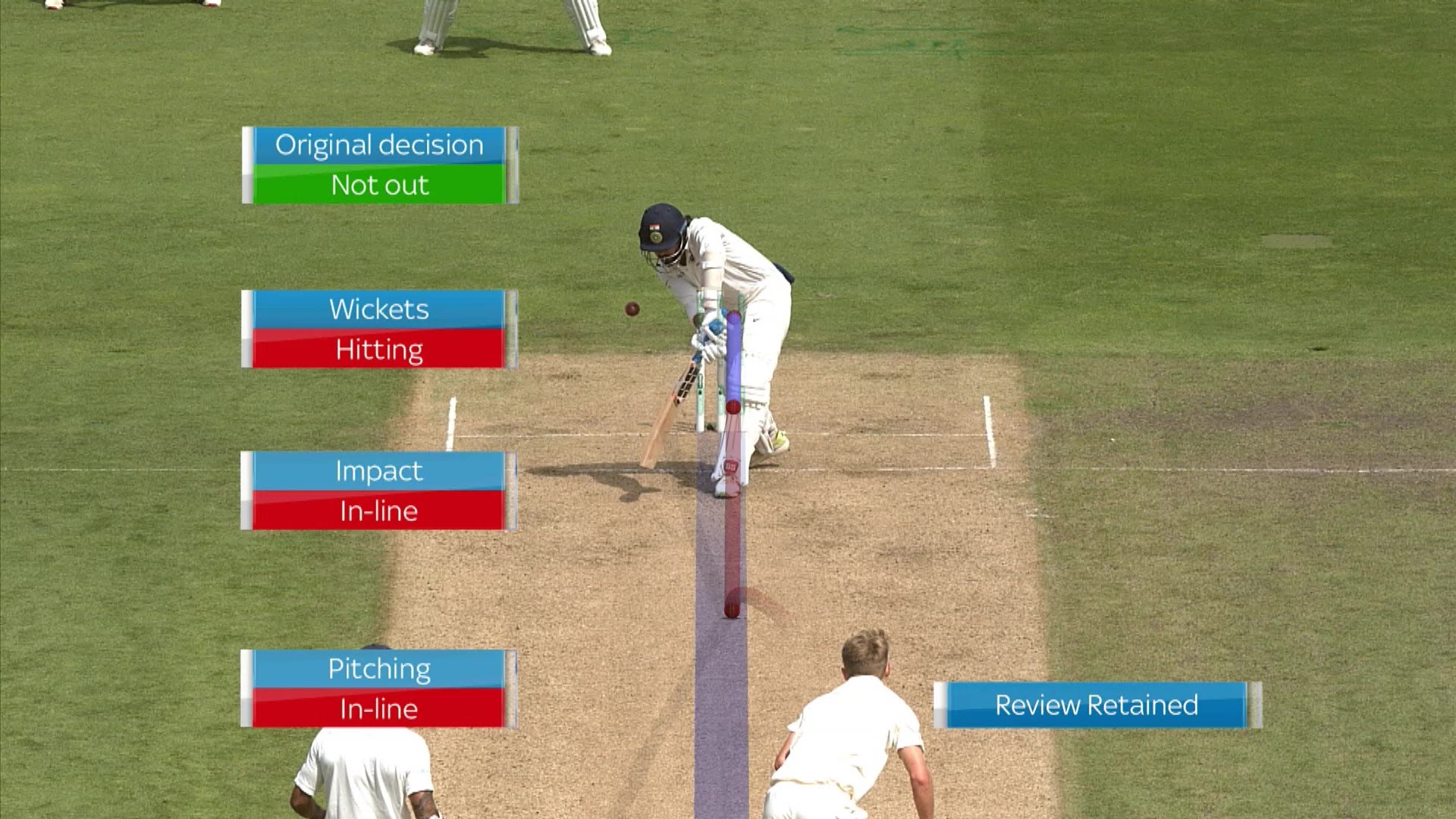
Problem: Existing video processing systems in cricket face challenges in accurately tracking a ball in 3D space throughout its flight path, due to variable camera distances, player obstruction, ball color variations and the need for real-time processing to assist umpiring decisions, particularly for LBW determinations.
Solution: A video processing system utilizing multiple cameras positioned around the cricket field, with a video processor and data stores for modeling the field and game rules, capable of identifying ball pixels, computing 3D positions, predicting flight paths and mapping interactions with field features to determine key events like LBW, while minimizing camera field of view and using statistical data for decision-making.
Benefit: The system provides accurate, real-time ball tracking and event detection, reducing human error in umpiring decisions and offering valuable statistical data for commentators and analysts, enhancing the accuracy of LBW determinations and providing insights for strategy and coaching.
Named after one of its inventors and perhaps also for the sharp vision it gives umpires, Hawk-Eye was originally developed by two engineers, Paul Hawkins and David Sherry, at Roke Manor Research (a subsidiary of Siemens) in the United Kingdom. In 1999, a UK patent application was submitted,
Hawk-Eye moved from the television screen to the umpire’s decision-making toolkit in 2009, when the International Cricket Council (ICC) officially adopted Hawk-Eye for Test matches and it became part of cricket’s Decision Review System (DRS).
Tennis was the sport that transformed Hawk-Eye from a promising technology into a trusted authority. Unlike cricket, where the system reconstructs a projected ball path, tennis demanded something simpler but far less forgiving: an immediate, binary decision – in or out – often separated by just a few millimeters.
Hawk-Eye first entered professional tennis as a review tool, not as a replacement for human officials. In 2006, the system was trialed at the US Open, allowing players to challenge line calls made by human judges. When challenged, Hawk-Eye reconstructed the ball’s bounce using camera-based tracking and displayed the result to players, officials and spectators.
This innovation did not remove human judgment; it augmented it. Players were given a limited number of challenges, preserving the rhythm of the game while introducing transparency. On average, players used around 2.3 challenges per set, with roughly 30% of challenges upheld, demonstrating both the value of the system and the fallibility of human calls.
The success of the US Open trial led to rapid acceptance. In 2007, the Wimbledon Championships adopted Hawk-Eye for reviewed line decisions, lending the technology additional credibility. Over the following years, the challenge system became standard across elite-level tennis, and by 2020 all four Grand Slam tournaments were using Hawk-Eye in this decision-reviewing role.
 Image courtesy of Hawk-Eye Innovations Ltd.
The reason Hawk-Eye gained trust so quickly was accuracy. The system achieved around 99.9% accuracy, compared with an estimated 85–90% accuracy for human line judges. For players, this reduced frustration. For fans, it replaced argument with evidence. For officials, it offered reassurance rather than replacement.
Crucially, tennis demonstrated that acceptance matters as much as precision. By making the technology visible – showing the data, the margin of error and the decision – Hawk-Eye became part of the spectacle rather than an invisible authority.
Once Hawk-Eye had proven itself as a review mechanism, the next step was inevitable. Advances in processing speed, camera resolution and decision algorithms enabled the system to move beyond review and into automated line calling. In this model, Hawk-Eye no longer waits for a challenge. It replaces human line judges entirely, calling lines in real time. The first large-scale introduction of automated line calling began in 2019, initially at selected tournaments and exhibition events. Adoption accelerated rapidly in 2020, when operational constraints and health considerations caused by the COVID-19 pandemic led major tournaments – including the US Open – to run matches without human line judges, relying entirely on automated calls.
Hawk-Eye shows how technology can transform sport, making split-second decisions fairer and more transparent, and shaping the way games are played and watched worldwide.
 Image courtesy of Hawk-Eye Innovations Ltd.
Hawk-Eye Innovations – a Sony Group company since 2011 and part of Sony's sport businesses – still delivers pioneering computer vision-based solutions that have now been adopted across more than 20 major sports, enhancing fairness, consistency and fan engagement worldwide. In recent years, Hawk-Eye has expanded its reach into leagues and events across cricket, tennis, football, baseball, rugby and more. For example, Hawk-Eye's Semi-Automated Offside Technology (SOAT) – shown above – accelerates VAR (video assistant referee) reviews by automatically generating lines and identifying the "kick point," increasing accuracy and reducing interruptions in elite football. Hawk-Eye now serves hundreds of tournaments and competitions globally, generating substantial licensing and services revenue as it underpins officiating and analytics solutions for major federations, broadcasters and rights holders. Its continued growth reflects the strong commercial demand for precise, data-driven sports technology in elite competition.
The wearables revolution: from elite performance to everyday well-being
For much of sporting history, advanced performance data were the preserve of elite athletes and professional teams. Physiological monitoring, workload optimization and recovery analysis were tools used behind closed doors by coaches, sports scientists and medical staff. Today, similar data sit on millions of wrists, fingers and phones. The global wearables market – now a cornerstone of sports technology – did not emerge by accident. It was shaped deliberately through sustained investment in innovation, then protected and scaled through IP.
The early 2000s marked a turning point when advances in miniaturized sensors, battery efficiency and wireless connectivity created the technical foundations for consumer-facing fitness tracking. One of the first companies to translate this into mass-market impact was Fitbit. Initially focused on step counting and basic activity metrics, Fitbit’s rapid rise was underpinned by a growing portfolio of patents covering motion sensing, data processing and user feedback systems.
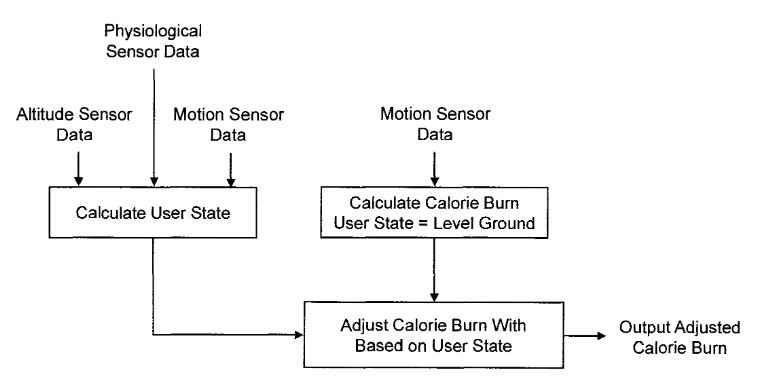
One of the earliest Fitbit patents, filed a year before the launch of the Fitbit Ultra in 2011, relates to improved calorie burn calculations.
Patent number: US 8180591 B2
Applicant: Fitbit Inc.
Title: Portable monitoring devices and methods of operating same
First publication date: April 5, 2012
Grant date: May 15, 2012
Patent drawing
End-user application

Problem: Existing portable monitoring devices lack accurate methods to calculate calorie burn and other activity-related metrics, particularly in varying environments and activities, as they rely on incomplete data analysis and do not effectively integrate altitude and motion sensor data.
Solution: A portable monitoring device equipped with both altitude and motion sensors, along with processing circuitry, calculates calorie burn by integrating data from these sensors to assess changes in elevation, motion and activity state, providing accurate metrics such as calorie expenditure, distance and pace across different activities.
Benefit: The device provides precise calculations of calorie burn and activity metrics, accounting for changes in elevation and motion, enhancing user data accuracy and reliability across diverse activities.
As the market matured, competition intensified and links to elite sport became more explicit. Garmin brought its heritage in GPS navigation and endurance sports into wearables, building devices used not only by consumers but also by professional cyclists, runners and teams seeking precise performance data. Garmin’s patents cover location tracking, heart-rate monitoring, training load metrics and sport-specific analytics – illustrating how technologies refined for high-performance environments could be adapted for mass adoption.
A further shift occurred when Apple entered the market with the Apple Watch. Rather than positioning wearables solely as fitness devices, Apple reframed them as holistic health platforms. Its extensive IP portfolio covers sensors, biometric analysis, user interfaces and secure health data integration. This marked a strategic transition from performance measurement to preventative health and well-being, expanding the audience for wearables far beyond sport-focused users.
More recently, companies such as Oura have pushed the frontier further, focusing on sleep quality, recovery and long-term well-being – areas long recognized as critical in elite sport but historically invisible to consumers. Oura’s ring-based form factor and patent filings around temperature sensing, readiness scoring and longitudinal health analytics reflect a broader industry trend: sports technology is no longer just about how fast you train, but how well you recover, sleep and sustain performance over time.
Oura’s recently granted patent for a compact, ring-based wearable integrates advanced electronics to deliver continuous, accurate health and fitness monitoring without compromising comfort or usability.
Patent number: US 12013725 B2
Applicant: Ouraring Inc.
Title: Wearable computing device
First publication date: May 2, 2024
Grant date: June 18, 2024
Patent drawing

Illustrative end-user application

Problem: Conventional wearable electronics are often bulky and intrusive, making them uncomfortable for extended wear and ineffective in providing consistent and accurate monitoring of body activities.
Solution: A wearable computing device in the form of a ring with a flexible printed circuit board, photovoltaic cells, LEDs and a charging mechanism that allows for prolonged use, enabling accurate fitness monitoring and gestural input through its compact and ergonomic design.
Benefit: The wearable computing device provides reliable and extended monitoring of fitness activities and biological data while being comfortable for prolonged wear, enhancing user experience with improved accuracy and convenience.
This evolution is seen clearly by analyzing the IP data. Early patents clustered around step counting and basic accelerometry. Over time, filings expanded into heart-rate variability, blood oxygen estimation, sleep staging, stress detection and AI-driven health insights. Patent landscapes also show increasing cross-sector convergence, with technologies moving between sports, healthcare and consumer electronics – accelerating innovation while also raising some complex questions about data ownership and interoperability.
Today, wearables are widely used across elite sport and by hundreds of millions of consumers worldwide. This is evident in the fact that the global wearables market size was already approximately USD 220 billion in 2025, and is expected to more than double, to almost USD 500 billion, by 2030.
The future of wearables most likely lies in deeper personalization, predictive health insights and integration with medical ecosystems. Once again, IP is likely to play a decisive role – shaping who leads, who collaborates, and how innovations reach society at scale.
Just as elite sport once led the way in understanding the value of performance data, wearables demonstrate how those insights – enabled and structured by IP – have escaped the stadium and become part of everyday well-being.
Modern sports footwear: engineered for speed and sustainability
Few sports technologies are as visible – or as contested – as those used in running shoes. Behind every high-profile model lie intense races in materials science, manufacturing and biomechanics, underpinned by dense patent activity. Over the past decade, these contests have reshaped not only elite competition, but also the expectations of everyday runners.
The first major wave of innovation focused on energy return and running efficiency. Advances in foam chemistry, plate integration and sole geometry enabled shoes that store and release energy more effectively with each stride. These technologies, widely adopted in elite distance running, were protected by patents covering both materials and their interaction with the body.
A second wave emerged with additive manufacturing: 3D printing opened new possibilities for footwear design, allowing midsoles to be built with complex lattice structures tuned for cushioning, stability and responsiveness. Beyond performance gains, additive manufacturing techniques enabled faster prototyping cycles and introduced the prospect of customization at scale. Patent filings in this space reflect growing interest in digitally driven design, manufacturing flexibility and data-informed performance optimization.
More recently, sustainability has become a defining driver of innovation. Footwear companies are now filing patents for recyclable materials, mono-material constructions and shoes engineered for easy disassembly at end of life. These designs challenge traditional manufacturing models and reflect growing pressure to address environmental impact without compromising athletic performance.
Adidas’ recent patent for modular, 3D-printed footwear concept uses integrally connected components to enable economically viable, mass-customized shoes tailored to individual fit, comfort and design preferences.
Patent number: US 12550975 B2
Owner: Adidas AG
Title: Modular footwear and methods of making the same
First publication date: December 4, 2025
Grant date: February 17, 2026
Patent drawing

Problem: Traditional shoe manufacturing processes rely on standardized sizes and designs, failing to meet individual consumers’ specific needs for fit, comfort and aesthetic preferences, leading to discomfort and inadequate support.
Solution: The development of footwear comprising modular parts with integrally formed connectors that can be assembled to form various portions of the shoe, allowing customization of shape, size and appearance through additive manufacturing techniques.
Benefit: Enables an economically feasible, personalized fit and appearance of footwear by allowing consumers to customize shoe components such as the upper, midsole and tongue portions, enhancing comfort and support according to individual preferences.
One example of this shift is On Running, a Swiss sportswear company that has extended its performance-led innovation model into circular footwear design. Building on its patented CloudTec cushioning architecture, On Running has developed shoes engineered not only for running efficiency, but also for end-of-life recovery. Through its Cyclon circularity program, the company has introduced models designed around recyclable, bio-based and mono-material components that can be returned, disassembled and remade into new footwear, thereby embedding sustainability directly into the product’s technical architecture.
On Running’s rise from a Swiss-based startup to a globally recognized sportswear brand is rooted in a singular engineering insight and the strategic use of IP. In 2010, former professional triathlete and duathlete Olivier Bernhard – alongside Swiss engineers Caspar Coppetti and David Allemann – transformed a garden-hose cushioning prototype into the patented CloudTec performance platform, designed to provide an explosive take-off and soft landing in running shoes. This mechanical architecture, both distinctive and performance-effective, became the brand’s core technological differentiator and was progressively protected through patents and design rights, enabling On Running to attract investment, establish manufacturing partnerships and scale internationally. From its first prototype and early industry awards to rapid global expansion – including a 2021 listing on the New York Stock Exchange and collaborations with elite athletes including Roger Federer – On Running’s story illustrates how engineered performance, patent-driven innovation and strategic IP commercialization can convert a bold idea into a leading global player in sports footwear.
On Running’s patent, and corresponding design, for a lattice structured midsole panel enhances flexibility and stability, optimizing natural foot motion while reducing weight and material usage.
Patent number: US 9320317 B2
Owner: On Clouds GmbH
Title: Sole construction
First publication date: September 18, 2014
Grant date: April 26, 2016
Patent drawing

Design

Problem: Existing sole constructions for running shoes lack integral flexibility, which can lead to inefficient movement sequences and potential damage during running, as they rely primarily on the deformability of individual hollow elements rather than providing overall elastic flexibility.
Solution: Incorporating a lattice-shaped panel in the intermediate sole that covers the heel, midfoot and forefoot regions, with longitudinal and transverse ribs, which allows for elastic bending and torsional flexibility, thereby enhancing the overall elastic flexibility and stability of the sole construction.
Benefit: The lattice-shaped panel improves the natural movement sequence of the foot during rolling off by providing adaptive flexibility and stability, reducing the risk of damaging movements and optimizing pressure distribution, while also reducing material usage and weight.
Viewed more holistically, patenting trends in sports footwear reveal a clear evolution. Earlier filings prioritized speed, cushioning and efficiency gains. More recent patents increasingly combine performance claims with sustainability objectives, signaling a broader redefinition of what innovation in sport looks like, and what it is expected to deliver. Sports footwear offers a clear illustration of how IP shapes competition – not just between athletes, but between ideas. Patents reveal how performance technologies mature, and how elite sport continues to act as a proving ground for products that ultimately reach millions of consumers worldwide.
Parasports
Parasports are organized competitive or recreational sporting activities designed for individuals with physical, sensory or intellectual impairments. The term “para” derives from the Greek word meaning “beside” or “alongside,” reflecting that these disciplines exist in parallel to non-disabled sports. Globally, the Paralympic movement – led by the International Paralympic Committee – has transformed parasports into a high-performance, internationally visible sector. Events such as the Paralympic Games demonstrate that elite athletic achievement in parasport is not defined by limitation, but by technical adaptation, training excellence and innovation.
Events at the Paris 2024 Paralympic Games drew huge global engagement – with TV viewers up 40% compared with the previous Paralympic Games in Tokyo – illustrating how inclusive sport innovation resonates with audiences worldwide.
Within the context of this report, parasports represent a particularly powerful illustration of how innovation, inclusion and performance intersect. Unlike many mainstream sports technologies, where marginal gains drive competitive advantage, parasport technologies often serve a dual purpose – enhancing elite athletic performance while simultaneously advancing accessibility and mobility solutions with broader societal impact. In this respect, parasport innovation sits at the convergence of sports engineering, rehabilitation science and assistive technology.
This dual-use dimension has been extensively documented in the 2021 WIPO Technology Trends report on Assistive Technology,
Beyond physical health, parasports are vital for fostering social inclusion, psychological empowerment and community integration. They challenge societal perceptions of disability by shifting the focus from limitations to athletic excellence. Furthermore, the specialized equipment and rules developed for these sports often drive broader technical innovations that improve general accessibility and quality of life for millions.
The analysis of worldwide patenting activity related to parasports focused on three primary areas: specialized adaptive hardware like “running blades,” exoskeletons and racing wheelchairs; assistive technologies tailored for athletes with physical impairments; and terms specific to exclusive disciplines such as goalball and boccia. It captures the technical evolution of equipment designed to enhance accessibility and performance across dozens of sports, from archery to skiing. This methodology ensures a comprehensive view of how modern engineering is specifically adapted to meet the needs of para-athletes globally.
 Note: All counts represent the number of inventions, measured in terms of the number of published patent families. One-to-many AI-based tagging was used to classify patents within specific categories. “Inventive location” is based on original patent applicant address. “Patent owners” is based on the current patent assignee’s ultimate owner but simplified to show the related, and more well-known, sports brand instead of, for example, the holding company.
Approximately 1,000 patents have been identified in this field over the last decade, with a robust growth rate of nearly 10%. Although the absolute numbers remain small, this trajectory indicates that parasport innovation is currently outperforming the overall sports patent growth (7.6%) in terms of relative expansion over the same time period. The top locations for patent filings are led by the United States, which accounts for 38% of the total. China follows with 19%, and India ranks third with 11%. The Republic of Korea and the Russian Federation hold the fourth and fifth positions with 6% and 5% respectively. Together, these countries signify leading innovation hubs for parasport technology, highlighting a concentration of inventive activity primarily in Asia, North America and certain European countries.
The primary user benefit categories are “Improved Performance” (50%), “Improved Access” (35%) and “Improved Safety” (15%). The data demonstrate that innovation in parasport technologies is predominantly driven by the goal of enhancing athletic performance, while significant efforts are also dedicated to increasing accessibility and participation opportunities for users. Additionally, a notable portion of patents addresses safety and injury prevention, reflecting an ongoing commitment to protecting athletes. This distribution suggests a balanced approach to advancing competitive abilities, inclusivity and safety within the parasport sector.
The top patent owners in parasports over the past decade shows contribution from both academic and corporate entities. While academia accounts for only 17% of general sports inventions, it drives a substantial 26% of inventions within the parasports sector. Leading patent owners by volume include US-based Abbott Laboratories and Edwards Lifesciences. Other notable contributors include Jingjie Logistics and Harbin Sport University from China, as well as Sanskriti University and TMU from India, emphasizing the active role of international academic institutions in technical innovation.
University of Bergamo’s invention of a sports wheelchair exemplifies the strong academic presence in this innovative field by providing a cost-effective, modulable design that adjusts to specific anthropometric and disability-related needs. This wheelchair eliminates the financial and physical barriers to entry in parasports, fostering greater athletic performance and social integration.
Patent number: WO 2017/037648
Applicant: University of Bergamo
Title: Modulable sports wheelchair
First publication date: March 9, 2017
Patent drawing
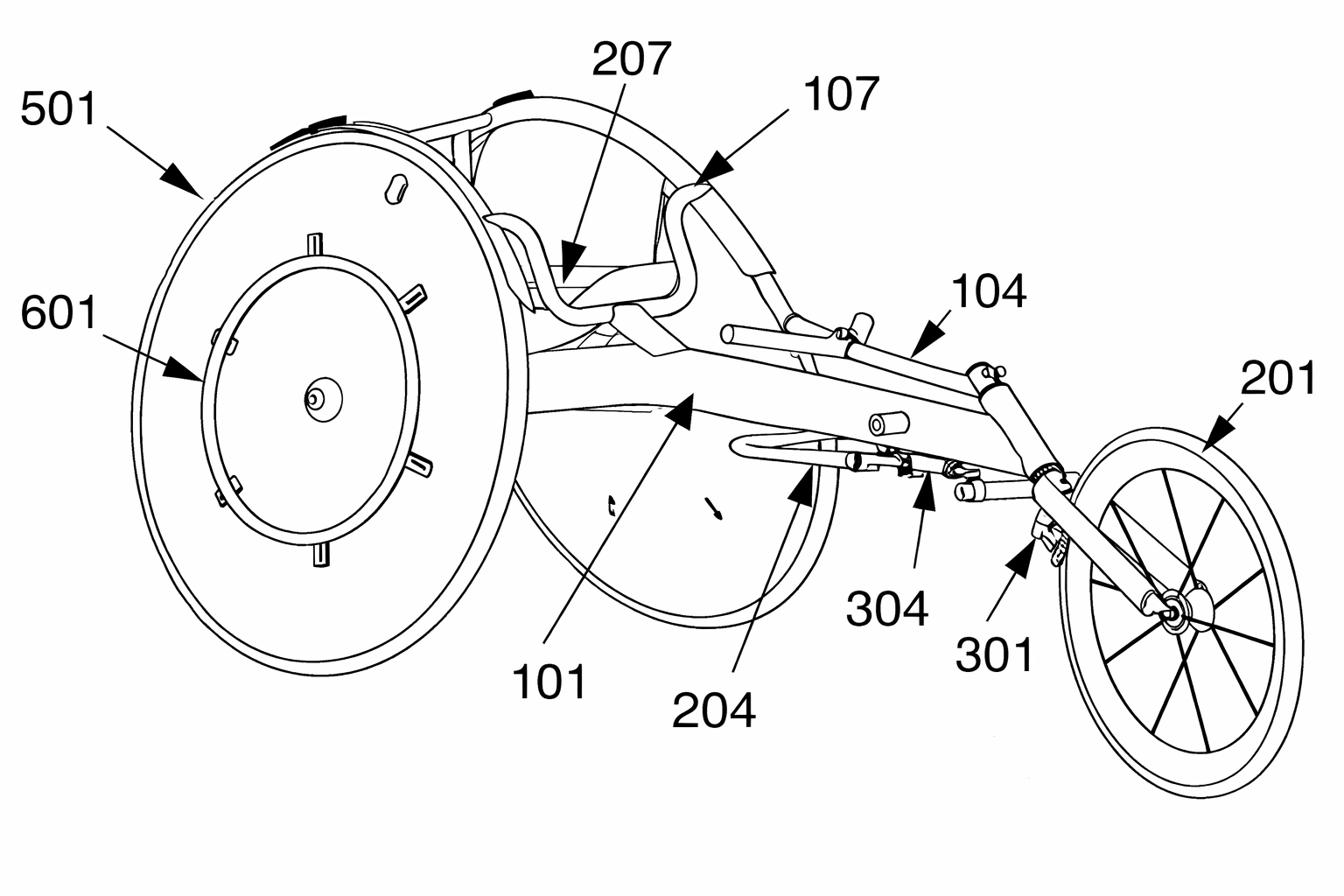
Problem: Current sports wheelchairs are often customized and expensive, limiting accessibility for athletes with disabilities, as they do not adequately accommodate individual anthropometric dimensions and disability-specific needs, hindering the development and popularity of the sport.
Solution: A modulable sports wheelchair with a structural seating cage and adjustable frame that allows for continuous width adjustment and customizable rear wheel positioning, enabling optimal athlete positioning and flexibility for various disabilities, reducing costs and increasing accessibility.
Benefit: The modulable wheelchair provides a cost-effective, customizable solution that meets the diverse needs of athletes with different disabilities, enhancing their ability to participate in sports and promoting social integration by allowing a single device to accommodate multiple users, comparable to high-end customized solutions.