
Not all sports innovate in the same way. The technologies that shape football differ from those driving athletics, cycling, tennis or swimming. Each sport presents its own challenges – speed, endurance, precision, safety, fairness or fan engagement – and innovation responds accordingly. This chapter explores how different sports generate distinct innovation patterns, illustrating how technology adapts to the unique demands of each game.
The global game: football (soccer)

Every time you watch a Football World Cup match or a spectacular goal, you are seeing far more than athletic brilliance. You are watching thousands of patented ideas working together in real time. That free kick bending into the top corner carries aerodynamic surface textures on the ball that are designed to tame air turbulence. The goalkeeper’s fingertip save depends on grip-enhancing polymers first tested in high-performance motorsport. Even the goalposts quietly assist with determining whether a goal is given, equipped with sensors capable of detecting a ball crossing the line with millimeter precision.
The FIFA Football World Cup is the most-watched sporting event ever, with global audiences reaching into the billions across television and digital platforms.
But the biggest transformation in football is the one fans cannot see. The sport has become a data engine. Professional players now train and compete wearing GPS and biometric trackers that record distance covered, sprint patterns and heart rate fluctuations. Performance tracking and monitoring now accounts for a third of all football-related patents, revealing how deeply data analytics shapes modern coaching, recovery and tactical decisions.
“VAR [technology] is here to stay. It helps the referee, it helps the game, it helps football.”
The patent publication trend adds another layer, with activity rising into 2018, staying high through 2019 to 2023, and then jumping sharply in 2024 and 2025. That rhythm mirrors tournament cycles, but it also reflects a global race to build better sensing, broadcasting and decision support tools. Football has become a technology-intensive sport, and the rapid spread of systems like the video assistant referee (VAR), goal-line detection and advanced tracking shows how quickly the game is evolving. Football’s worldwide governing body, the Fédération Internationale de Football Association (FIFA), now treats innovation as a strategic pillar, linking these tools to fairness, accuracy and the overall experience for referees, players and fans.
For supporters, the message is simple. Every clever detail on the pitch, from the ball’s behavior to the precision of officiating and the comfort of modern boots, leaves a patent trail behind it. Football’s innovation engine is bigger, more global and more diverse than ever.
 Note: All counts represent the number of inventions, measured in terms of the number of published patent families. One-to-many AI-based tagging was used to classify patents within specific sports and categories. “Inventive location” is based on original patent applicant address. “Patent owners” is based on the current patent assignee’s ultimate owner but simplified to show the related, and more well-known, sports brand instead of, for example, the holding company.
Precision-engineered performance: golf

A perfect golf swing looks effortless from a distance, but slow it down and the illusion disappears. The club head is moving faster than a car on the highway. The ball compresses like a stressed engine component. The sound at impact is the unique product of materials, geometry and timing. Golf may appear traditional, but every shot is a collision between human rhythm and decades of engineering, with a relentless quest for marginal gains that creates an innovation intensity unmatched in sport.
Athletes in high-impact contact sports tend to have shorter professional careers, while in sports like golf, top-level competition can continue well into an athlete’s 40s, and beyond.
Golf’s biggest transformation is happening in the invisible world of measurement. Swing radars, launch monitors and high-speed cameras now capture every nuance of motion, and with more than 4,000 inventions in analytics and simulation – including data and image-processing technologies – over the past decade, the sport has become a proving ground for motion capture, radar sensing and machine learning. The patent publication trend reflects this shift: steady growth, a brief slowdown, then a sharp surge as participation expanded, and simulators and connected driving ranges became popular. What is often overlooked is how far golf’s innovations travel, from synthetic turf and battery systems to aerospace modeling and medical-grade manufacturing. In the pursuit of a perfect shot, technologies emerge that reach far beyond the 108 million golfers worldwide.
“Do I believe that AI can change how golf is fundamentally coached? 100%. I think it’s the future.”
For players, the experience still feels simple: a ball, a club, a target. But behind that simplicity sits a dense web of invention. From the tension-wound rubber of the 1898 Haskell ball that first unchained the drive, to the rugged Surlyn shells of the 1980s that turned distance into a luxury available to all, golf has traded hand-stitched leather for high-stakes chemistry. Each patent in this lineage marks a moment where a simple white sphere stopped being just a ball and evolved into a precision-engineered projectile piece of aerospace flight.
-01.svg) Note: All counts represent the number of inventions, measured in terms of the number of published patent families. One-to-many AI-based tagging was used to classify patents within specific sports and categories. “Inventive location” is based on original patent applicant address. “Patent owners” is based on the current patent assignee’s ultimate owner but simplified to show the related, and more well-known, sports brand instead of, for example, the holding company.
Note: All counts represent the number of inventions, measured in terms of the number of published patent families. One-to-many AI-based tagging was used to classify patents within specific sports and categories. “Inventive location” is based on original patent applicant address. “Patent owners” is based on the current patent assignee’s ultimate owner but simplified to show the related, and more well-known, sports brand instead of, for example, the holding company.Split-second precision: racket sports

Racket sports – which include tennis, badminton, table tennis, padel, pickleball and squash, among others – create a unique innovation ecosystem where breakthroughs in one discipline rapidly spread to others, creating cross-pollination effects found in few other sports. A carbon fiber advancement developed for tennis rackets appears in badminton equipment within months, while string technology innovations flow seamlessly between sports that share similar impact dynamics.
“With racket technology and string technology, you can iron those [technical] problems out…”
The evolution of racket strings illustrates this interconnected innovation pattern. Natural gut strings, used for centuries, gave way to synthetic materials in the 1950s, but the real revolution began with the molecular engineering of the 1990s. Modern strings incorporate polyester polymers, co-polymer blends and even nano-materials that respond differently to ball contact. This technological momentum extended beyond equipment. Court-side analytics systems evolved to track ball trajectories, footwork patterns and shot selection tendencies, turning matches into rich datasets. Coaches began using predictive models to anticipate opponent behavior, while broadcasters transformed these metrics into immersive visual storytelling. Racket sports’ strategic depth became more visible – and more compelling – than ever before.
Padel and pickleball are two of the fastest-growing sports globally, with easy-to-learn rules and strong social appeal.
What makes innovation in racket sports unique is its balance: technology enhances the game without overwhelming it. The essence remains the same – timing, rhythm and precision – but the tools now reveal layers of performance that were previously invisible. This evolution becomes even clearer when tracing the sport’s innovation timeline, from early composite breakthroughs to today’s sensor-driven, data-rich ecosystem.
 Note: All counts represent the number of inventions, measured in terms of the number of published patent families. One-to-many AI-based tagging was used to classify patents within specific sports and categories. “Inventive location” is based on original patent applicant address. “Patent owners” is based on the current patent assignee’s ultimate owner but simplified to show the related, and more well-known, sports brand instead of, for example, the holding company.
Beyond the boundary: cricket

Cricket’s technological evolution is often described as gradual, but historical patent records tell a far more dynamic story. Over the past decade, annual filings have climbed from just over 300 in 2016 to more than 850 by 2025, reflecting a sport that has become a serious innovation arena, and that is quietly reshaping how cricketers train, how officials make decisions and how fans experience the game. What makes this shift remarkable is that it has unfolded without disturbing the sport’s cultural foundations.
The turning point came after Phil Hughes’ tragic death in 2014, which forced cricket to confront the limits of its protective gear. That moment accelerated years of delayed innovation, prompting rapid upgrades to helmets and early experiments with simple embedded sensors to better understand impact forces. Safety became the spark that pushed the sport into a new technological era, and as patent filings rose through the late 2010s and early 2020s, cricket began treating innovation not as disruption but as necessity – a shift embodied most clearly in the emergence of the Decision Review System (DRS) and its suite of high-speed imaging, acoustic detection and predictive modeling tools.
“Digital transformation will play a crucial role… as we look to attract and engage more fans…”
What surprises many outside the sport is how far cricket’s innovations now reach. The mathematics behind ball-tracking informs defense systems; acoustic analysis developed for edge detection supports industrial diagnostics; and computer-vision techniques refined to distinguish bat from pad have influenced medical imaging. Cricket, once seen as a guardian of tradition, has become an unexpected contributor to technological progress well beyond the boundary rope.
This evolution is visible not only in the rising volume of patents but in the changing nature of the inventions themselves, a progression that becomes clear when tracing cricket’s innovation timeline, from early protective breakthroughs to today’s AI-driven performance systems.
Cricket is the second most popular sport in the world, with particularly strong engagement in South Asia, Australia and the Caribbean.
 Note: All counts represent the number of inventions, measured in terms of the number of published patent families. One-to-many AI-based tagging was used to classify patents within specific sports and categories. “Inventive location” is based on original patent applicant address. “Patent owners” is based on the current patent assignee’s ultimate owner but simplified to show the related, and more well-known, sports brand instead of, for example, the holding company.
Chasing milliseconds: swimming

Swimming has undergone one of the most dramatic technological revolutions in modern sport, a shift clearly reflected in its rising patent activity – from just over 700 published patents in 2016 to more than 1,700 by 2025. This steady climb mirrors a discipline that has embraced engineering as a core performance driver, transforming the pool into a space where biomechanics, hydrodynamics and data science converge.
The first wave of innovation focused on the fundamental challenge of moving through water with less resistance, prompting designers to experiment with compression patterns, micro-textured fabrics, and pool features that dissipate turbulence more efficiently. As these hydrodynamic improvements took hold, the sport entered a phase where engineering and technique advanced together. At the same time, measurement technology matured: underwater cameras, pressure-sensing platforms and wearable trackers began capturing stroke timing, kick efficiency and body-roll symmetry with far greater precision than coaches could ever infer by eye. Training shifted from repetition to targeted refinement, and the steady rise in patent activity, including hundreds of globally oriented Patent Cooperation Treaty (PCT) filings, reflects how swimming innovation has expanded from isolated experiments into a fully integrated performance ecosystem.
“Innovation is at the heart of our strategy… from wearable technology to enhanced broadcast data, we are committed to showing the world how fast these athletes truly are.”
What distinguishes swimming’s technological journey is its constant negotiation between enhancement and integrity. The sport has repeatedly confronted the boundaries of what equipment should and should not do, ensuring that innovation elevates human performance without overshadowing it. This balance has shaped the trajectory of patents across the last decade, from early hydrodynamic breakthroughs to today’s sensor-driven performance systems.
The Olympic Games, featuring sports such as swimming, athletics and gymnastics, attract a global television audience of more than two billion people – making them one of the most widely watched sporting events in the world.
 Note: All counts represent the number of inventions, measured in terms of the number of published patent families. One-to-many AI-based tagging was used to classify patents within specific sports and categories. “Top countries” is based on the original patent applicant address. “Patent owners” is based on the current patent assignee’s ultimate owner but simplified to show the related, and more well-known, sports brand instead of, for example, the holding company.
Timelines
The following timelines illustrate how innovation within the five sports studied in this chapter has evolved over time through selected patent examples. By placing individual inventions in chronological sequence, these timelines provide a tangible view of technological progression – showing how incremental improvements, new materials and emerging digital capabilities gradually reshape how sport is played, measured and experienced.
The examples were identified using the WIPO PATENTSCOPE database and selected to highlight representative developments within each sport rather than to provide an exhaustive history. Viewed together, they demonstrate how innovation in sport often unfolds cumulatively: early mechanical or materials-based inventions are progressively complemented by electronics, sensors, data analytics and connectivity. In this way, patent documents offer a unique historical record of technological change, revealing the pathways through which sports technologies evolve from simple equipment improvements to sophisticated, data-driven systems.
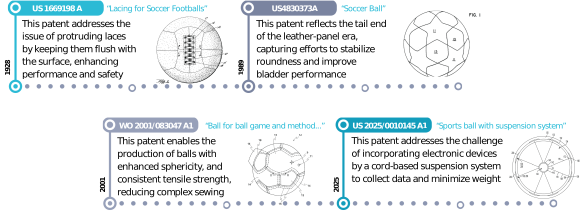 Source: WIPO, based on patent data from PATENTSCOPE, January 2026.


