
Understanding rights clearance
What is rights clearance?
Audiovisual productions incorporate, adapt and use vast quantities of preexisting material that is protected by various categories of rights. In most cases, the producer must obtain permission before using those rights. A right is “cleared” when an object or a person that integrates the project (a music, a painting, a product, a magazine, the photograph of someone, etc.) is identified, evaluated according to the circumstances of the use and the rights required for a lawful use also identified.
The audiovisual producer, ultimately as the entity or person responsible for assuming the risks of the production, takes the decision if an authorization is needed.
The clearing process ends with either using the content with the conclusion that no license is needed, the content is used in accordance with the license obtained, substituting it with other content or removing it altogether.
In summary, rights clearance is undertaken with two main objectives:
Reduce the legal risks involved in the production and the final content, including for the obtaining of insurances; and
Ensure the chain-of-title of the content.
Chain-of-title is the unbroken record of ownership of the copyright and other legal rights in the film property. The chain-of-title is a condition for the circulation of the film in the market and the producer is required by all those involved in the exploitation of the content to expressly assert it for distributors, sales agents and so on.
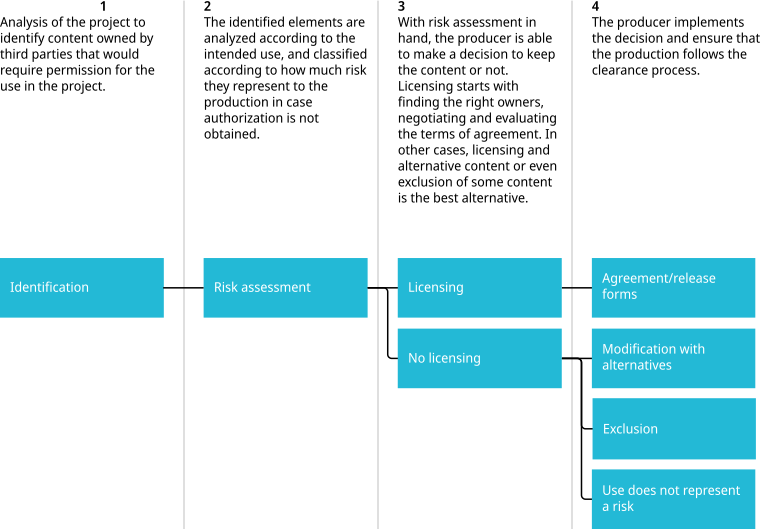
The rights clearance process for an audiovisual project can be summarized as shown in figure 1.
Why is rights clearance important?
Rights clearance aims to mitigate risks for the producer and all those that will be involved in the exploitation of the content such as distributors, financiers and so on. The main risk that a producer needs to avoid is that the result of all the time, money and collaborative effort is not allowed to reach the audiences, either temporarily or permanently. Or that if it does, fines are imposed as a result of an infringement or even that the rights needed to distribute the film need to be licensed retroactively or be removed, with the corresponding financial consequences. Even when the infringement is considered not to be done by the producer directly but by a distributor in another country instead, the producer normally assumes the responsibility for that infringement through contractual obligations.
In the audiovisual industry, this risk is aggravated because audiovisual content is shared throughout the world (through digital platforms, cinemas, TV, etc.) and because many of the IP rights are protected in multiple territories.
IP protection is territorial in the sense that each country or territory has their own IP laws. The decision whether a film is considered to be infringing someone’s rights is taken considering the laws where that right was exploited, for example when a film or series will reach the audiences (with some exceptions that are better analyzed case-by-case by an entertainment lawyer). Although national laws differ, there is an overall similarity in a number of issues specially regarding a minimum level of protection.
Is clearance only a legal matter?
Clearance starts with a legal question with consequences for the planning, budget, distribution and even artistic choices of the project. For example, preexisting trademarks may be included on a set for artistic reasons (real-life objects add to the realism of the project) or for commercial reasons (product placement deal with a company). In other cases, a biopic about a celebrity will only be viable if certain content is part of the project, such as the songs by that celebrity, broadcast where that celebrity appears, newspaper articles and so on.
Producers must determine whether they can use IP-protected material in an audiovisual production based not only on legal considerations, but also commercial, financial and even reputational factors. Reputational considerations are particularly common in the true-crime genre.
Who is responsible for IP clearance?
An audiovisual project is a collaborative effort. The person responsible for orchestrating the various elements into a single product that will be distributed and exploited to reach the audiences is the producer. The producer owns the copyright over the finalized product: the film, documentary, TV series and so on. As the copyright holder of the audiovisual work and the person responsible for the execution of the project, the producer will also be liable for materials used in the production, guaranteeing it through the chain-of-title. Since the producer has the liability, they are also the one responsible for mitigating the risks through rights clearance.
The producer is, therefore, the one responsible for rights clearance, especially in independent productions. If two or more producers work together on a single audiovisual project, they may assign liability in a particular way, but legal systems generally require those who commit IP infringement to accept joint liability.
For commissioned and non-independent works, normal practice of the sector considers the producer as the coordinator of the rights clearance process which they must carry out in accordance with the terms set out by the financial backers (a platform, a TV channel, a studio, etc.) The contract between the producer(s) and the financier normally stipulates in a clear way the liability and rights clearance obligations.
In the specific case of commissioned productions, such as an original production by a channel or streaming platform, the practice is that the contract between the financing agent and the producer not only provides that rights clearance is the responsibility of the producer, it also provides policies and criteria for risk-taking decisions that are predetermined in advance for all the content financed by that company. In most cases, rights clearance is a precondition for obtaining the green light for the project. This is done with the provision of a clearance report prepared by a legal expert.
What is a clearance report?
By now, you will realize that rights clearance is not only important but fundamental for an audiovisual project. How is it actually done?
The key document that will help producers to structure their clearance process is the clearance report. This report is prepared by a legal expert identifying the objects and materials included in the project that represent a risk of infringement on third-parties rights. This report, as mentioned later in this guide, can and should be updated by the time more materials are included in the script or outside the script such as in the schedule, storyboard, the actual shooting of the scene and even in the post-production phase.
Accordingly, the clearance report covers a script analysis but also other elements such as shot-by-shot analysis. It maps a diverse array of IP rights and personality rights such as trademark analysis (real and fictional trademarks), fact-checking (for documentaries and works inspired by real events), title reports and clearance/release submission logs. Other reports can also be attached, depending on the practices of each production company or financing agent.
In short, the clearance report will provide producers with a reference of the clearing activity of the project allowing the supervision of subsequent actions, such as the licensing of IP rights, risk-mitigation steps or the decision to assume the risk of using the material as it is, without consent. This way, the producer can undertake the necessary adaptation and measures in other areas of the project beyond the legal, such as artistic, planning, budget and so on.
How to proceed when the clearance report indicates the need for authorization
A well-structured audiovisual project considers the possible risks that could hinder the project. The definition of how much risk a project is allowed to have in terms of rights clearance will be one of the factors that producers will need to weigh once the first clearance report indicates the material that represent a risk.
At that moment, the producer will normally have a meeting with the legal expert or clearance team to understand the risks indicated in the clearance report in order to take one of the following actions:
Initiate the process of licensing of the content.
Substitute the element or content by a different one.
Use the element or content in a different way.
Keep the use as it is without licensing.
In the case where the seeking of licenses is the preferred alternative for the audiovisual project, the producer should be aware that this could unexpectedly turn into a process that lasts several weeks and, in some cases, months or even years. See figure 2 for a summary of the process of licensing from the clearance report.

What to do if it is not possible to license a right identified during clearance report
Depending on the nature of the project, certain rights may be identified as non-licensable already during the development or production phase. In this case, the earlier the producer realizes they will not be able to rely on a right the easier the adaptation of the project.
For example, a project includes a character who is in a cover band of The Beatles. The script and the story is based on the main character performing five different songs through the film, either on stage or during rehearsals. The total music time of those scenes is approximately five minutes in total. At the same time, imagine that the project’s budget is USD 500,000, with the music budget 5 percent of this. In summary, the project will have USD 25,000 dollars to obtain the rights of all the music used in the project, including three songs from The Beatles. From the outset, it is clear that some adaptation will be needed in the project because the rights over the music of the project are beyond the budget planned. Adaptation should be done as early as possible and even before the project is presented to financiers.
In other cases, the risks and needs to adapt the project might be less clear at the beginning. For example, a project where a statue located in a public space is mentioned in the script. Should it not be possible to clear (release from the creator of the statue), the producer might benefit from an exception for works permanently located in public spaces. This analysis would appear in a clearance report based on the evaluation of how the statue appears in the scene or script and the applicable legislation.
While the type of rights, risks to the production and time needed to negotiate a license depend on a number of different factors, the main advice to producers is to start the clearing process as early as possible. This could be done with an initial assessment from the producers themselves in order to better plan the audiovisual project.
What to consider when assessing the rights clearance report
As a follow-up from the identification of the need to clear a right, producers could think of the following aspects when deciding on the next steps:
What is the level of risk derived from the use of the content?
Can the use be configured as a limitation or exception?
Could the way it is used be adapted in order to comply with a limitation or exception?
How long would it take to obtain the signed license? Is it in accordance with the project plan?
What conditions could be imposed that could limit the intended use in the project?
How much would the license cost? Is it in accordance with the financial plan?
Once licensed, does it make sense to use the content in other moments of the project?
Could it be substituted? What is the alternative content and implications for the project? Who needs to be involved in this decision from an artistic point-of-view?
Do limitations and exceptions allow the content to be used without requesting permission?
Sometimes it is possible to use content in a lawful way without requesting permission. It is very important that producers understand that those circumstances are not only exceptional but that they might also represent a risk. In copyright law, those circumstances are called limitations and exceptions. They are specific regulatory provisions – generally interpreted restrictively – that allow the use of IP rights without the right holder’s prior permission.
Similarly to protection, the limitations and exceptions are also dependent on the legal system of each territory or country. In the audiovisual sector, the most well-known national system of limitation and exception is from the United States of America, called the “fair use doctrine.”
In some countries, the legal analysis will conclude that there are no exceptions applicable to the specific intended use, resulting in a higher risk to the project. The decision regarding that risk will depend on the producer as mentioned before.
When to start clearing the rights
Rights clearance affects the projects’ planning, financing and artistic choices. Experience tells us that the last moment that rights clearance should start is at preproduction where the script analysis should take place. A concern for the producer is that the production time between script analysis and the production phase might not be enough for the negotiation and licensing process. In some cases, licensing a song can take much more than eight weeks from finding the right owners, negotiating the terms of the agreement and signing the agreement.
Producers should take rights clearance into consideration as soon as they start work on a project. The more care that is taken with rights clearance before the production phase, the less adaptation and changes will be needed during it.
Clearance during the development phase
Carrying out clearance at the development stage is important because development-stage material is analyzed to map out the strategic risks associated with the project from the beginning. This allows the producer to make informed decisions and take action to mitigate or reflect accordingly in the planning and budgeting of the project.
When the producer is still pitching the project to possible partners and financiers, awareness of the rights clearance process will be an important element in the evaluation of the viability of the project. At this stage, the producer’s actions may involve obtaining IP rights or personality rights that are linked to the creation of the project itself. For example: life-story rights, fiction books, comic books, nonfiction materials (news articles), plays, movies in the case of remakes, concepts and even submission releases to avoid litigation risks.
At this phase, the producer might not have the resources to obtain the rights already identified as needed and sign license agreements. In those cases, producers could seek “option agreements.” These agreements establish the conditions of a future license by giving the producer the option to enter into the negotiated agreement or not during a period of time. For example, literary option agreements might grant exclusive rights to a producer to adapt a fiction book into a film or a TV series. After the expiration of the option agreement, the producer is no longer allowed to adapt the book unless they enter into an extension or a new agreement with the right owner.
In other cases, a first clearance activity might indicate to the producer that the use of a content or right is not viable, and the project is already adapted from the beginning to mitigate the risk with no time and budget implications later on.
If any of the risks – identified or not – are not eliminated or mitigated by the time the script and storyboard are finalized it might actually become part of the scenes already shot. That scenes might represent a risk so important for the production that it might not be possible to use it in the final cut with the budgetary and artistic impact. The later the clearance is done, the more expensive it will be and the longer it will take to mitigate the risks.
Clearance during production phase
Clearance is a continuous process (see figure 3). While the recommendation is to start as early as possible, the beginning of the preproduction is considered a limit to undertake a clearance report. This might be the last opportunity to clear materials before they are used in the production (with the respective risks and implications for the chain-of-title and insurances).
In the production phase, the main difference is that the script is finalized, a storyboard or even the screenplay are created. While the project starts to move into shooting and editing of the scenes, the clearance process could include the following:
Examination of agreements of the content identified in the development phase
Examination of materials that were included to substitute those identified as risks
Examination of new materials included in new versions of the script, storyboard and screenplay
Scene review for confirmation of the clearance measures

How to keep track of rights clearance in the script
As the production advances, the script might be adapted, new scenes might be included and new ideas tested on the spot. Ideally, productions would have a legal expert available to routinely answer questions and provide information about the inclusion of materials. In reality, it doesn’t happen for cost and logistic reasons. Although a legal opinion will necessarily be needed during the project, producers tend to reduce the number of consultations – and the fees due – to legal experts.
Many of the time-consuming tasks of the rights clearance could be done by the producer and their team, especially if good practices are followed. Still, legal advice will be needed at some point, even if on a “mandatory” basis for the E&O insurance provider.
One of the main challenges during the project is to keep track of “cleared” content and new content or content that is not cleared when there are new versions of the script, storyboards, screenplay and so on.
This is where annotation of the scripts can play an important role, especially to avoid high-risk content being included and only identified when it is “too late” for mitigation. Screenwriters should annotate the scripts as to document the source of their creativity when writing. Annotations ideally include:
Source of inspiration: this doesn’t apply for items that are completely fictional and a result of the writer’s creativity.
Characters, events, settings and dialogue that have a relationship with preexisting materials, content, facts, people, etc.
Annexes or separate files with reference materials used in parts of the script with the index of page and scene.
The annotations should cover two main areas of the script:
Characters
Are they real, fictional or a composite?
For real people, is the person living or dead? Where was the information about that person found?
For composites, the name of the person that inspired the character and what aspects of the person were used.
Scenes: Are they related in any way with a real fact (an event that actually happened)? If they are, include the relevant details:
the book (non-fiction) where it is described, including the page number
news article: details of source, author and date
internet source: website, author, link and date it was accessed
radio, podcast, YouTube video, etc.: date it was accessed or broadcast, link, channel or station, person interviewed or speaking, any other details that could be relevant
court proceedings: whether they were sealed or kept confidential , how the details were accessed, details of the case and parts which inspired the scene.
Rights clearance and financing models
The decision about the risk identified during the clearance process might include other stakeholders beyond the producer. This could impact how clearance is carried out and especially what risks the producer could or could not take. From the producer’s perspective, it is important that the project is in line with clearance processes or instructions given in this regard. Below are the main three financing models and how the clearance is impacted.
Independent productions
Independent productions normally leave the clearance process entirely as the responsibility of the producer. The producer will decide the risk to be assumed upon the clearance report and, in most cases, the possible artistic elements in case of adaptation and changes due to the clearing process. At the same time, the producer will also have the responsibility of the declarations under the E&O insurance, the chain-of-titles obligations and any infringement that results from the content.
Commissioned and non-independent productions
If a production is financed wholly or in part by a studio, a broadcaster or a streaming platform and the copyright will be transferred to someone from the producer, the contractor, as the copyright holder, will be liable for any legal risks associated with the use of third-party IP rights in the production.
In commissioning contracts, however, the clauses typically transfer the liability for those responsible for the production. This is because the contracts usually state that the contractor can exploit the work without infringing the rights of third parties (chain-of-title) and that the producers must compensate the contractor for losses resulting from noncompliance with that guarantee.
While having the responsibility to guarantee the chain-of-title, producers might have to apply policies and processes from the financier or commissioning entity. In many instances, the clearing process of core elements (either in terms of risk or budgetary implications) might also be taken involving the entity that commissioned the production. This could also be clearly established as a requirement in contractual clauses in the Production Services Agreement (PSA) besides being a precondition for the green light or even the acceptance of the final product.
International coproductions
Projects might include more than one producer in more than one location. Rights clearance for international coproductions may be the responsibility of a single coproducer or more than one coproducer, depending on the needs and characteristics of the project. More than one jurisdiction will usually be considered during the clearance process, especially if the production is financed by one country but takes place in another.
For example, when original artistic work is licensed from one of the coproducing countries, the licensing is usually handled by the coproducer from that country, who will be able to communicate with the license holder more easily, since the local coproducer will speak the same language and have better access. If, for some reason, it is not possible to license the rights, experts in both jurisdictions will usually examine whether any copyright limitations or exceptions apply, and perhaps also whether the material is in the public domain. The experts are selected from both jurisdictions because the legal risk must be assumed by all coproducers, the only exception being when the coproduction contract assigns the risk to a single coproducer.
Clearance policies
As mentioned above, under some financing models the producer might need to follow an existing clearance policy from a broadcasting organization, streaming platform or a studio that keeps a tight control on some elements of the project (for example, age classification or accepted level of risk). Those companies will request that their policy is observed in all projects that are commissioned or that they invest in. By using predetermined policies, investors can harmonize productions in terms of rights clearance practices and facilitate the management of their catalogue in terms of legal risk and conditions that might affect the exploitation of the content.
Once the project is agreed between the producer and the commissioning entity, the producer receives a project-specific guide or report in which the rights clearance policies and criteria are presented. Their observation and specific reporting are normally also included as a contractual obligation. The main elements that could differ from one policy to another are as follows.
The use of limitations and exceptions
Different companies are open to different levels of risk. Rights clearance policies reflect a company’s risk appetite. Policies might be more flexible or more restrictive in relying on situations where a written license was not obtained but the use was based on existing limitations and exceptions. These instructions provide a prior analysis of the legal risk that the producers should consider but producers will need to interpret the instructions and apply them to the specific situation while considering the laws in force where production is taking place (in comparison to the one mentioned in the policy that could reflect, for example, the law from United States of America or France).
Territorial and temporal scope
Some companies, such as global streaming platforms, tend to stipulate that the producer should license the rights with no territorial restrictions since the audiovisual works will be shown in the territories in which the platform offers its services – possibly globally or nearly.
In addition, there must be no time limits on the exploitation of works on global streaming platforms, and licenses for such platforms should not be exclusive, since works produced for one platform are increasingly being allowed to be shown on rival platforms, and even through other distribution channels such as movie theaters (theatrical release). Where instructions include such conditions, producers must observe them when licensing rights and follow the process foreseen, such as reporting and/or including the commissioning company in the negotiation.
Presentation of reports
Besides following the instructions, producers must prepare authorization reports written specifically for each channel and platform. The reports normally include information on decisions (or proposals) not to license certain IP rights and the legal basis for not doing so. Sometimes, producers will be required to submit the final decision on the licensing of certain rights to the commissioning organization, in which case they operate under the direct supervision or even negotiate directly with right owners.
Chain-of-title
For works based on real events or on preexisting works, the documents used to verify the chain-of-title of the production must include either a risk analysis or the previous instances in which the existing right was licensed must be part of the set of documents for verifying the chain-of-title for the production. This is because of the importance of those documents for the project and the existence of a structural risk. In other words, producers must check that all the rights they need to exploit the content were actually transferred to them. In commissioned productions, the platform or channel reviews the chain of rights before giving the greenlight with the relevant consequences of committing rest of funds and triggering a number of contractual clauses.
Insurance
Some organizations will have strict requirements in terms of insurances to be taken by the producer. This could impact the budget of the project in a substantial manner. In terms of rights clearance and chain-of-title, the policy might require a more comprehensive E&O insurance (see explanation further above). The E&O policy requires not only a clearance report but might not accept higher risks taken by the producer.
Risk in the audiovisual project and rights clearance
Defining risks
Risk is indissociable from the audiovisual production. On a more general note, the risks listed exist in an audiovisual project:
Business/legal risks
External/operational
Liquidity
Market
Credit
The main entity or person taking the risk is the producer. When other entities participate in the production, particularly financing it, the risk of the producer will also affect them (and their investment). Therefore, risk is normally defined by the financial backer who will try to reduce its exposure. Rights clearance is therefore centered around legal risks analysis and is the first step, as previously mentioned.
Taking risks
It would be difficult to create an audiovisual work in which all third-party IP rights or personality rights were fully licensed in writing. An audiovisual project without risk is virtually impossible. In practice, some level of risk is part of the industry.
Risks are different according to the rights affected by the project and the characteristics of the content. To determine the risks in each project, it is essential to understand the specific features of each type of production and to identify what type of audiovisual work is being produced. Each type of audiovisual work presents a different level of risk. Figure 4 shows how the level of risk varies between different types of project.

Mitigating risks
Once the risks are identified, they should be mitigated or eliminated. The mitigation will need to be in line with the production plan, business model, budget and, of course, artistic options. Some mitigating strategies are as follows.
Documentaries
The rights clearance for documentaries are particularly important due to the purpose and connection with real people, places and stories. The legal risk can be mitigated with precise fact-checking and the public interest on information that might already be in the public knowledge. In addition, documentaries often use preexisting works that cannot yet be licensed in full because some of the authors and owners are unknown. The reality of documentaries is that they rely strongly on limitations and exceptions as well as an overall higher risk taking than other types of content.
Fictional works
Creative freedom in fictional works is nearly total. Therefore, the inclusion of material owned by a third party is the result of a choice and it is difficult to justify unauthorized use, especially without the informational aspect that could be found in documentaries. This also applies to the use of materials based on existing copyright limitations and exceptions. Nevertheless, because of the freedom given by fictional works, script and scenes could be developed and adapted to reduce risks indicated in the rights clearance process. This could lead to modification of the script, soundtrack, camera position, set dressing and many other aspects of the project.
Works inspired by real events
Audiovisual content inspired by real events is constrained by the need to use certain content or to portray certain events or real persons in the story. In many cases, that is the main attractive element of the project. They are, in a sense, bound by the preexisting events and content, which limits the creators’ ability to alter the script or screenplay or set so that they do not have to clear a specific right. Works inspired by real events therefore present a higher level of risk compared to fictional ones since the portrayal of an event or person may affect rights without the possibility of mitigating the risks for the project. Furthermore, projects inspired by real events might generate risks involving personality rights such as defamation and the reputation of those involved in the real event. In other words, the combination of reality and fiction needs to be done with care as it could affect people in a way that represents a high risk to the project.
For example, a true-crime production tells a story of a real-life person who was notorious for committing crimes while listening to certain jazz albums. For dramatic effect, some of the crimes and some of the profiles of the victims were changed in the screenplay to disassociate the characters portrayed from real people. Despite these changes, the jazz composer or recording label may believe that associating the music with real crimes will affect both the music and artist’s reputation and moral right.
Likewise, if the main character of a film repeatedly wears the same soccer jersey of a certain team or brand while committing crimes, the producer may struggle to obtain the license for the trademark since its inclusion would harm the brand’s commercial value and marketing.