
The drive for greater efficiency
Maximizing vehicle efficiency is a critical, complementary strategy for achieving comprehensive decarbonization of heavy-duty road transport. Efficiency improvements are essential regardless of the energy source (electric, hydrogen, low-carbon fuel-based or hybrid) because they directly reduce the total energy required to transport goods, thereby lowering both operational costs and overall life-cycle greenhouse gas emissions. In the context of new energy vehicles like battery-electric vehicles and fuel cell electric vehicles, higher vehicle efficiency translates directly into a smaller, lighter and less expensive battery or hydrogen storage system, or an extended driving range for a given energy capacity. For vehicles using low-carbon fuels, efficiency minimizes the demand for these often costly and supply-constrained resources.
The drive for greater efficiency in heavy-duty road transport centers on the three main technological pillars detailed below:
Electric power- and drivetrains represent a fundamental shift from mechanical to electrical propulsion, requiring distinct optimizations compared to traditional combustion engines. This category includes the development of e-axles, including electric motors and advanced power electronics, such as inverters that manage energy flow with minimal loss. It also covers specialized gearing for electric vehicles, such as multi-speed transmissions designed to keep electric motors within their optimal efficiency range during the diverse load and speed conditions typical of heavy-duty road transport. While electric motors are inherently efficient, innovations are essential to maximize regenerative braking capability and manage the thermal challenges of high-power continuous operation. Ongoing progress in inverter design, thermal management and power electronics helps to reduce energy losses, extend vehicle range and improve performance in demanding duty cycles.
Vehicle design focuses on minimizing the external forces that resist vehicle movement: aerodynamic drag and rolling resistance. As battery-electric and fuel-cell trucks often carry limited onboard energy compared to diesel tanks, reducing energy waste is paramount. Innovations in this field range from streamlined cab shapes and mirror-replacement camera systems to drag-reducing trailer add-ons. Furthermore, the development of specialized tires is critical; these must balance low rolling resistance to extend range with the durability required to support the increased weight of battery packs and the permanent solicitation of electric motors, which are constantly giving or recovering energy.
The use of advanced materials addresses the challenge of “lightweighting” buses and trucks to offset the substantial mass of zero-emission energy storage systems. Heavy battery packs can significantly reduce a truck’s commercial payload capacity, directly impacting revenue. To update this technology, the industry is researching and developing various lighter-weight materials from high-strength steel to cast aluminum and high-performance materials such as carbon fiber reinforced polymers and ceramics (often used in bearings or thermal management components). These materials offer high strength-to-weight ratios that allow for structural weight reduction without compromising safety or durability. However, widespread adoption of these materials faces challenges due to high manufacturing costs.
Together, these technological areas form the foundation of a comprehensive efficiency strategy for heavy-duty road transport. Improvements in these technologies reduce total energy demand, lower operating costs, enable smaller batteries or hydrogen storage systems, and ultimately enhance the feasibility and economics of low-emission freight and bus operations. As the sector transitions toward electrification and new vehicle architectures, improvements in drivetrain efficiency, optimized design and advanced materials will become even more critical to meeting climate targets while maintaining performance and competitiveness. This chapter explores the patent landscape across these three intertwined domains, detailing how technological innovation in efficiency is accelerating the practical and economic viability of decarbonized heavy-duty road transport solutions.
A Michelin patent application describes a truck tire with a stiff outer bead design that reduces bending hot spots, improves heat resistance and provides enhanced casing durability.
Patent publication number: WO 2021/126187 A1
Owner: Michelin
Title: Truck tire with stiff outer bead products
Publication date: June 24, 2021
Patent drawing
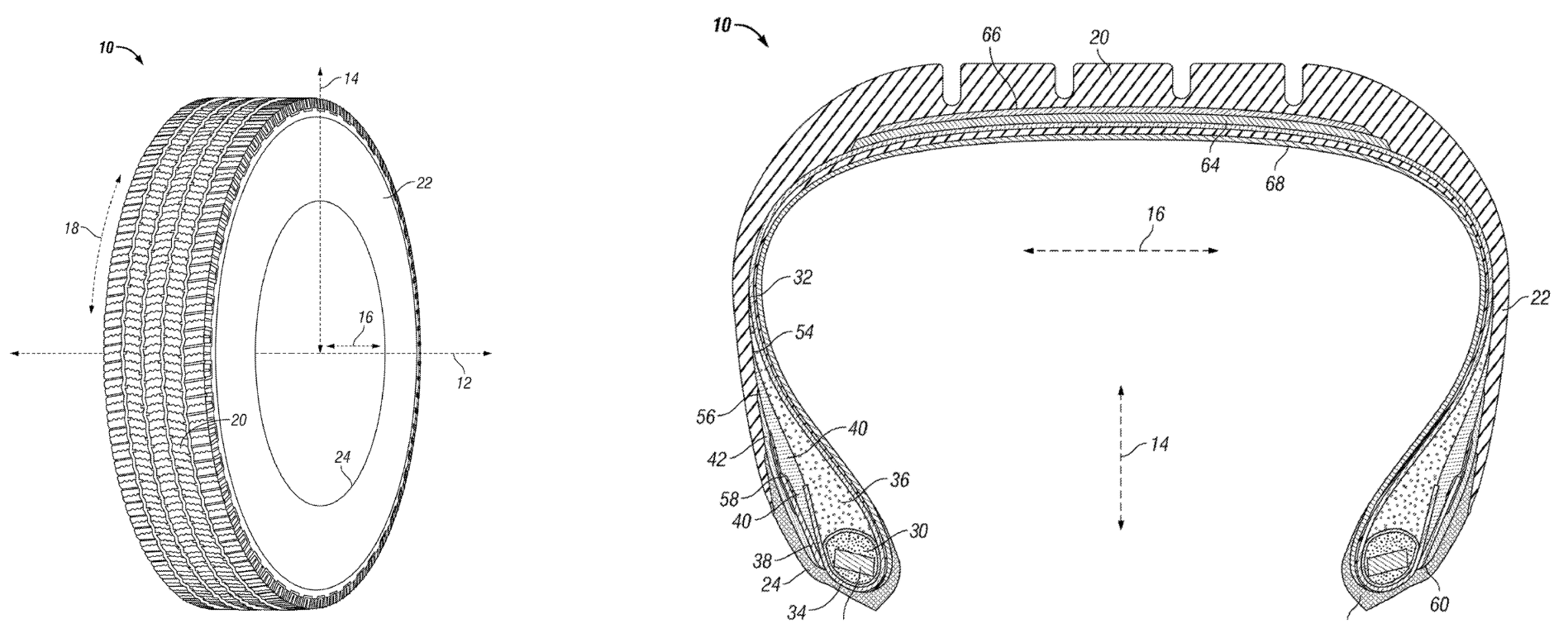
AI simulation

Problem: Heavy truck tires are prone to bending hot spots and reduced heat resistance due to flexible bead core designs, which increase manufacturing complexity and cost and do not effectively eliminate bending issues.
Solution: A bead design featuring two bead layers with stiffness of 8–14 MPa, positioned to reduce or eliminate bending hot spots and enhance heat resistance, while avoiding the use of coextruded materials and complex chafer configurations.
Benefit: The design effectively reduces bending hot spots, improves heat resistance, and enhances casing ply fatigue resistance without increasing manufacturing costs, by distributing hydrostatic stresses and providing rigidity to the tire’s casing ply.
Global patent development
Global patent development in vehicle efficiency
From 2000 to 2024, the volume of published patent families related to heavy-duty vehicle efficiency expanded substantially, growing from approximately 750 to more than 5,100 published families (Figure 5.1). International patent families (IPFs) followed a similar but slightly flatter trajectory, rising from 437 to just under 2,000. It is important to observe, however, that this growth trend peaked in 2021 with 5,884 publications (and in 2020 for IPFs); subsequent annual activity has decreased by roughly 13%.
A factor that probably played a role in the recent slowdown was the global semiconductor shortage and pervasive supply chain disruptions following the COVID-19 pandemic, which severely restricted production and led to significant revenue losses across the automotive industry. These factors compelled heavy-duty road transport companies to enact broad cost-reduction measures and prioritize patenting activities in other fields, such as low-emission energy sources and energy infrastructure.

Comparison between vehicle efficiency technologies
A closer analysis of patenting activity reveals that advanced power- and drivetrain technologies dominate the research landscape in the field of vehicle efficiency for heavy-duty road transport (Figure 5.2). The number of published patent families in this field has seen substantial growth, increasing from 234 in 2000 to 3,177 in 2024. This trend represents a compound annual growth rate (CAGR) of more than 11%.
Patenting activity in vehicle design and tire technologies also grew rapidly between 2000 and 2014 but has largely plateaued since then. One contributing factor to this stabilization is the technological maturity of core concepts, such as improved aerodynamics and low rolling-resistance tires. Although these areas continue to deliver incremental improvements, the remaining innovation potential tends to be smaller and results in fewer new patentable inventions.
Among the three technological subfields, advanced materials show the slowest long-term growth. Global published patent families only increased from 191 in 2000 to 523 in 2024, and current activity is approximately 25% below the peak levels reached in the mid-2010s. While materials research remains strategically important, its patenting intensity has not kept pace with power- and drivetrain innovations or vehicle design. As many high-performance materials – such as carbon-fiber composites – remain expensive to produce, their commercial uptake in cost-sensitive industries like heavy-duty logistics has remained modest. Because the efficiency gains from lightweighting often do not offset the high upfront costs, manufacturers have had weaker incentives to invest in new materials research, which may have contributed to slower innovation activity in this field.

Patenting growth compared to other technologies
The development of published patent families in the field of heavy-duty vehicle efficiency demonstrates above-average innovation speed compared to both the overall patenting trends in heavy-duty road transport and total global patenting (Figure 5.3). While patenting activity across all areas of heavy-duty road transport shows only a moderate increase over the general technological average, the field of vehicle efficiency has experienced growth that is twice as high (+587% vs. +262% for the average of all technologies). This dynamic growth is attributable to the significant increase in patents related to advanced powertrains and drivetrains. However, other key areas of decarbonization in heavy-duty road transport (low-emission energy sources and energy infrastructure) have experienced even higher growth rates.

Top inventor locations
In the field of vehicle efficiency for heavy-duty road transport, China, the United States and Japan are in a close three-way competition for the top spot in patent publications the innovation lead (Figure 5.4). China tops the ranking with nearly 17,700 published patent families between 2000 and 2024, while the United States (15,625) and Japan (14,362) remain in close contention. Germany also plays a significant role, with over 10,000 published patent families during the same period, followed by the Republic of Korea with 6,887.
As observed in other areas of heavy-duty road transport decarbonization, the share of international patent families of all patent families originating from China (15%) is considerably lower than that of most other leading research countries.

Patent growth and specialization
Analysis of patenting activity over the past five years reveals significant geographical divergence (Figure 5.5). India has emerged as the fastest-growing innovation location in vehicle efficiency, showing a surge in patent publications from 66 in 2019 to 300 in 2024. This corresponds to a robust 35% CAGR. Sweden was the only other major research location to exhibit strong momentum, recording an average annual increase in published patent families of 11%.
In contrast, patenting activity has largely stagnated over the past five years in Canada, China and Germany. In all the remaining major research countries, patenting activity has seen a decline, which is most pronounced in the Russian Federation.
When assessed by the relative specialization index (RSI), Sweden, Germany, Austria and France demonstrate the highest levels of relative specialization in heavy-duty vehicle efficiency technologies. Conversely, China’s level of specialization remains the lowest among the top research locations.
These results mirror the patent trends observed in low-emission energy sources and energy infrastructure. This underscores the high degree of technological convergence in related heavy-duty transport areas.

Relative specialization in heavy-duty vehicle efficiency
Most top research countries show a high RSI in all three areas of vehicle efficiency for heavy-duty road transport (Figure 5.6). However, there are also some outliers that focus their research efforts mostly on a specific field. An example is Switzerland, which focuses on advanced materials and advanced power- and drivetrains, but is less specialized in vehicle design and tire technologies. Japan, in contrast, has a negative RSI in advanced materials but is highly specialized in vehicle design and tires, as well as advanced power- and drivetrains.

Research priorities
An analysis of research activities across the top locations shows that most countries concentrate their research on the development of advanced powertrains and drivetrains for battery-electric and fuel cell heavy-duty vehicles (Figure 5.7). Austria, Germany, Sweden, China and the Republic of Korea exhibit a particularly strong orientation toward this field, with patent families related to powertrain and drivetrain technologies accounting for more than 50% of all vehicle-efficiency patents in these countries.
Vehicle design and tire technologies represent the second most prominent area of efficiency-related research across major innovation locations. This technology class covers aerodynamics, body and chassis optimization, lightweight structural components and, especially, low-rolling-resistance tire technologies. The share of patents in this field is particularly high in Russia (56%), France (47%) and Japan (45%). A key reason is the presence of several major global tire manufacturers in these countries – including Cordiant in the Russian Federation, Michelin in France and Bridgestone, Yokohama Rubber and Sumitomo Rubber Industries in Japan – whose long-standing research and development programs continue to drive innovation in tread design, rubber compounds and casing structures for heavy-duty vehicles.
Advanced materials play a smaller role globally but are especially prominent in Switzerland, where they account for 31% of vehicle-efficiency patents. This specialization benefits from Switzerland’s strong materials science ecosystem, including universities and research institutes, such as ETH Zurich, that have research projects in the field of advanced lightweight materials for vehicles.

The location ranking for the three areas of heavy-duty vehicle efficiency reflects the differences in research priorities (Figure 5.8). China leads in advanced powertrain and drivetrain innovation, with more than 9,600 patent families published since 2000 – highlighting its strong emphasis on electric vehicle development. The United States has published the greatest number of patent families in advanced materials (3,061), while Japan ranks first in vehicle design and tire technologies (6,716), just ahead of China (6,597).

Key filing jurisdictions
As shown in Figure 5.9, China and the United States are the leading jurisdictions for patent filings. Between 2000 and 2024, China recorded nearly 38,500 patents related to heavy-duty vehicle efficiency, while the United States recorded more than 33,500. Germany is another major filing location with 24,021 patents. Patent filings under the Patent Cooperation Treaty (PCT) and the European Patent Convention (EPC) represent the fourth- and fifth-largest filing routes, with nearly 21,900 and just over 20,000 applications submitted since 2000, respectively.

A granted Volvo Truck patent covers an electric truck powertrain with a dry sump lubrication system that reduces splash losses, improves efficiency and enables a more compact, cost-effective design.
Patent publication number: US 11725722 B2
Owner: Volvo Truck
Title: Electric powertrain for truck
Publication date: October 6, 2022
Grant date: August 15, 2023
Patent drawing

AI simulation
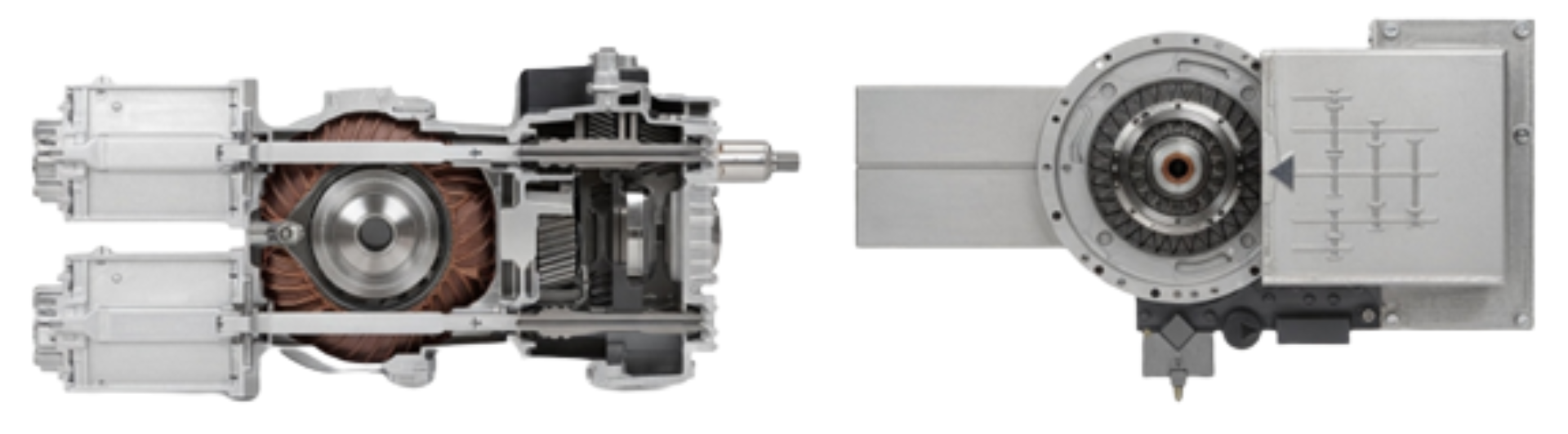
Problem: Existing powertrain assemblies for electric and hybrid vehicles face high power losses and inefficiencies due to “splash losses” from wet sump lubrication systems, which require complex and costly oil-tight seals and separate lubrication systems for the gearbox and axle, limiting compactness and increasing costs.
Solution: A dry sump lubrication system is implemented, where a separate oil storage area is integrated within the axle oil sump, using a scavenge pump to retrieve oil from the gearbox sump and convey it to the storage area, and a main pump to distribute it to the gearbox gears, reducing oil levels and splash losses without the need for additional reservoirs or complex seals.
Benefit: This configuration significantly reduces splash losses and improves efficiency by eliminating the need for separate lubrication systems and oil reservoirs, enhancing the compactness and reducing the costs of the powertrain assembly while maintaining effective lubrication.
Top patent owners
As in the case of low-emission energy sources and energy infrastructure, Toyota – Japan’s largest automotive manufacturer – holds the top position in the patent ranking for heavy-duty vehicle efficiency technologies, with 2,081 published patent families since 2000 (Figure 5.10). However, Toyota’s lead in this area is considerably narrower than in other segments. Sumitomo Rubber Industries (1,921), Volkswagen Group (1,796) and Hyundai Motor Company (1,732) follow close behind.
A key distinction from the findings in the low-emission energy sources and energy infrastructure chapters is the prominent role of tire manufacturers in the vehicle efficiency research landscape. Within the top 25 patent holders, roughly one-third are companies that are either fully dedicated to tire development or for whom tires represent a significant business segment. These include Sumitomo Rubber Industries, Michelin, Bridgestone, Continental, Goodyear, Yokohama Rubber and Toyo Tire.
The remainder of the top 25 is composed primarily of major vehicle manufacturers, including Ford, General Motors (GM) and Kia, as well as major automotive suppliers, such as ZF and Bosch. The highest-ranked non-automotive companies appear only at the 19th and 25th positions – CRRC and Siemens, respectively.

Patent growth
Recent patent trends indicate that Volvo and ZF have achieved the strongest growth in their patent portfolios related to heavy-duty vehicle efficiency over the past five years. Volvo, for example, is developing next-generation e-axles for its electric trucks. By integrating key driveline components directly into the axle housing, Volvo’s e-axle architecture reduces system weight and frees up space for additional battery capacity, thereby extending range without compromising payload. ZF has likewise expanded its innovation efforts. In 2024, the company introduced a new electric central drive for heavy-duty trucks that enables original equipment manufacturers (OEMs), such as Ford, to electrify existing truck platforms with minimal redesign. Because the unit fits into the same installation space as a conventional internal combustion engine transmission, manufacturers can electrify vehicles while maintaining assembly processes and chassis layouts largely unchanged, thereby accelerating the transition to electric heavy-duty drivetrains.
Goodyear, General Motors, BYD and Toyo Tire have also increased their patenting activity dynamically since 2019, while the patenting activity of some companies, such as Yokohama Rubber, Honda and Michelin, has declined noticeably.
Research priorities
Most of the top research companies show a clear concentration of their research and development efforts in the development of advanced powertrains and drivetrains for heavy-duty vehicles (Figure 5.11). Major automotive OEMs – including Toyota, VW, Hyundai and Ford – are strong examples, with the majority of their efficiency-related patents originating from innovations in electric motors, e-axles, hybrid systems, transmission architectures and power electronics.
By contrast, leading tire manufacturers, such as Sumitomo Rubber, Michelin, Bridgestone, Continental, Goodyear, Yokohama Rubber and Toyo Tire – unsurprisingly – focus almost exclusively on vehicle design and tire technologies. Their patent portfolios revolve around tread compounds, rolling-resistance reduction, durability improvements and aerodynamically optimized tire and wheel designs.
Advanced materials account for a relatively small share of patenting activity for most companies in the data set. However, they represent a substantial portion of the research activity for a few specialized firms. Notably, Chinese CRRC stands out, with advanced materials representing 42% of its vehicle-efficiency patent portfolio, driven by its expertise in lightweight composites and high-performance materials. While CRRC’s research activities are railway-oriented, the underlying materials know-how (composites, lightweight load-bearing structures) is transferable to heavy-duty road vehicles. Siemens, likewise, shows a comparatively high share (24%), reflecting its work on high-efficiency motor components and thermal management materials.

Top patent owners in heavy-duty vehicle efficiency technologies
Toyota is the leading patent holder in advanced powertrains and drivetrains, reflecting its long-standing focus on next-generation propulsion technologies. The remainder of the top patent owners in this category consists primarily of major car and truck manufacturers and automotive suppliers. One notable exception is Kubota, an agricultural machinery producer, which appears in 15th place.
In the area of advanced materials, the ranking is more diverse. Michelin holds the top position, driven by its intensive research and development program in high-performance elastomers, composites and sustainable tire materials. CRRC follows close behind, highlighting the spillover of materials innovation from the rail sector into heavy-duty road transport. Hyundai ranks third, supported by its broad materials research for lightweight vehicle structures and next-generation batteries.
In vehicle design and tires, specialist tire manufacturers dominate the landscape. Sumitomo Rubber, Michelin and Bridgestone occupy the top positions, reflecting their strong innovation focus on tire construction and rolling-resistance reduction. However, the field also includes several major truck manufacturers – including VW, Hyundai and Ford – which hold substantial portfolios of design-related patents due to their work on chassis optimization and aerodynamic truck design.