
The fundamental constraint
Decarbonizing heavy-duty road transport relies on more than just adopting low-emission energy sources. It is also vital to establish a robust, scalable energy infrastructure backbone. The deployment and operational efficiency of zero-emission trucks and buses is fundamentally constrained by the availability of energy distribution networks. This infrastructure includes high-power charging networks for battery-electric vehicles (BEVs) and grid updates, as well as hydrogen generation, storage, distribution, and refueling stations for fuel cell vehicles (FCEVs). This chapter explores each of these domains and the technical and economic hurdles driving significant global patenting activity.
Battery-electric heavy-duty vehicles (HDVs) require a widespread and reliable charging infrastructure, ranging from private depot chargers to minimize operating costs, to public high-power stations located along freight transport routes to maintain capacity. Current innovation in this sector is focused on overcoming the time constraints of recharging large battery packs, with the aim of enabling charging times comparable to driver rest breaks. However, the shift to megawatt-scale power transfer introduces significant technical challenges. They include the thermal management of cables and connectors (e.g., liquid cooling), standardizing interoperable interfaces and integrating stations into the power grid.
Despite the rapid expansion of heavy-duty charging networks in China, Europe and Northern America in recent years, infrastructure deployment lags behind the trajectory required for large-scale fleet electrification. The scale of the investment gap is significant. For instance, the International Council on Clean Transportation (ICCT) estimates that by 2030, the European Union alone will require between 60,000 and 80,000 public chargers, including 4,000 to 5,300 megawatt-scale chargers, alongside 150,000 to 175,000 private depot chargers.
(1)ICCT (2025a). Charging infrastructure needs for battery-electric trucks in the European Union by 2030. International Council on Clean Transportation. Available at: https://theicct.org/publication/charging-needs-battery-electric-trucks-europe-oct25. This stands in stark contrast to the estimated only 1,500 public heavy-duty chargers in existence in 2025, highlighting the urgent need to accelerate infrastructure rollout.(2)EAFO (2025). New public HDV recharging infrastructure data now live on EAFO. European Alternative Fuels Observatory. Available at: https://alternative-fuels-observatory.ec.europa.eu/general-information/news/new-public-hdv-recharging-infrastructure-data-now-live-eafo. Hydrogen-based transport requires the establishment of a dedicated value chain, encompassing the production, storage and transportation of low-carbon hydrogen, as well as the construction of refueling stations. Compared to stations for passenger vehicles, hydrogen refueling stations for heavy-duty vehicles require higher pressure, greater storage capacity and faster dispensing technologies, which increases cost and technical complexity. Furthermore, technical divergence regarding storage methods – specifically between compressed gaseous hydrogen and liquid hydrogen – is driving innovation in station design. Currently, the main barriers to scaling up are the cost and availability of low-carbon hydrogen, whether produced by electrolysis or carbon capture reforming, and the high capital expenditure required for storage and distribution.
While deployment of hydrogen refueling stations is growing globally, it remains at an early stage. According to the Ludwig-Bölkov-Systemtechnik (LBST) H2stations.org, approximately 1,160 hydrogen refueling stations were operational worldwide at the end of 2024.
(3)H2stations.org by LBST (2025). Milestone reached: Over 1,000 hydrogen refuelling stations in operation worldwide in 2024. H2stations.org by Ludwig Bölkow Systemtechnik. Available at: https://www.h2stations.org/press-release-2025-milestone-reached-over-1000-hydrogen-refuelling-stations-in-op-eration-worldwide-in-2024. China leads global deployment, with 384 stations, followed by the Republic of Korea (198), Japan (161), Germany (113) and the United States (89).
Unlike electric and hydrogen pathways, alternative low-emission fuels – such as advanced biofuels, synthetic fuels (e-fuels) and renewable natural gas – do not require the development of an entirely new infrastructure system. These fuels are for the most part “drop-in” energy carriers that can be blended with, or used as substitutes for, existing liquid fuels or pipeline-grade natural gas.
As a result, infrastructure deployment is not the main technological constraint for alternative fuels. The real limitations lie in feedstock availability, production scalability and cost competitiveness. Because the distribution infrastructure –pipelines, storage terminals, tanker trucks, and dispensing pumps – consists of long-established technologies that often need only minor modification, patent activity related to the infrastructure dimension of alternative fuels is limited. Innovation in this area is focused primarily on fuel production technologies rather than on distribution systems. For that reason, this chapter does not provide a patent analysis of alternative fuel infrastructure.
A China Southern Power Grid patent application describes an optimized bus charging control method that shifts charging to off-peak periods, reducing grid load and improving power reliability.
Patent publication number: CN 115345345 A
Owner: China Southern Power Grid
Title: Bus charging station regulation and control method based on charging pile state optimization
Publication date: November 15, 2022
Patent drawing

AI simulation
.png)
Problem: Existing technology mainly relies on power regulation in electric vehicle charging regulation, which results in high equipment modification requirements and difficulty in effectively balancing the interests of all parties. It is also difficult to transfer peak loads to off-peak periods, affecting the power quality and reliability of the power grid.
Solution: By collecting regional bus station load data and the charging data of individual electric buses, an electric bus dispatching model is and a cluster electric bus charging optimization model is established to optimize the charging period, reduce the peak load at night, and use the double-layer optimization model to realize the transfer of peak load to off-peak hours.
Benefit: Achieves the maximum reduction of feeder load rate, ensures safe charging operation, and achieves significant peak-cutting and valley-filling effects. It has convenient conditions for implementation, reduces feeder load rate, and improves the reliability and economic operation of the power grid.
Global patent development
Global patent development in energy infrastructure
Between 2000 and 2024, patents in energy infrastructure for heavy-duty road vehicles – encompassing charging, smart grids and hydrogen solutions – skyrocketed, surging from around 280 to over 6,400 published families (Figure 4.1). International patent families (IPFs) show a similar increase, rising from 136 to almost 1,750. However, despite this overall expansion, 2024 saw the first slight decline in patent publications since 2014. This is primarily due to a slowdown in patenting activity in China following years of significant growth, although decreases are also seen in other leading countries, including the United States, Japan, the Republic of Korea and Germany.
Overall, the trajectory of patenting activity in energy infrastructure closely mirrors that of low-emission energy sources for heavy-duty road transport. Both areas have shown comparable long-term expansion, with compound annual growth rates of 12% for low-emission energy sources and 14% for energy infrastructure over the past 25 years. This parallel development underscores a strong interdependence between innovation in energy technologies and the infrastructure required to support deployment.

Comparison between battery-electric and hydrogen infrastructure
Taking a closer look at patenting activity reveals that charging infrastructure and smart grid technologies dominate research within the area of energy infrastructure for heavy-duty road transport (Figure 4.2). The number of published patent families in this field increased from 236 in 2000 to 6,028 in 2024. Although hydrogen infrastructure patent activity has also increased dynamically, it remains significantly more modest, rising from 48 family publications in 2000 to 453 in 2024.
This significant disparity reflects the current technological and economic consensus within the heavy-duty vehicle sector. Battery-electric vehicles are favored because of their superior energy efficiency and projected lower total cost of ownership. Such technology is also an opportunity for new business models, with the possibility of offering different charging technologies (plug, wireless) and different energy transfer (grid-to-vehicle, vehicle-to-vehicle and vehicle-to-grid). This strategic preference is driving extensive research and development and patenting into high-power charging standards and complex smart grid integration technologies. Again, development is in line with the findings in Chapter 3 on low-emission energy sources, where batteries are shown to have consistently been the clear focus of research efforts.

The deployment of fuel cell-electric and hydrogen combustion engines in heavy-duty road transport currently faces a strategic choice between gaseous hydrogen and liquid hydrogen infrastructure – one that has significant logistical, technical and economic implications.
Gaseous hydrogen, typically compressed to 350 bar or 700 bar, is the dominant form in today’s hydrogen landscape, because gaseous hydrogen refueling stations are easier and cheaper to build. However, gaseous hydrogen has a lower volumetric energy density than liquid hydrogen. This limits range and requires large, heavy high-pressure tanks to be onboard the vehicle. Liquid hydrogen, stored cryogenically at around –253°C, offers a significantly higher volumetric energy density, which is crucial for maximizing range and payload for long-haul trucking. The major drawbacks are the energy-intensive liquefaction process (typically consuming 25–35% of the hydrogen’s energy content) and boil-off losses during storage and transport, when some of the hydrogen vaporizes naturally due to heat ingress. Therefore, the transition to LH₂ would require significant investment in liquefaction capacity and new supply chains.
For long-haul trucking, some company and industry forecasts point toward liquid hydrogen being the preferred long-term option.
On the other hand, there are also current research projects, such as the EU Horizon RHeaDHy project (which includes corporate partners such as Toyota, ENGIE, and Hydrogen Refueling Solutions), focused on developing high flow refueling components and specialized cooling technology for gaseous hydrogen with the goal to allow refueling of 700 bar H2 trucks at 100kg within 10 minutes.
Therefore, while the long-term dominant solution for long-haul trucking remains uncertain, gaseous hydrogen is likely to maintain relevance for shorter or regional transport operations, such as city buses and localized logistics, where its simpler infrastructure retains an advantage.
Patenting growth compared to other technologies
The rate of patenting in heavy-duty road vehicle energy infrastructure demonstrates strong growth compared to both the overall patenting trends in heavy-duty road transport and total global patenting (Figure 4.3). While published patent families across all heavy-duty road transport areas show only a moderate increase over the general technological average, the energy infrastructure field has experienced growth exceeding 2,200%. This surge is predominantly attributable to the significant rise in patents related to charging solutions and smart grids. This rise is in line with the battery patent trends set out in Chapter 3 on low-emission energy sources.

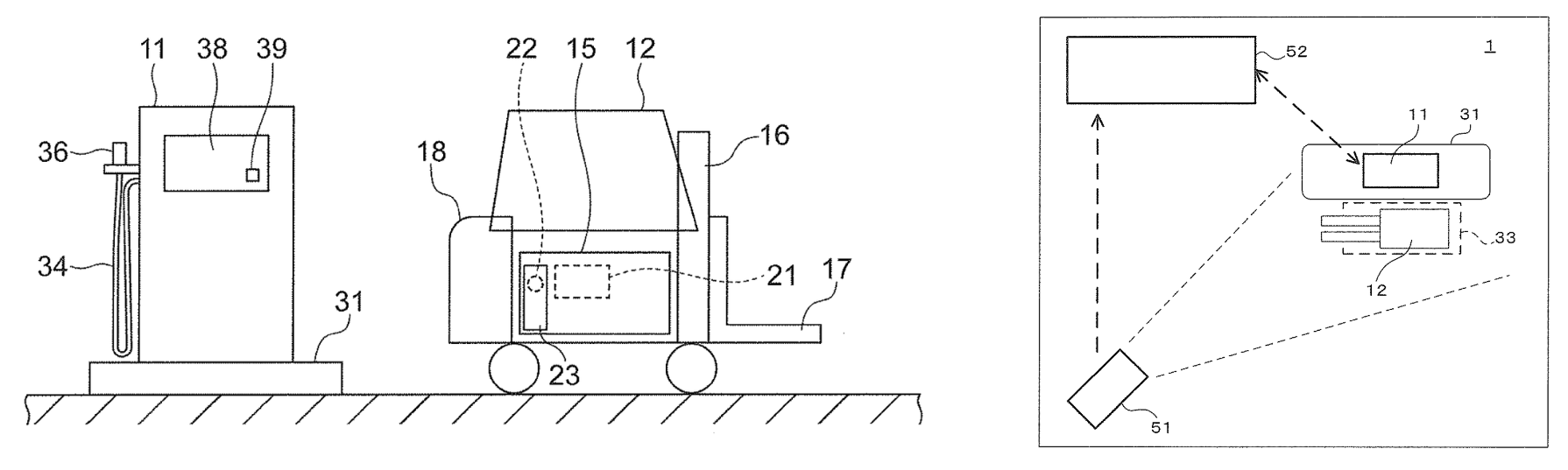
A granted Toyota patent describes a hydrogen filling system that uses image recognition to identify vehicles and ensure safe, pressure-appropriate hydrogen refueling.
Patent publication number: JP 7324652 B2
Owner: Toyota
Title: Hydrogen filling system
Publication date: February 25, 2021
Grant date: August 2, 2023
Patent drawing
AI simulation

Problem: Existing hydrogen filling facilities struggle to differentiate between fuel cell vehicles with high and low hydrogen filling pressures, leading to potential erroneous filling due to the absence of communication functions in vehicles with low pressure requirements.
Solution: A hydrogen filling facility equipped with a camera and control device for image recognition to identify the type of vehicle, allowing or prohibiting hydrogen filling based on the vehicle’s characteristics, thus ensuring compatibility with the appropriate filling pressure.
Benefit: Prevents erroneous hydrogen filling into vehicles with incompatible pressures by accurately identifying the vehicle type, thereby ensuring safe and correct filling operations.
Deep dive on charging/smart grid technologies
Research activities in the development of charging infrastructure and smart grids for heavy-duty vehicles can be thematically grouped into the following core areas:
Electric vehicle (EV) grid integration technologies are essential for handling the substantial, concentrated power demands of charging depots and public fast-charging systems. These technologies facilitate a two-way flow of energy, enabling fleet batteries to discharge power back to the grid. This helps utilities stabilize the grid and manage peak demand. It also potentially offers a revenue stream for fleet owners. The number of published patent families in this field almost doubled between 2019 and 2024, rising from 648 to 1,244 (Figure 4.4).
Smart grid technologies for heavy-duty road transport share certain themes with EV grid-integration technologies, but also encompass additional areas of research, including digital twins for grid operations and optimization, interoperability standards and communication protocols, and predictive congestion management for electricity networks. In 2024, around 1,000 patent families were published in the field of smart-grid technologies.
Another key research area is charging at site/depot charging, with 891 published patent families in 2024. This area involves stationary infrastructure installed at fleet hubs. It allows operators to leverage cost-effective smart charging protocols overnight to ensure that vehicles are charged using off-peak power in readiness for their daily routes.
Charging point design is the next largest research field, with 685 published patent families in 2024. It encompasses the development and standardization of physical hardware, including high-power connectors and cable management systems, as well as communication protocols. These standards are crucial for ensuring interoperability, allowing any heavy-duty EV to safely and reliably charge at any compatible station. This is an important requirement for the widespread commercial adoption of EVs.
In the field of charging speed and capacity improvement, published patent families rose from 371 to 514 between 2019 and 2024. Research in this area is focused on developing high-power charging systems for large truck batteries. This has led to the development of the Megawatt Charging System (MCS) standard, which is designed to handle a maximum power output of 3.75MW. MCS charging delivers high power output quickly enough to enable long-haul trucks to achieve a significant state of charge during mandatory driver rest stops. The common goal is to enable charging from 20% to 80% battery capacity in under 30 minutes. One such example is Scania’s new MCS rapid charging solution.
Battery-swapping is a disruptive technology whereby vehicles can exchange a depleted battery pack for a fully charged one in a quick, mechanized process that often takes mere minutes. This avoids charging delays and maximizes vehicle uptime, although it requires highly standardized battery packs. Battery-swapping has gained significant traction in China’s heavy-duty road transport sector, as the Chinese government has actively promoted it through subsidies, standardization efforts and inclusion in its development plans.
A further roughly 1,400 published patent families in 2024 related to battery-electric energy infrastructure could not be clearly assigned to any of the specific categories described above. These patents are shown as “other” in Figure 4.4.

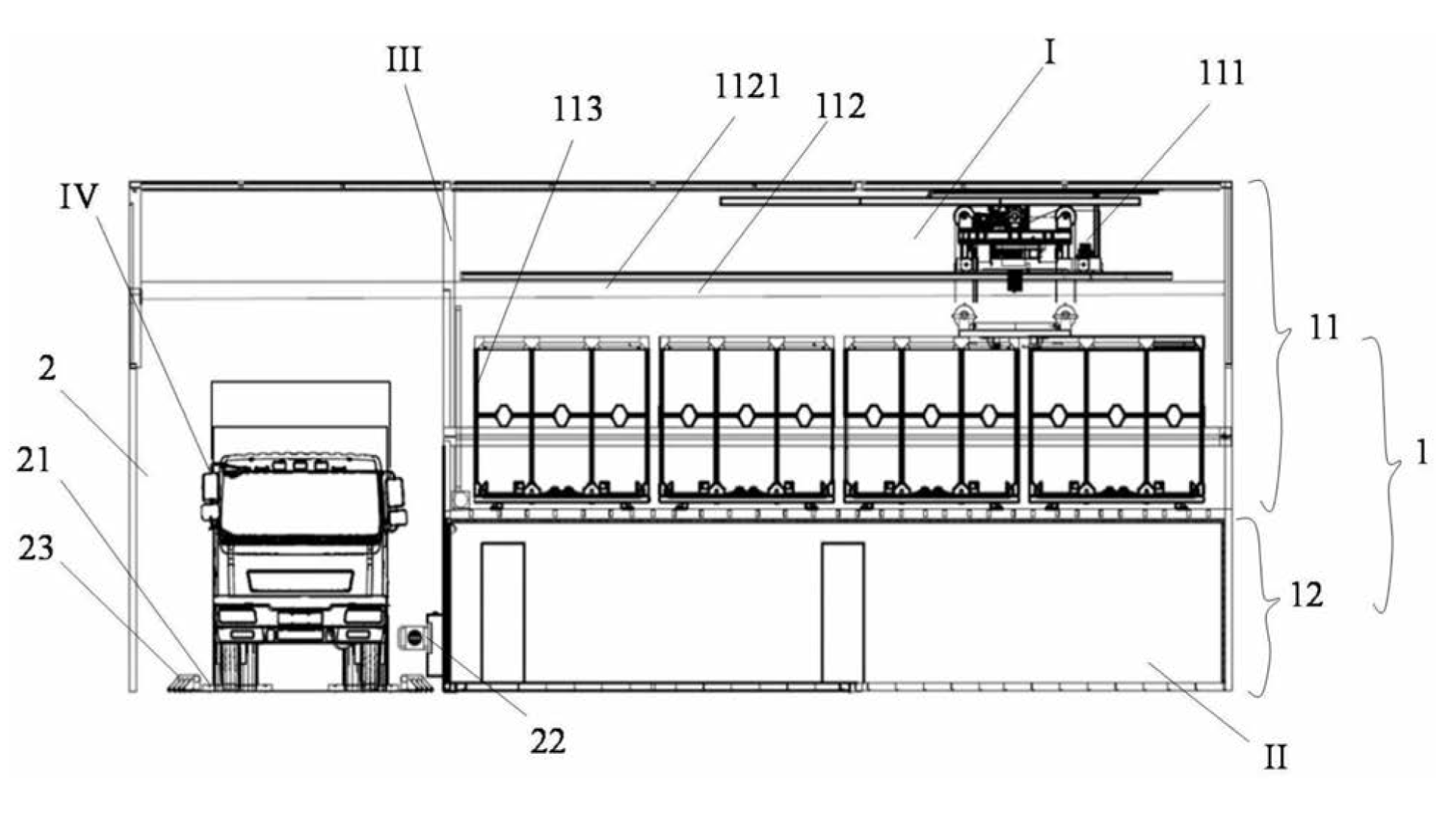
A Geely patent applicatiocovers a modular heavy truck battery-swap station using stacked containers, reducing construction costs, footprint, and improving swap efficiency and safety.
Patent publicaion number: CN 113733969 A
Owner: Geely
Title: Heavy truck battery-swap station
Publication date: December 3, 2021
Patent drawing
AI simulation

Problem: Heavy-duty truck battery-swapping stations require a large factory building, have a long construction period, incurhigh costs and it is difficult to solve the problems of short cruising range, long charging time and the high purchase price of pure electric heavy-duty trucks.
Solution: A heavy-duty truck battery-swapping station is designed that adopts a stacked and connected upper and lower container structure. The battery turnover layer is located in the upper container, and the control layer in the lower container. All battery swapping-related equipment is distributed in the two containers. Supports modular design and transportation, and complete overall assembly and debugging before leaving the factory.
Benefit: Realizes a low-cost, small-area power swap station, shortens the station landing period, reduces construction costs, and improves power swap efficiency and safety.
Top inventor locations
Results for the top inventor locations for energy infrastructure for heavy-duty road transport are very similar to the ones for low-emission energy sources. China is again the key player in global patenting activity for energy infrastructure for heavy-duty vehicles, with a clear focus on the development of domestic patents (Figure 4.5).
The United States ranks as the second most important research location, with a stronger international focus, as represented by the large number of IPFs. Rounding out the top five key research locations worldwide are Japan (third), Germany (fourth) and the Republic of Korea (fifth).

Inventor location analysis for energy infrastructure for heavy-duty road transport also delivers similar results in terms of patent dynamics and specialization compared to the energy sources (Chapter 3). India, Sweden and Canada have the strongest patent momentum, while Sweden, Germany and Austria the most specialized in heavy-duty energy infrastructure technologies.
Patent growth and specialization
Over the past five years, India has shown a remarkable surge in patenting activity related to heavy-duty energy infrastructure, rising from 39 publications in 2019 to 449 in 2024. This corresponds to a compound annual growth rate of more than 60%, making India by far the fastest-growing innovation location in this field.
Sweden and Canada also have strong momentum, recording average annual increases in published patent families of 24% and 22%, respectively. China, which remains the largest patenting country in terms of absolute numbers, has posted an annual growth rate of around 12% since 2019. In contrast, patenting activity in Germany and Japan largely stagnated over the same period.
When measured by the Relative Specialization Index (RSI), Sweden, Austria, and Germany are the countries most specialized in heavy-duty energy infrastructure technologies. In contrast, China’s level of specialization is the lowest among the top research locations.
Relative specialization in heavy-duty energy infrastructure
A closer examination of specialization across battery-electric and hydrogen infrastructure reveals that those countries most specialized in battery-electric infrastructure – Sweden, Germany, Austria and Canada – also exhibit a strong specialization in hydrogen infrastructure.
By contrast, India demonstrates a high degree of specialization only in battery-electric infrastructure, with domestic funding programs supporting this development.
Research priorities
Analysis of research focus across the top 15 locations shows that battery-electric energy infrastructure dominates across all regions (Figure 4.6). In every country examined, patent families related to charging and smart grid technologies account for at least 80% of all patent families in the field of heavy-duty road transport energy infrastructure.
China and India display the strongest emphasis on battery-electric infrastructure, with such patents representing 95% of total activity. By contrast, Austria and France have the highest relative focus on hydrogen infrastructure, with shares of 18% and 17%, respectively.

Differences in research priorities are also reflected in country rankings for the two main types of heavy-duty energy infrastructure (Figure 4.7). China is the undisputed leader in charging and smart grid technologies, with more than 20,400 patent families published since 2000, followed by the United States, with 8,502, and Japan, with 8,282 patent families.
China also leads in hydrogen infrastructure patents, though its advantage over the United States and Japan is less pronounced.

Key filing jurisdictions
Figure 4.8 shows China is not only the leading inventor location, but also top in terms of patent filings. Between 2000 and 2024, more than 33,100 patents related to heavy-duty energy infrastructure were filed in China. The United States ranks second, with 19,852 filings over the same period. Patent filings under the Patent Cooperation Treaty (PCT) represent the third-largest filing route, with nearly 12,900 applications submitted since 2000.

Top patent owners
Japan’s largest automotive manufacturer, Toyota, heads the list of leading research entities in the field of energy infrastructure for heavy-duty vehicles (Figure 4.9). The company is active in the two core energy infrastructure areas for heavy-duty vehicles – charging/smart grid and hydrogen. For instance, Toyota has recently partnered with Chiyoda Corporation to develop a large-scale electrolysis system to produce green hydrogen.
The rest of the top 10 consists mainly of other major automakers and suppliers such as Volkswagen (VW), Hyundai, Ford, Kia, General Motors, Honda, and Bosch. The only non-automotive companies in this top 10 are two Chinese utilities: State Grid and China Southern Power. China’s State Grid is developing and testing vehicle-to-grid technologies using electric buses to develop a more flexible and resilient power system.

Among the top 25, Volvo (Sweden) and Stellantis, headquartered in the Netherlands, stand out as the only firms outside the five dominant regions (China, Germany, Japan, the United States and the Republic of Korea). Notably, there are no universities or public research institutions in the top 25 – the list consists entirely of corporate actors.
Patent growth
Recent patent trends show that many leading Chinese companies have actively expanded their portfolios in heavy-duty energy infrastructure, with China Southern Power standing out for a compound average annual growth of nearly 36% in published patent families. Among Japanese, European and US companies, growth is more varied: General Motors, Stellantis, and Hitachi show strong increases, whereas Nissan, General Electric (GE) and VW have reduced patenting activity.
Volvo is the company to have recorded the highest growth since 2019, averaging 47% per year. The company participates in the joint venture Milence with Daimler Truck and Traton, targeting the installation of at least 1,700 charging stations across Europe.
Research priorities
Battery-electric infrastructure is the main infrastructure research area in terms of patenting activity for all top patent owners in heavy-duty vehicles, accounting for more than 80% of published patent families for the top 25 patent owners. This focus is particularly pronounced among Chinese players like BYD, State Grid, and China Southern Power, whose patent portfolios overwhelmingly concentrate on charging infrastructure and associated grid technologies.
In contrast to the Chinese companies, some European and Japanese automotive companies pursue a more balanced, dual-track approach. BMW has the highest share of hydrogen infrastructure research among major automakers, with nearly 20% of its relevant energy infrastructure patents dedicated to hydrogen infrastructure. While BMW’s commercial focus is on the high-end passenger market, it is also a research partner in the heavy-duty sector, using its logistics network to test and advance hydrogen fuel cell technologies for decarbonizing freight transport.
Top patent owners in heavy-duty energy infrastructure
Toyota is the top patent owner both in charging/smart grid technologies and in hydrogen infrastructure. While carmakers and suppliers dominate the ranking in both of the infrastructure categories, some prominent research companies from other industries are also represented. In charging/smart grid technologies, two Chinese utilities, State Grid and China Southern Power, are major players. In hydrogen infrastructure, the three largest global industrial gases companies, Linde, Air Liquide, and Air Products and Chemicals are among the top 15 patent owners.