
Why decarbonization matters
The energy transition continues to progress. Latest analysis by the International Renewable Energy Agency (IRENA) finds that 692 GW of new renewable capacity was added in 2025.
A major sector where the penetration of alternative fuels needs to increase to support renewable goals is the electrification of end-use sectors. IRENA has found this approach to be one of the most effective decarbonization pathways. According to IRENA’s analysis, the electrification rate of end-use sectors will need to increase from 23% in 2023 to 30% by 2030 to stay on the 1.5°C pathway.
Some of the key solutions to electrification in end-use sectors include the deployment of electric heat pumps (up to 400% more efficient than traditional boilers), electric vehicles (up to 80% more efficient than internal combustion engines), and the introduction of efficient technologies in heavy industries, namely, steel, cement and chemicals. Figure 1.1 provides an overview of electrification rate required in each key end-use sector by 2030.
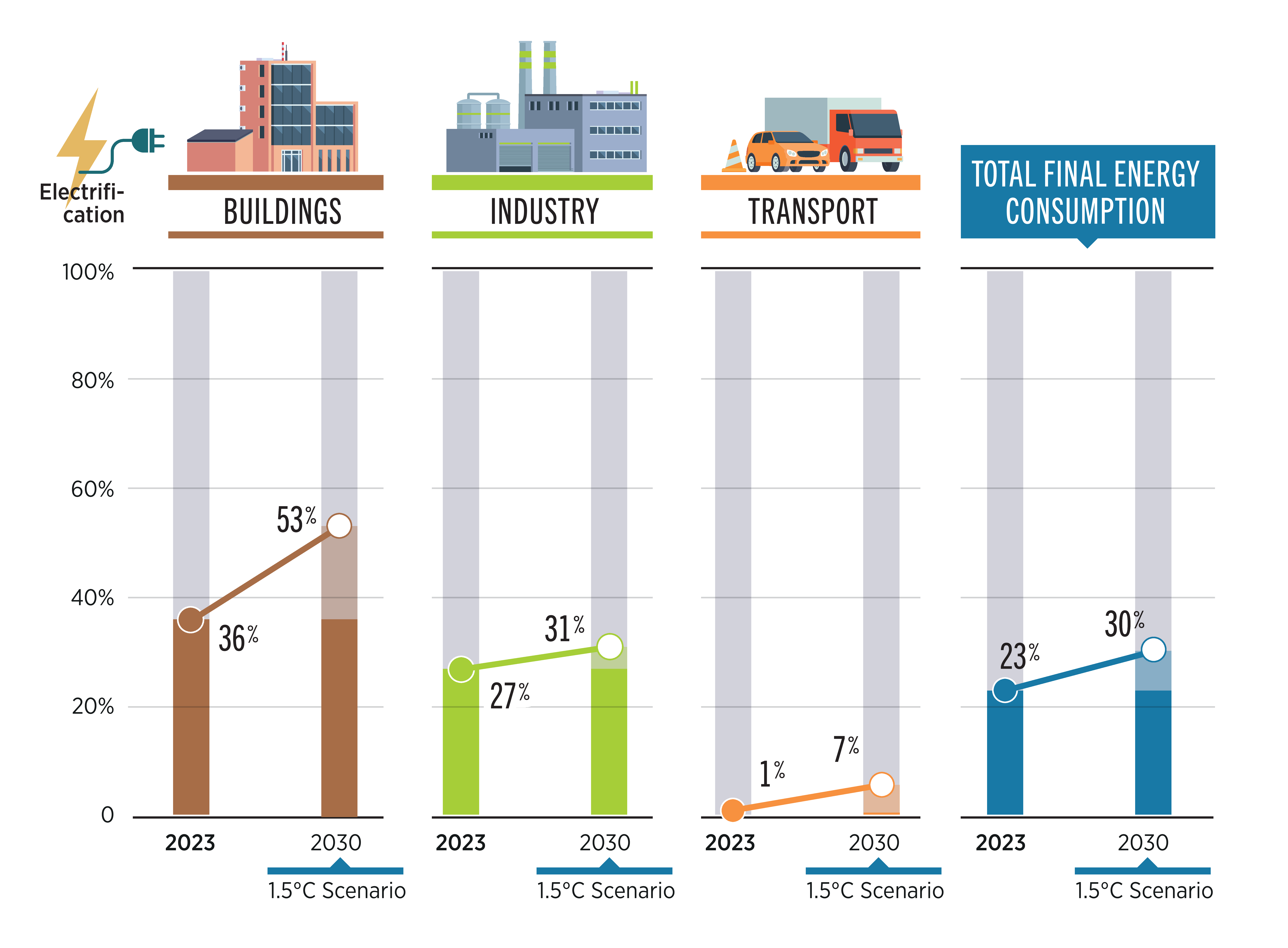 Note: TFEC is the total final energy consumption.
IRENA has found that progress in transport electrification in 2024 was significant, but remains insufficient. Under IRENA’s 1.5°C scenario, electrification of transport sector total final energy consumption worldwide would need to have reached nearly 7% by 2030.
The decarbonization of the road transportation sector will require a systematic approach that leverages measures that include vehicle energy efficiency improvement, renewable energy-based electrification, better urban planning, and making public transport more accessible among others. Several of IRENA’s recent analyses have found electrification of road transportation to be a promising avenue toward making this segment sustainable.
When discussing electrification of road transport, a significant portion of the global narrative is focused on electric vehicles (EVs), especially passenger EVs, due to the fact that:
lightweight duty vehicles is the most prevalent category of vehicle worldwide;
many governments and policymakers have provided investments and subsidies for EVs because of their maturity and the rapid technological innovation undertaken by several original equipment manufacturers (OEMs); and
technological progress and deployment in EVs have been very rapid.
But overall market penetration is still limited, especially in developing countries.
However, while EVs are a crucial enabler of road transportation decarbonization, two often-overlooked segments are buses and heavy-duty trucks. These two segments need to be put in the spotlight in order to accelerate road transportation decarbonization efforts – especially given they account for 9% and 31%, respectively, of the road transport sector’s global emissions.
How IRU is helping to achieve net zero by 2050
The International Road Transport Union is helping the commercial road transport industry meet its objective of carbon neutrality by 2050. While highly disruptive and challenging for all stakeholders, the energy transition toward cleaner energy could allow industry greater resilience against its many other challenges such as digitalization of transport documents and driver shortages. IRU Green Compact is a pathway looking at the most pragmatic solutions to reducing bus and truck emissions. This involves working on greater transport efficiencies (vehicles, fleets, logistics and drivers) in order to ease the move toward alternative fuels, with the support of the right enabling conditions. As for buses, solutions exist to encourage a modal shift away from private cars and go even further in carbon reduction.
Buses
Mobility is a fundamental need of citizens worldwide. And while the lion’s share is covered by private forms of transportation such as cars, buses are playing a major role in the public transportation system, especially within and between urban nodes. Beyond travel, buses also contribute toward education, jobs and economic development opportunities, especially for those individuals and communities unable to afford private transportation. In urban contexts, buses are the most efficient mode of transportation, allowing for greater passenger carrier capacities, as well as reducing road congestion.
As of 2022 there were approximately 20 million buses on the road worldwide. This mode of transportation is essential for many small and medium-sized cities, as well as cities in emerging and developing markets, thanks to its ease of deployment and cost-efficiency. There is an expectation that the global bus fleet will grow as urbanization increases along with drives to encourage a shift toward public modes of transport. The popularity of rapid bus transit services that have lower capital costs is also expected to increase the demand for greater bus deployment.
The need to make buses more sustainable arises from the high contribution they make toward road transport emissions – accounting for 500 million tonnes of direct CO2 in 2022. Currently, most buses are powered by diesel engines and account for 25% of the black carbon emitted by the transport sector globally. Pollution arising from diesel buses has impacted health, especially in densely populated city areas.
Heavy-duty freight
More often than not, trucks are the beginning and end of goods trade and commerce. A key element of the supply chain, they expedite the rapid transport of goods over land and answer the many needs of cargo owners. Trucks are to be found in all industries, moving industrial, agricultural and manufactured goods around the world. As of 2023, they comprised a fleet of approximately 50 million medium- and 35 million heavy-duty vehicles. Trucks also account for a third of global road transport emissions, especially in countries where the primary sector and industry are the primary economic drivers.
While the longest journeying international freight is generally covered by the maritime industry, and sometimes by the aviation industry, trucks dominate the regional economy, moving 60% of surface goods worldwide.
With global trade and gross domestic product (GDP) per capita expected to grow worldwide in the future, road transport is projected to expand, creating challenges for the road industry in meeting demand while at the same time reducing carbon emissions. Much like buses, trucks are heavily reliant on fossil fuels to provide power at the lowest cost and greatest uptime.
Objectives of this report
Given the importance of buses and heavy-duty trucks in the global transportation sector, the main purpose of this report is to highlight the innovations being developed to decarbonize these two road transportation modes. To do so, the report leverages patent data from global patent databases to elucidate broadly where innovations are occurring and, based on the trends observed, pinpoint market and technology gaps, as well as opportunities relevant to making these road transport modes sustainable and efficient.
This report is derived from WIPO’s flagship Technology Trends: Future of Transportation
The report examines the broad set of technologies contributing to the decarbonization of heavy-duty road transport and identifies those countries, companies and institutions driving innovation in this field. The patent analysis focuses on four core technology areas critical to reducing greenhouse gas emissions from buses and heavy-duty trucks (Figure 1.2).

The transition away from internal combustion engines powered by fossil fuels is the central pillar of heavy-duty road transport decarbonization. Key technological pathways include battery-electric powertrains, hydrogen fuel cells, hybrid powertrains, and combustion engines operating on low-carbon fuels such as biofuels, synthetic fuels and natural gas. These technologies differ significantly in their maturity, infrastructure requirements, and suitability for specific use cases, but together they define the main options for reducing tailpipe emissions in heavy-duty vehicles.
Complementary to low-emission vehicles is the need for a robust, scalable energy infrastructure capable of supporting widespread deployment. The operational feasibility of low-emission buses and trucks depends on the availability and performance of energy distribution networks, including high-power charging systems, smart grids, as well as hydrogen production, storage and refueling infrastructure.
Improvements in vehicle efficiency remain a crucial supporting strategy for decarbonizing heavy-duty road transport, irrespective of the underlying energy source. Efficiency gains directly reduce the amount of energy required to transport goods and passengers, thereby lowering operating costs and lifecycle greenhouse gas emissions. Relevant technologies include advances in electric powertrains and drivetrains, vehicle aerodynamics, lightweight and high-performance materials, and reductions in tire rolling resistance.
Finally, digital technologies and data-driven fleet optimization offer additional opportunities to reduce emissions through improved vehicle operation and system-level efficiency. Applications such as platooning, smart routing, and vehicle-to-infrastructure communication can reduce energy consumption by minimizing idle time, smoothing driving patterns, anticipating charging or refueling needs, and improving asset utilization. While these technologies do not replace the need for low-emission energy sources, they play an important complementary role by optimizing the energy use across heavy-duty vehicle fleets.
Together, these four technology areas form the analytical framework for the patent-based assessment presented in the following chapters, which examine innovation trends, leading actors, and the geographical patterns shaping the decarbonization of buses and heavy-duty trucks.