
Technological developments and trends
As heat extremes escalate, the need for smarter and more equitable solutions is becoming urgent. Traditional responses such as alerts, shade and hydration are no longer sufficient. Innovation is now central to building heat resilience, driving new solutions that help cities, communities and individuals identify and apply measures that prevent or reduce extreme heat risk before it manifests as heat shock. From construction materials design to wearable devices that detect early signs of heat stress, to satellite-driven heat-risk maps, technology is transforming how we understand, forecast, respond and adapt to, and survive extreme heat.
Innovation also supports inclusivity and equity, providing scalable, low-cost solutions for vulnerable populations who bear the greatest heat burden. Across sectors, innovators are integrating climate data, human and ecosystem health information, digital platforms, advanced materials, smart infrastructure and behavioral science to redefine responses to extreme heat. These solutions go beyond the purely reactive – they are preventive, dynamic and increasingly tailored to specific needs of different populations and environments.
The overlooked crisis of extreme heat in a warming world
As the planet warms, billions are being exposed to increasingly deadly extreme heat that strains economies, disrupts public health and education services, damages energy and transportation systems and threatens global development goals and the ecosystems upon which we depend. With over 489,000 deaths per year from heat-related causes and 2.41 billion workers exposed to excessive heat (
With this in mind, the UN Secretary-General (UNSG) issued a Call to Action on Extreme Heat to combat the wide-ranging and growing threat of extreme heat. The UNSG’s Call, developed with 10 UN agencies, urges global action in four key areas: protecting vulnerable people, safeguarding workers, strengthening resilience through science and data, and limiting warming to 1.5 degrees Celsius (°C) by phasing out fossil fuels and accelerating renewable energy (
Following the record-breaking heat of 2024, scientists now project that global temperatures could rise nearly 3°C by the year 2100 if greenhouse gas emissions aren’t drastically cut. Notwithstanding the risk of ecosystem collapse in some of our most precious biomes, it is cities that will bear the brunt of this warming. Due to heat-trapping urban features such as extensive pavement and limited green space, urban areas could experience an additional 1°C of localized heating, placing more than 4 billion city dwellers at heightened risk (
The challenge of heat stress is further compounded by fragmented institutional responsibilities, as heat impacts span across sectors such as health, labor, environment, energy, transportation and infrastructure – making coordinated action difficult. This urgent need to build robust, evidence-based governance approaches that mitigate heat risk holistically was the motivation behind the work of the United Nations Office for Disaster Risk Reduction (UNDRR), the Global Heat Health Information Network (GHHIN), World Meteorological Organization (WMO), World Health Organization, and national and international experts building integrated approaches to extreme heat-risk governance (
Heatwaves: silent killers on the rise
A heatwave can be defined as a period where local excess heat accumulates over a sequence of unusually hot days and nights and can last from several days to months (
Heatwaves have earned the name “silent killers” because their deadly toll unfolds quietly and in a dispersed fashion across various locations, and through time. In recent years, they have expanded into new regions while also occurring at unexpected times of the year. With global warming, these extreme heat episodes are becoming more common and lasting much longer (
Heatwaves have earned the name “silent killers” because their deadly toll unfolds quietly and in a dispersed fashion across various locations, and through time
High-profile examples have illustrated this deadly trend: over 35,000 people died during the 2003 European heatwave (
Cooling the concrete jungle: battling the urban heat island
An urban heat island (UHI) occurs when cities experience significantly higher temperatures than surrounding rural areas due to dense buildings, asphalt, and limited green space (
To combat the UHI effect, cities use passive cooling techniques such as cool roofs, shading and cross-ventilation. Cool roofs that are made with reflective materials or light colors reduce solar heat absorption, lowering indoor temperatures and energy use. Similarly, permeable pavements reflect heat while managing stormwater. Urban greening, including tree planting, creating mini-forests and shading parks, lowers temperatures through shade and evapotranspiration while also improving air quality (
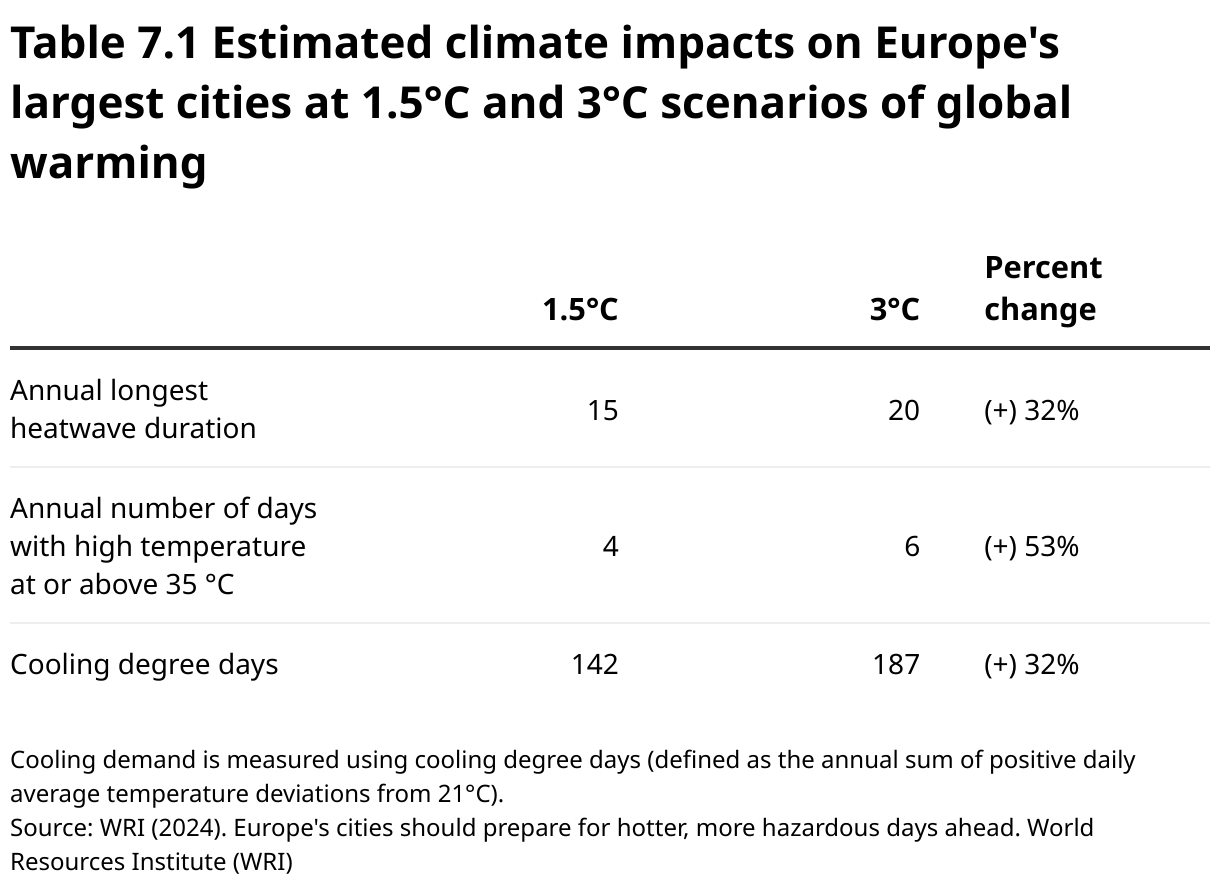
See Box 7.1 for a discussion and comparison of projected urban heat impacts in European cities at 1.5°C vs. 3°C warming.
In addition to infrastructure, affordable cooling solutions such as shaded windows, rooftop gardens and solar-powered fans can reduce reliance on air conditioning (AC). Strengthening energy policies – through tiered pricing, subsidies and renewable energy adoption – helps protect vulnerable populations. Community engagement via heat awareness campaigns, cooling centers and local partnerships is equally critical. For instance, Ahmedabad’s “Cool Roofs” Program targets vulnerable groups through coordinated agency efforts, financing mechanisms and workforce training (
Europe is the world’s fastest-warming continent: at 1.5°C of warming, European cities would face challenging but manageable heat impacts, with Naples experiencing 25-day heatwaves and modest increases in cooling demand. However, as depicted in table 7.1, at 3°C, these impacts become severe and unmanageable: heatwaves in Naples would double to 50 days, southern cities would endure month-long extreme heat periods, and cooling demand would surge by 32 percent (reaching 60 percent in Barcelona) (
Protecting workers from heat stress
Protecting outdoor workers from extreme heat is increasingly urgent, as thousands die annually from heat-related illnesses. In 2020, 4,200 workers worldwide died from heatwaves, and 231 million were exposed, a 66 percent increase since 2000. The International Labour Organization (ILO) warns that more workers are being exposed to heat stress. Workers in Africa, the Arab states and Asia and the Pacific are most often exposed to excessive heat – where 92.9 per cent, 83.6 per cent and 74.7 per cent of the workforce are affected, respectively, compared to a global average of 71 per cent, according to the most recent figures available (2020). In its 2024 report, the ILO reported that between 2000 and 2020, Europe and Central Asia saw the fastest rise in excessive heat exposure for workers, increasing by 17.3 percent, nearly double the global average. The Americas and Europe/Central Asia also experienced the largest jumps in heat-related workplace injuries, up 33.3 percent and 16.4 percent respectively. Notably, most heat exposure and related injuries occur outside official heatwaves (
Advanced wearable heat-stress sensors, cooling vests and environmental monitoring technologies provide real-time, non-invasive tracking of core body temperature, heart rate and hydration
Basic strategies to reduce heat danger include ensuring access to water, shade and rest breaks, promoting gradual acclimatization, and raising awareness about heat illness symptoms. Personal protective equipment (PPE) should be used only when other heat-stress controls aren’t possible. Simple PPE is often more practical and cost-effective. Advanced cooling PPE – such as liquid-cooled or phase-change garments – can help but don’t always prevent overheating (i.e., rising core body temperatures) and can be uncomfortable. While liquid cooling offers strong protection, phase-change vests or ice packs are usually more practical and affordable options (
As featured in the technology solution sections, advanced wearable heat-stress sensors, cooling vests and environmental monitoring technologies provide real-time, non-invasive tracking of core body temperature, heart rate, hydration and heat-stress indicators to protect workers from heat-related illnesses. Emerging wearable technologies, or “wearables,” are developed to monitor core body temperature and detect early signs of heat stress – crucial since traditional skin temperature readings (such as those from consumer smartwatches) don’t accurately reflect internal heat risk.
The US military leads this field with an algorithm, tested on 14,000 soldiers, that uses heart rate, skin temperature and movement to estimate the risk of heat-related illness (
Some tools still require more real-world validation to prove their effectiveness in preventing heat illness on worksites or in daily life (
When heat won’t let up: keeping cool in homes and communities
A multitude of home-cooling solutions helps people manage and survive extreme heat by enhancing personal hydration, improving air circulation and providing targeted cooling comfort. Hydration products such as Liquid I.V. use electrolyte mixes to quickly replenish fluids, while portable fans – handheld, neck, clip-on or stroller models – provide personal cooling on the go. Innovative cooling pillows and mattresses incorporate adjustable firmness and cooling technology to regulate temperature during sleep. For rapid relief, micro-cooling chairs circulate ice water to lower body temperature. Additionally, cooling fabrics and wearables help reduce core body temperature and boost endurance without chemicals.
Likewise, urban heat-management efforts, including heat-risk mapping and accessible cooling centers, complement these personal solutions by guiding people to cooler locations and safer routes. Heat-risk mapping involves combining environmental data such as temperature variability and urban heat islands with social and demographic information (e.g., age, income, housing quality) to identify populations most vulnerable to extreme heat. These maps – known as heat-vulnerability maps – visualize heat-vulnerability indices and help cities identify hotspots where residents face the greatest health risks during heatwaves. Several cities have developed public interactive heat-risk maps linked with the locations of cooling centers and safe spaces.
Digital platforms use these maps to inform authorities and the public, often including multilingual, mobile-accessible features that help users find nearby cooling centers, shaded areas, water fountains and spray parks. They can be multilingual and mobile-accessible. Crowdsourcing tools collect real-time user data on temperatures, personal heat experiences and resource availability (i.e., whether a cooling center is crowded or open). Apps such as Extrema consolidate these services, providing heat-risk notifications and safety alerts to users and their loved ones. Many platforms now also offer route planning for pedestrians or public transit users that prioritizes shaded streets, tree canopy cover and proximity to water fountains and cooling centers known as “cool routes” to reduce heat exposure during travel. Additionally, cities use satellite imagery, drones and AI to map tree cover and urban shade, guiding tree planting and green infrastructure projects that enhance cooling and improve air quality.
Cooling centers bring relief but AC is not a silver bullet
A cooling center is a designated air-conditioned or cooled location where people can find relief and safety during extreme heat. These centers can include government buildings (such as libraries or schools), community or religious centers, private businesses (such as shops or malls), and outdoor sites such as spray parks or pools. Temporary cooling spaces may also be set up for special events such as marathons or concerts (
AC is not a sustainable long-term solution
They are a widely used, cost-effective way to provide relief from extreme heat, especially for low-income populations who may lack or avoid AC due to high electricity costs. They are often part of broader heat health warning systems (HHWS), which include alerts, public communication and emergency measures tailored to local needs. HHWS have been proven to reduce heat-related deaths.
It has been shown that spending time in cool environments, especially with AC, significantly reduces heat-related illness and death, with studies showing up to a 66 percent lower risk of mortality for those who use air-conditioned spaces during heatwaves (
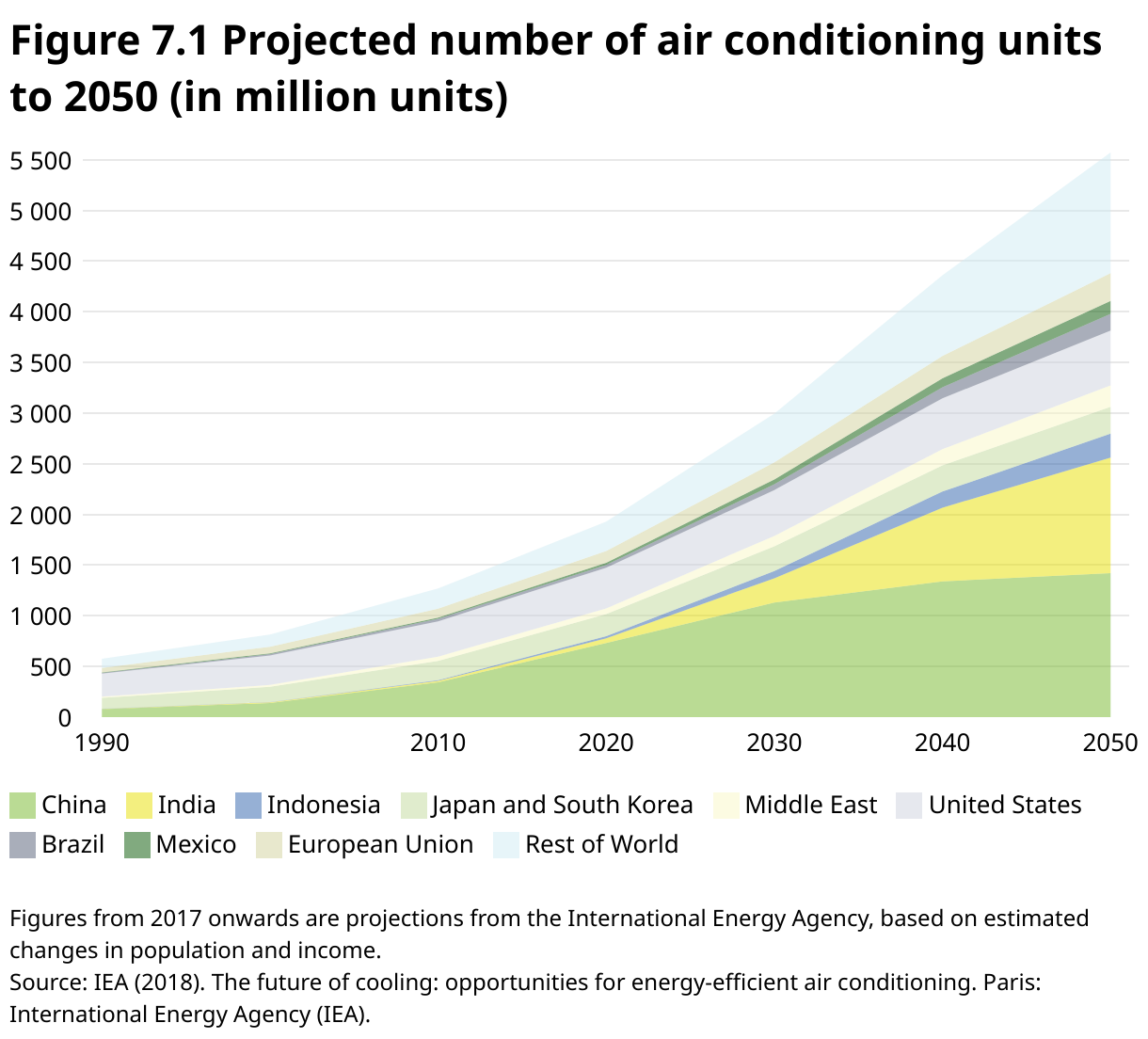
However, AC is not a sustainable long-term solution. It is expected to become the most widely used strategy for coping with heat worldwide, yet it remains inaccessible to many vulnerable populations, is highly energy-intensive, financially and environmentally costly, and can fail during power outages. A rapid increase in AC creates a self-reinforcing cycle: as the climate warms, demand for cooling grows, which – depending on how electricity is generated – can further contribute to climate change (
Super-efficient AC can drastically cut energy use
Innovation is improving the efficiency of AC units. Super-efficient ACs, optimized for real conditions with high-efficiency components, provide better dehumidification and comfort while being more energy efficient. A Global Cooling Efficiency Accelerator study in Palava City, India, tested super-efficient AC prototypes, finding they use 60 percent less energy than typical models while improving comfort and reducing peak demand. The study also revealed that current testing standards underestimate AC energy use in humid climates, highlighting the need for updated evaluation methods that account for humidity and user behavior (
Startups are developing technologies that significantly reduce energy use and environmental impact, including using liquid desiccants to reduce AC energy consumption, materials that remove humidity before cooling, and solid-state thermoelectric systems without refrigerants or moving parts. Other innovations use compressor-free, refrigerant-free designs with novel materials to lower power demand (ibid.). For more heating, ventilation and air conditioning (HVAC) technologies, see the Green Technology Book Adaptation edition (cities chapter), mitigation edition (cities chapter), energy solutions edition (green urban energy solutions and essential services chapters) and the EXPO25 special edition (green urban energy solutions and key service sectors chapters).
Mist, fog and ancient wisdom provide urban refreshment
Mist and fog cooling systems provide efficient, energy- and water-saving outdoor cooling by releasing ultra-fine water mist that lowers air temperature by up to 10°C. These systems work by turning water into an ultra-fine mist using high-pressure technology. As the tiny droplets evaporate, they absorb heat from the air, a process known as adiabatic cooling, which lowers the surrounding temperature (
In Seville, Spain, Cartuja Qanat is an innovative open-air public space erected in 2022, designed to combat rising urban temperatures. It uses ancient qanat cooling systems, tunnels dug to bring water to agricultural fields that were first documented in the present-day Islamic Republic of Iran 1,000 years ago. The Persians realized that the running water also cooled the air in the canals, so they built vertical shafts to bring that air to the surface through passive ventilation driven by wind pressure. By lowering ambient temperatures, the space offers a climate-resilient model for urban design. The project showcases how traditional knowledge and innovative design can come together to fight climate change in cities (
Designing buildings to beat the heat
Buildings can reduce indoor heat through material and design choices. High-thermal-mass materials such as concrete, stone or earth absorb and gradually release heat, while insulation such as polystyrene and polyurethane foam helps reduce heat transfer. Breathable and sustainable options such as hempcrete or bamboo improve airflow, especially when paired with shading, sealed exteriors and smart ventilation systems (
Insulation such as polystyrene and polyurethane foam helps reduce heat transfer
Cool-roof strategies vary depending on context and can be grouped into five main types (
Coated cool roofs: Reflective paints (e.g., lime wash, acrylic) applied to existing surfaces.
Membrane cool roofs: Prefabricated reflective sheets made from polyvinyl chloride or bitumen.
Tiled cool roofs: High-reflectivity tiles or shingles installed over existing or new roofs.
Alternative materials: Options such as ModRoof, made from coconut husk and paper waste.
Green roofs: Vegetation-covered rooftops that reduce heat but can be cost- and water-intensive.
Choosing the right solution depends on roof type, cost, labor and maintenance needs. Especially when integrated with passive design, these strategies help buildings stay cool, reduce reliance on AC, and support broader urban heat resilience goals. For more detailed design and retrofit strategies, see Box 7.2.
Using mechanical or natural ventilation and materials with high thermal mass can reduce reliance on AC. Coupling cold storage with heat pumps, including geothermal systems, increases cooling flexibility. Indoor humidity control also improves thermal comfort. These combined measures reduce heat entering buildings and urban spaces, improving comfort and reducing cooling energy needs.
Windows and skylights: Limit window size on east and west sides; avoid skylights or use alternatives; use windows with low solar heat gain; provide exterior shading (e.g., overhangs, shutters) and interior shading; ensure proper installation and air sealing.
Attics and roofs: Use high insulation and air sealing; design for effective attic ventilation; install radiant barriers; choose reflective roof materials/colors; avoid placing ducts or HVAC in unconditioned attics; air seal all penetrations; avoid recessed lights in ceilings exposed to attic.
Walls: Use high insulation with techniques that reduce thermal bridging (such as insulated panels); minimize unshaded east/west walls; select reflective exterior finishes; opt for compact house designs to reduce surface area; incorporate vegetative (green) walls to provide shading, evapotranspirative cooling and added insulation.
Foundations: Air seal sill plates, rim joists and penetrations in foundation walls.
Site and landscaping: Plant trees and vegetation to shade windows, roofs and pavements; avoid large unshaded concrete or asphalt areas; use light-colored, reflective pavements; encourage water retention with permeable landscaping.
Emergency cooling: simple techniques are surprisingly effective
In the face of extreme heat and increasingly frequent power outages, emergency cooling is becoming a critical consideration for home safety and comfort. Both full AC systems and passive cooling methods keep indoor temperatures low and maintain systems at a level low enough to be supported by backup sources such as batteries or generators. Emergency cooling often relies on existing HVAC systems, often complementing their use with simple strategies such as using fans and shading.
Mechanical AC remains the most direct method for emergency cooling. Full systems can be used, alongside smaller units such as mini-splits, window units or portable AC units. These systems also use less electricity, rendering them useful during outages. An energy recovery ventilator improves indoor air quality and reduces HVAC energy use by exchanging heat and moisture between incoming fresh air and outgoing stale air, making it especially effective in air-conditioned homes in warm, humid climates. Unlike traditional systems, ground-source heat pumps rely on the stable temperatures underground, performing better during extreme heat (
Emergency cooling is becoming a critical consideration for home safety and comfort
For emergencies, backup power systems are essential because grid failures often occur due to high demand during heatwaves. Generators or battery systems can meet needs, but loads must be prioritized, including refrigeration and lighting. Reducing the load on both the grid and the backup system can be done by choosing efficient appliances, shading windows or isolating a “cool room” within the home. A cool room is a simple, budget-friendly refuge during extreme heat that can improve survival during power outages by isolating the home’s naturally coolest space (
Innovating heat early warning systems: technology, equity, and integrated action
In February 2023, the Global Heat Health Information Network convened experts from around the world to discuss scaling heat health early warning systems (HHEWS), aligning with the goals of the global Early Warning For All (EW4All) initiative. The roundtable emphasized the urgent need to prioritize vulnerable populations who bear the greatest risks from extreme heat. Participants highlighted the importance of integrating social science and behavioral insights to tailor warning messages that resonate locally. The discussions also stressed the importance of cascading risk awareness to coordinate messaging and interventions during overlapping crises such as floods or pandemics. Crucially, the experts called for a shift from ad hoc, one-off risk responses toward building durable, community-based systems with multi-sectoral collaboration (
Developed countries such as Canada, the United States of America and several European nations have advanced heat warning systems integrating health data, behavioral models and real-time monitoring. The US National Weather Service issues heat-index-based alerts 3–7 days in advance via multiple platforms. Canada’s Heat Alert and Response Systems combine forecasts with community protocols and cross-sector data sharing. Europe’s HHEWS provide multi-day heatwave forecasts and vulnerability mapping to aid government preparedness. Germany uses a biometeorological model that accounts for urban heat islands, nighttime temperatures, and population acclimatization over 30 days, generating highly localized risk-based alerts (
Innovation examples
Using weather forecasts to predict heat stress and protect workers in Europe

The HEAT-SHIELD project, funded by the European Union (EU), created Europe’s first web-based heat stress warning platform to protect workers from extreme heat. Using data from the European Centre for Medium-Range Weather Forecasts, the platform provided weekly and monthly forecasts of heat stress risks across the continent. It mapped the likelihood of temperatures exceeding 27°C WBGT (Wet Bulb Globe Temperature), a key measure of heat stress. Anyone could access general heat forecasts on the website, while registered users received personalized advice tailored to their specific workplaces and needs. This included recommendations on clothing, hydration, and work/rest schedules to help prevent heat-related illness. The platform also sent email alerts about upcoming heat risks, giving workers, employers, and stakeholders time to plan preventive actions (
Saving the lives of workers on sugarcane fields in Nicaragua

The Adelante Initiative, launched in 2017, tackles extreme heat risks faced by sugarcane workers in Nicaragua. Partnering with Ingenio San Antonio and Bonsucro, La Isla Network created a heat stress prevention program combining simple yet effective technological and logistical measures across a vast 75,000-hectare plantation. Key components include mandated breaks supported by mobile shaded tents, ensuring accessible rest spots equipped with purified water and isotonic drinks to maintain hydration and electrolyte balance. Sanitation facilities were added to accommodate increased fluid intake safely. The program’s backbone is the PREP methodology—Prevention, Resilience, Efficiency, and Protection. It uses physiological data and heat exposure assessments to design tailored interventions that safeguard health without reducing productivity. Real-time monitoring of heat exposure and health outcomes guided ongoing adjustments (
Beating the city heat: Vienna’s tech-driven urban refresh

Raintime has helped transform Vienna’s Praterstern from a concrete-heavy traffic hub into a refreshing urban oasis, featuring 8,000 m2 of green space and 101 trees. At its heart lies a 500 m2 star-shaped water feature inspired by the original Praterstern design. This unique installation uses temperature-responsive water jets, sprinklers and foggers to cool the area, creating a pleasant microclimate that can be adjusted or turned off as needed. The project applies the “sponge city” principle, directing rainwater and water from the feature into the ground to nourish the trees and improve urban water management. The key technological highlight is the Raintime “Dry Mist” fog cooling system, which atomizes water into microscopic droplets via high-pressure nozzles (
Cooling Freetown with low-cost and scalable urban heat solutions

Freetown, the capital of Sierra Leone, faces extreme urban heat due to its tropical climate and the widespread use of heat-trapping building materials such as corrugated metal. With 99 percent of the city’s structures made from low-reflectivity surfaces, average summer temperatures are about 29°C. To respond, the city has begun adopting innovative technologies. Under the leadership of Africa’s first Chief Heat Officer Eugenia Kargbo in 2021, Freetown introduced heat-reflective shade structures across three major open-air markets. Made from plexiglass designed to reflect solar radiation, these structures also integrate solar panels that power nearby streetlights and extend working hours for vendors. Another key initiative is the deployment of cool-roof technologies. In the informal settlement of Kroo Bay, a pilot program is applying reflective coatings to 55 metal rooftops. This simple solution reduces indoor temperatures by reflecting sunlight, providing immediate relief to residents. These low-cost innovations highlight how targeted technology can reduce heat exposure in vulnerable communities (
Proven technology solutions
Worker heat-stress prevention: wearable heat-stress monitor
Evalan

ARMOR is a non-invasive heat-stress monitoring solution to protect individuals in physically demanding roles such as military personnel, athletes, firefighters and industrial or agricultural workers. It measures heart rate and estimates core body temperature and physiological strain index (PSI) using the patented ECTemp algorithm developed by the US Army. The system consists of an optical heart-rate sensor, a compact transmitter device and a mobile app that gives supervisors real-time insights into each user’s heat exposure levels. The app displays estimated core temperature and PSI using a customizable color-coded risk scale and issues alerts when heat strain reaches dangerous levels. Designed for group use, ARMOR comes in sets of up to 25 devices with a centralized charging case.
Technological maturity: Proven
Contracting type: For sale
Technology level: Medium
Place of origin: Kingdom of the Netherlands
Availability: Kingdom of the Netherlands
Contact: WIPO GREEN Database
Worker heat-stress prevention: cooling vest
TST Sweden

The Cooling Vest is designed to reduce the risk of heat stress and dehydration – a growing challenge in industrial, emergency, and outdoor work under high-heat conditions. Unlike traditional ice vests that expose the body to extreme cold, the Cooling Vest provides gentle, safe, and consistent cooling. As body or surrounding temperatures rise, the cooling elements absorb excess heat, helping the wearer remain within their optimal performance zone without feeling cold. The vest provides up to 90 minutes of effective cooling at 60 °C / 140 °F or up to 4 hours at 45 °C / 113 °F. The technology behind the cooling elements is a phase-change material that activates at 28 °C / 82 °F. The elements recharge without any external energy source – in a room at 22 °C / 72 °F they recharge within 2–3 hours, and in a freezer within just 5–10 minutes.
Technological maturity: Proven
Contracting type: For sale
Technology level: Medium
Place of origin: Sweden
Availability: Worldwide
Contact: WIPO GREEN Database
Air cooling systems: evaporative cooler
Symphony

Symphony’s evaporative air coolers (also called bio coolers or wet air coolers) cool hot, dry or humid environments by adding moisture to the air. This moisture absorbs heat as it evaporates, reducing the air temperature naturally. An internal fan then circulates the cooler, more comfortable air throughout the space. These energy-efficient coolers are ideal for hot climates and offer a cost-effective alternative to traditional AC.
Technological maturity: Proven
Contracting type: For sale
Technology level: Medium
Place of origin: India
Availability: Worldwide
Contact: WIPO GREEN Database
Emergency cooling: portable air conditioners
DENSO Corporation

MovinCool portable AC units offer fast, effective cooling on wheeled mounts, ideal for emergency or backup use in healthcare, government, education, retail and manufacturing settings. They reduce heat stress for people and equipment, supporting critical operations during heatwaves, power outages, floods and disasters. Easily deployed in mobile clinics, tents or server room failures, they run on generators and outperform fans or dehumidifiers for drying. The Climate Pro K Series suits offices, healthcare and telecom spaces, while the Pro X Series is built for industrial and outdoor use.
Technological maturity: Proven
Contracting type: For sale
Technology level: Medium
Place of origin: Japan
Availability: Worldwide
Contact: WIPO GREEN Database
Personal cooling solutions: electrolyte powder
Liquid I.V.

Liquid I.V. offers electrolyte drink mixes designed to boost hydration using their patented Cellular Transport Technology (CTT®), which helps the body absorb water faster than with water alone. Their product line includes standard and sugar-free options, as well as formulas for energy, immune support, children and gut health. Available in over 80,000 US stores, Liquid I.V. also leads a 1:1 Giveback Mission, having donated over 55 million servings of hydration aid globally, with a goal of reaching 150 million by 2032.
Technological maturity: Proven
Contracting type: For sale
Technology level: Medium
Place of origin: United States
Availability: Worldwide
Contact: WIPO GREEN Database
Personal cooling solutions: cooling pillow
Simba Sleep

The Simba Hybrid™ Pillow features an adjustable design using Nanocube® foam filling, allowing users to modify height and firmness by adding or removing small cubes. This makes it suitable for various sleep positions, particularly effective for side sleepers seeking neck alignment and support. One side of the pillow incorporates Stratos® cool-touch technology, which delivers a lasting cooling sensation and helps regulate temperature during sleep. The construction includes a breathable cotton surface and a mesh border to enhance airflow. The pillow also comes with a zip-off, machine-washable cover and a storage bag for excess Nanocubes®. Its down-like cushioning provides support without the density of traditional memory foam, which can improve comfort.
Technological maturity: Proven
Contracting type: For sale
Technology level: Medium
Place of origin: United Kingdom
Availability: Worldwide
Contact: WIPO GREEN Database
Personal cooling solutions: cooling towel
Mission

The MISSION Cooling Towel regulates body temperature during physical activities. Utilizing proprietary cooling technology, the towel provides immediate cooling upon activation and maintains a cool sensation for up to two hours. This sustained cooling effect helps to lower core body temperature, reduce heart rate and enhance endurance during exercise. It is chemical-free. Studies conducted at the MISSION Heat Lab at UConn’s Korey Stringer Institute have demonstrated that the MISSION Cooling Towel can increase endurance by 12 percent, lower core body temperature by 0.56°C, reduce heart rate by 18 beats per minute and boost performance by 3.6 percent.
Technological maturity: Proven
Contracting type: For sale
Technology level: Medium
Place of origin: United States
Availability: Worldwide
Contact: WIPO GREEN Database
Climate monitoring: WBGT index measurement
Senseca

The HD32.2 is a portable thermal microclimate data logger designed to ensure safety, efficiency and comfort in hot working environments by measuring the WBGT index. It supports up to three SICRAM-enabled probes, which store their calibration data internally and are automatically recognized by the device. The HD32.2 can log data in up to 64 sections with customizable sampling intervals and auto-start scheduling. Measurements include globe temperature (combined effect of radiant heat and ambient air temperature), natural ventilated wet bulb temperature and ambient temperature. Using these inputs, it calculates WBGT indexes for both shaded and sun-exposed conditions. Data transfer is done via an RS232 connection. The device is commonly mounted on a small tripod, but for long-term monitoring, a stable tripod version (HD32.3A) is recommended.
Technological maturity: Proven
Contracting type: For sale
Technology level: Medium
Place of origin: Italy
Availability: Worldwide
Contact: WIPO GREEN Database
Heat-reducing construction materials: cooling paint
Nippon Paint Singapore

Nippon’s SolarCool is a premium 100 percent acrylic exterior cool coating featuring COOL-TEC Technology. It reflects a significant amount of solar energy, reducing surface temperatures by up to 5°C, which helps lower heat build-up and decreases AC energy consumption. SolarCool is weather-resistant and provides protection from the growth of algae with a low-sheen finish. It’s ideal for eco-sensitive commercial and residential areas with high human traffic, including hospitals, schools, residential buildings and hotels. Temperature reduction may vary depending on the color used.
Technological maturity: Proven
Contracting type: For sale
Technology level: Medium
Place of origin: Singapore
Availability: Singapore
Contact: WIPO GREEN Database
Frontier technology solutions
Worker heat-stress prevention: sweat sensor for hydration
Epicore

Epicore Biosystems tap into the power of sweat to monitor hydration, nutrition, stress and key health biomarkers through advanced devices worn on the skin. Sweat is rich in hormones and metabolites and provides a non-invasive window into health – ideal for managing pregnancy, athletic performance and workplace safety. The connected hydration device provides real-time fluid and electrolyte guidance for workers, while the Gx sweat patch helps athletes personalize rehydration and recovery. The biowearables are certified for industrial safety and data security. They transform sweat into actionable insights to improve wellness, performance and preventive care.
Technological maturity: Frontier
Contracting type: For sale
Technology level: Medium
Place of origin: United States
Availability: Worldwide
Contact: WIPO GREEN Database
Worker heat-stress prevention: wearable cooling device
Sony

The Reon Pocket Pro is a wearable device that cools or warms the body by directly targeting the contact area. It features dual thermo modules that alternate intensity for sustained cooling, with up to 34 hours of use on cool level 1. Advanced sensors and algorithms detect the user’s activity and environmental conditions to automatically adjust temperature in Smart Cool or Smart Warm modes. New sensors improve the Auto Start/Stop function by detecting when the device is worn. The device can be paired with the REON POCKET TAG, which measures ambient temperature and humidity to provide even smarter control of the REON POCKET.
Technological maturity: Frontier
Contracting type: For sale
Technology level: Medium
Place of origin: Japan
Availability: Worldwide
Contact: WIPO GREEN Database
Air cooling systems: smart evaporative digital air cooler
Igenix

The Igenix Smart Digital Air Cooler features a 10 liter removable water tank. When filled, the water absorbs heat from the air, and the integrated fan circulates this cooled air throughout the room. It includes ice packs that can be placed in the water tank to further lower the air temperature, providing an extra cooling effect. By activating the humidification mode, the cooler adds moisture to the air, which can be beneficial in dry environments. It can be controlled remotely using the Tuya Smart Life app or with voice commands via Amazon Alexa and Google Assistant. The cooler offers 120° horizontal oscillation for wider airflow, a timer with two-, four- or eight-hour settings, and three fan speeds plus three wind modes for customizable comfort. A water level window helps easily monitor the tank.
Technological maturity: Frontier
Contracting type: For sale
Technology level: Medium
Place of origin: United Kingdom
Availability: Worldwide
Contact: WIPO GREEN Database
Air cooling systems: dedicated outdoor AC system for humid environments
Blue Frontier

Blue Frontier’s BF-DOAS™ is a dedicated outdoor air system that efficiently controls humidity and temperature. Using a patented two-stage core, it employs a non-toxic liquid desiccant to extract moisture from 100 percent fresh ventilation air, while a cooler brings the air to room-neutral temperature. This approach eliminates the need for reheat or refrigerants, improving energy efficiency, comfort and indoor air quality. BF-DOAS™ features energy storage, digital twin reliability and adaptive setpoint control, ensuring precise, independent management of humidity and temperature. It prevents condensation and delivers highly efficient ventilation in a single packaged system.
Technological maturity: Frontier
Contracting type: For sale
Technology level: High
Place of origin: United States
Availability: United States
Contact: WIPO GREEN Database
Personal cooling solutions: handheld, neck, table, stroller and clip fans
JisuLife

JisuLife specializes in innovative and sustainable personal cooling solutions. A range of portable fans – including handheld, neck, table, stroller and clip fans – are available to enhance air circulation both indoors and outdoors. Many use high-capacity rechargeable batteries offering extended run times, fast charging and improved energy efficiency, which provides for all-day use without frequent recharging. The fans provide powerful airflow with minimal noise for use in offices, bedrooms or public spaces. Wearable neck fans enable hands-free use, while clip-on fans are designed for strollers or desks. Most fans also have multiple speed settings, including eco and turbo modes, which allow users to customize airflow to match their comfort level and conserve battery life.
Technological maturity: Frontier
Contracting type: For sale
Technology level: Medium
Place of origin: China
Availability: Worldwide
Contact: WIPO GREEN Database
Personal cooling solutions: cooling chair/cooling pad
ecto

Arctica cooling technology circulates ice water through 15 m of micro-cooling lines, cooling to as low as 7°C in under a minute. The Ecto Cooling chair and Chill TOPR can be set up in less than 2 minutes and pack down quickly for easy transport. The technology works with any cooler – the trunk hose is simply dipped into at least 2.5 cm of ice-cold water. There is no need to buy a dedicated cooler; an existing one can be used. Ecto operates with most USB Type-A power banks under 30,000 milliampere-hours (mAh). An optional 5,000 mAh battery is available, providing over 10 hours of operation on high setting and also serving as a backup power source for other devices. Cooling can be controlled with a single button, choosing between 18°C, 13°C, or 7°C, plus a super chill mode that cools in just 90 seconds for quick relief.
Technological maturity: Frontier
Contracting type: For sale
Technology level: Medium
Place of origin: United States
Availability: Worldwide
Contact: WIPO GREEN Database
Air cooling solutions: high-pressure misting system
Cool-Off

Cool-Off’s high-pressure misting systems utilize the principle of evaporative cooling to significantly reduce ambient temperatures. Water is pressurized up to 1,500 pounds per square inch (10,342 kPa) and forced through specialized nozzles with micro-orifices, producing ultra-fine mist droplets around 5 μm in size. These minuscule droplets rapidly evaporate upon contact with the air without wetting surfaces, absorbing heat and lowering the surrounding temperature by up to 14°C in seconds. This creates a comfortable cooling effect for outdoor patios, restaurants and large events. The system includes 30 misting nozzles that work in unison. This misting technology has been operational for years at theme parks, resorts and restaurants, and now it is available to homeowners. The residential misting systems connect to any standard water line.
Technological maturity: Frontier
Contracting type: For sale
Technology level: Medium
Place of origin: United States
Availability: United States
Contact: WIPO GREEN Database
Public heat response: Cooling center finder online platform
Cool Options NYC

New York City’s Cool Options Finder is a GIS-powered online tool available year-round that maps air-conditioned public facilities (including libraries, community and senior centers, and cultural institutions), as well as outdoor cooling features like public pools and spray showers. The platform is maintained by NYC Emergency Management’s GIS Division and uses data from city agencies and community partners. During heat emergencies—defined as when the heat index reaches 35 °C for two consecutive days or 38 °C on a single day—the tool is updated in real time to reflect changes in site availability (i.e., when an AC breaks). Users can view current locations, hours of operation, and filter for features such as accessibility and pet-friendliness through the interactive map or by calling the 311 hotline. It’s part of a broader “Beat the Heat” strategy that integrates “Notify NYC” alerts, a heat vulnerability index, and community outreach to ensure equitable access during extreme heat events.
Technological maturity: Frontier
Contracting type: N/A (proprietary)
Technology level: Medium
Place of origin: United States
Availability: Worldwide
Contact: WIPO GREEN Database
Heat scenario modeling: digital twin
Cooling Singapore (Singapore – ETH Centre)
.jpg.png)
Cooling Singapore is a multi-disciplinary research initiative tackling urban heat in Singapore. In its current phase, the project is developing a digital urban climate twin (DUCT) – a city-wide digital model integrating environmental, land use, industrial, transport and climate data at regional and micro scales. The DUCT includes an interactive interface to run simulations and explore “what-if” urban planning scenarios, helping policymakers and planners assess the heat impacts of buildings, transport and industry. Led by the Singapore-ETH Centre, the project involves partners including Singapore Management University, the Singapore–MIT Alliance for Research and Technology, multidisciplinary research platform TUMCREATE, the National University of Singapore and the Cambridge Centre for Advanced Research and Education, and is supported by the National Research Foundation Singapore under its CREATE program. The team is working closely with government agencies to ensure the DUCT and the DUCT Explorer app meet real-world planning needs.
Technological maturity: Frontier
Contracting type: For collaboration
Technology level: High
Place of origin: Singapore
Availability: Worldwide
Contact: WIPO GREEN Database
Public heat response: AI-powered HVAC systems for buildings and infrastructure
Sener

RESPIRA® is an AI-powered HVAC management system designed to optimize energy efficiency, thermal comfort and air quality in complex infrastructures such as subways, airports, hospitals and malls. It analyzes and balances factors such as temperature, humidity, energy use and air quality to predict and improve environmental conditions, enhancing user well-being and lowering operational costs. RESPIRA® centrally controls ventilation systems, adjusting fan speeds individually to ensure efficient air renewal, better hygiene and reduced spread of pathogens. Currently being deployed in the Barcelona metro, RESPIRA® manages 187 station fans and 142 tunnel fans, processing over 500 million data points annually. The system is expected to cut winter energy use by 30–40 percent, leading to average annual savings of 25 percent, while also lowering tunnel temperatures and improving air quality for the metro’s 400 million annual passengers.
Technological maturity: Frontier
Contracting type: For licensing
Technology level: High
Place of origin: Spain
Availability: Worldwide
Contact: WIPO GREEN Database
Horizon technology solutions
Heat-reducing construction materials: fungi tiles
Nanyang Technological University / bioSEA

Scientists at NTU Singapore, in partnership with biomimicry design firm bioSEA, have created energy-free cooling tiles made from mycelium, the root network of fungi, and bamboo shavings. These “fungi tiles” offer insulation properties superior to conventional materials such as expanded vermiculite and lightweight clay aggregates. Inspired by elephant skin, the tiles feature a wrinkled, bumpy surface that enhances heat regulation. Just as elephants rely on the crevices in their skin to dissipate heat (since they lack sweat glands), the tile’s textured surface mimics this natural cooling mechanism. Lab tests have confirmed the tile’s effectiveness in regulating temperature. With the concept validated, researchers are now moving toward scaling production and testing the tiles on actual building facades.
Technological maturity: Horizon
Contracting type: Under development
Technology level: High
Place of origin: Singapore
Availability: N/A
Contact: WIPO GREEN Database
Air cooling systems: efficient AC for humid climates
Transaera

Transaera is redefining AC to combat humidity-driven energy waste. Their technology uses advanced materials to extract moisture before cooling, while repurposing system heat to power the cycle, dramatically reducing electricity consumption, costs and emissions. Compatible with standard AC equipment, their proprietary coating and devices enable efficiency without major redesigns. This solution targets humid tropical regions, where 2.5 billion people lack cooling access, offering manufacturers a scalable way to deliver affordable comfort.
Technological maturity: Horizon
Contracting type: Under development
Technology level: High
Place of origin: United States
Availability: N/A
Contact: WIPO GREEN Database
Air cooling systems: plug-and-play air conditioner with thermal energy storage
Social Cooling
 Source: Social Cooling
 TerraBreeze is a plug-and-play air conditioning system designed for rooms of up to 50 m². It uses a patented thermal energy storage system that captures heat inside the device instead of venting it outdoors, eliminating the need for external ducting and installation. The stored heat is absorbed by a phase-change material and later released during low-usage periods, requiring two to four hours to fully discharge. The heat is typically released at night, which is why TerraBreeze is primarily intended for offices and public spaces with night-time off-hours. The system is being trialed in lab conditions in 2025 and will in 2026 be piloted with actors including the Austrian energy utility E-Steiermark AG, the City of Vienna, and two municipalities and a coworking space in Luxembourg. Market launch is planned for the summer of 2026.
Technological maturity: Horizon
Contracting type: Available for pre-order
Technology level: High
Place of origin: Austria
Availability: Austria
Contact: WIPO GREEN Database
Heat-reducing construction materials: sub-ambient cooling coating
Umi Coating New Material Technology
 Source: Getty Images/tumsasedgae
 UmiCool is a sub-ambient cooling coating developed by a Hong Kong PolyU startup co-founded by Prof. Dai Jianguo. Using patented fluorescent radiative cooling technology, the coating absorbs ultraviolet radiation from sunlight and converts it into infrared radiation for re-emission, achieving up to 97% solar reflectance and reducing indoor temperatures by up to 4 °C. UmiCool can be applied to exterior walls of buildings to lower heat gain and reduce reliance on air conditioning, contributing to energy savings and sustainable urban development. The coating has been proven effective in pilot projects implemented in Beijing, Hong Kong, Qingyuan and Zhuhai. The startup is planning to establish a sales and production base in Guangdong to expand its business in the Greater Bay Area.
Technological maturity: Horizon
Contracting type: Under development
Technology level: Medium
Place of origin: Hong Kong, China
Availability: China
Contact: WIPO GREEN Database