In the mountain village of Koniaków, southern Poland, a distinctive crochet tradition has been carried by women’s hands for more than a century. Each piece is created freehand, without a template, and it carries something more than artistry. It carries memory, identity, and a way of seeing the world.

Today, one of the strongest guardians of this living heritage is Lucyna Ligocka Kohut, an ethnographer and cultural entrepreneur who has dedicated her work to keeping Koniakow lace recognized, protected, and connected to the community that creates it. Lucyna founded the Koniakow Lace Foundation and opened the Koniakow Lace Museum and Cultural Center, which now serves as a museum, exhibition space, learning environment, and community hub for artisans of all ages.
She is also an alumna of WIPO’s CEBS Women’s Entrepreneurship Program in 2023, which supported her efforts to link traditional knowledge with sustainable business and intellectual property strategies.
Building Global Recognition for Traditional Polish Crochet

Lucyna’s leadership has helped Koniakow lace achieve international recognition, strengthening visibility for the artisans and reinforcing pride within the community. Working closely with local lace makers, she coordinated the creation of a five-meter lace work that was entered into the Guinness World Records in August 2013. She also supported efforts to bring the tradition into the national spotlight. In 2017, Koniaków lace was listed on Poland’s National Intangible Cultural Heritage List, marking an important step in its formal recognition.
Her work has consistently centered on the artisans themselves, and it has opened doors to new creative opportunities. Koniaków lace later appeared at Paris Fashion Week in 2018 as part of an international fashion collaboration, with forty artisans contributing handmade pieces.
Centrum Koronki Koniakowskiej’s Trademark
 Determined to safeguard this heritage for the future, Lucyna has also taken concrete steps to strengthen how the tradition is recognised in the marketplace. Following her participation in WIPO’s CEBS program, she registered a European Union trademark in 2024 to support the identity and visibility of the Koniaków Lace Center. The trademark, registered under the name Centrum Koronki Koniakowskiej Lucyna Ligocka-Kohut (No. 019008920), helps reinforce the link between the craft, its place of origin, and the community behind it.
The Art of Koniaków Lace
Koniaków lace belongs to a place and to a community whose knowledge has shaped it over generations. The village of Koniaków is located high in the Silesian Beskid Mountains, near the tripoint of Poland, Czechia, and Slovakia. In this region, lace making developed as part of daily life rather than as a separate or ceremonial activity, practiced at kitchen tables, shared among neighbors, and integrated into the household rhythm.
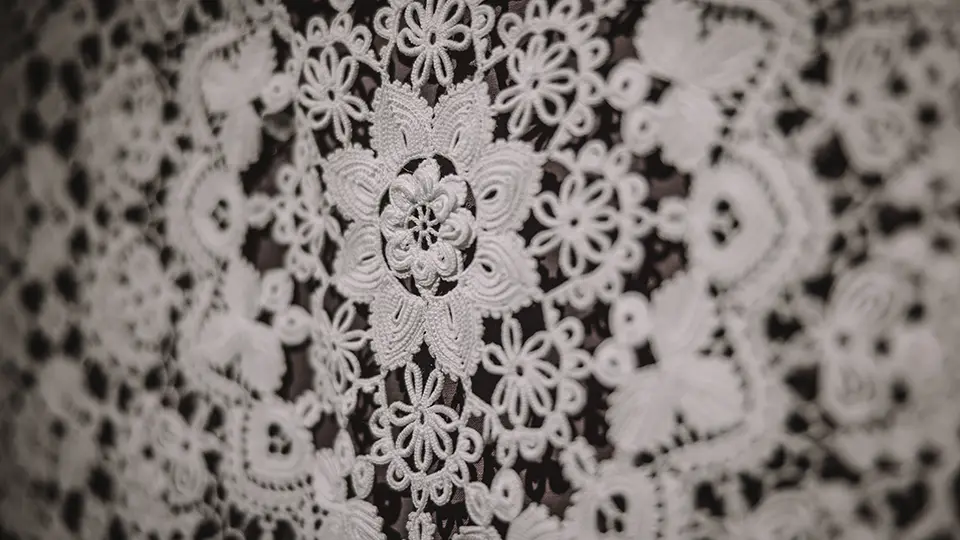
What sets Koniaków lace apart is its production method. Each piece is created entirely by hand, using a crochet hook and fine thread, without patterns, charts, or written instructions. Lace makers work freehand, building their designs step by step. Motifs emerge one by one, guided by experience, memory, and a visual and tactile intuition developed over years of practice. This approach gives the lace its distinctive character. Even pieces that follow similar forms remain individual, shaped by the hand that makes them.
Polish Lace Making- A Skill Passed Down Through Generations
The knowledge behind the craft is learned gradually and informally. Skills are passed down through observation, repetition, and shared time. Children grow up watching mothers, grandmothers, and neighbors work, absorbing techniques long before they can describe them. Over time, the hands learn what words rarely explain fully, how thread tension affects structure, how motifs are joined, and how balance is maintained across a piece. This form of embodied knowledge lies at the core of tradition.
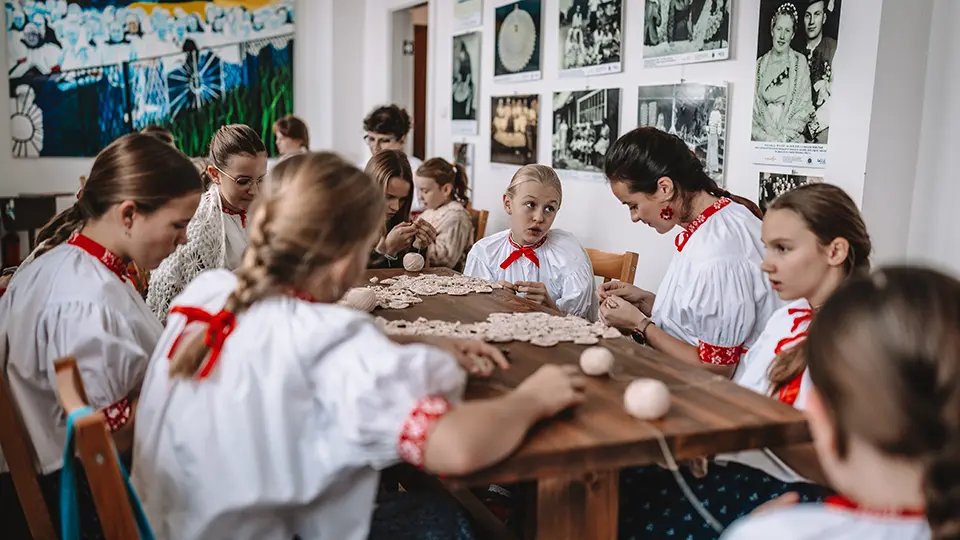
Historically, Koniaków lace functioned as both a creative practice and a source of income. Women used the craft to support their households while maintaining a strong connection to local identity and social networks. As markets and tastes shifted, designs evolved, yet the underlying techniques remained rooted in the community. Change occurred through adaptation rather than replacement, allowing the tradition to continue without losing its foundations.
Today, Koniaków lace continues to develop, shaped by new ideas and broader audiences, while remaining closely tied to its place of origin. Each piece reflects the skill of its maker and the environment in which the tradition emerged. This continuity of knowledge, combined with ongoing creative expression, defines Koniaków lace as a living form of traditional knowledge, sustained through practice rather than preserved at a distance.
Lucyna Ligocka-Kohut’s early life
Lucyna Ligocka-Kohut grew up in Koniaków, where lacemaking was part of everyday life. It appeared in family homes, in conversations among women, and in the quiet hours spent working with thread and hook. From an early age, she was immersed in the rhythm of the craft, observing how it shaped routines, relationships, and shared time within the village.

Her introduction to the tradition developed through closeness and continuity. The women of the community were her earliest guides, passing on skills through example, repetition, and time spent together. Young girls learned by watching older hands at work, gradually understanding how motifs were constructed, how tension was controlled, and how patience influenced the final result. This way of learning fostered an intuitive relationship with the craft that deepened over time.
Lucyna’s professional path diverged from that of many lace makers in the village. She did not enter lace making as a commercial producer, choosing instead to study ethnology and anthropology. That academic training provided her with tools to interpret the cultural and social meaning embedded in everyday practices. It also sharpened her awareness of how vulnerable traditional knowledge can become when it remains unseen or undervalued beyond its immediate environment.
As her work evolved, Lucyna’s role shifted toward coordination and advocacy. She worked alongside lace makers, bringing structure and visibility to their work through exhibitions, cultural initiatives, and collaborative projects. These efforts created opportunities for artisans to present their craft in new contexts while remaining connected to its local roots.
This combination of lived experience and academic perspective shaped Lucyna’s approach over time. Her understanding of the tradition from within the community, combined with her ability to engage with institutions, partners, and markets, positioned her to support Koniaków lace in a way that stayed grounded in the people who practice it, while opening pathways toward long term recognition and sustainability.
The Koniaków Lace Museum
The Koniaków Lace Museum was established to present the craft in its full context. Rather than functioning as a conventional exhibition space, it serves as a working environment that mirrors how the tradition is practiced in the village. The museum is part of a broader cultural center founded by Lucyna Ligocka-Kohut, which brings together preservation, education, and daily practice in a single space.

Visitors to the museum encounter the history of Koniaków lace through original works, archival materials, and narratives linked directly to the women who created them. The displays trace the evolution of the lace, from established forms to more contemporary interpretations, while maintaining the techniques that define the tradition. Each piece is presented with attention to authorship and process, emphasizing the experience and skill required to produce it.
Beyond exhibition, the museum plays an active role in sustaining the tradition. It hosts workshops, demonstrations, and educational activities led by practicing artisans, enabling direct knowledge sharing rather than interpretation from a distance. Younger generations learn techniques that have long been passed down informally, while visitors gain insight into the time, precision, and discipline involved in the craft. This direct exchange reinforces the value of learning through practice and keeps the tradition anchored in use rather than display.
The museum also serves as a meeting point for the local community. Lace makers use the space to connect, exchange ideas, and collaborate on projects. By providing a visible and accessible setting for their work, the museum strengthens links between artisans and audiences seeking craft rooted in place and tradition.
Through the museum, Koniaków lace is presented as a living practice shaped by people, time, and shared knowledge. Space reflects Lucyna’s approach to heritage, one that prioritizes continuity, transmission, and respect for the makers themselves, ensuring that traditional knowledge remains active in the present while being carried forward with care.
The Koniaków Lace Center
As interest in Koniaków lace expanded beyond the region, Lucyna recognized the need for a structure capable of meeting international demand while remaining firmly connected to the community. She established the Koniaków Lace Center as a business entity to organize production, partnerships, and market access in a way that respects the craft's pace and values. The Center serves as a clear point of coordination between lace makers, collaborators, and buyers, helping ensure that growth remains sustainable and community-led.

The Lace Center works closely with local artisans, taking into account individual working rhythms and the realities of handmade production. It supports order organization, facilitates collaboration, and ensures fair visibility for the women behind each piece. By operating as a business grounded in traditional knowledge, the Center demonstrates that heritage-based work can generate economic opportunity without eroding authenticity or quality.
This structure also allows the craft to engage confidently with international audiences. Designers, cultural institutions, and buyers have a single, reliable point of reference, while artisans benefit from collective organization rather than managing external demand individually. By linking each product to its origin, its makers, and its production process, the Center reinforces trust and transparency in the market.
Lucyna’s approach reflects a broader message she often shares, particularly with women seeking to build something meaningful from tradition. She emphasizes the importance of access to knowledge and institutional support, and the role these play in turning cultural expertise into long-term opportunity.
Programs such as WIPO’s show ordinary people that it is possible to do something truly big, if we are given the knowledge and the chance.
Through the Koniaków Lace Center, Lucyna has created a practical framework in which traditional knowledge supports livelihoods, strengthens community cohesion, and enables sustainable growth, while remaining firmly in the hands of those who have carried the craft for generations.
Conference on Geographical Indications
In 2025, Lucyna took part as a speaker in the conference “Heritage that Inspires, Geographical Indications, Local Craftsmanship and Design,” held in Poland. The event focused on the opportunities created by the European Union’s new regulation on geographical indications for craft and industrial products, and what this framework could mean in practice for local communities and traditional producers.
Lucyna’s contribution was grounded in experience. She spoke from the perspective of someone working daily with a tradition that is inseparable from place, skill, and community. Her participation highlighted how legal recognition can support authenticity, reinforce trust, and give artisans stronger control over how their work is represented in the market.
Obtaining Geographical Indication Recognition for Koniaków Lace
Building on the knowledge gained through WIPO’s CEBS Women’s Entrepreneurship Program and her continued engagement with intellectual property tools, Lucyna is now participating in a project with the Patent Office of the Republic of Poland aimed at obtaining geographical indication recognition for Koniaków lace. This initiative aims to formally link the craft's name to its region of origin, reinforcing the connection among product, place, and traditional know-how.
For the lace-making community, this step represents more than legal protection. It offers a way to secure recognition for generations of work, prevent misuse of the name, and strengthen the craft's long-term sustainability.
Lucyna’s journey, from cultural stewardship to entrepreneurship and institutional engagement, shows how traditional cultural expressions can remain dynamic when supported by the right tools. By bringing heritage, innovation, and intellectual property into dialogue, she continues to create conditions in which traditional cultural expressions (TCEs) can remain active today while being carried forward responsibly into the future.
WIPO’s Women’s Entrepreneurship Program
WIPO’s Women’s Entrepreneurship Program is an initiative that supports women entrepreneurs working in creativity, heritage, and innovation. The program equips participants with practical knowledge on intellectual property, business development, and market positioning, helping them strengthen and protect what they build.